Golf Ball Pen Cup with Golfer Figurine
Created today
Description
A desk pen stand built around a small golf scene: a 110 mm round base carries a slim golfer figure toward the back and a smooth golf-ball pen cup at the front-right, with the pen dropping into a 30 mm hole in the top of the ball. The club head sits at ground level on the base. A separate small golf ball, 4.2 mm across, sits on the base about 9 mm in front of the club head. "Mahindra Manulife" is cut into the front edge of the base, 4.5 mm tall and 1 mm deep, reading from the front, with the golfer set back so the club head clears the lettering. Above the text sit three upright parallel marks, each end cut at a slant — top tip pointing up on the right, bottom tip pointing down on the left — 10 mm long, 1.8 mm wide at the middle, 4 mm apart and cut 2 mm deep. The pen cup is a plain smooth sphere about 50 mm across; its golf-ball read comes from the cup shape and context rather than surface texture. The golfer has a slimmer, less muscular build: thinned thighs, calves, upper arms and forearms, a narrower torso and shoulders, and smoother blended limbs. It has a calf bulge, thighs that widen into the hips, a continuous torso from pelvis to chest, shoulders that blend into the upper arms, a slight jaw, a separate neck, ears, a nose, and a cap, with both hands on the grip. The legs and shoes sit inward under the pelvis rather than out at the sides of the waist; the feet are about 7 mm from the centreline and the hips about 6 mm apart. The hands are rounded palms with four fingers wrapped across the grip and a thumb, with no wrist cuffs. Each shoe has a thin flat sole, an upper that tapers from a heel block to a rounded toe, and a short ankle collar. The base, golf-ball cup and golfer are the three named areas of the design.
Starting dimensions
- Base: 110 mm round, 10 mm tall
- Golf-ball cup: 50 mm across, 45 mm tall, with a 30 mm pen hole
- Golfer: about 21 mm wide, 42 mm deep and 68 mm tall, set back to clear the front lettering, with the legs under the pelvis and the feet about 7 mm from the centreline
- Small front golf ball: 4.2 mm across, about 9 mm ahead of the club head
- Front text: 4.5 mm tall, 1 mm deep
- Three marks above the text: 10 mm long, 1.8 mm wide at the middle, 4 mm apart, 2 mm deep
Remix hooks
- Base outline is the freest choice. The 110 mm round plate can be trimmed, squared off or stretched into an oval without touching the figure or the cup — just leave a clear arc at the front for the lettering and the marks, and enough surface behind the golfer for the stance.
- The front text is the easiest thing to make your own: the wording, the 4.5 mm height and the 1 mm depth are all movable, and the three marks above it can be swapped for any shape — a monogram, a club crest, a simple icon. A deeper cut reads more boldly, a shallower one stays crisp on a resin print, and taller letters need a wider clear arc along the front edge.
- Golfer setback is a real parameter, not a fixed value: moving the figure forward or back trades text clearance against the balance of the composition, and the club head has to stay clear of the lettering.
- Leg stance is set with feet about 7 mm from the centreline and hips about 6 mm apart; moving them outward changes the silhouette and can make the thighs touch near the top.
- Golf ball size is the next knob: the 50 mm ball and its 30 mm bore scale together, and the 30 mm bore is already wide for a 50 mm ball — widen it further only if the ball grows with it.
- Ball surface is an open canvas: the smooth sphere is the neutral starting point, so add your own dimples, a seam ring, a fine pattern, or a painted finish. Keep whatever you add clear of the pen opening.
- Small front ball is a separate detail: the 4.2 mm sphere and its 9 mm gap can be scaled, moved closer to the club, or swapped for a tee, marker or small flag without touching the cup.
- Pen hole depth is not tied to any particular pen — set the bore to your own pen length before printing, deep enough to stop it toppling and shallow enough to grab.
- Golfer details are the obvious swap: change the club for a putter, a flag or a raised arm, re-dress the figure, or thicken the fingers if your printer turns them into a ridged lump — they finish around 1.7 mm across as drawn, and the shoes are about 16 mm long.
- Pairs with other desk organisers and small pieces: a ball marker dish or a tee tray works alongside it on the same desk.
These numbers are a starting point rather than a fixed spec: only the pen bore and the ball wall behind it carry a real constraint; everything else is a dimension you can move.
Images
More like this
Explore more in Storage & Organization →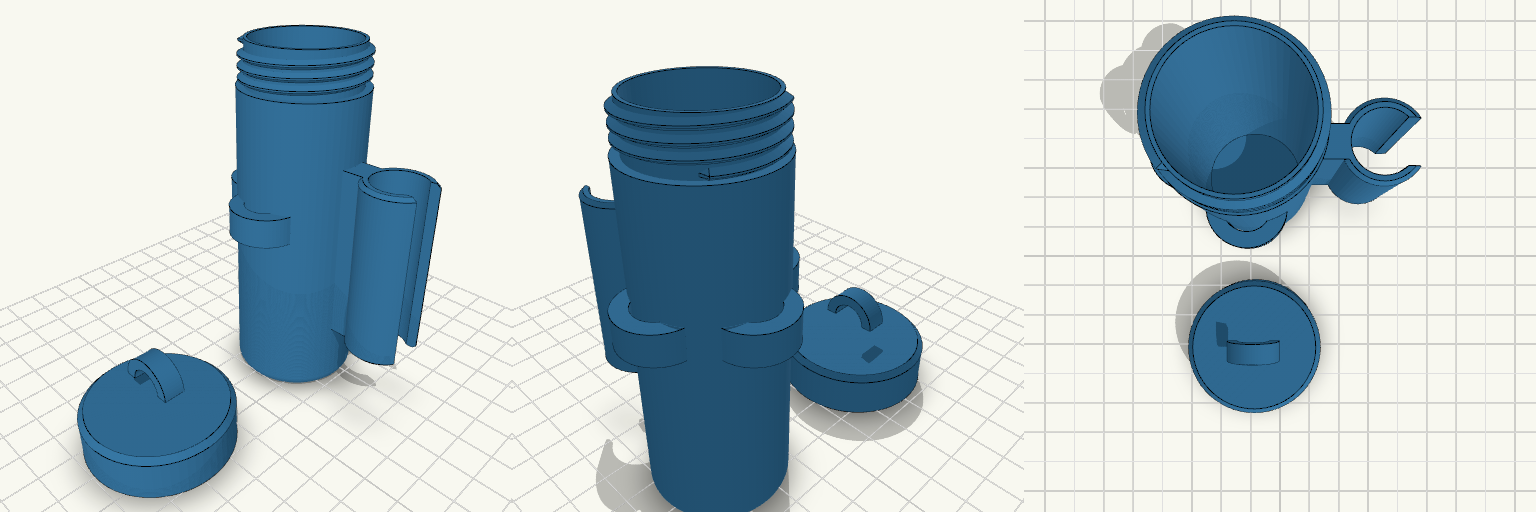
RigPot — Bankstick Jar with Rig Loops
RigPot is a 30 mm bore, 100 mm tall screw-top jar built for carp tackle. It has a 50 mm side clip for a 15 mm bankstick, and three half-round loops for hanging rigs. Features 30 mm inside diameter, 100 mm tall Screw lid printed separately beside the jar Bankstick clip, 50 mm long, 15.4 mm bore with a snap-in slot Three flat half-ring rig loops at 90°, 180° and 270°, both ends fused into the jar wall Print notes The jar, clip and loops print as one body The lid is a separate piece and prints beside the jar
ESP32-S3 Sliding-Lid Enclosure with Dual USB-C Cutouts
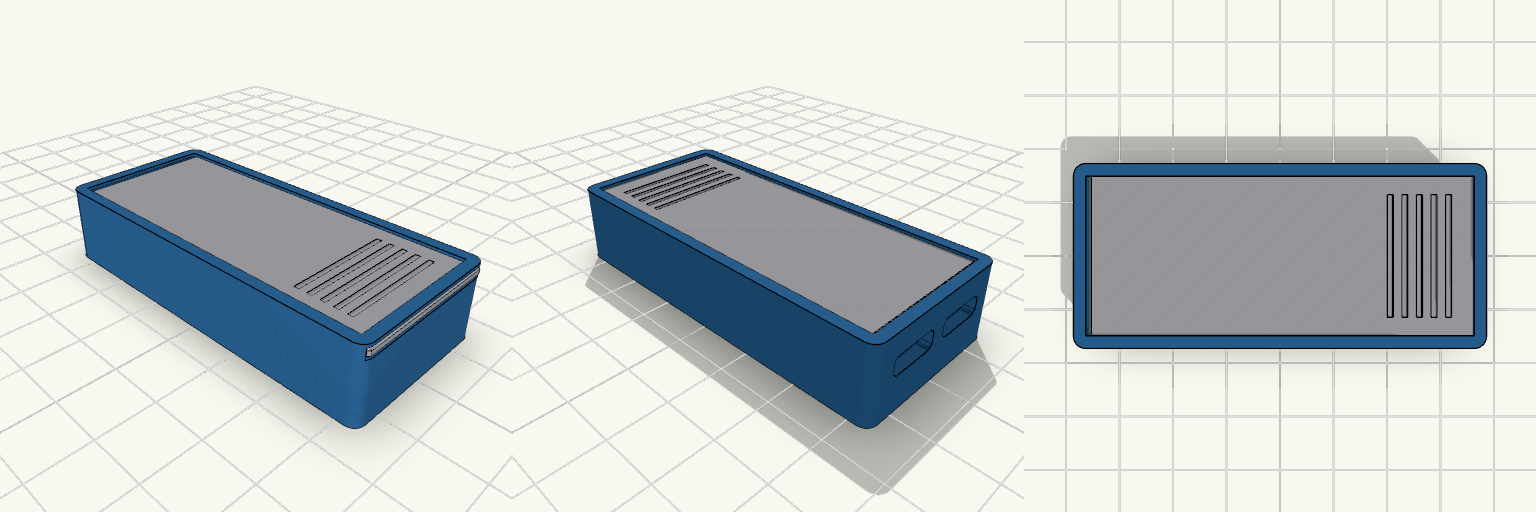
What it's for A modern, low-profile enclosure for an ESP32-S3 N16R8 board measuring 62.7 × 25.4 mm. The base holds the board on four standoffs, and the sliding lid closes the case from the end opposite the USB-C openings. Two rounded USB-C cutouts in the end wall give access to the board's connectors. Dimensions Base: 67.5 × 30.2 × 14 mm. Sliding lid: 65.2 × 28.2 × 1.6 mm, with five shallow grip ribs. Interior: 63.5 × 26.2 × 12 mm, giving about 0.4 mm of play per side around the 62.7 × 25.4 mm board. Walls: 2 mm. USB-C cutouts: 9.4 × 3.6 mm with rounded corners; 3 mm gap between the two cutouts, so their centers sit about 11.9 mm apart. Print notes Prints as two separate parts: the base and the sliding lid. Assemble by sliding the lid into the base. The USB-C cutout height assumes the connectors sit on top of the board; check the connector position against the actual board before printing. The two USB-C openings are separate cutouts, not a single merged slot. Remix ideas Adjust cutout spacing or height for a different board or connector layout. Add ventilation slots, an antenna opening, or a label recess. Change the lid grip ribs or wall thickness for a different fit and finish.
17 mm Pocket Capsule for a Nurofen Tablet
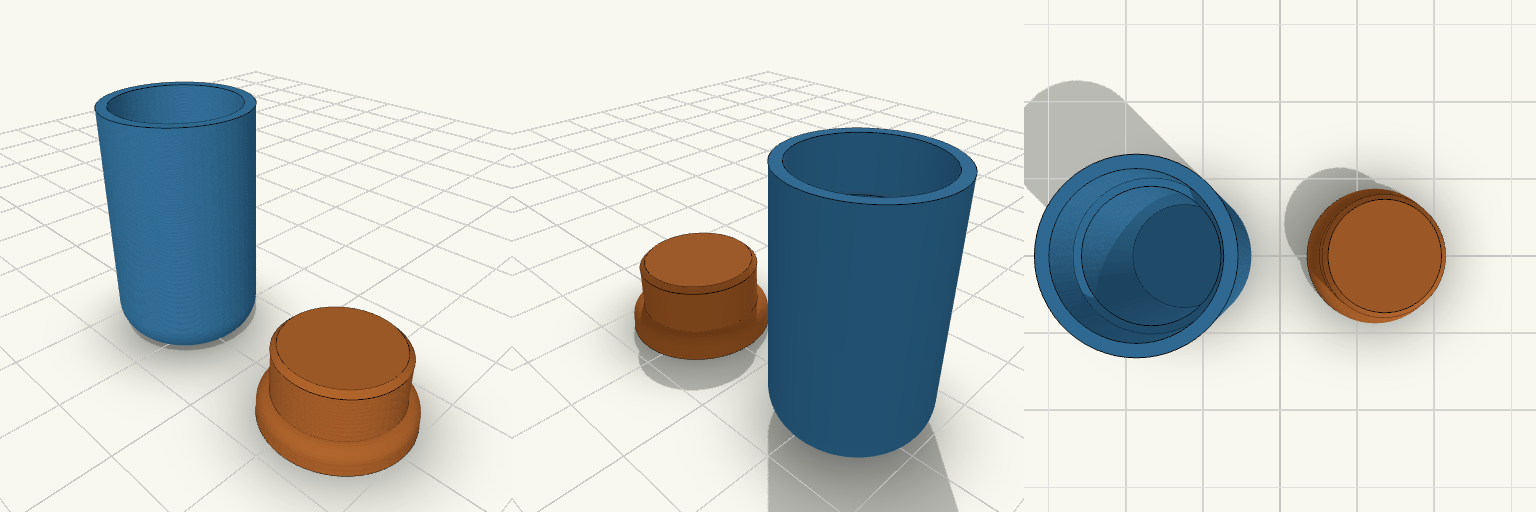
A small two-piece capsule for carrying a single Nurofen Flex 400 mg tablet in a pocket. The cavity is sized so the tablet stands upright inside with about 2 mm to spare, and a push-fit lid closes over the body. The lid sits beside the body on the print plate. Specifications Capacity: One Nurofen Flex 400 mg tablet, standing on end. Internal cavity: 13 mm wide × 20 mm deep. Overall height: About 28 mm including the floor and lid seat. Body size: 17 mm across × 28 mm tall. Lid size: 17 mm across × 8.8 mm tall. Pieces: Prints as two pieces — capsule body and push-fit lid. Lid fit: The lid plug is about 0.2 mm smaller than the seat on each side; check the fit after printing and expect it to vary with your printer. Tablet check: Sized around an assumed tablet of about 18 × 10 × 7 mm; measure your own tablet before relying on the fit.
Telescoping Tube Container with Detent
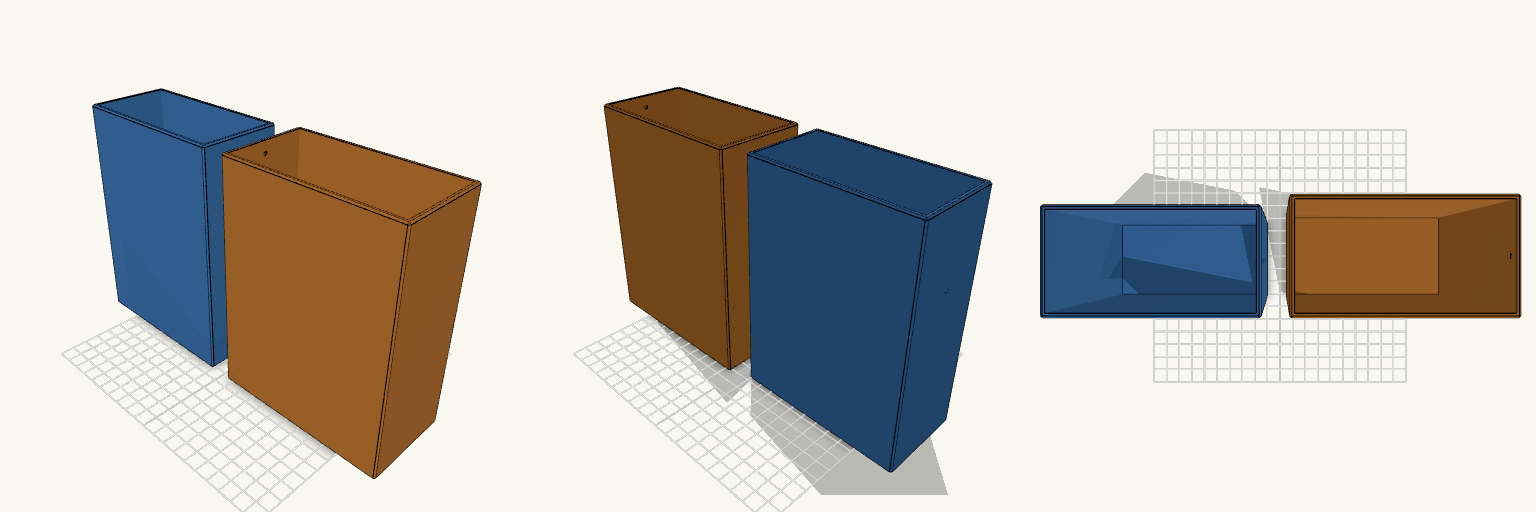
What it's for Two rectangular tubes, each closed at one end, that slide together lengthwise into a closed container. Small detent bumps keep it shut. Dimensions Interior when closed: 112 x 262 x 55 mm Overlap: 60 mm Each tube: about 163 mm long, fits a 250 mm plate lying flat Clearance: 0.4 mm per side Print notes Print each tube as its own job. They are spaced apart in the preview so they do not touch. The detent is a pair of small round bumps on the inner tube that click into matching dimples in the outer tube's walls. Remix ideas Add a finger notch on the rim. Deepen the dimples for a firmer hold. Add dividers inside.
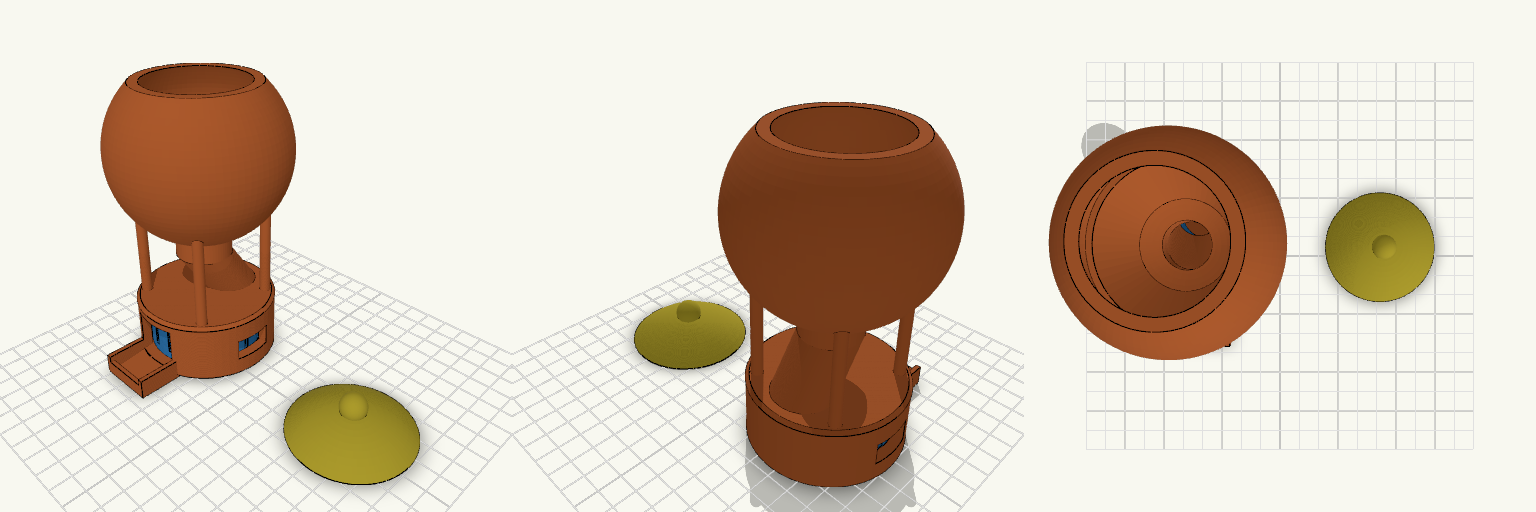
Kaugummiautomat im Heißluftballon-Stil für 18-mm-Kaugummis
Der Kaugummiautomat gibt einzelne Kaugummis vorne aus dem Zylinderfuß aus. Die Kugel sitzt mittig über dem Fuß und lässt sich über einen abnehmbaren Deckel befüllen. Vier gerade, senkrechte Streben tragen die Kugel vom Fußrand bis in die Kugelwand. Ein Rohr führt von der Kugelmitte über einen schrägen Trichter zur Drehmechanik im Zylinder: Eine Drehscheibe mit einem Loch für je ein Kaugummi wird von außen durch die Seitenfenster gedreht, sodass pro halber Umdrehung ein Kaugummi zur vorderen Öffnung rollt. Vor der 22-mm-Öffnung liegt eine mitgedruckte Ablagerampe, die das Kaugummi auffängt und nach vorn führt. Gesamtgröße (Druckplatte): 82 × 91 × 129 mm Kaugummi-Durchmesser: ca. 18 mm Deckel: 55,8 × 55,8 × 19 mm, abnehmbar Drehscheibe: 55 × 55 × 20 mm, im Fuß mit ca. 0,3 mm Luft eingebaut Streben: vier Stück, gerade und senkrecht vom Fußrand bis in die Kugelwand Rohr: oben mittig unter der Kugel, unten zum versetzten Loch der Drehscheibe abgewinkelt; ein Trichter in der Kugel leitet die Kaugummis dorthin Ausgabe: 22 mm breite Öffnung vorn, davor eine 26 mm breite Ablagerampe mit 2 mm Seitenwänden, 20 mm Länge, 6 mm hoher Frontkante und Abfall von 4 mm auf 1,5 mm Druck: als ein Stück; im Bereich der Drehscheibe Stützmaterial einplanen oder die Scheibe nach dem Druck kurz lösen
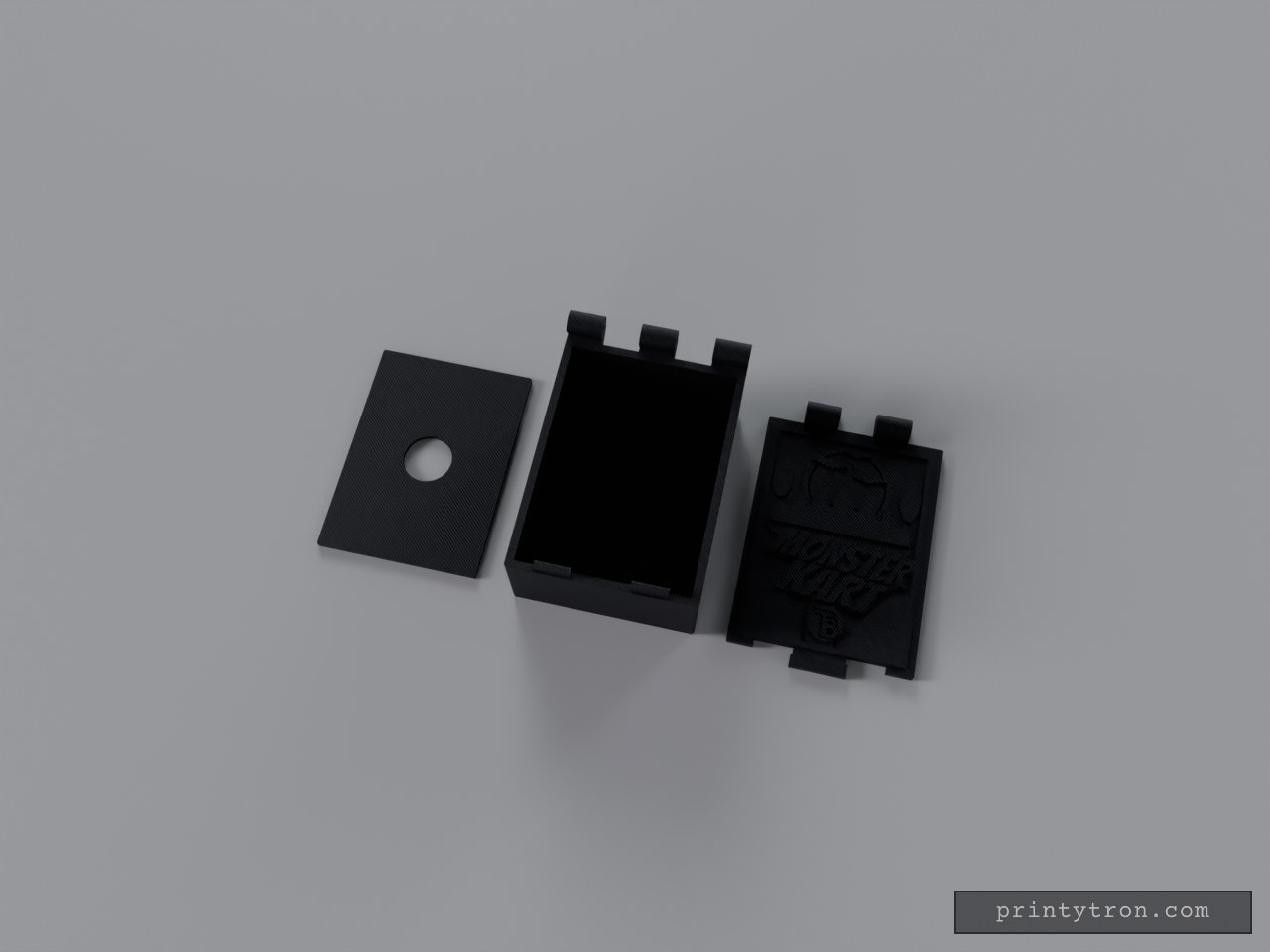
Monster Kart box
A hinged-lid card game box for a deck of 63 × 88 mm cards, sized for about 50 cards. The lid pivots on a mechanical barrel hinge along the back: three knuckles on the box and two on the lid, interleaved and held by a removable 1.75 mm filament pin. A front snap latch keeps the lid closed, and the hinge axis sits behind the back wall so the lid corner clears the rear wall and knuckle supports through 120°. Beneath the card stack, a removable divider plate with a 20 mm finger hole covers a hidden 12.7 mm compartment for paper inserts or original drawings. The box and divider plate are plain black to limit AMS waste; only the lid top carries the four-colour relief artwork. Specifications Box: 72.4 × 106.8 × 45.7 mm overall; card space approximately 66 × 91 × 20 mm for about 50 cards. Hidden compartment: 12.7 mm high under the card stack, with four corner posts supporting the divider plate. Divider plate: flat and removable, 2 mm thick, with a 20 mm finger hole. Hinge: five interlocking 9 mm knuckles with 0.4 mm axial gaps; moving-part clearance approximately 0.3–0.4 mm; 2.1 mm bores on one straight coaxial axis. The axis sits 4.9 mm behind the back wall. A 1.75 mm filament pin feeds in from one end through a flared lead-in and is held by friction; the opposite end is closed 1.2 mm short of the face, so the pin is pulled back out from the entry side. Latch: two flexing front posts with sloped hooks snap into lid notches; a thumb tab at the front centre releases it. Lid artwork: red rectangular border; dark black/purple background; large white moon near the upper centre; black haunted-castle silhouette with varied pointed towers; black bat silhouettes that read mainly as two long curved wings with very small bodies, sharp tips and scalloped trailing edges; purple hills and mist; a curved purple path; angled MONSTER in white and KART in red with black outlines; a 16 mm interlocking TB monogram centred near the bottom — a white glyph inside a red disc separated by a 0.5 mm black gap. The T carries an 8 mm top bar and a 1.8 mm full-height stem. The B shares the stem as a flat left spine, with a smaller upper bowl and fuller lower bowl, a pinched waist, and D-shaped counters rather than circular holes. A gap of about 1 mm separates the T bar from the top of the B. Only black, red, purple and white are used. Printing: support-free geometry for a 0.4 mm nozzle; latch posts are 1.4 mm thick; bat membranes come to about 1 mm. In the TB monogram the upper counter is about 1.1 mm tall — check it on a first print. Assembly: three printed pieces — box, divider plate and lid — plus a 1.75 mm filament pin. The lid's colour layers are grouped as one multi-colour object for four-slot AMS printing.