Silo-Chute Bag Clip
Made by a Guest
Created 1 months ago
Description
A miniaturized silo gate for the kitchen counter, built to route dry goods smoothly from bag to bowl. It merges a rigid slide-action seal with an integrated pour channel, ending the morning ritual of scattering cereal and rice across the floor. The two-part mechanism locks down folded plastic tight against moisture, while the tethered plug keeps the channel safely closed between pours.
Design Details
- Slide-On Seal: Replaces weak spring hinges with a continuous sliding compression sleeve for a tighter grip.
- Flared Channel: The 15mm inner diameter spout guides grains and small cereals directly to the target without the need for a separate funnel.
- Integrated Tether: A flexible arm ensures the tapered sealing plug is never lost in the kitchen drawer.
Images
More like this
Explore more in Kitchen & Bathroom →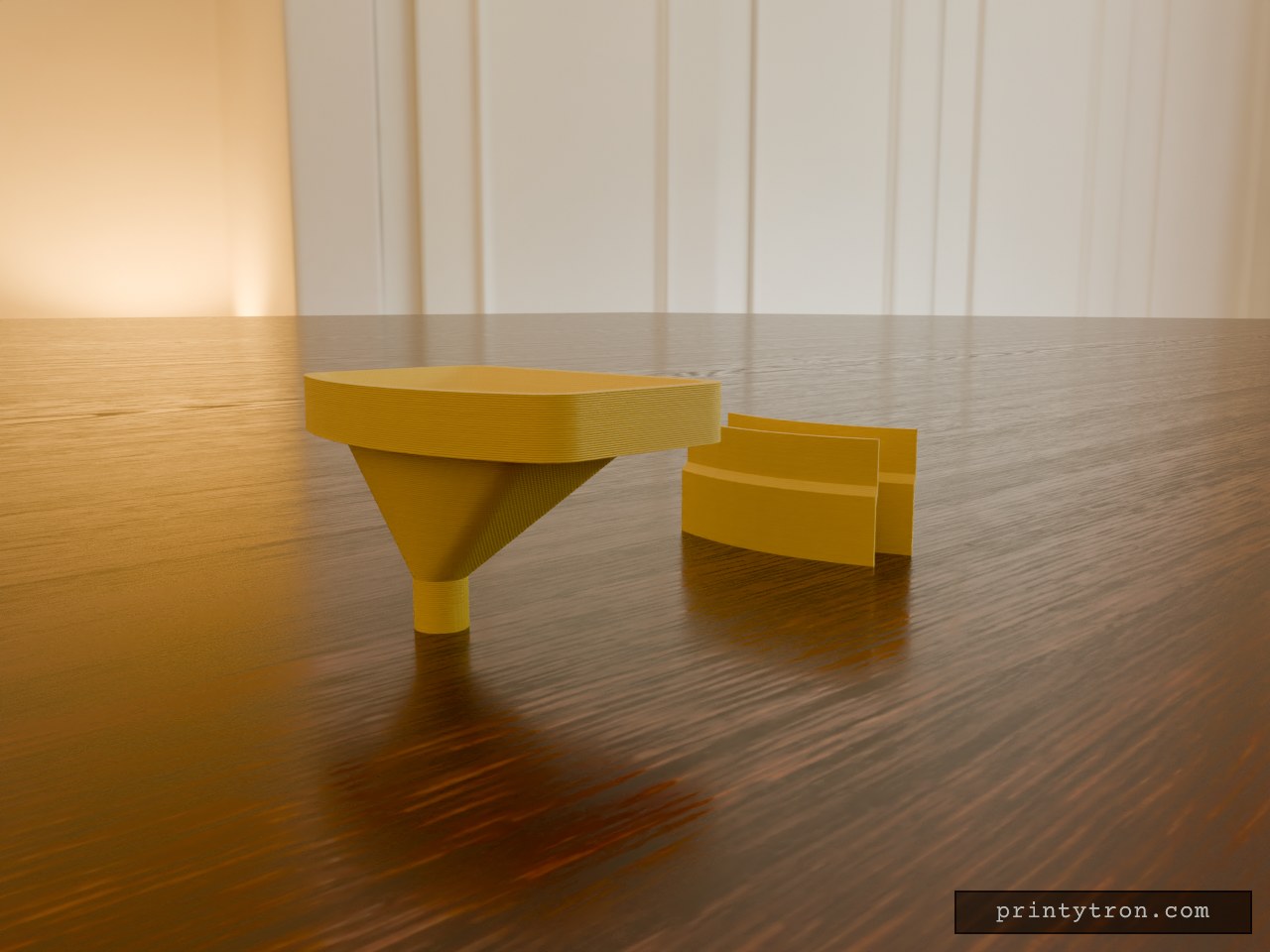
5 Gallon Bucket Urine diverter Funnel With Glue-On Clip
A urine diverter for a 5-gallon bucket. This funnel has a curved outer edge and a skirt, and it comes with a separate curved clip strip that glues to the bucket wall so the skirt hooks over it. I the clip is too near the edge because of taper at the bucket top, just print 2 and glue together (I only printed bottom half of second) Key numbers Bucket inside diameter: 296 mm (clip and funnel curve at 148 mm radius) Clip: about 44° of arc, around 114 mm long, 54 mm tall, 2.5 mm thick Profile: lower section glues flat to the bucket wall, then steps in 2.5 mm so the top stands off the wall by the skirt thickness Skirt: 20 mm tall, 2.5 mm thick, drops into the gap behind the clip's upper lip Spout: 19 mm outside, 15 mm bore Print: clip standing upright, brim needed for support; glue the lower face to the bucket wall
LevelUp — 60 ml Clip-On Scoop
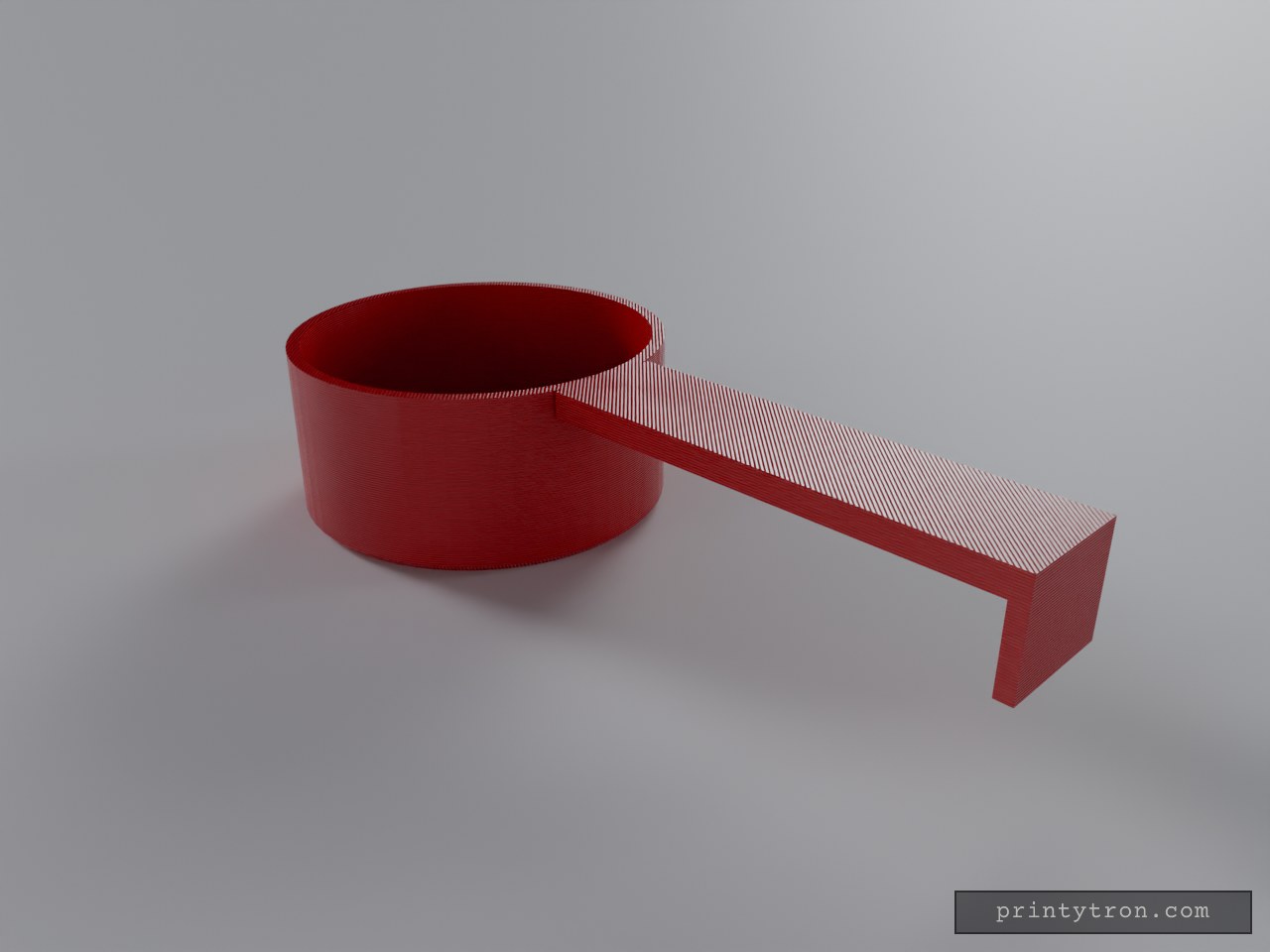
LevelUp is a single-piece measuring scoop sized to hold exactly 60 ml when filled level, made as a replacement for a lost tub scoop. It suits coffee grounds or protein powder. The rim is sharp and flat across the whole top, and the handle sits flush with it, so a knife can sweep straight across to strike off the excess. A short downward lip at the end of the handle hooks over the edge of the tub to keep the scoop in place. Dimensions Bowl inner diameter: 55 mm Bowl inner depth: about 25.3 mm, which gives 60 ml Floor thickness: 2 mm Wall thickness: 2 mm (59 mm outer diameter) Handle: 70 mm long, 18 mm wide, 4 mm thick Clip lip: 12 mm drop, 2.5 mm thick Features Flat, level rim and handle top for accurate strike-off Chamfered bottom edge on the bowl Plain lip clip, not a full hook Print notes Print bowl-down so the rim and handle top come out flat. The clip lip was sized without measuring a specific tub. Adjust it to the thickness and height of your tub's edge. For food contact, use a food-safe filament, and expect layer lines to hold powder. Hand-wash it.
Tiered 12-Jar Spice Rack
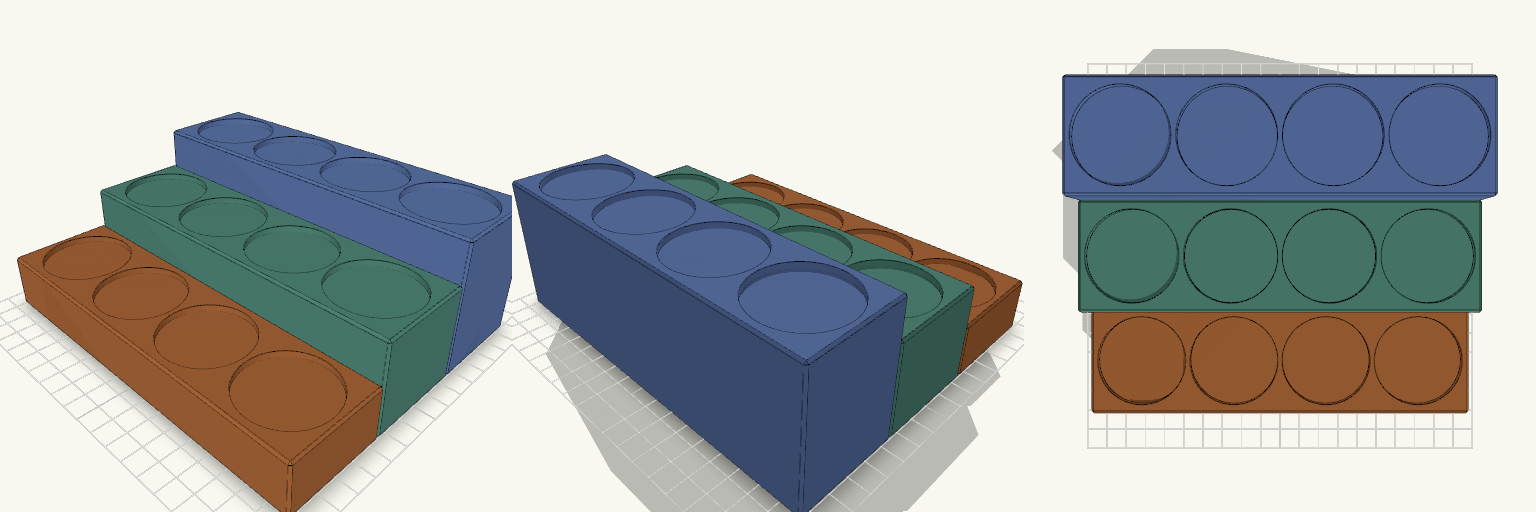
A three-tier spice rack that holds 12 jars, four per tier, with each tier stepping up so every label stays in view without lifting a jar out. Each pocket is sized for jars about 40 mm across, so the rack is easy to scan for cumin or anything else. The rack measures 180 mm wide, 150 mm deep and 66 mm tall at the back. Tier heights are 26 mm (front), 46 mm (middle) and 66 mm (back). Each tier is 50 mm deep and 20 mm taller than the one in front. Each jar sits in a 42 mm round pocket, 3 mm deep, which stops it sliding forward. The edges carry a 1 mm chamfer. It prints as one piece, and the three tiers are shown in separate colours so they are easy to tell apart. Remix hooks Step height (20 mm): raise it for taller jars behind, or lower it for a shorter rack. Labels stay readable as long as the step is at least as tall as the label band on the jar in front. Tier depth (50 mm): this is set equal to the back-step. Widening both leaves room for larger jars, and a wider step also gives a clearer view of the row behind. Pocket diameter (42 mm) and depth (3 mm): 2 mm of clearance suits 40 mm jars. Increase the diameter for jars that run a little wide. Deepen the pocket for a firmer hold, or set the depth to 0 for a flat shelf. Jars per tier (4, 44 mm pitch): change the count to alter the rack width. Drop to 3 per tier for a narrower footprint, or add a fourth tier for 16 jars. Pairs well with: a non-slip mat underneath, or a rear lip or wall panel to mount it in a cupboard.
Cylinder Candy Dispenser new
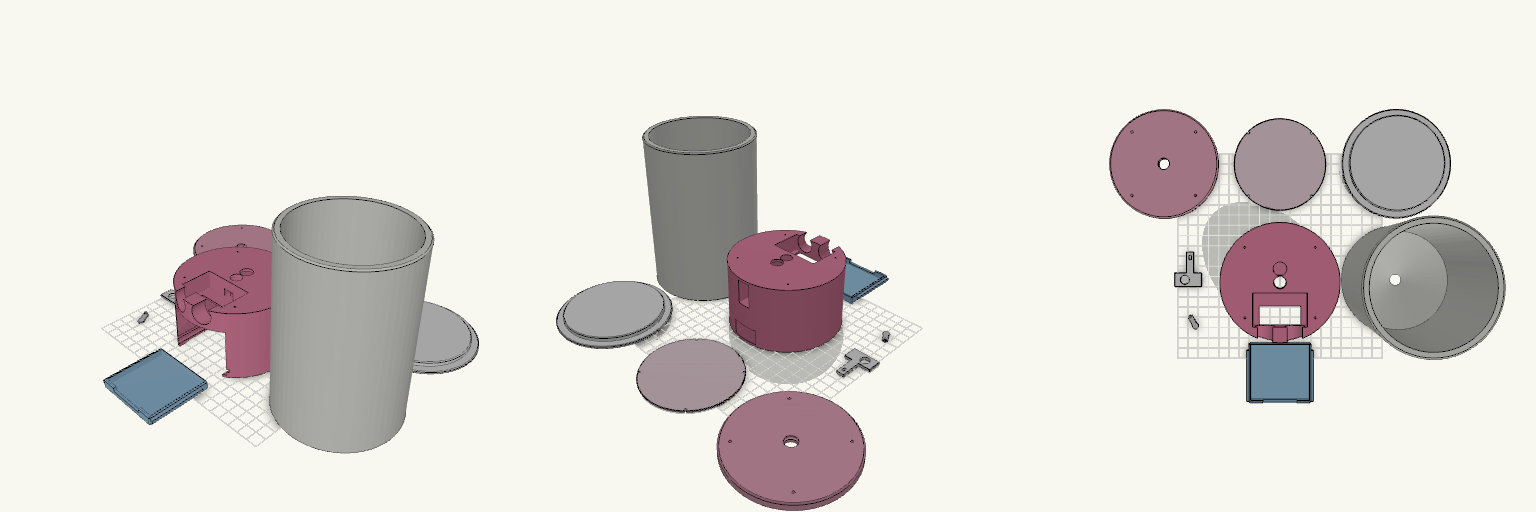
A candy dispenser with a watchful streak: the body stands as one straight 105 mm column from foot to cylinder rim, and two enlarged eye holes on the front give it the look of a sentinel standing guard over the tall hand opening below. Those eyes open into a deeper, snug sensor pocket for an ultrasonic sensor, so a wave of the hand can trip the servo gate and drop candy into the opening. The pocket sits close to the front wall, and its floor is opened into the catch bay, so the sensor board goes in from below: with the tray out, push it up through the hand opening with the two transducers facing front, then slide it forward the short distance to the eye holes. The hand opening is a genuine hole cut clean through the front wall, about 63 mm wide and roughly 43 mm tall, running from just above the base floor to just under the sensor pocket. A retractable catch tray rides on side rails on its floor, just under the outlet, with a low notch at the front so you can scoop the candy out with your fingers. A cone at the floor of the candy cylinder funnels the sweets down to the outlet. The taller base tucks a Pico bay behind the hand opening and opens through the back wall so the USB port faces out, while the candy cylinder above stays the same width and height. A removable bottom lid, light pink and screwed in place, closes the base and gives access to the Pico bay, servo bay and sensor pocket from below. All six pieces are laid out separately on the plate, each oriented for printing without supports. The candy cylinder is silk white, the base pink, the catch tray light blue, the gate slider white, the servo horn a very pale grey, and the base lid light pink. The printed parts Base Housing — a round 105 mm pink body, 70.5 mm tall. The hand opening cuts through the front wall from just above the base floor to just under the sensor pocket. The two sensor eye holes sit above it, about 17 mm across and cut clean through into the sensor pocket. Directly above the hand opening, that pocket is about 46 mm wide, 30 mm deep and 20 mm tall, sized for an HC-SR04 board with its eyes lined up on the front; it is pushed forward so it begins about 10 mm from the front wall, which shortens the slide the board needs to reach the eye holes. Its floor is open to the catch bay so the board can be fed in from below, and a small cable slot runs from the back of the pocket toward the Pico bay. The servo bay is sized for an SG90: the servo slides in from the back wall, shaft up, with its mounting ears resting in a slot cut into the housing. A round recess above the body lets the shaft boss sit so the horn runs flush under the gate. A Pico bay about 25 mm wide and 45 mm deep sits behind the hand opening, open through the back wall so the USB port faces out. Candy Cylinder — a 105 mm open cylinder, 152 mm tall, in silk white, with walls about 5.25 mm thick, flush with the base so the body reads as one uninterrupted column. A cone at its floor feeds the outlet, slightly steeper to match the narrower bore; everything above it is candy storage. It holds roughly 1 litre of candy and is open at the top for filling. Gate Slider — a flat white plate that slides sideways in a slot across the outlet, just under the candy cylinder floor. A solid bar covers the outlet when closed; a clearance opening lines up when open. Its tail has a slot for the servo horn pin, and about 60° of servo sweep moves the gate roughly 13.6 mm — enough to fully open or close the outlet. Servo Horn — a 10.1 × 13.3 × 3.2 mm pale-grey horn with a pin that rides in the gate's tail slot. The servo below the gate slot turns it to shift the gate. Catch Tray — a 64.5 × 57 × 7.5 mm light-blue tray that slides into the hand opening on two side ribs set in matching grooves, and sits directly under the outlet. Its back and side walls are about 1.5 mm thick, the front wall carries a low scoop notch, and the front edge stands about 1.5 mm proud of the housing as a pull tab. The rails are 3 mm wide with about 0.5 mm clearance in the grooves. There is no end stop, so the tray pulls out completely; a small snap bump would add a stopping point. It prints flat and needs no supports. It sits low in the taller opening. Base Lid — a light-pink disc about 89 mm across and 1.5 mm thick. It seats in a shallow recess in the underside and is held by four screws near the edge. Pilot holes in the base take roughly M2.5 screws, about 2.6 mm deep, so use short screws around 6 mm; the lid has clearance holes. A window in the underside lets you reach the Pico bay, servo bay and sensor pocket once the lid is off. Candy capacity — the cylinder holds about 1 litre. As rough estimates, that is roughly 900 g to 1 kg of M&M's, about 1,000 pieces, or about 150 to 200 Nerds Gummy Clusters, roughly 500 g. These are estimates, not measured fills. Before you print The servo pocket matches an SG90: about 12.6 mm wide and 23 mm tall, with a mounting-ear slot. The sensor pocket is a forward-set cradle, about 46 × 30 × 20 mm, directly above the catch bay, and its floor is open into the bay so a real HC-SR04 board can be inserted from below — the opening is about 37 mm wide, a little narrower than the 45 mm board, so you may need to tilt it in. The Pico bay, servo pocket, sensor pocket and bottom lid have not been test-fitted with real parts. The outlet is only about 11 mm at final scale, and the gate opening is about 9 mm. An M&M is around 13 mm across, so neither M&M's nor gummy clusters will pass through as built. Widen the outlet and gate to about 18 mm before printing, or plan on smaller candy. Gummy clusters may still jam even at that size. Thin walls to watch: the wall between the servo bay and the hand opening is about 0.6 mm at final scale, the wall between the Pico bay and the hand opening is about 2 mm, the wall between the sensor pocket and the catch bay is thin, the front wall ahead of the forward-set sensor pocket is thin, and the gate slot has only about 1.4 mm of material above it before the cylinder floor. Print the base with extra perimeters and extra top layers. The 152 mm candy cylinder is a thick-walled tube — heavier than this height needs. You can print it with fewer perimeters and save time; keep it upright as laid out and print it slowly. Check that it fits your printer's height; if not, split it into two stacking rings. An X1 or P1 has 256 mm of build height, so it fits there. The bottom lid is thin and flexible; use short screws in its shallow pilot holes. Keep the gate plate flat on the bed so it slides cleanly through its slot, and keep the tray flat so its side rails and walls stay square. The base and candy cylinder have no locating lip, so glue or tape them together. The six pieces are already separate on the plate. Import the STL or 3MF into Bambu Studio or another slicer and arrange them there. Wire the sensor and servo to the same controller. When the sensor sees a hand, the controller turns the servo to open the gate, waits, then turns it back to close. Remix hooks — widen the outlet and gate for reliable candy flow, widen the sensor opening so the board slips in without tilting, move the sensor pocket even closer to the front, add a locating lip and matching recess so the base and cylinder seat together, widen or heighten the hand opening, deepen the catch tray to fill the taller opening, add a small snap bump to give the tray a stopping point, or split the tall cylinder into stacking rings.
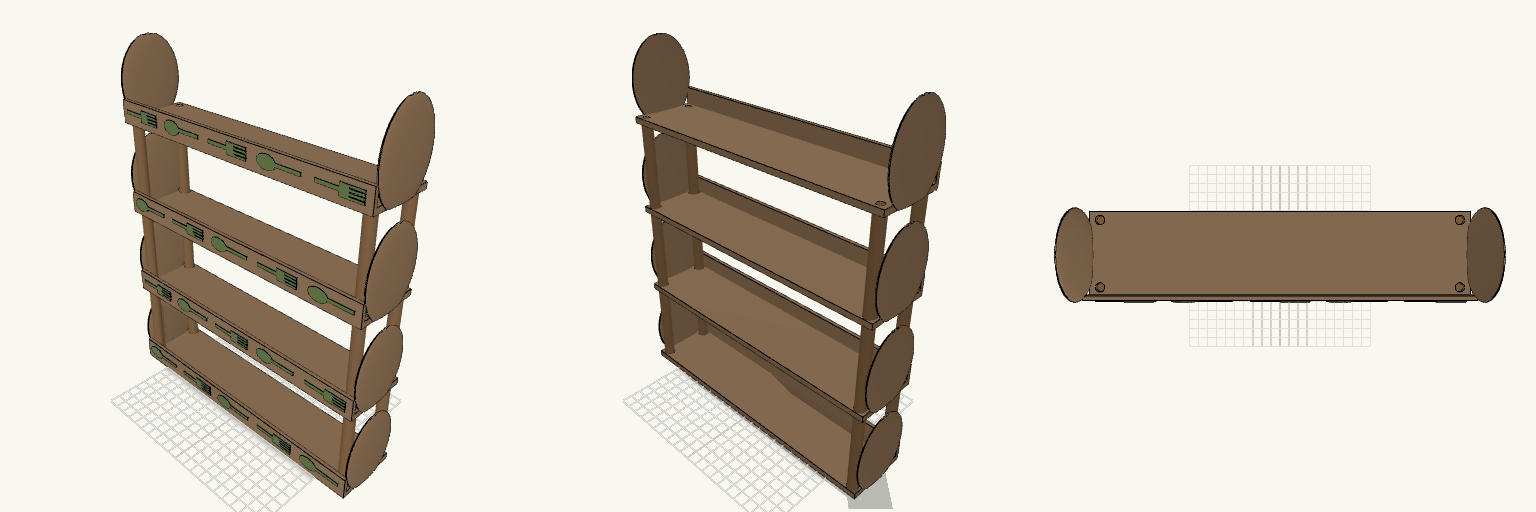
Modular Backless Spice Rack
A four-level spice rack for 20 jars, five per shelf, with no back panel to save filament. Each shelf is its own tray with smooth lens-shaped oval sides and a front lip carrying raised spoons and forks. Round connector posts with small pegs join the shelves and pull apart. Remix hooks Slot width (52 mm): change for larger or smaller jars; overall width follows. Level pitch (85 mm): raise for tall jars, which also lengthens the connector posts. Shelf count: set to 2–6 levels for a different stack. Side shape: oval height 76 mm and depth 60 mm; scale the oval for a rounder or flatter profile. Peg fit: pegs are 6 mm with 0.2 mm clearance per side; tune for your printer. Variants: swap the cutlery for other icons, or add wall-mount holes in the shelf floor. Overall size is about 266 × 60 × 325 mm. Print shelves flat and posts upright. Pairs well with a wall strap or a non-slip mat.
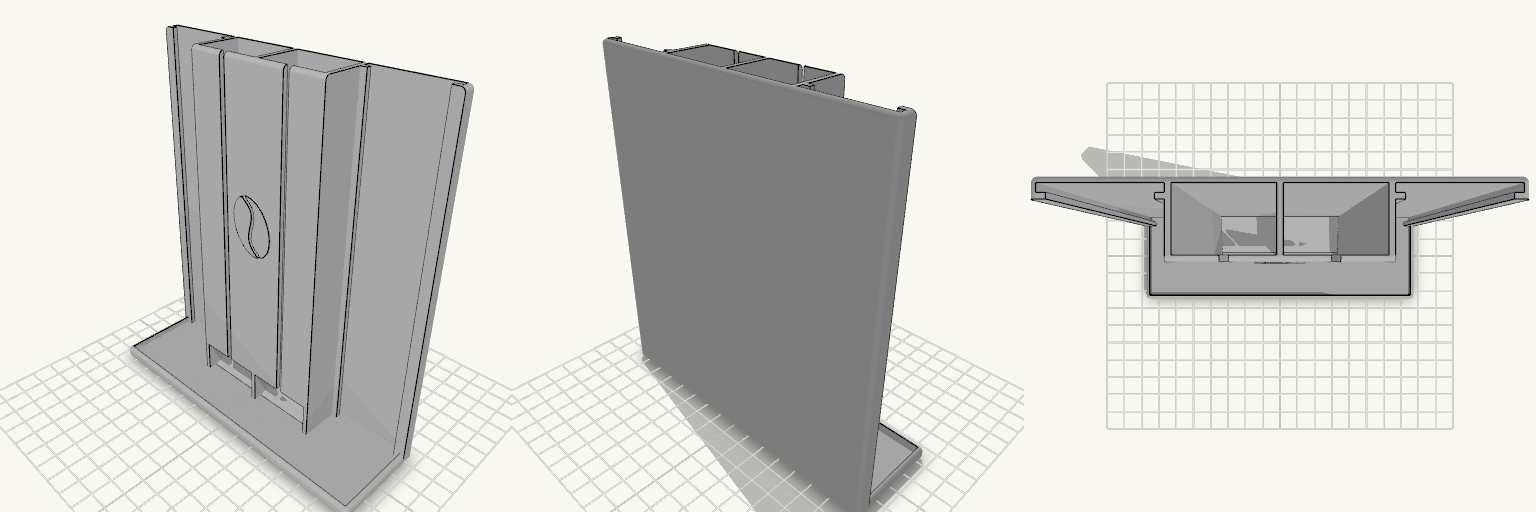
Nespresso Original + sucre 30×20 mm, distributeur 4 colonnes
Distributeur en hauteur pour capsules Nespresso Original (colonnes extérieures) et sucre en morceaux de 30 × 20 mm (colonnes centrales), à coller le long d'une machine. À vérifier avant impression Cavité sucre : 32 × 22 mm, pour des morceaux de 30 × 20 mm. Cavité capsules : 39 mm de large, deux rails de 3 mm, soit 33 mm de passage. Parois latérales du sucre : 2 mm. Largeur totale : environ 152 mm, au-dessus de 140 mm. Incompatibilités Ne convient pas aux capsules Vertuo. Pente de fond uniquement sur les colonnes sucre.