Utilitarian Thin-Walled Pipe
Made by a Guest
Created 3 months ago
Description
A bare-bones, precision-cut cylindrical sleeve evoking raw industrial hardware. It carries a uniform 1.5mm wall over its entire span, engineered strictly for custom slip-fit or sleeving applications where clearances are tight and material cannot be wasted.
Dimensional Specs:
- Inner diameter: 65 mm
- Outer diameter: 68 mm
- Total length: 65 mm
Photos
Technical views
More like this
Explore more in Home & Fixtures →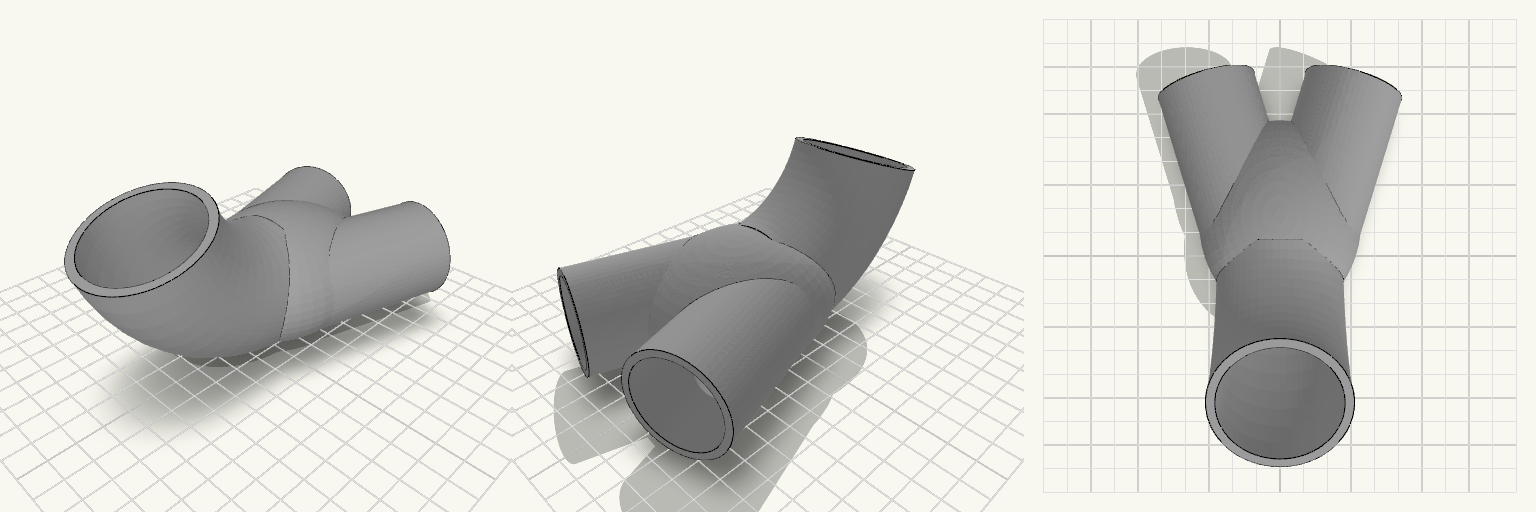
Curved Ø42 Pipe with Two Ø38 Branches
A hollow pipe that bends 70° along a 70 mm centreline and then splits into two diverging branches. The main bore is Ø42 with a 3 mm wall (Ø48 outside), giving a bend radius of roughly 57 mm. Where the bend meets the branches, the junction is stretched into a long egg-shaped blend — about 76 mm along the flow and 62 mm across — so the outside runs smoothly from the bend into each branch and the Ø42 bore narrows gradually into the two Ø33 bores, with no step or flat seam at the joint. On the print plate the two smaller branches lie flat and fan out sideways, side by side at ±17°, while the big curved pipe rises from them and bends upward, leaving its Ø42 inlet at the top of the bend rather than on the plate. The branches leave from either side of the junction rather than a single shared point, and the gap between them narrows quickly toward the blend, so only the outer stretch of each pipe stays clear for a hose — about 16 mm of clear space at the open ends, on centres roughly 56 mm apart. The whole part prints as a single hollow form with the branches already joined to the curve — no separate pieces or assembly. As it sits on the plate it measures about 92.6 × 141.2 mm with a height of about 69.9 mm, so check that against your bed before slicing. Keep the internal passages free of supports or bridging material so the flow stays unrestricted. Main bore: Ø42 inner, Ø48 outer, 3 mm wall Bend: 70° over a 70 mm centreline (≈57 mm radius), rising upward Branches: two, at ±17°, Ø38 outer, Ø33 inner (≈2.5 mm wall), 62 mm long, lying flat and fanning sideways Junction: stretched egg-shaped blend, approx. 76 mm along the flow and 62 mm across, feeding both branch bores without a step Branch spacing: ≈56 mm centre to centre, ≈16 mm clear at the open ends Footprint on the plate: approx. 92.6 × 141.2 mm, height approx. 69.9 mm Use it where a single round duct has to turn a corner and then divide into two angled outlets of a smaller diameter that each take a hose.
Draining Sleeve Foot for a Laundry Hamper Leg
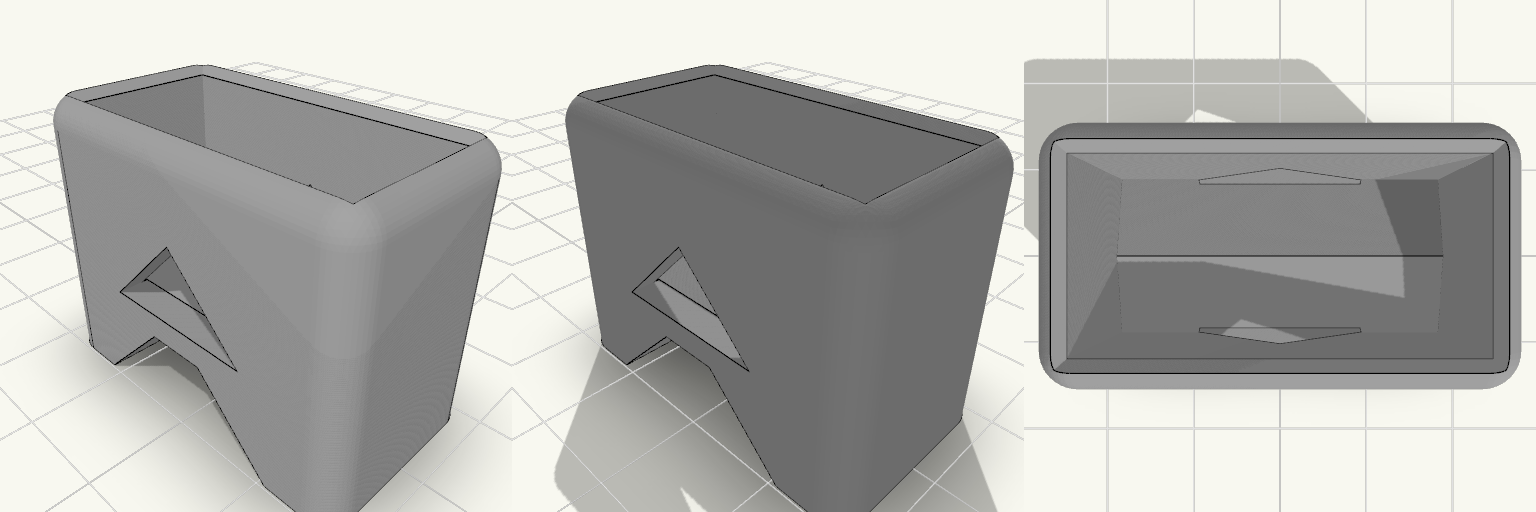
The wood at the bottom of a hamper leg is the first thing to go: it stands in whatever puddle the bathroom floor collects, drinks it up, and goes soft until the basket slumps and rocks. This sleeve slides onto the end of one rectangular wooden leg, holds the wood about 9 mm clear of the floor, and slopes its pocket floor so splash water runs out the sides instead of sitting in there against the wood. What it does Pocket: 31 × 15 mm inside, sized exactly to the leg with no added play — that measurement already accounts for clearance. 15 mm deep at its shallowest point, the centre ridge, and deeper toward the sides where the floor falls away. Stand-off: a single arched cut runs the full depth of the underside, leaving two flat feet that hold the leg about 9 mm off the floor. Overall height is about 27 mm. Drainage: the pocket floor is a shallow ridge sloping down to both long sides, with one 16 mm slot through each long wall at the low edge. Water leaves sideways, and the slot bottoms sit 10.5 mm above the floor, so no opening rests in the wet. Each slot is pointed at the top rather than flat-roofed, which is what lets it print clean. Shape: 1.2 mm chamfer at the opening to get it started over the wood, 3 mm rounding on the vertical and top edges so it doesn't snag a mop or a bare toe. The bottom edges are left sharp so they sit flat on the bed. Printing it Print in PETG with the sleeve opening facing up and the two feet on the bed — no supports anywhere. The arch sides are 45°, so the only bridge is the flat strip about 6 mm across the roof of the arch. The finished part measures roughly 36 × 20 × 27.2 mm, walls 2.5 mm thick. A plain matte finish in white, grey or black sits well in a bathroom. A zero-clearance pocket is tight in PETG. Check the leg with calipers before printing if the wood looks swollen or tapered — if it won't slide on, the pocket wants a few tenths opening up.
Hideaway — Türrahmen-Batteriebox
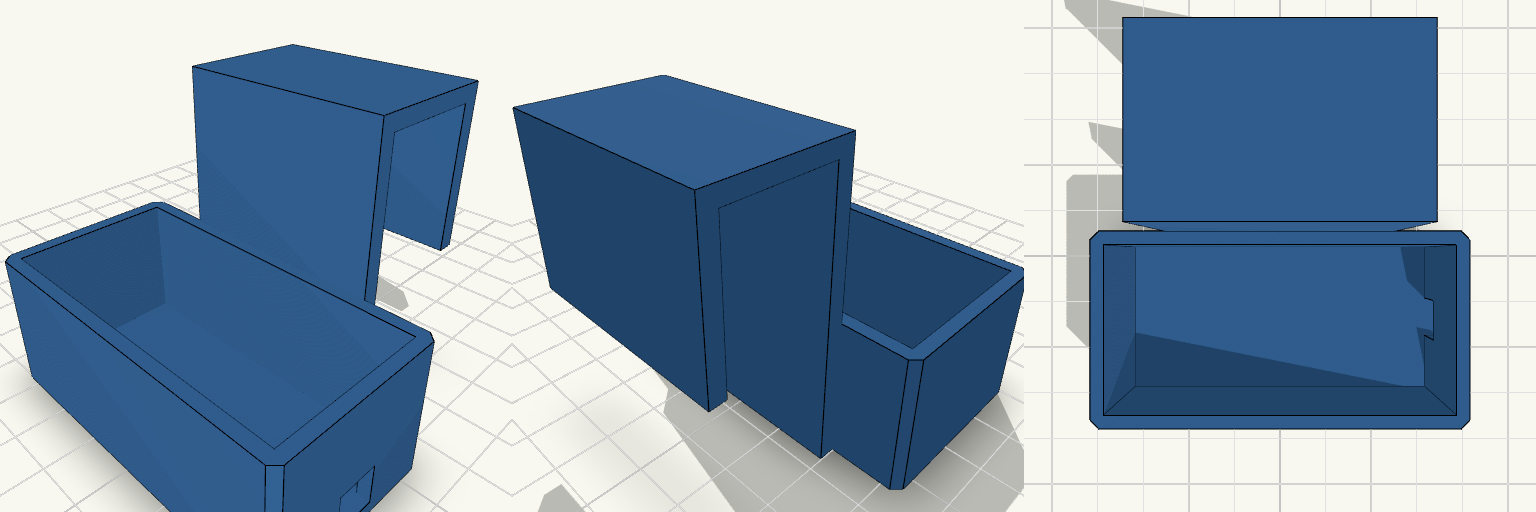
Hideaway ist eine kleine, oben offene Box mit Haken, die über einen Türrahmen gehängt wird und eine Batteriebox für Lichterketten verdeckt. Der Haken sitzt an der Rückseite, der Kabelausschnitt wandert seitlich aus der Box, damit die Vorderwand geschlossen bleibt. Maße Innenraum: 62 × 30 × 24 mm (passend für eine 3×AA-Batteriebox) Haken: für Türrahmen von ca. 20 mm Dicke, 40 mm breit Wandstärke: 2,4 mm Kabelausschnitt: 8 × 8 mm in der rechten Seitenwand, knapp über dem Boden Hinweise Ein Teil, kein Deckel – oben offen Vorderwand geschlossen, Kabelauslass seitlich Ohne Stützen druckbar, Rückseite flach auf das Druckbett
8.35 mm Fiberglass-Rod Joiner with Camera Arm
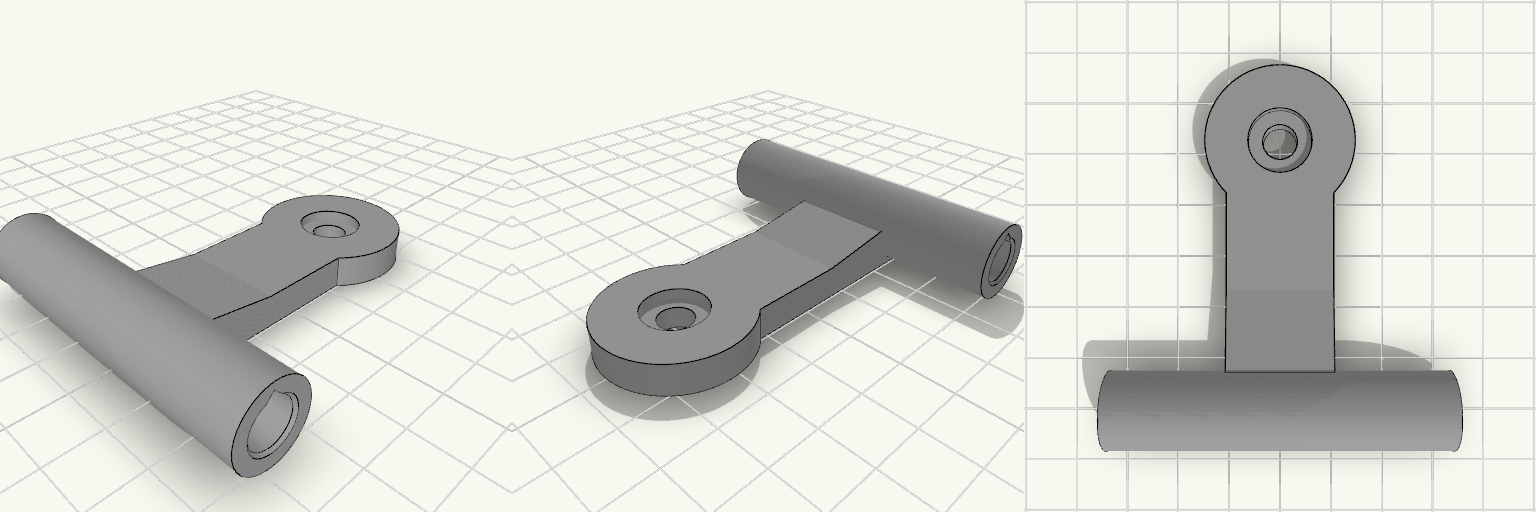
Replacement two-way joiner for the top-front-center of a fiberglass-rod printer enclosure. It splices two nominal 8.2 mm rods end-to-end and carries a flat-lying arm with a screw boss for a Sercomm RC8110 camera. Print it as one piece with the arm flat on the bed, then rotate the part about the rod axis during installation to aim the camera downward and toward the bed center. Specifications Rod sockets: 8.35 mm ID, 30 mm deep per side, 0.5 mm entry chamfers, separated by a 3 mm solid center stop; 63 mm overall sleeve length. Sleeve: approximately 14.35 mm OD with 3.0 mm wall thickness. Arm: 20 mm wide and 6 mm thick, extending 50 mm from the sleeve, with a root block and gusset blending it into the sleeve. Camera boss: 28 mm diameter and 6 mm thick, with a 6.6 mm through-hole and a 12 mm × 2 mm counterbore for a 1/4"-20 camera screw. Print footprint: 63 × 71.2 × 14.4 mm as oriented on the plate; the teardrop socket bores and flat arm are intended to print without support. Fit: press-fit for measured 8.19–8.20 mm rods; PETG wall thickness is sized to resist splitting and bending from the tensioned enclosure fabric.
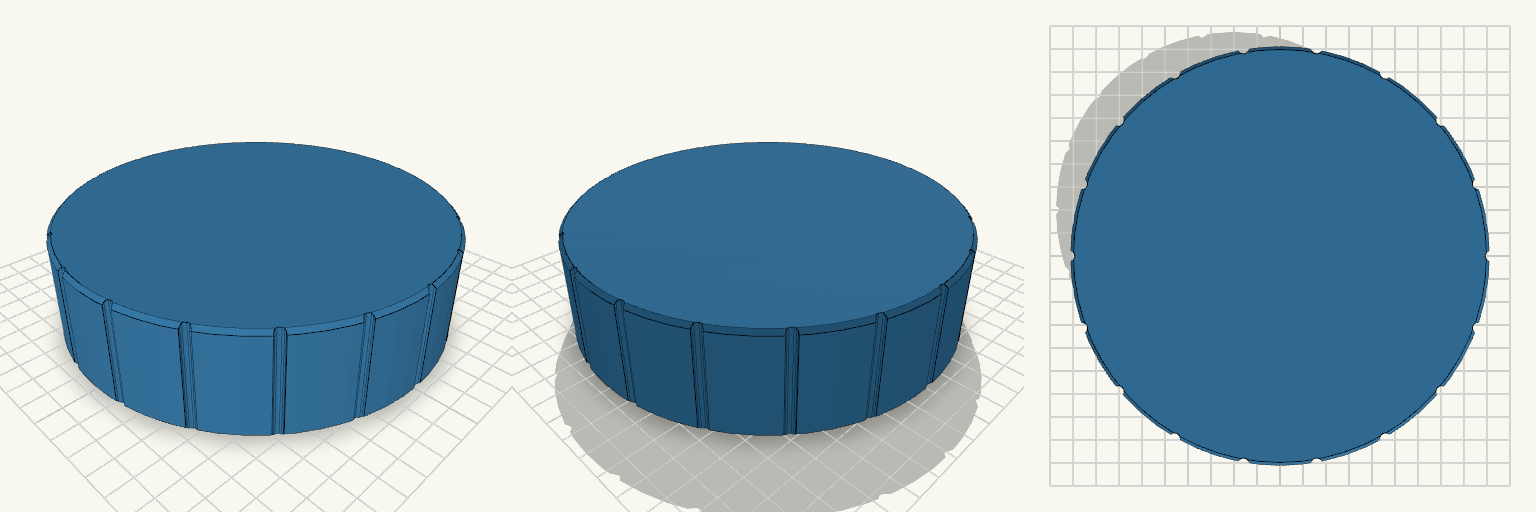
Twist-On Portable AC Port Cap
A screw-on lid in the spirit of a big jar cap, sized to seal the wall bracket that takes a 6 inch portable AC hose. The inside carries a female thread that mates with the bracket's 145 mm male thread, so it twists on the same way the hose does. Design notes 12 mm pitch, 5 mm thread depth, 2.5 mm clearance over the 145 mm thread 155 mm outer diameter with a 3 mm closed top and thin walls to save print time Scalloped grip notches around the rim Prints open-side up or top-down; the thread is coarse, so a 0.4 mm nozzle is fine
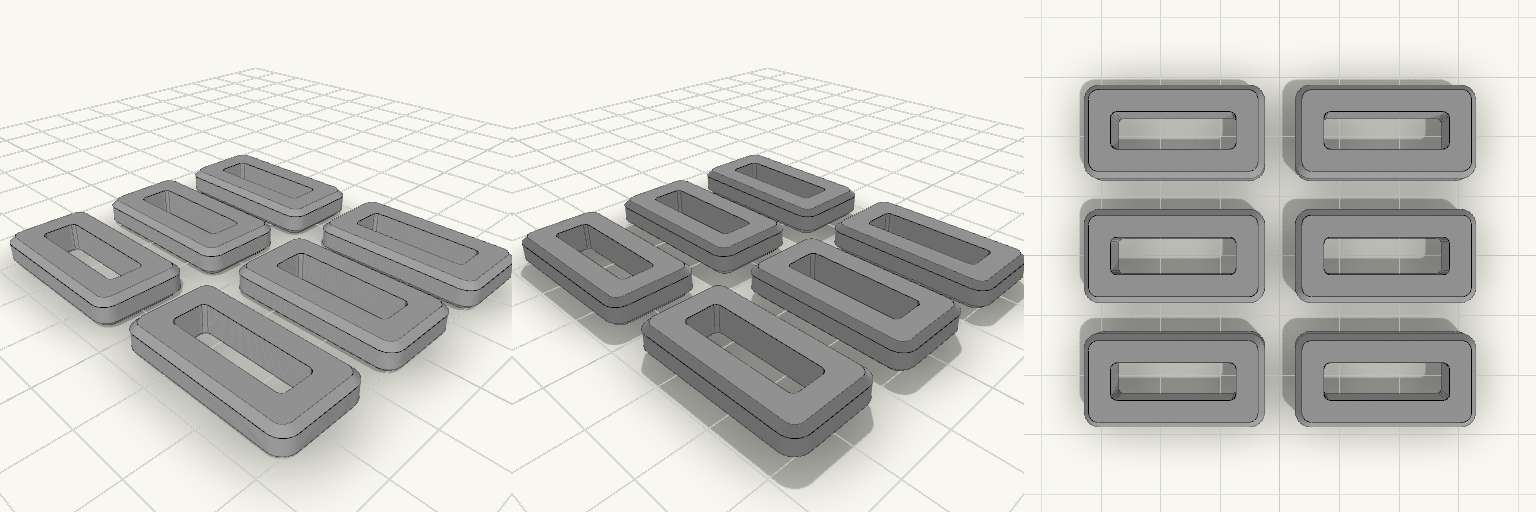
StrapSlot — Rectangular Velcro Strap Keeper
StrapSlot is a rectangular slot ring made for velcro straps — a buckle ring, strap keeper, or loop in one compact part. The internal opening is a clean 20 × 6 mm slot, and the 4.7 mm body uses 4.5 mm walls with rounded corners for a tidy outer profile. A 1 mm chamfer on the outer top and bottom edges softens the outside of the ring, while the slot edges stay square. Use it to keep a strap flat and contained, or as a replacement ring where a rectangular slot is needed. Dimensions | Feature | Size | | --- | --- | | Ring (each) | 29 × 15 × 4.7 mm | | Internal slot | 20 × 6 mm | | Wall thickness | 4.5 mm | | Outer edge chamfer | 1 mm on top and bottom | | Slot edges | Square | | Corners | Rounded | | Full set footprint | 63 × 55 mm, 4.7 mm tall | In the set Six identical rings, arranged in a 2×3 grid with 5 mm gaps between them. The whole set sits flat on the plate at a single 4.7 mm height, so it prints as one batch. Snap or separate the rings after printing to use them individually. Fit notes The 20 × 6 mm slot is the critical fit dimension; check your strap width and thickness against it. The 4.7 mm overall thickness sets the ring depth. The 4.5 mm walls, rounded outer corners, and 1 mm outer-edge chamfer define the outside shape.