Wide Brim Elliptical Hat
Created 3 months ago
Remixed 2 times
Description
Here's a baseline wide-brimmed hat shell, anchored around the 170x200mm elliptical clearance requested. It is built flat to maximize bed adhesion for large-format printers, treating the build plate as the brim's reference plane. The dome is a simple half-ellipsoid that covers the core geometry, leaving plenty of room for modifications.
Remix Hooks
- Crown Height: Set to a default 100mm. Scale the Z-axis of the crown geometry if you need a taller top hat or a shallower boater profile.
- Brim Contour: It is completely flat right now to survive the first layer on a 400x400mm bed. You could run a slight Z-warp over the outer 50mm to give it a swoop, though that will require supports.
- Material: At 2.4mm thick, this is dimensioned for standard rigid filaments (PETG/PLA) to hold its shape. Dialing the thickness down to 1.2mm for TPU would give the brim some authentic flop.
Photos
Technical views
More like this
Explore more in Gifts, Seasonal & Personalized →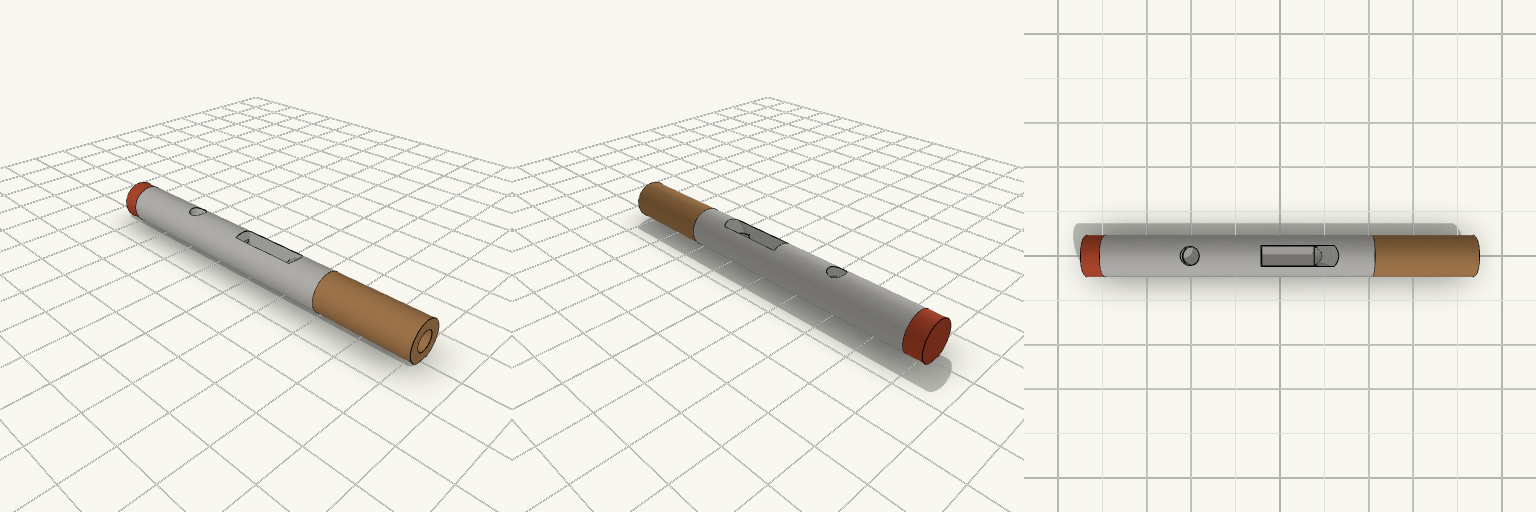
Film-Noir Cigarette Fipple Whistle
A cigarette you can't smoke but can play: an 84 mm-long fipple whistle disguised as a filter-tipped stick, complete with an orange ember tip, a white paper body and a tan filter. Inhale through the filter end and air slips through the intake hole near the ember, runs a thin flat duct across a window and breaks over a sharpened edge — the classic whistle mechanism, wearing a noir prop's silhouette. It is an inhale-only instrument; blowing back out through it will sound weak or not at all. This version is tuned for a softer, lower note: the duct is narrow and shallow, the window is long with a gentle ramp, and the intake is widened a touch to keep the hiss down. A gentle, steady inhale gives the smoothest sound; a hard pull turns breathy. Design notes Three colour-coded sections in the viewer: Ember Tip, Paper Body and Filter, printed as a single piece. The underside is flattened, so it sits stable on the plate and needs no supports. Keep your lips clear of the intake hole while you inhale — that hole is the voice. Tone stays tunable: a longer window takes it darker, a slightly more open duct brings back volume if it comes out too faint. Pairs well with a trench coat, a rainy window, and anyone who appreciates a joke that also functions.
Yuletide Vault — 24-Drawer Advent Calendar
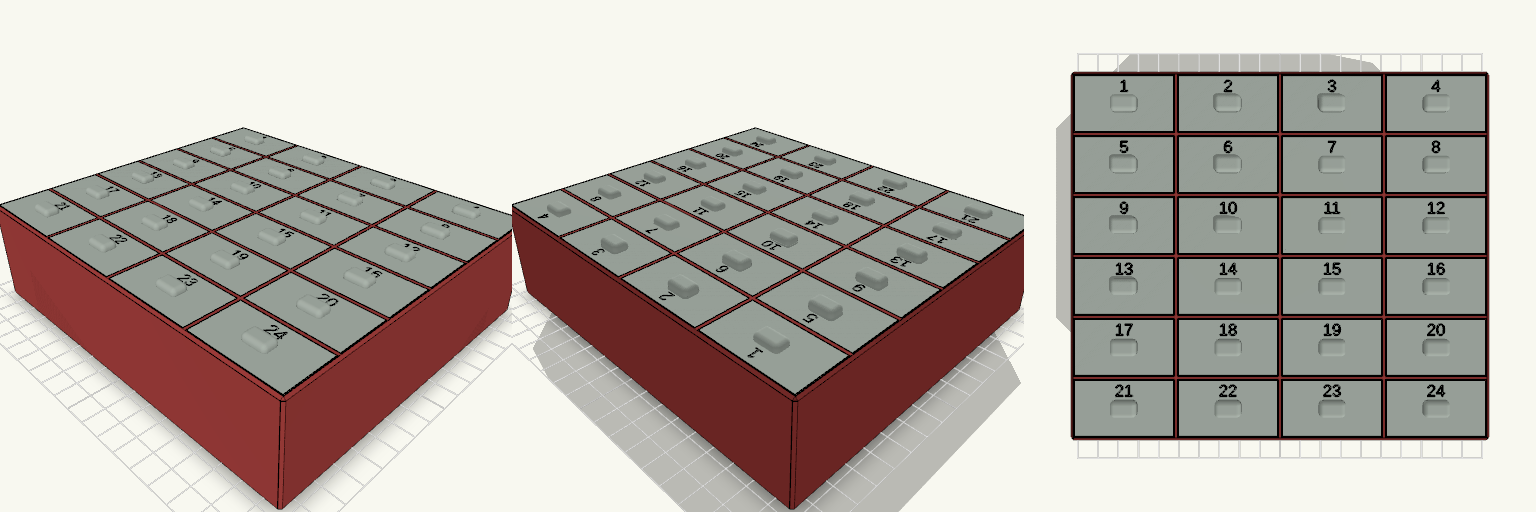
A print-in-place advent calendar with 24 identical sliding drawers in a 4 × 6 grid. Every drawer front carries an engraved number from 1 to 24 and a soft-edged finger handle, so the countdown opens one small compartment at a time. The drawer bodies, fronts and matching frame openings keep clean square corners; only the handles are rounded, giving a comfortable grip without softening the rest of the geometry. Each cavity is sized around a 35 mm × 20 mm candle, making the drawers practical for a daily treat or a small gift. The whole assembly fits the Bambu Lab A1 Mini build plate and prints without supports in the sliding channels. Features 24 identical drawers arranged in 4 columns and 6 rows, numbered 1–24. Square drawer bodies, fronts and frame openings; only the handles are softened, with an edge radius of about 1.5–2 mm. Each drawer has an 11 × 7 mm handle that protrudes 3 mm, centred on the front. Engraved numbers sit 0.6 mm deep in the strip above each handle, clear of the grip area. 0.4 mm clearance on every side and at the back keeps the drawers sliding freely. A stop ridge inside each pocket catches the drawer's back wall after about 40 mm of travel, so drawers cannot fall out accidentally. Drawer cavity: 38.5 × 42 × 22 mm, sized to hold a 35 × 20 mm candle. Dimensions Overall footprint: 175.2 × 154.2 × 49.6 mm including handles — fits the A1 Mini's 180 mm plate. Drawer outside: 41.5 × 45 × 23.5 mm; wall and floor thickness: 1.5 mm. Frame divider walls: 1.2 mm. Print notes The calendar prints as one piece with the drawers already seated in the frame. The back face lies flat on the plate and the fronts and handles face up, which avoids supports in the channels. Print in white PLA for the intended look.
Festive Headstand: Upside-Down Pineapple with Ball Gag
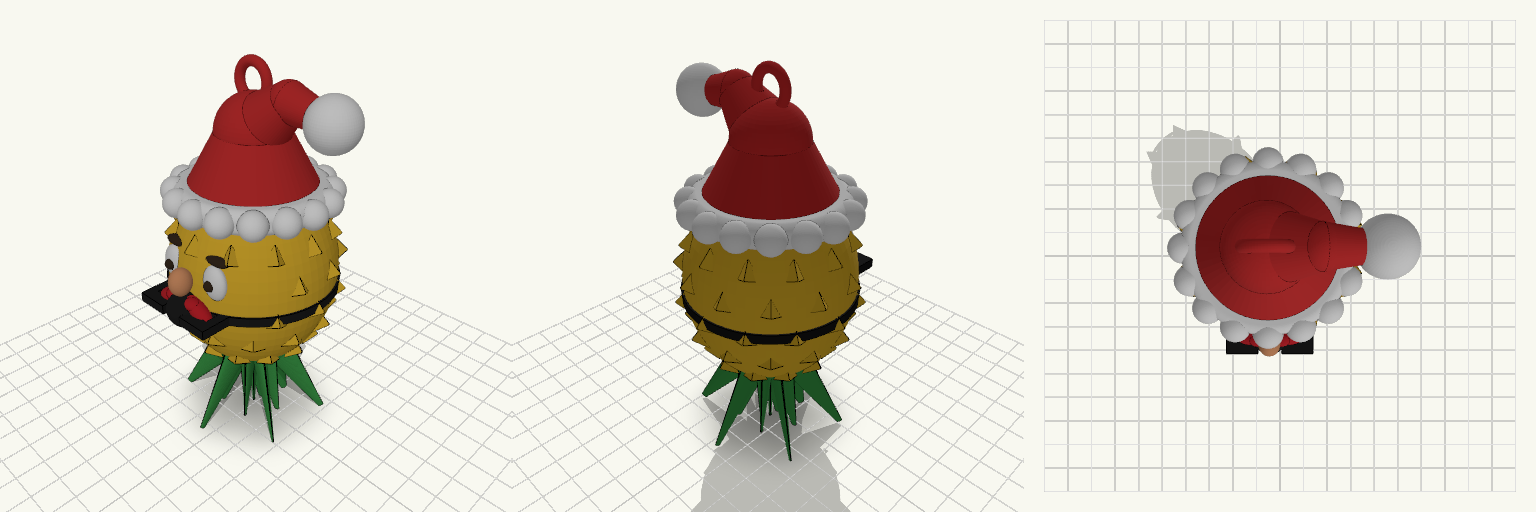
A cartoon pineapple does a festive headstand: it balances on an oversized leafy crown, the fruit body rising above, and a big fluffy red Christmas hat droops off to one side, ending in a single large rounded bobble. Two wide-open eyes with dark pupils and brows sit on the fruit, a small skin-toned nose between them, and a black ball gag framed by small red puckered kissing lips takes the place of a mouth. The lips form a compact ring with cupid's-bow lobes on top and a fuller lower lip, set back into the fruit's surface around the ball so the black shows through the middle. The strap runs around the head and across the front, outside the lips, lying against them as it passes over their corners and into the ball, so the lips sit behind it. The leaves are the star of the stand: a dozen broad blades plus a ring of shorter ones fan out beneath the fruit and lift it clear of the surface, giving the upside-down pose its height and silhouette. The body is scaled in staggered rows of triangular scales, kept clear of the face, so the fruit reads as a pineapple from any angle. And yes — the inverted pineapple is the classic swinger sign, worn here in full holiday dress. Use it as intended, or simply as a seasonal oddity. Made to hang A loop sits upright on the hat's peak, ready for a hook, ribbon or tree branch. With no base disc under the crown, the pineapple rests on its leaf tips — perfect for hanging, less so for standing on a shelf. The hat's tip droops to one side and ends in one large rounded bobble, so check clearance around the hook. Design notes Tall, wide leaf crown with 12 broad leaves and a ring of shorter ones; it doubles as the stand. Face: two open eyes with pupils and brows, a small nose, a black ball gag, and small red puckered kissing lips with a cupid's bow. The lips are sunk back into the face around the ball rather than standing proud of it, so the strap sits in front and the red shows as a ring. Strap wraps the back of the head and bands across the front outside the lips, resting against the face and covering their corners. Staggered triangular scales wrap the body in rows, with the face left smooth. Oversized hat with a thick trim of rounded puffs and a smooth bobble, finished with the hanging loop. The fluffy hat trim is the widest point, so check your bed size before printing.
Stockless Anchor Cross Pendant
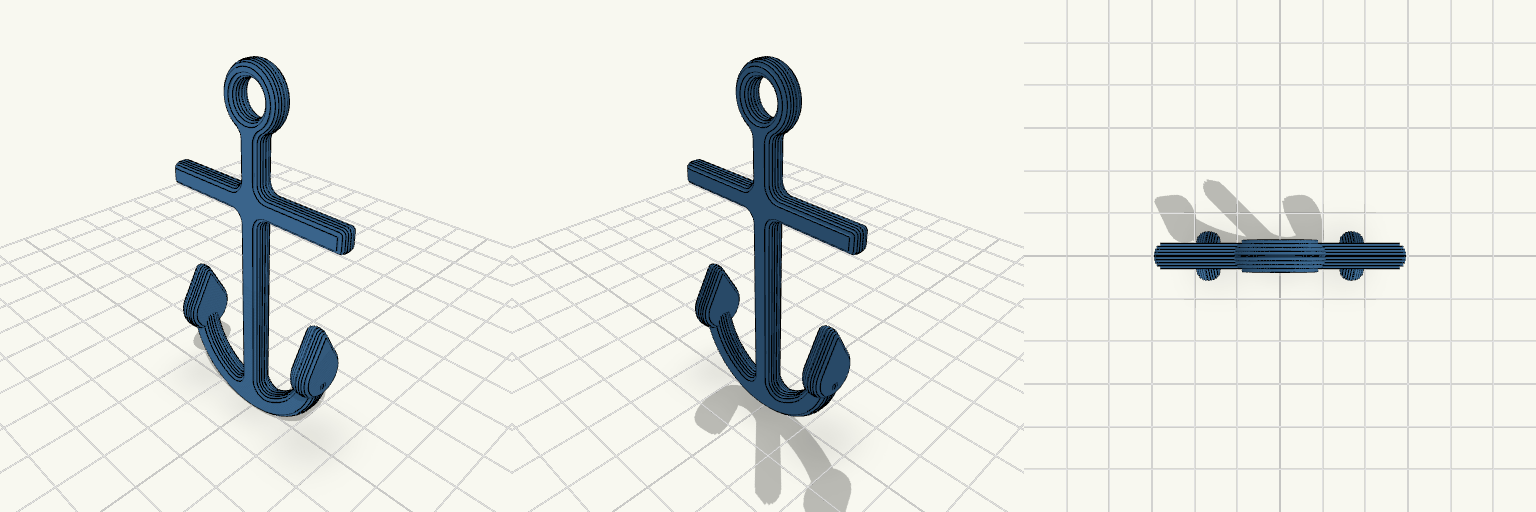
A pendant that combines a cross and a stockless anchor. A plain shaft and crossbar form the cross, a shallow U-shaped crown sits below it, and spade-shaped flukes rise from the crown ends. A bail ring at the top takes a chain. Upright orientation, front face toward -Y Fully rounded edges and filleted inside corners Spades kept whole, with no trimmed faces 40 mm crossbar The crown's lowest point is a narrow contact line, so use a brim or supports if printing it upright.
Tasse chocolat 100 mm, père Noël et anse séparée
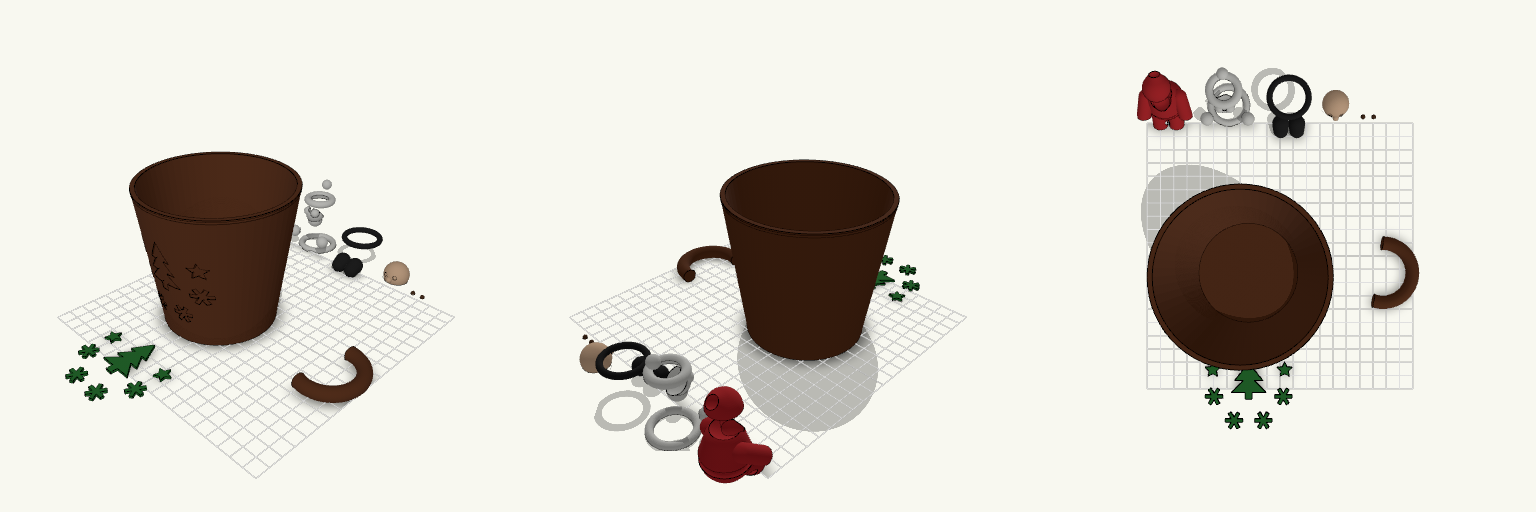
Tasse à chocolat creuse de 100 mm de haut, avec un père Noël cramponné à la paroi arrière, en position d'escalade, et une anse imprimée à part. La tasse est ouverte en haut, sans couvercle, avec une base plate et une paroi lisse côté +X puisqu'elle n'a plus d'anse. Le père Noël est solidaire de la tasse, plaqué contre la face extérieure : ses bras montent jusqu'au rebord et ses deux moufles blanches, rondes, se logent dans deux creux ronds du rebord, à environ 14 mm de chaque côté du centre ; sa tête et son bonnet dépassent au-dessus du rebord, et ses jambes prennent appui contre la paroi, à l'extérieur, les pieds à quelques millimètres au-dessus du plateau. Chaque partie est découpée suivant la forme de l'intérieur, y compris au-dessus du rebord : rien ne dépasse dans la cavité, qui reste creuse sur toute sa hauteur. La face avant porte des creux à la forme exacte des décorations de Noël, qui s'impriment à plat sur le plateau et se collent dedans. Tasse : 100 mm de haut, 80 mm de diamètre en bas, 110 mm en haut, parois de 3 mm, fond de 5 mm, rebord arrondi, intérieur entièrement creux et dégagé, base plate ; largeur totale d'environ 130 mm avec l'anse en place Père Noël intégré : derrière la tasse, face à l'avant, en position d'escalade ; remonté pour que la tête et le bonnet passent au-dessus du rebord ; moufles rondes logées dans les creux du rebord, jambes et pieds contre la paroi extérieure, les pieds à environ 6 mm au-dessus du plateau ; manteau et bonnet rouges, fourrure, barbe et moufles blanches, ceinture et bottes noires, visage et yeux ; les couleurs se touchent sans se chevaucher, à exporter en 3MF pour les conserver Moufles et creux du rebord : moufles maintenues rondes, décalées d'environ 3 mm vers l'extérieur du rebord pour ne plus être rognées par la cavité, avec les manches qui suivent ce décalage ; deux creux ronds au rayon des moufles, avec 0,4 mm de jeu pour la colle, à environ 14 mm de chaque côté du centre ; ils ne traversent pas la paroi et l'intérieur reste lisse ; peu profonds, le rebord ne faisant que 3 mm d'épaisseur Anse séparée : posée à plat à droite de la tasse, côté +X, même couleur chocolat ; rayon de 22 mm, épaisseur de 10 mm ; extrémités découpées pour épouser la paroi ; se colle sur la tasse, sans creux de guidage ; s'imprime sans support sur sa face large Décorations séparées : sapin à trois étages et tronc sans étoile au sommet, deux étoiles latérales et quatre flocons, tous verts, 1,4 mm d'épaisseur, posés à plat devant la tasse côté −Y ; les deux flocons latéraux sont à environ 26 mm du centre et 42 mm de haut Creux d'encastrement des décors : profondeur d'environ 1,5 mm, 0,3 mm de jeu tout autour pour la colle ; la paroi garde environ 1,5 mm sous les creux et l'intérieur reste creux Points d'impression : prévu pour une FDM domestique ; les jambes du père Noël sont en porte-à-faux contre la paroi inclinée et ses pieds ne reposent pas sur le plateau, un peu de support peut être utile à cet endroit ; les branches des flocons font environ 2,4 mm de large, ce qui est fin pour une buse de 0,4 mm ; un flocon plat sur une paroi courbe reste une approximation La tasse sert de contenant pour des bonbons ou du chocolat chaud. L'anse et les décorations vertes s'impriment à part, chacune dans sa couleur, puis se collent : l'anse sur le côté de la tasse, les décorations dans leurs creux sur la face avant.
Bold Block-Letter FLOYD Name Sign
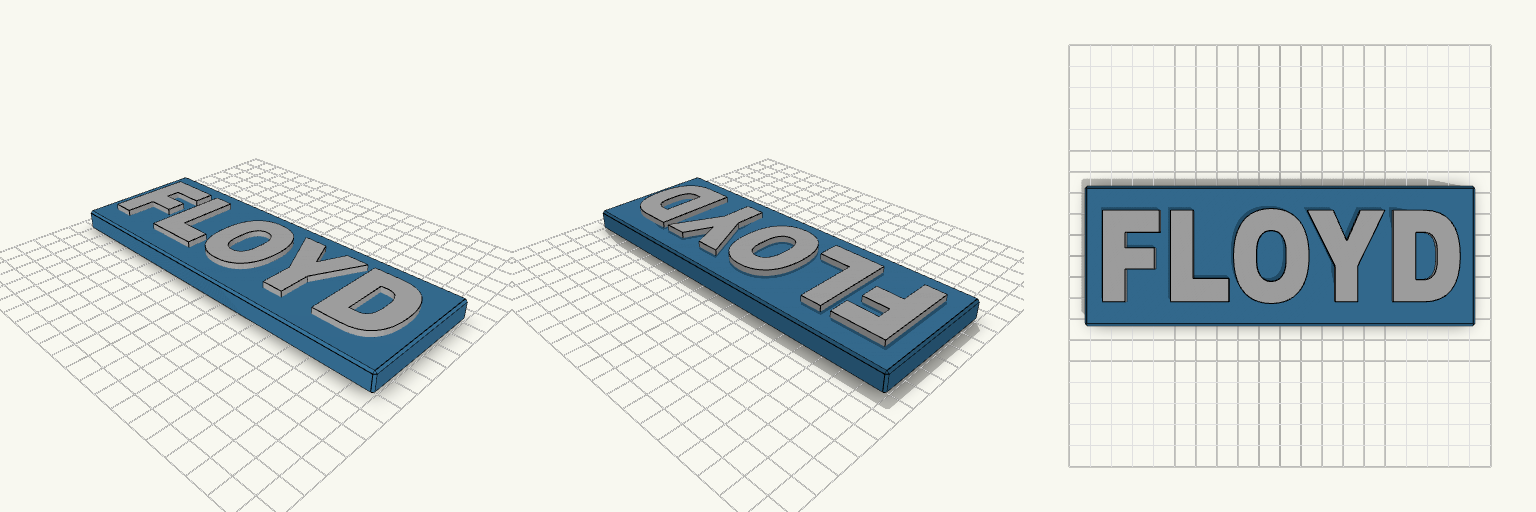
A confident single-word nameplate: a 179 × 64 mm slab, 10 mm thick, with FLOYD rising 3 mm off the face in heavy block capitals for a total height of 13 mm. The letters stretch to roughly 162 × 43 mm, running almost the full length of the top face and leaving only a slim border around them. It reads as signage first and decoration second — the kind of bold lettering that belongs over a door, on a wall, or fixed to a workshop board, and with 10 mm of depth behind it, it also stands on its own as a chunky desk or shelf piece. Sized for a Bambu Lab A1 mini, the sign uses the bed's full width in one direction only, so it prints as one piece with no scaling needed. That width fit is tight: only about 0.5 mm of margin remains on the long side, so a skirt, brim, or calibration offset could push it past the bed edge — a slightly smaller scale is safer if the slicer complains. The 10 mm body uses noticeably more filament than a thin plate, so keep that in mind if material use or weight matters. Design notes Raised lettering sits proud of the plate, catching light and shadow and allowing a contrasting colour with a filament swap at the right layer. The top face, the lettering and the sides are all square-edged; the plate has a flat back and prints from a single flat base without supports. Wide, thick strokes keep the text legible from across a room and sturdy enough to handle. The lettering is proportioned to the plate, so shrinking it uniformly in the slicer keeps the composition intact. Pairs well with a wall bracket, a small stand, or adhesive pads on the back — or just set it down as it is. A plain blue plate with white letters is only one finish — a dark plate with bright lettering, a painted recess, or a single-colour print all work with the same geometry.