Festive Headstand: Upside-Down Pineapple with Ball Gag
Created 7 days ago
Description
A cartoon pineapple does a festive headstand: it balances on an oversized leafy crown, the fruit body rising above, and a big fluffy red Christmas hat droops off to one side, ending in a single large rounded bobble. Two wide-open eyes with dark pupils and brows sit on the fruit, a small skin-toned nose between them, and a black ball gag framed by small red puckered kissing lips takes the place of a mouth. The lips form a compact ring with cupid's-bow lobes on top and a fuller lower lip, set back into the fruit's surface around the ball so the black shows through the middle. The strap runs around the head and across the front, outside the lips, lying against them as it passes over their corners and into the ball, so the lips sit behind it. The leaves are the star of the stand: a dozen broad blades plus a ring of shorter ones fan out beneath the fruit and lift it clear of the surface, giving the upside-down pose its height and silhouette. The body is scaled in staggered rows of triangular scales, kept clear of the face, so the fruit reads as a pineapple from any angle.
And yes — the inverted pineapple is the classic swinger sign, worn here in full holiday dress. Use it as intended, or simply as a seasonal oddity.
Made to hang
- A loop sits upright on the hat's peak, ready for a hook, ribbon or tree branch.
- With no base disc under the crown, the pineapple rests on its leaf tips — perfect for hanging, less so for standing on a shelf.
- The hat's tip droops to one side and ends in one large rounded bobble, so check clearance around the hook.
Design notes
- Tall, wide leaf crown with 12 broad leaves and a ring of shorter ones; it doubles as the stand.
- Face: two open eyes with pupils and brows, a small nose, a black ball gag, and small red puckered kissing lips with a cupid's bow.
- The lips are sunk back into the face around the ball rather than standing proud of it, so the strap sits in front and the red shows as a ring.
- Strap wraps the back of the head and bands across the front outside the lips, resting against the face and covering their corners.
- Staggered triangular scales wrap the body in rows, with the face left smooth.
- Oversized hat with a thick trim of rounded puffs and a smooth bobble, finished with the hanging loop.
- The fluffy hat trim is the widest point, so check your bed size before printing.
Images
More like this
Explore more in Gifts, Seasonal & Personalized →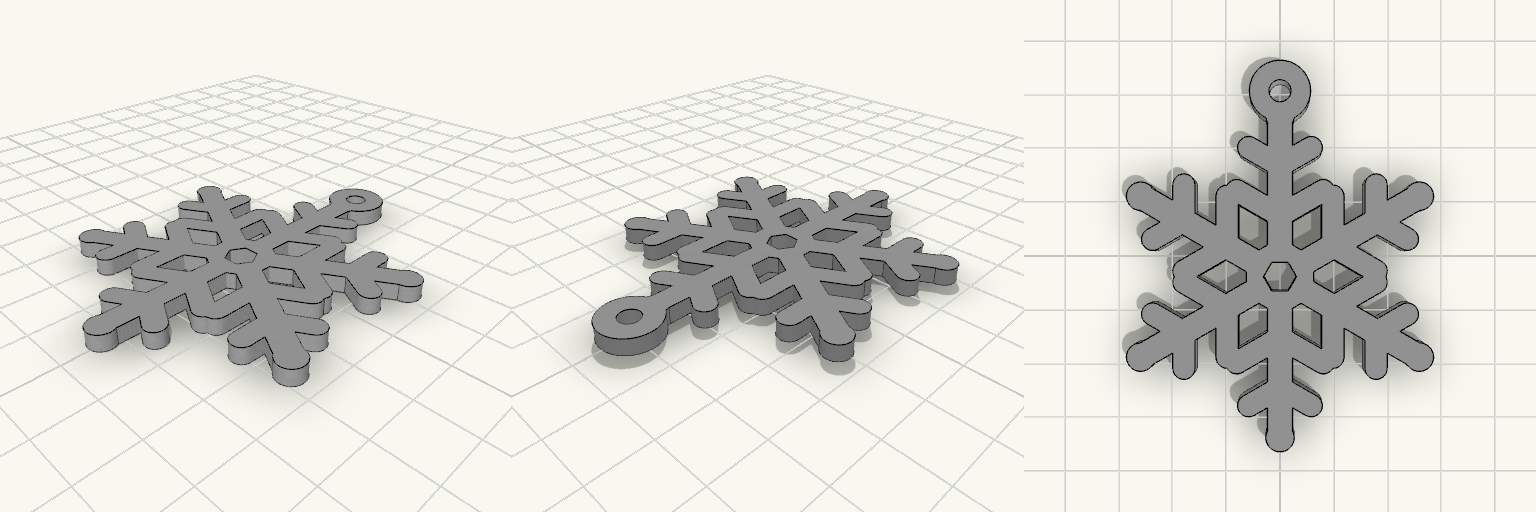
4 mm Hanging Hole Snowflake Christmas Ornament
A flat, six-armed snowflake ornament with a 4 mm string hole through a round eyelet that sits on the tip of the top arm. It prints as one solid piece, 3 mm thick, flat on the bed with nothing to support. Fits String, twine or thin ribbon up to roughly 4 mm through the eyelet; a knot or bead wider than the hole keeps it from pulling through. A tree branch, hook or nail with about 71 mm of clear height, so the eyelet and the point below it hang free. Does not fit / not included No hook, clip, stand or separate hanger — the eyelet is part of the print itself. No text, logo or engraved date; nothing is lettered on it. Not a multi-part kit; there is nothing to assemble. Check before printing Overall footprint is 55.3 mm wide across the flat sides and 70.5 mm tall including the eyelet, at 3 mm thick. Confirm the hanging spot leaves that much room and that your cord end passes the 4 mm hole — a hole that prints slightly tight may need a quick ream with a 4 mm drill bit. What is on the part Six broad arms, 4.5 mm wide with rounded ends, joined by side branches 4 mm wide — thick enough to handle and pack away each year. A 14 mm hexagon at the centre with a 6 mm hole through it, which trims filament without thinning the arms. An 11 mm rounded eyelet overlapping the full width of the top arm, so it reads as an extension of the arm rather than something stuck on. Every arm and branch is solid and properly joined, so the whole ornament stays low on filament while holding up to a season of hanging.
24-Compartment Chimney Advent Calendar stackable
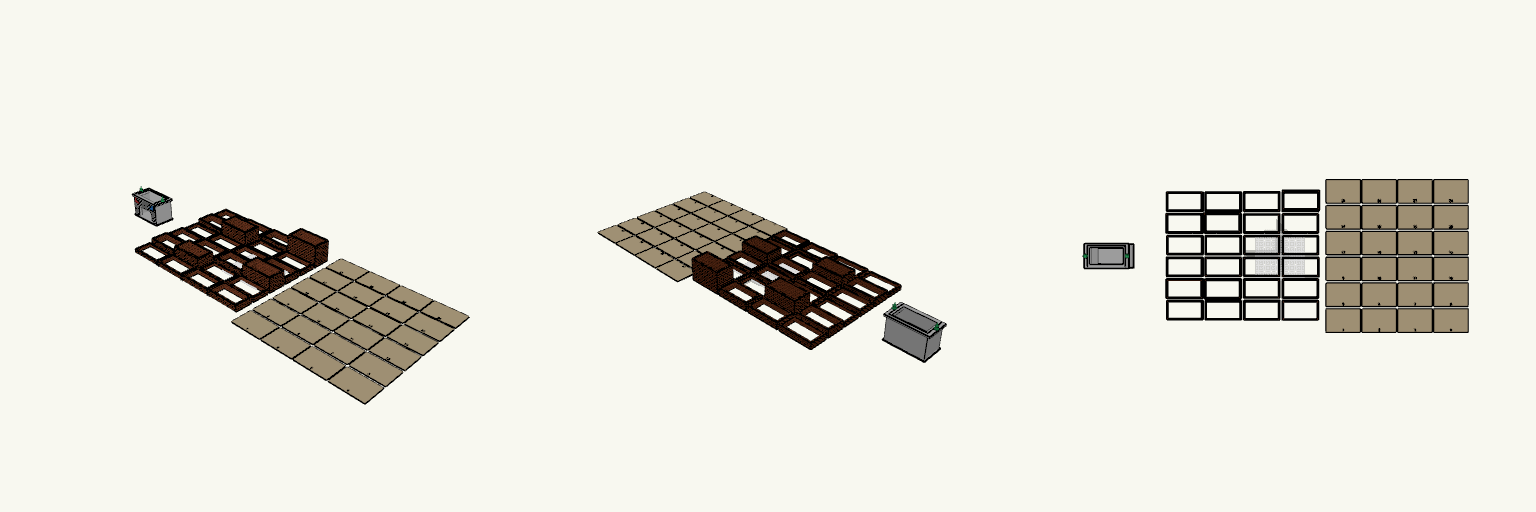
Advent calendar built as a fireplace with a stackable chimney. The fireplace is one printed piece; the chimney is 24 separate thin-walled segments, each 150 x 80 mm, with a numbered card between each pair. Pulling a card drops the sweets above it down the chimney into the firebox. Fireplace: one piece, white, with brick-line texture, arched firebox opening, mantel, funnel into the firebox, two stockings and two small trees. Segments: 24 pieces, 150 x 80 mm outside, 1.6 mm walls. Heights 20-40 mm for most, 60, 70 and 80 mm for three, and 100 mm for the last. Cards: 24 cards, 144 x 98 x 1.2 mm, numbers 1-24 engraved on the handle. Each rests on the inner lip at the top of the segment below and slides in through a slot at the front bottom of the segment above. Locating ring: a low ring on the mantel keeps the first segment in position; the front is open for the first card. Print notes: segments print open-end up with no supports. The stockings and trees are part of the printed fireplace. Stack height: roughly 1.0 m with all 24 segments.
Yuletide Vault — 24-Drawer Advent Calendar
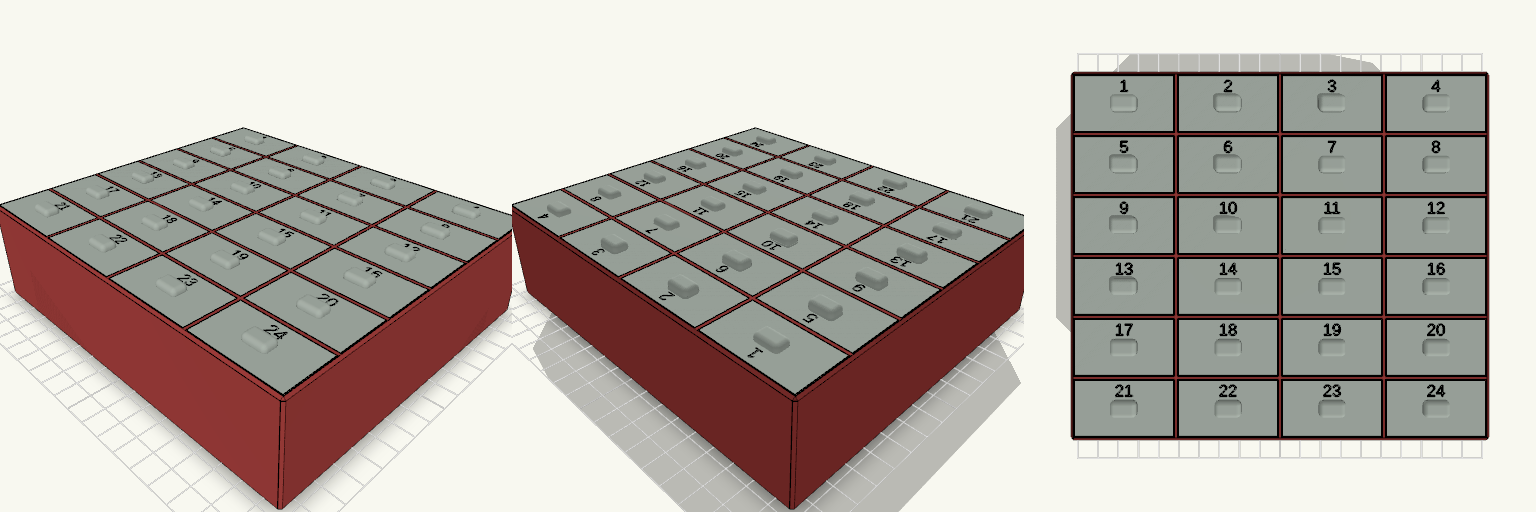
A print-in-place advent calendar with 24 identical sliding drawers in a 4 × 6 grid. Every drawer front carries an engraved number from 1 to 24 and a soft-edged finger handle, so the countdown opens one small compartment at a time. The drawer bodies, fronts and matching frame openings keep clean square corners; only the handles are rounded, giving a comfortable grip without softening the rest of the geometry. Each cavity is sized around a 35 mm × 20 mm candle, making the drawers practical for a daily treat or a small gift. The whole assembly fits the Bambu Lab A1 Mini build plate and prints without supports in the sliding channels. Features 24 identical drawers arranged in 4 columns and 6 rows, numbered 1–24. Square drawer bodies, fronts and frame openings; only the handles are softened, with an edge radius of about 1.5–2 mm. Each drawer has an 11 × 7 mm handle that protrudes 3 mm, centred on the front. Engraved numbers sit 0.6 mm deep in the strip above each handle, clear of the grip area. 0.4 mm clearance on every side and at the back keeps the drawers sliding freely. A stop ridge inside each pocket catches the drawer's back wall after about 40 mm of travel, so drawers cannot fall out accidentally. Drawer cavity: 38.5 × 42 × 22 mm, sized to hold a 35 × 20 mm candle. Dimensions Overall footprint: 175.2 × 154.2 × 49.6 mm including handles — fits the A1 Mini's 180 mm plate. Drawer outside: 41.5 × 45 × 23.5 mm; wall and floor thickness: 1.5 mm. Frame divider walls: 1.2 mm. Print notes The calendar prints as one piece with the drawers already seated in the frame. The back face lies flat on the plate and the fronts and handles face up, which avoids supports in the channels. Print in white PLA for the intended look.
110 mm pot à bonbons pain d'épice
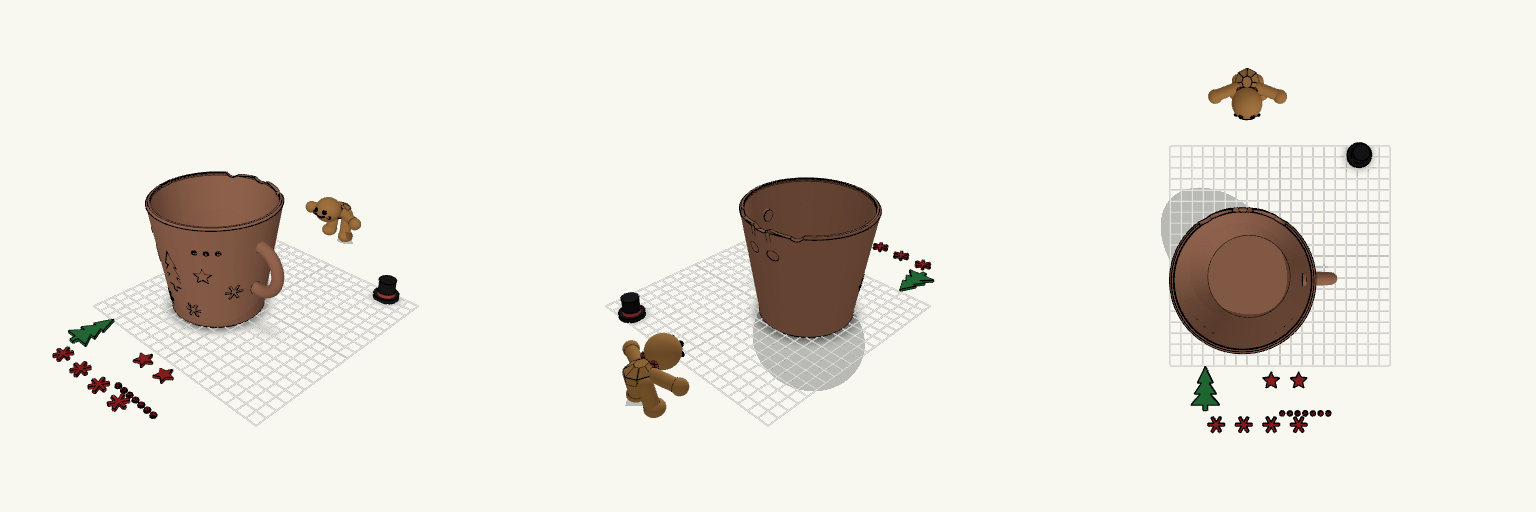
Pot à bonbons en forme de tasse de chocolat chaud, avec un bonhomme en pain d'épice couché sur le rebord arrière. Il n'y a pas de couvercle : le dessus reste ouvert et les bonbons se prennent par le haut. La pièce se présente en volumes séparés, posés à plat sur le plateau, à réunir à la colle après impression. La cote qui commande tout, c'est le diamètre au sommet de la tasse : 110 mm. C'est lui qui définit l'ouverture et l'encombrement du pot une fois monté. La tasse fait 100 mm de haut, son diamètre passe de 80 mm au pied à 110 mm au sommet, avec des parois de 3 mm, un fond de 5 mm et une base parfaitement plate. L'anse, sur un côté, porte l'emprise à 130 mm de large pour environ 110 mm de profondeur. Les pièces du plateau Tasse : 130 × 110 × 100 mm environ, avec les creux des motifs sur la face avant et l'emplacement du bonhomme sur le rebord arrière. Bonhomme pain d'épice : debout sur ses pieds, 68 × 44 × 51 mm ; le corps ne touche pas le plateau. Sapin de Noël : à plat, 26 × 40 × 2 mm — trois étages, un petit tronc et une étoile au sommet. Décors rouges : à plat, 2 mm d'épaisseur — deux étoiles, quatre flocons et sept demi-perles. Visage (yeux et sourire), Nœud et joues, Chapeau haut de forme (22 mm de large, ruban rouge à part) : chacun traité comme une pièce distincte. Une fois collé, le bonhomme repose sur le rebord par le torse, les bras et les jambes, la tête relevée vers l'avant, coiffé du haut de forme noir incliné vers l'arrière. Le sapin vert occupe le centre de la face avant, entouré des décors rouges en relief de 2 mm, sur une paroi de 3 mm qui s'évase. À vérifier avant de lancer Ouverture : 110 mm de diamètre au sommet, la référence pour la tasse. Plateau : la tasse seule occupe déjà environ 130 × 110 mm ; les autres pièces se répartissent à côté, sans se toucher. Bonhomme : il est modélisé debout et son corps ne porte pas sur le plateau — il faut le coucher sur le dos dans le trancheur, sinon il s'imprime dans le vide. Chapeau : le bord large reste en porte-à-faux ; prévoyez un support dessous. Couleurs : chaque pièce séparée reçoit son filament dans le trancheur (tasse chocolat, sapin vert, décors rouges, chapeau noir). Un STL ne contient aucune couleur. Ce à quoi ce modèle ne convient pas Aucun couvercle n'est prévu, ni à visser ni à poser : ce n'est pas un pot fermé. Les pièces n'ont pas d'ergots d'emboîtement. Elles se posent bord à bord et demandent de la colle ; sans collage, l'ensemble ne tient pas. Le bonhomme n'est pas une figurine libre : sa découpe suit le rebord arrière de cette tasse précise. Le chapeau et le visage sont des pièces rapportées, pas des éléments venus de matière avec la tête.
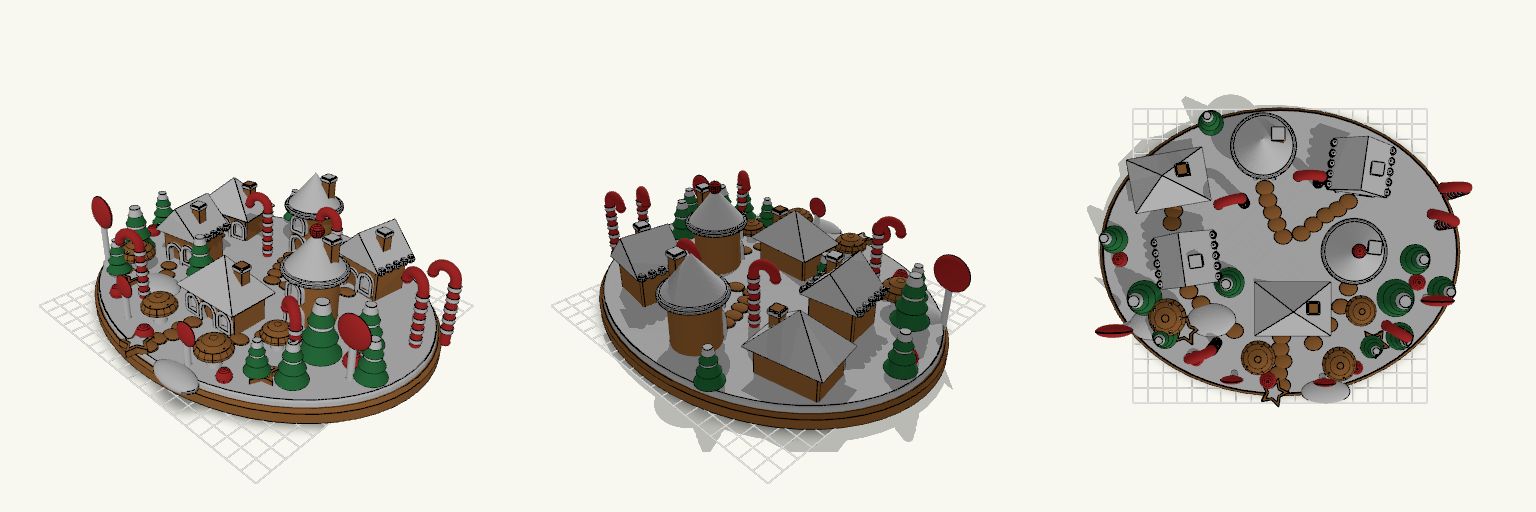
Village de Noël en pain d'épice
À quoi ça sert Un village de Noël miniature en pain d'épice, posé sur un socle ovale enneigé. Six maisons occupent la scène : une maison à pignon, une tour ronde à toit conique et une chaumière pyramidale, chacune répétée deux fois et enfoncée dans la neige. Des chemins en pas de biscuit relient les portes au reste du village. Six sucres d'orge se dressent entre les maisons et sur les côtés, accompagnés de sucettes à disque rouge uni sur bâton blanc, de bonbons ronds, de champignons, de biscuits étoilés et de dix sapins. Tous les éléments sont intégrés à la composition plutôt que posés au hasard. Dimensions Encombrement au sol : environ 240 × 197,5 mm, pour une hauteur d'environ 66 mm. Le village est bas et large : le socle laisse de la neige libre autour des maisons, ce qui rend la scène aérée. Emprise au sol des groupes : pain d'épice environ 240 × 197,5 mm ; glaçage et neige environ 234 × 193,6 mm ; bonbons rouges environ 226 × 137,3 mm ; sapins environ 230,6 × 161,2 mm. Notes d'impression Le modèle est réparti en quatre groupes de couleur — pain d'épice, glaçage et neige, bonbons rouges, sapins — disposés séparément : comptez plusieurs pièces à imprimer puis à réunir. Prévoyez le temps de changement de filament ou une impression par couleur. Les fenêtres et les pointes de sapins sont les détails les plus fins : avec une buse de 0,4 mm, des fenêtres un peu plus grandes faciliteraient le rendu. Les maisons ajoutées à l'arrière et les sucres d'orge supplémentaires rapprochent certains éléments : vérifiez qu'aucune pièce ne se touche avant de lancer l'impression. Aucun test d'impression n'a été réalisé, et la solidité des plus petits reliefs (rebords de glaçage, pointes) n'a pas été vérifiée. Idées de remix Rapprocher les maisons et réduire le socle pour un village plus compact. Ajouter des collines basses en pain d'épice pour donner du relief sans revenir à des montagnes. Varier les six maisons : taille ou forme de toit différente d'un exemplaire à l'autre. Agrandir les fenêtres ou épaissir les bords de glaçage pour une impression plus tolérante. Changer les couleurs des quatre groupes pour varier l'ambiance : pain d'épice plus clair, glaçage coloré, bonbons assortis au sapin.
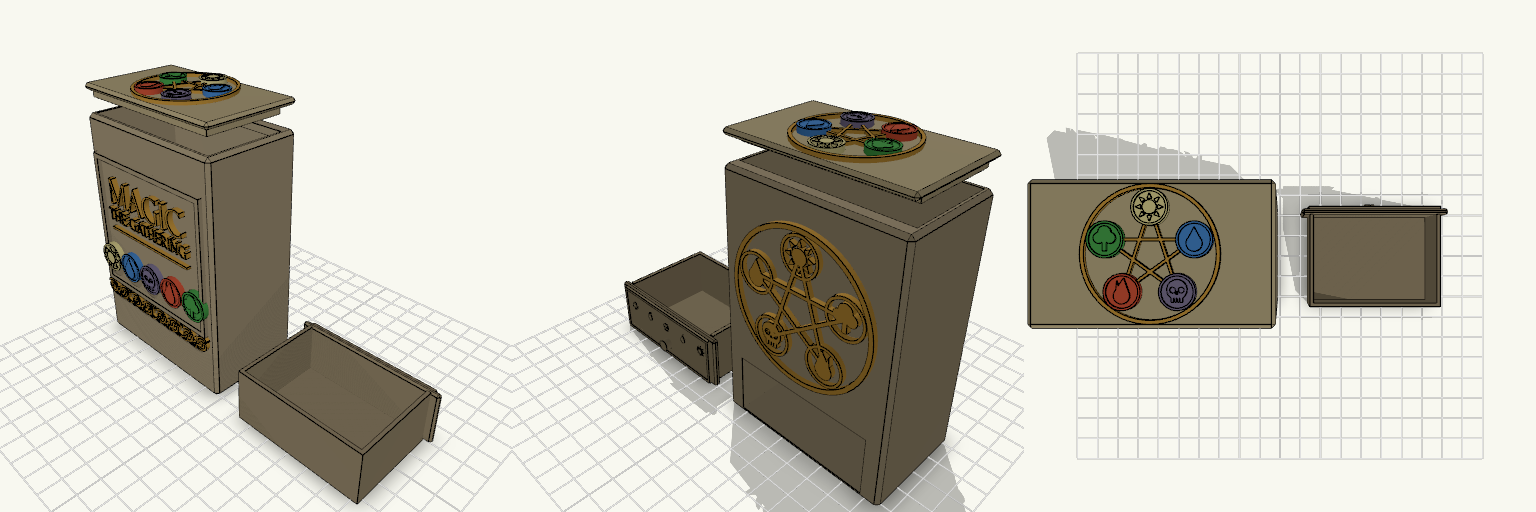
Planeswalker's Five-Color Drawer Deck Box
A deck box dressed like a spellbook cover: raised "MAGIC / THE GATHERING" title, five mana medallions (sun, drop, skull, flame, tree) and a gold swirl band on the front, with the five-colour wheel on the back wall and on the lid. The sliding dice drawer is laid out beside the box, flat on the build plate and ready to print on its own. Open-top deck cavity with a blocker lip across the back Tall drawer with a raised border and mana symbols on its face Separate lid with a plug and a pentagram wheel Front art stands directly off the wall, with no backing plate