120mm Self-Watering Planter
Made by a Guest
Created 1 months ago
Description
A 120mm diameter by 120mm tall self-watering planter designed to keep moisture-sensitive plants like basil alive. The bottom 30mm acts as a dedicated water reservoir, separated from the soil by a perforated platform and a central wicking column. A built-in fill tube routes water directly to the base, while a side window at the 15mm mark provides a visual water level check and acts as a hard overflow drain to prevent drowning the roots.
Starting Points for Remixing
- Scale and Proportions: Overall footprint is 120x120mm. Stretching the Z-axis is straightforward, but requires manually offsetting the 30mm platform and 15mm overflow window to maintain the reservoir geometry.
- Platform Flow: The internal drainage perforations are currently set to 3.5mm. Widen these for coarse chunky soil mixes, or tighten the grid spacing for more aggressive root aeration.
- Wicking Column: The central 40mm wicking cone drops to the base with 10mm side slits. Depending on the soil's capillary action, adjusting the slit height changes how quickly the topsoil hydrates.
- Print Pairings: Prints as one solid piece without supports. Best paired with PETG for long-term water tightness and UV resistance if placed on a windowsill.
Images
More like this
Explore more in Home & Fixtures →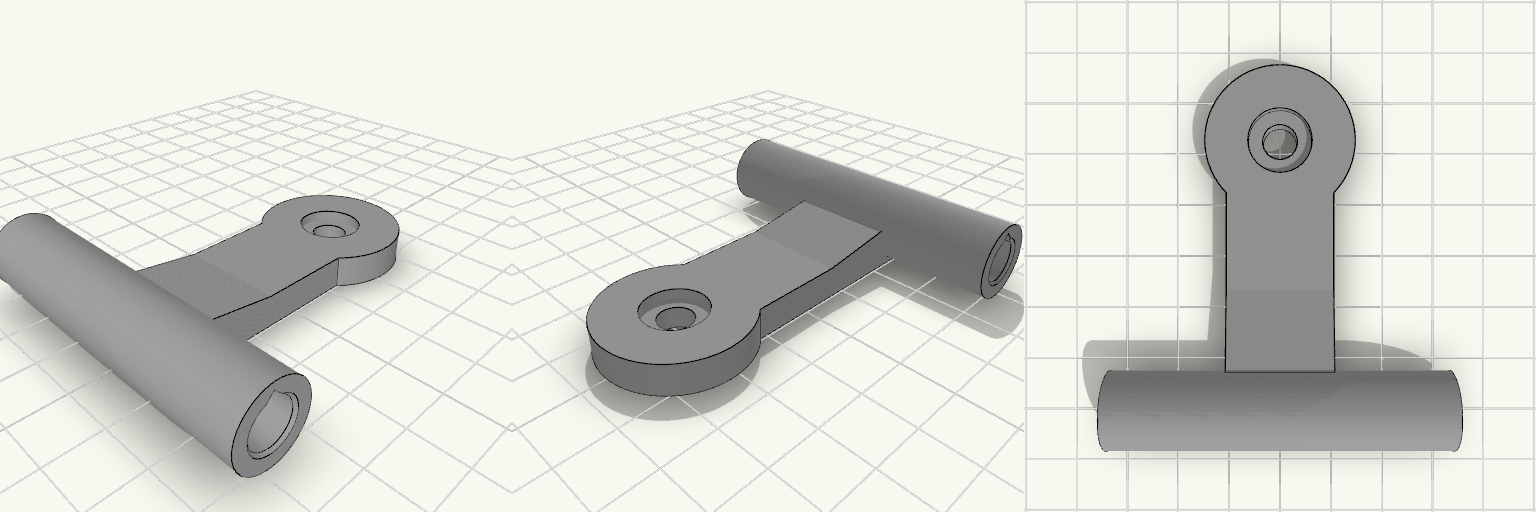
8.35 mm Fiberglass-Rod Joiner with Camera Arm
Replacement two-way joiner for the top-front-center of a fiberglass-rod printer enclosure. It splices two nominal 8.2 mm rods end-to-end and carries a flat-lying arm with a screw boss for a Sercomm RC8110 camera. Print it as one piece with the arm flat on the bed, then rotate the part about the rod axis during installation to aim the camera downward and toward the bed center. Specifications Rod sockets: 8.35 mm ID, 30 mm deep per side, 0.5 mm entry chamfers, separated by a 3 mm solid center stop; 63 mm overall sleeve length. Sleeve: approximately 14.35 mm OD with 3.0 mm wall thickness. Arm: 20 mm wide and 6 mm thick, extending 50 mm from the sleeve, with a root block and gusset blending it into the sleeve. Camera boss: 28 mm diameter and 6 mm thick, with a 6.6 mm through-hole and a 12 mm × 2 mm counterbore for a 1/4"-20 camera screw. Print footprint: 63 × 71.2 × 14.4 mm as oriented on the plate; the teardrop socket bores and flat arm are intended to print without support. Fit: press-fit for measured 8.19–8.20 mm rods; PETG wall thickness is sized to resist splitting and bending from the tensioned enclosure fabric.
Draining Sleeve Foot for a Laundry Hamper Leg
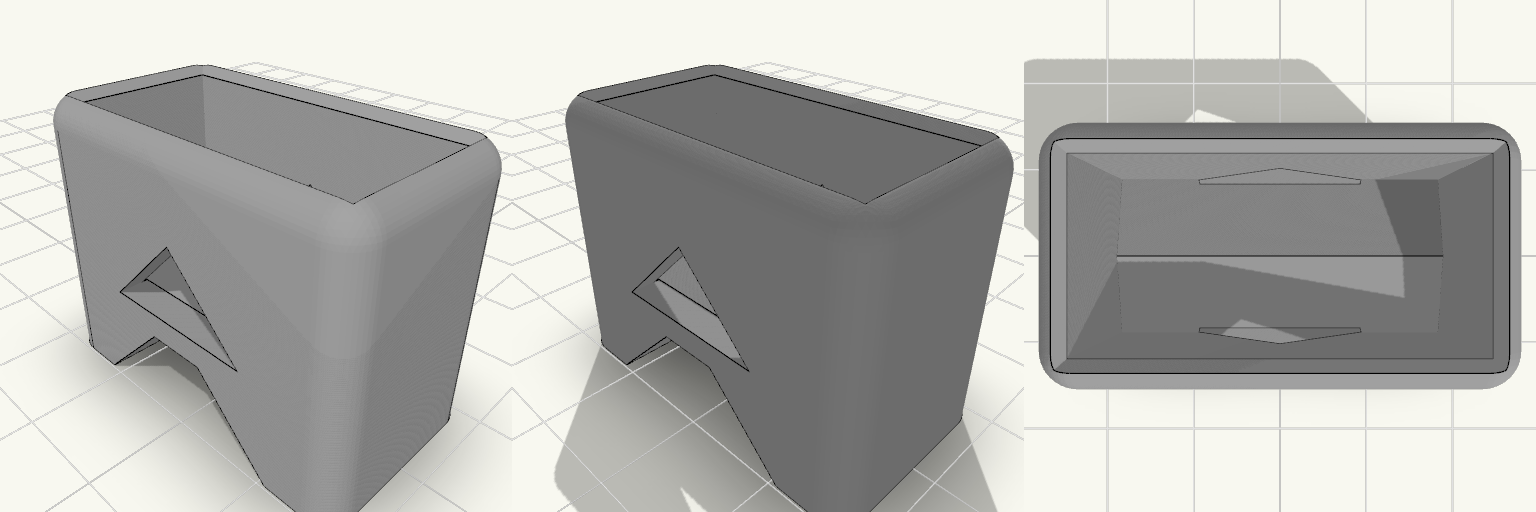
The wood at the bottom of a hamper leg is the first thing to go: it stands in whatever puddle the bathroom floor collects, drinks it up, and goes soft until the basket slumps and rocks. This sleeve slides onto the end of one rectangular wooden leg, holds the wood about 9 mm clear of the floor, and slopes its pocket floor so splash water runs out the sides instead of sitting in there against the wood. What it does Pocket: 31 × 15 mm inside, sized exactly to the leg with no added play — that measurement already accounts for clearance. 15 mm deep at its shallowest point, the centre ridge, and deeper toward the sides where the floor falls away. Stand-off: a single arched cut runs the full depth of the underside, leaving two flat feet that hold the leg about 9 mm off the floor. Overall height is about 27 mm. Drainage: the pocket floor is a shallow ridge sloping down to both long sides, with one 16 mm slot through each long wall at the low edge. Water leaves sideways, and the slot bottoms sit 10.5 mm above the floor, so no opening rests in the wet. Each slot is pointed at the top rather than flat-roofed, which is what lets it print clean. Shape: 1.2 mm chamfer at the opening to get it started over the wood, 3 mm rounding on the vertical and top edges so it doesn't snag a mop or a bare toe. The bottom edges are left sharp so they sit flat on the bed. Printing it Print in PETG with the sleeve opening facing up and the two feet on the bed — no supports anywhere. The arch sides are 45°, so the only bridge is the flat strip about 6 mm across the roof of the arch. The finished part measures roughly 36 × 20 × 27.2 mm, walls 2.5 mm thick. A plain matte finish in white, grey or black sits well in a bathroom. A zero-clearance pocket is tight in PETG. Check the leg with calipers before printing if the wood looks swollen or tapered — if it won't slide on, the pocket wants a few tenths opening up.
U-Turn — Zweiteilige 180°-Schlauchführung
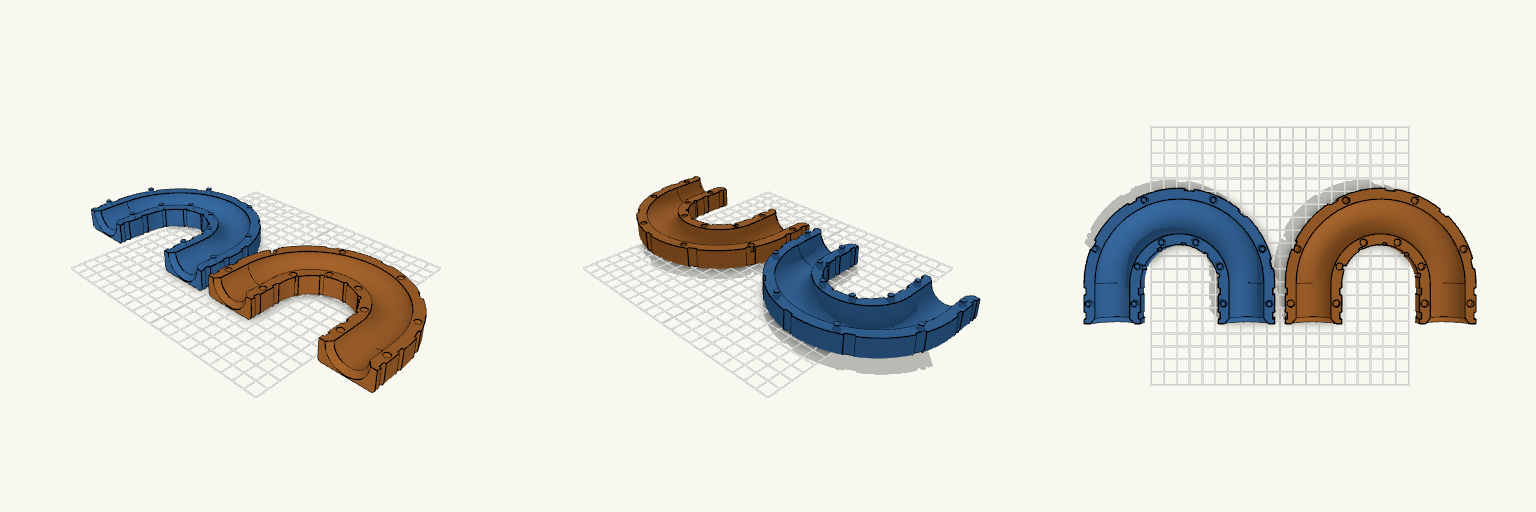
U-Turn ist eine zweiteilige 180°-Schlauchführung, die einen Schlauch mit 25 mm Außendurchmesser in einem gleichmäßigen Bogen umlenkt, sodass Ein- und Auslauf parallel nebeneinander in dieselbe Richtung zeigen. Statt Schrauben oder Muttern halten handelsübliche Kabelbinder die beiden Hälften zusammen: Mehrere außenliegende Nuten laufen um den gesamten Querschnitt, sodass die Binder nicht seitlich abrutschen und nicht in den Schlauchkanal hineinragen. Die flache Außenseite liegt beim Druck unten, die Nut zeigt nach oben — dadurch kommen beide Hälften ohne Stützmaterial aus. Maße Schlauchkanal: 26 mm Innendurchmesser für einen Schlauch mit 25 mm Außendurchmesser Bogen: exakt 180°, Biegeradius 50 mm zur Mittellinie, Mittellinien 100 mm auseinander Gerade Ein- und Auslaufstrecken: je 30 mm, an den Enden auf etwa 33 mm aufgeweitet Wandstärke: 4 mm; Querschnitt 42 mm breit, jede Hälfte 17 mm hoch Kabelbindernuten: 5,2 mm breit und 1,5 mm tief für 4,8 mm breite Binder; Restwand an der dünnsten Stelle 2,5 mm Aufbau Beide Hälften verlaufen über den gesamten 180°-Bogen und tragen je eine halbrunde Nut, die zusammengesetzt einen geschlossenen, kreisförmigen Kanal ergibt. Die Hälfte mit den Zapfen trägt Zapfen von 5 mm Durchmesser und 4 mm Höhe, die Gegenhälfte passende Aussparungen von 5,4 mm Durchmesser — das ergibt ein Montagespiel von 0,2 mm je Seite. Die Zapfen sitzen beidseitig des Kanals, sowohl auf dem Bogen als auch an den geraden Endstücken, und verhindern ein seitliches Verrutschen. Montage Die Hälfte mit den Aussparungen umdrehen, auf die Hälfte mit den Zapfen setzen und andrücken. Anschließend Kabelbinder durch die Nuten führen und festziehen: fünf Nuten verteilen sich gleichmäßig entlang des U-Bogens, je zwei sitzen an den geraden Endstücken. Druckhinweise Beide Hälften werden getrennt gedruckt und anschließend zusammengesteckt; die Kabelbinder übernehmen die Fixierung. Der Kanal ist an beiden Enden großzügig abgerundet, damit der Schlauch ohne Knickstellen ein- und ausläuft.
Flacher S-Haken mit Stift, 14,2 mm
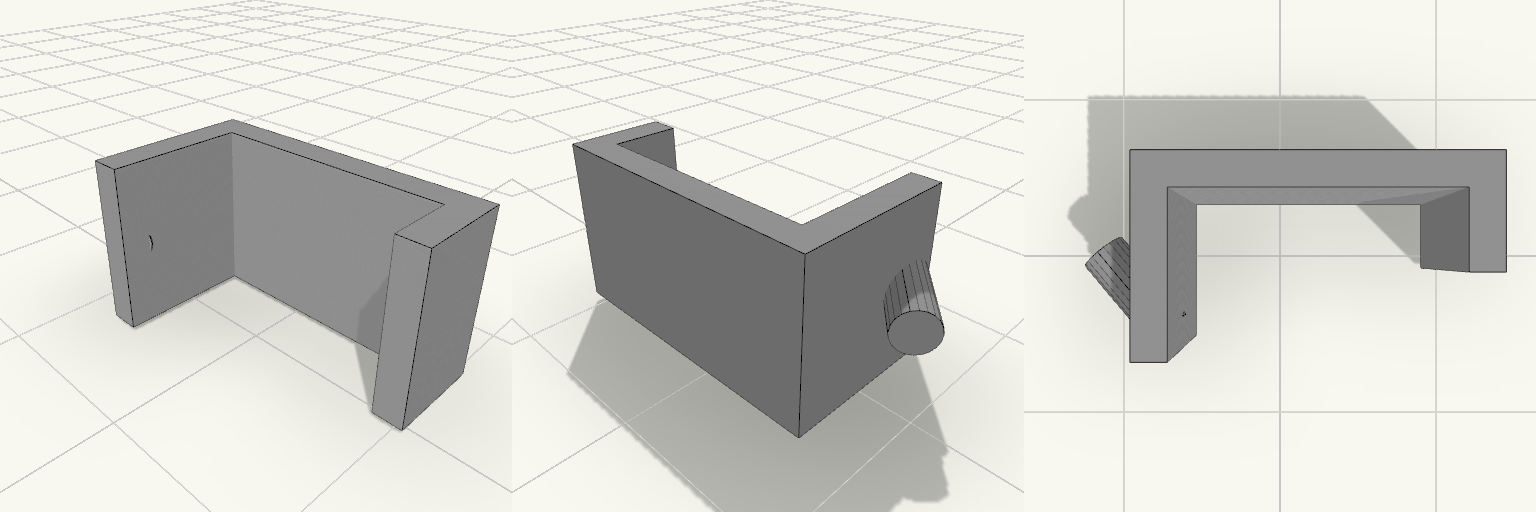
What it's for Flacher Türhaken, der über eine Tür greift. Ein geneigter Stift ersetzt die vordere Wand am unteren Haken. Dimensions Höhe (Z): 10 mm Wandstärke: 1,75 mm Obere Öffnung: 14,2 mm Obere Lippe: 4 mm tief Stift: Ø 2,5 mm, 5,5 mm lang, 40° zur senkrechten Wand geneigt Remix ideas Stift länger oder kürzer für andere Lasten Öffnung an andere Türstärken anpassen Dickere Wand für mehr Tragkraft
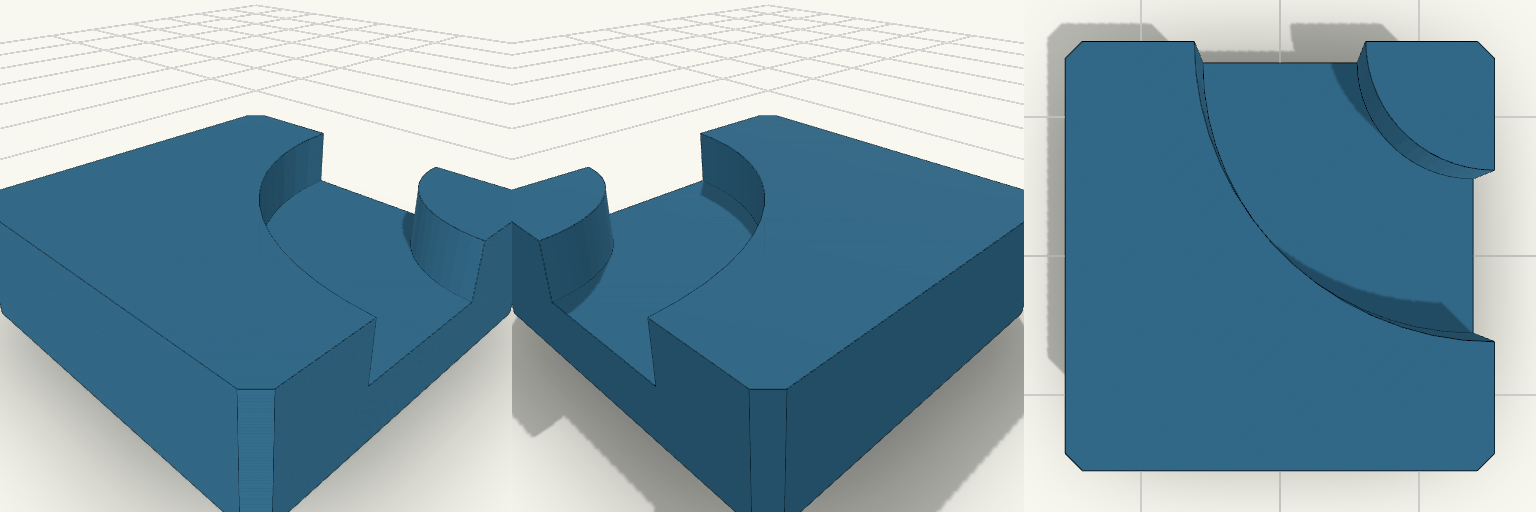
LED Strip Corner Routing Bracket
A 25 mm square corner block, 8 mm tall, with a quarter-circle channel on top that seats a 10 mm LED strip and turns it 90 degrees. Made for under-shelf lighting where the strip needs to follow an inside corner without kinking. The underside is flat, so it takes adhesive tape or double-sided foam. The channel is 10 mm wide and 4 mm deep, with a 12.5 mm centerline radius. It enters and exits through the two sides that meet at the far corner. Vertical corners carry a 1 mm chamfer. Remix hooks Block size (25 mm): the main lever. A 35 mm block with a 17.5 mm centerline radius gives a gentler bend for stiffer strips. Centerline radius (12.5 mm): keep it at half the block size so the channel meets the edges, or shrink it for a tighter turn. Channel width (10 mm): add 0.3 to 0.5 mm of clearance for strips with thick silicone sleeves, or narrow it for bare strips. Channel depth (4 mm): deepen it to sink the strip below the surface, or make it shallower and add a diffuser lip. Height (8 mm): can be lowered to about 6 mm and still keep the 4 mm channel with a solid floor. Pairs with Straight strip sections between corners, with one bracket per inside corner. A snap-in diffuser cover cut to the same 10 mm channel width. A mirrored variant for the opposite corner direction. Print notes Print flat on the back, with no supports needed. Use PETG or ABS if the bracket sits near warm drivers.
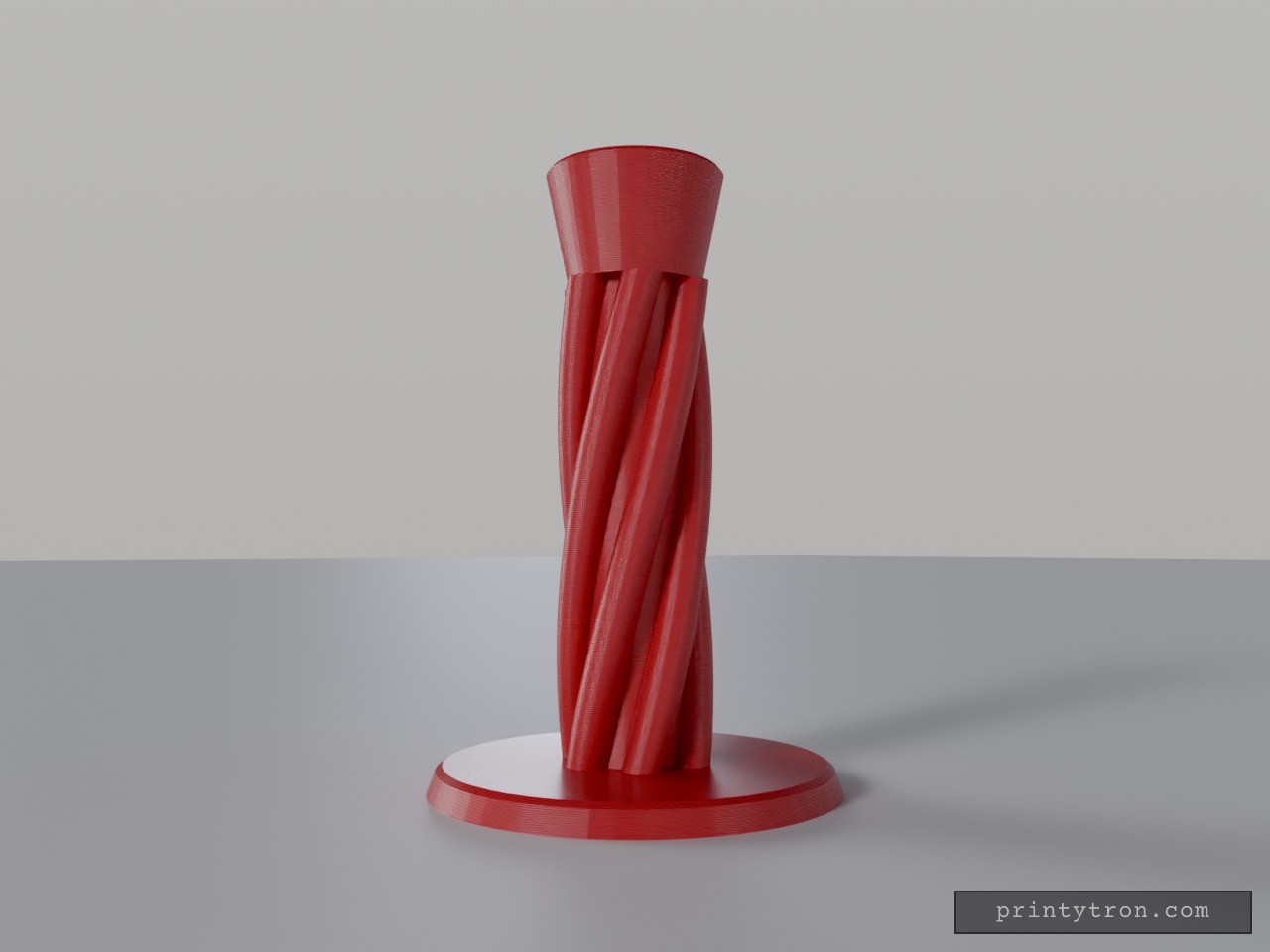
Twisted Column E27 Lamp Stand
A table lamp stand with a twisted six-lobe column rising from a round base to a cup that holds a standard E27 lamp socket. A 12 mm bore runs down the centre and a 7 mm channel carries the cable out the back of the base, so the wiring stays hidden. Remix hooks Socket pocket: 40.6 mm diameter, 26 mm deep. Measure your socket body and adjust socket_d before printing; many holders vary by a millimetre or two. Twist and lobes: 120° twist, 6 lobes. Change the twist angle for a gentler or more dramatic spiral, or the lobe count for a different silhouette. Height: the column is 140 mm; total height is about 182 mm. Taller columns suit larger shades. Base: 120 mm diameter, 8 mm thick. Widen it or add weight (coins, steel washers) for large shades. Set-screw hole: a 3.2 mm cross hole near the cup top is there for an M3 grub screw to lock the socket. Pairs with: an E27 socket with threaded nipple or clip-in body, a fabric cord with inline switch, and any E27 drum or cone shade. Print upright without supports. Use mains-rated, certified electrical parts, and a low-heat LED bulb rather than incandescent.