140mm Striped Cookie Stencil
Made by a Guest
Created 1 months ago
Description
A flat, 1mm-thick stencil designed for decorating cookies and baked goods with horizontal stripes. The pattern features alternating 5mm cutouts and solid bands, enclosed by a rigid 10mm perimeter. A tab extends from the top edge for handling and includes a 6mm hole for hanging storage.
Specifications
- Overall Dimensions: 140 × 140 mm (5.5 × 5.5 in) frame.
- Pattern Area: 120 × 115 mm.
- Stripe Width: 5 mm gaps spaced by 5 mm solid dividers.
- Thickness: 1.0 mm (ideal for 5 layers at 0.2 mm layer height).
- Storage: 40 mm wide top tab with a 6 mm hanging hole.
Images
More like this
Explore more in Kitchen & Bathroom →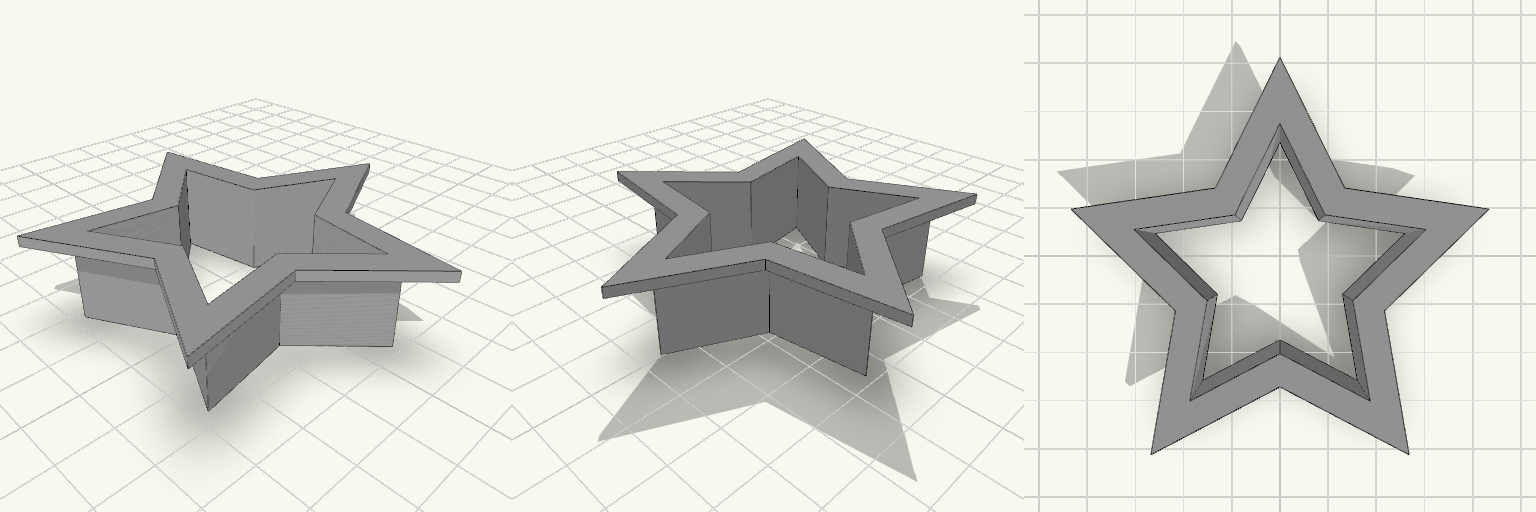
5-Point Star Cookie Cutter
A five-point star cookie cutter, 60 mm tip to tip, with 18 mm tall walls and a wide flat flange around the top edge. The flange gives a thumb a broad surface to press on, so pushing the cutter through dough doesn't put a thin edge against your skin. Remix hooks The values below are the ones worth changing. Everything else follows from them. Star size (R, 30 mm): This is the tip radius, so 60 mm across. Change it to scale the star. At about 40 mm across or less, check that the flange doesn't crowd the inner corners. Point sharpness (ratio, 0.5): This is the inner radius divided by the outer radius. Lower values like 0.4 give spikier points. Higher values like 0.6 give a chubbier, more rounded star. Very spiky points are harder to press out of dough. Flange (flangew 4 mm, flanget 2 mm): Widen it for a more comfortable press, or thicken it for more stiffness. Rounding the flange's outer corners is an easy variant if you want it softer on the thumb. Wall (wall, 1.2 mm): This is about three nozzle widths on a 0.4 mm nozzle. Thinner cuts more cleanly but is more fragile. Thicker is sturdier but pushes dough aside more. Height (H, 18 mm): Lower it for thin cookies, or raise it for thick dough or a deeper grip. Pairs well with A set of different sizes, made by changing R and nothing else. Other shapes that reuse the same wall and flange values, such as a heart or circle, so the whole set feels the same in the hand. A matching stamp or embossing plate that fits inside the cutter opening. Printing Print it flange-up or flange-down on the bed. Flange-down needs no supports, and the thin walls grow straight up from the flange. Use food-safe filament if you want to use it on dough.
Tiered 12-Jar Spice Rack
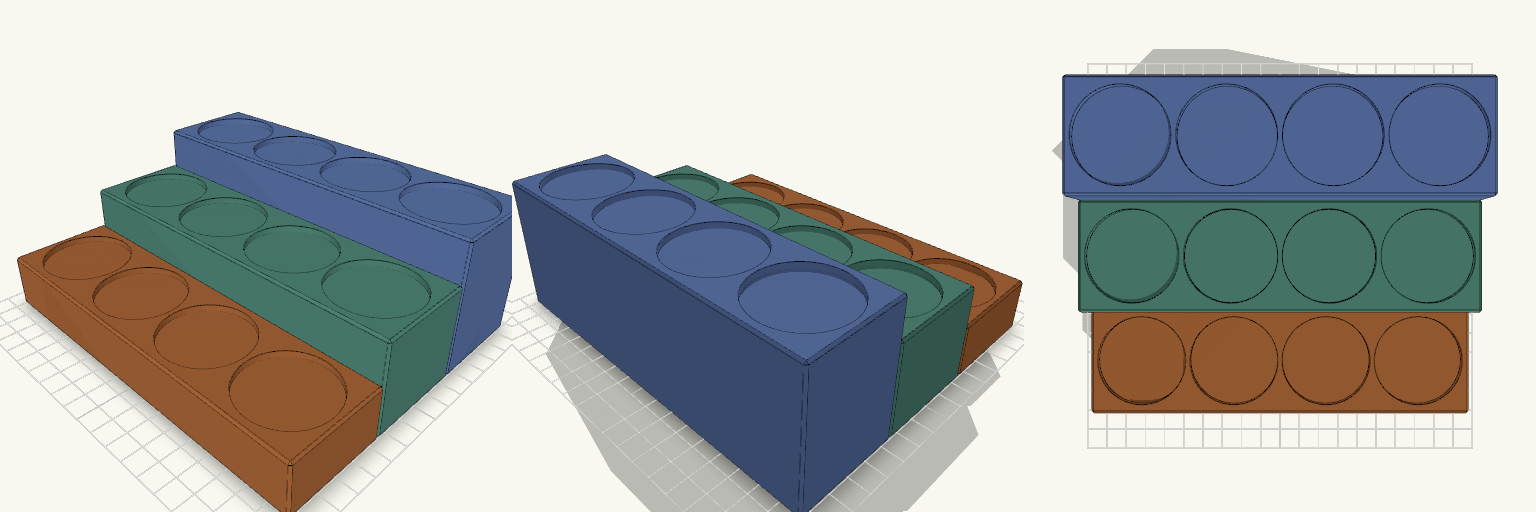
A three-tier spice rack that holds 12 jars, four per tier, with each tier stepping up so every label stays in view without lifting a jar out. Each pocket is sized for jars about 40 mm across, so the rack is easy to scan for cumin or anything else. The rack measures 180 mm wide, 150 mm deep and 66 mm tall at the back. Tier heights are 26 mm (front), 46 mm (middle) and 66 mm (back). Each tier is 50 mm deep and 20 mm taller than the one in front. Each jar sits in a 42 mm round pocket, 3 mm deep, which stops it sliding forward. The edges carry a 1 mm chamfer. It prints as one piece, and the three tiers are shown in separate colours so they are easy to tell apart. Remix hooks Step height (20 mm): raise it for taller jars behind, or lower it for a shorter rack. Labels stay readable as long as the step is at least as tall as the label band on the jar in front. Tier depth (50 mm): this is set equal to the back-step. Widening both leaves room for larger jars, and a wider step also gives a clearer view of the row behind. Pocket diameter (42 mm) and depth (3 mm): 2 mm of clearance suits 40 mm jars. Increase the diameter for jars that run a little wide. Deepen the pocket for a firmer hold, or set the depth to 0 for a flat shelf. Jars per tier (4, 44 mm pitch): change the count to alter the rack width. Drop to 3 per tier for a narrower footprint, or add a fourth tier for 16 jars. Pairs well with: a non-slip mat underneath, or a rear lip or wall panel to mount it in a cupboard.
Herb Stripper Paddle for Kale and Rosemary
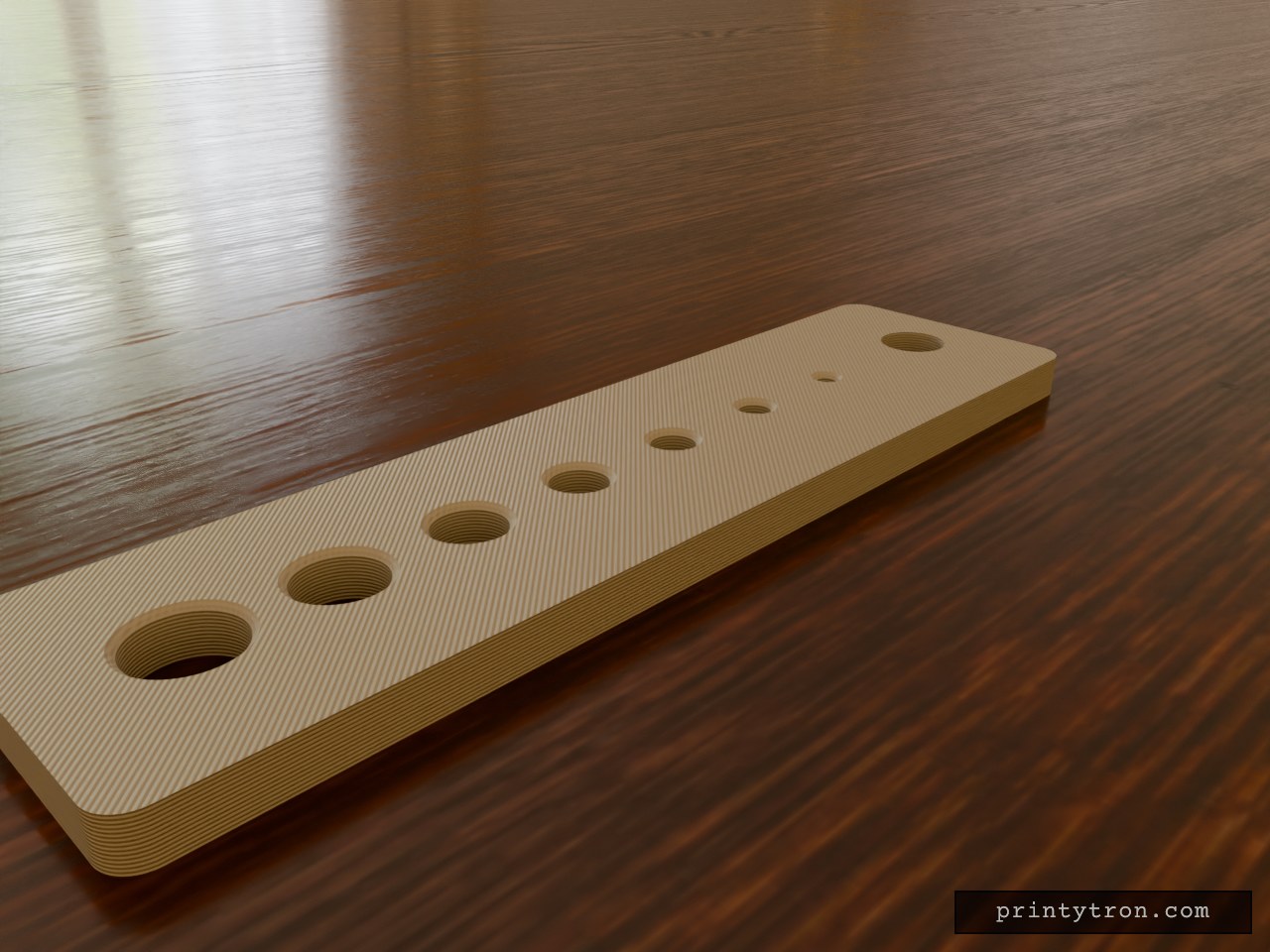
Picking kale, chard or rosemary leaves off the stem by hand is slow, and one hole size never fits both a fat kale rib and a thin rosemary sprig. This herb stripper paddle has seven holes graduated from 12 mm down to 3 mm, so you pick the hole that grips the stem and pull the stem through. The leaves catch on the edge and come off. Each hole has a small flare on the top face so the stem starts in without catching. A hang hole at the end lets the paddle sit on a hook next to the board. Key numbers Paddle: 150 mm long, 40 mm wide, 6 mm thick Stripping holes: 12, 10.5, 9, 7.5, 6, 4.5 and 3 mm, spaced 16.5 mm apart, big to small Hang hole: 10 mm, 12 mm in from the end Corners: 4 mm radius on the flat outline Printing Print flat, with the flared side facing up No supports needed Food-safe filament such as PETG is the usual pick, and a wash by hand is best Use 3 or more perimeters so the thin edges around the holes stay stiff
Funnel 6 to 2.5 Inch
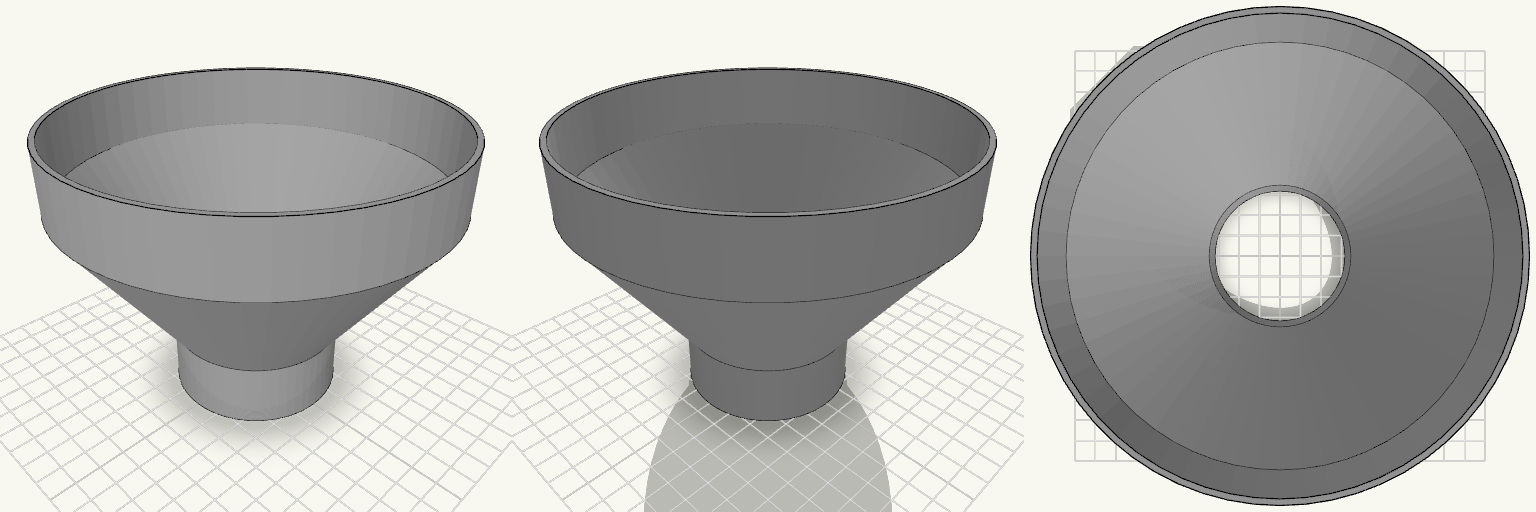
A one-piece funnel with a 6 in (152.4 mm) inner diameter at the wide end, tapering to a 2.5 in (63.5 mm) inner diameter spout. Each end has a 1 in (25.4 mm) straight wall. Remix hooks Taper length: 60 mm cone section. Lengthen for a gentler slope, shorten for a squat funnel. Wall thickness: 2 mm. Raise to 3 mm for rigidity with heavy contents. Spout diameter: 63.5 mm inner. Change it to match a specific container neck. Pairs with: a mesh strainer disc sitting in the 1 in top collar, or a rubber gasket on the spout. Variants: add a rim lip or hanging tab.
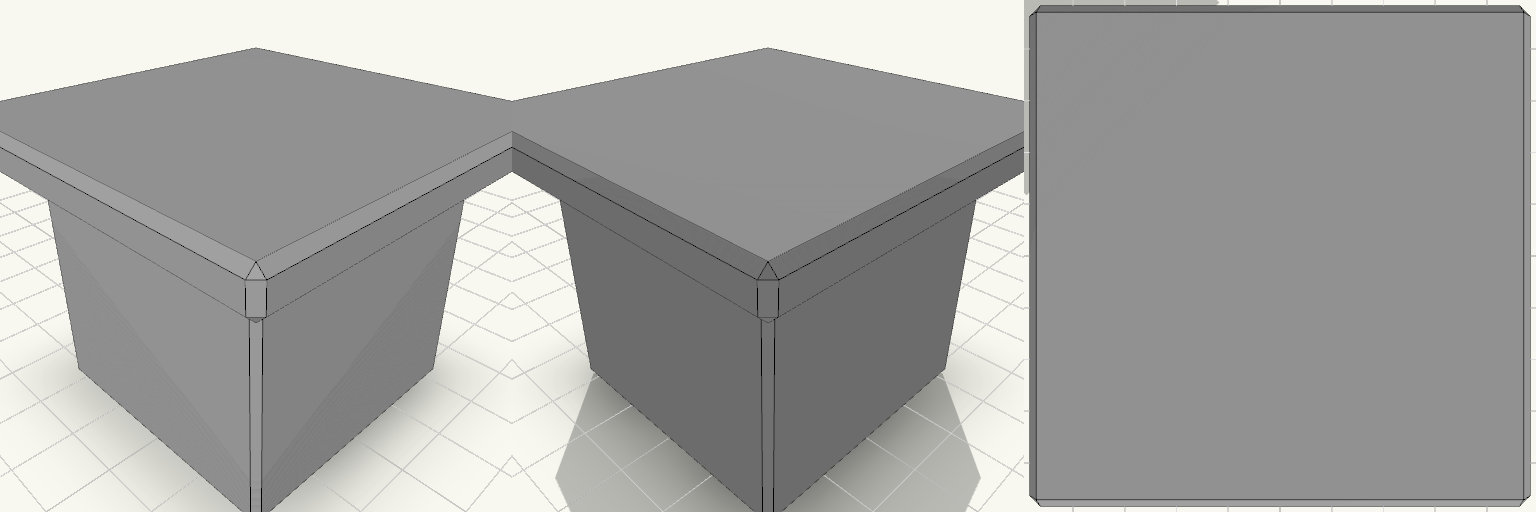
Brutalist T-Post Cap with Square Platform
A blocky sleeve that drops over a T-post and carries a flat square platform on top — a brutalist plinth silhouette in cap form, all hard edges and stacked planes. The pocket inside is T-shaped, cut generously around a typical steel fence T-post: a 38 × 7 mm flange opening and a 7 × 38 mm stem slot, leaving roughly a millimetre of play per side so it drops on without a fight. The sleeve is 40 mm deep with 3 mm walls and a 4 mm roof, and the whole cap stands 46 mm tall over a 60 × 60 × 6 mm platform. Design notes T-shaped pocket for a T-post — flange opening 38 × 7 mm, stem slot 7 × 38 mm. Pocket sized with a little slack per side; the 7 mm slot width is the fit-critical dimension on real posts. 40 mm deep sleeve, 3 mm walls, 4 mm roof. 60 × 60 × 6 mm square platform sits on top as one solid piece with the sleeve. Overall footprint on the print plate: 60 × 60 mm, 46 mm tall. Prints as a single part; no assembly and no fasteners. Good to know The pocket is shaped from a typical steel fence T-post rather than a measured one — check your post's flange width, stem length and metal thickness before committing to a long print. Platform size is independent of the pocket, so it can grow or thicken without touching the post fit. Tightening or loosening the pocket is a small change if the cap ends up sloppy or stubborn on the post. The sleeve's outside was widened to 44 mm to keep the walls at a full 3 mm around the bigger pocket, so the cap stays chunky rather than thin-shouldered.
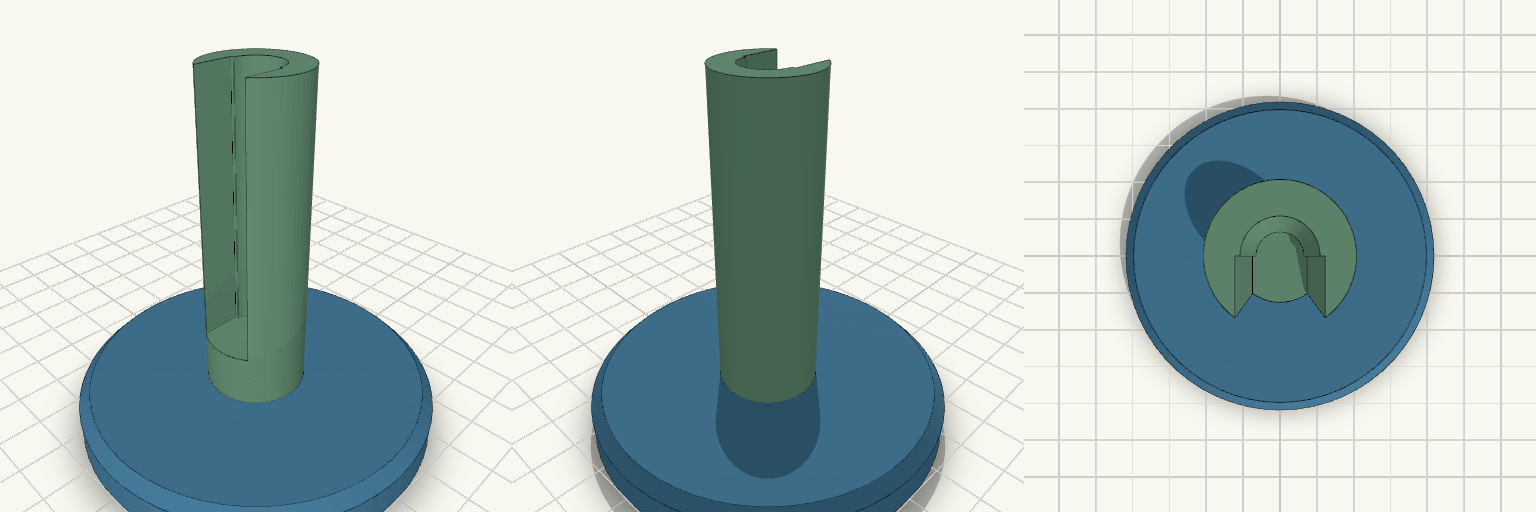
10mm Safety Razor Handle Drying Stand
A drying stand for a safety razor with a 10 mm diameter handle. The razor sits head-down so water drains off the head instead of pooling. The stand is an 80 mm round base with a 22 mm post, and it stands about 78 mm tall overall. What it fits Safety razor handles of 10 mm diameter. The bore is 11.5 mm, which leaves 0.75 mm of clearance per side. The slot is 13 mm wide and opens toward the front (-Y). The handle slips in sideways. No ring needs to be threaded over it. Measure before printing Measure the widest point of your handle, including any knurling or grip rings. The design assumes a 10 mm shaft. If the handle is thicker than 11 mm, the bore will bind. The 13 mm slot would also let a handle up to about 12 mm pass through, but it would not seat properly. What it does not fit Handles over about 11 mm in diameter. Cartridge or disposable razors with wide, flat handles. Two razors. There is one post and one slot. Print notes The base is 9 mm thick with a chamfered top edge. It gets its weight from mass, so print it with high infill (50% or more). The base and post are one welded piece.