Funnel 6 to 2.5 Inch
Created 2 days ago
Description
A one-piece funnel with a 6 in (152.4 mm) inner diameter at the wide end, tapering to a 2.5 in (63.5 mm) inner diameter spout. Each end has a 1 in (25.4 mm) straight wall.
Remix hooks
- Taper length: 60 mm cone section. Lengthen for a gentler slope, shorten for a squat funnel.
- Wall thickness: 2 mm. Raise to 3 mm for rigidity with heavy contents.
- Spout diameter: 63.5 mm inner. Change it to match a specific container neck.
- Pairs with: a mesh strainer disc sitting in the 1 in top collar, or a rubber gasket on the spout.
- Variants: add a rim lip or hanging tab.
Images
More like this
Explore more in Kitchen & Bathroom →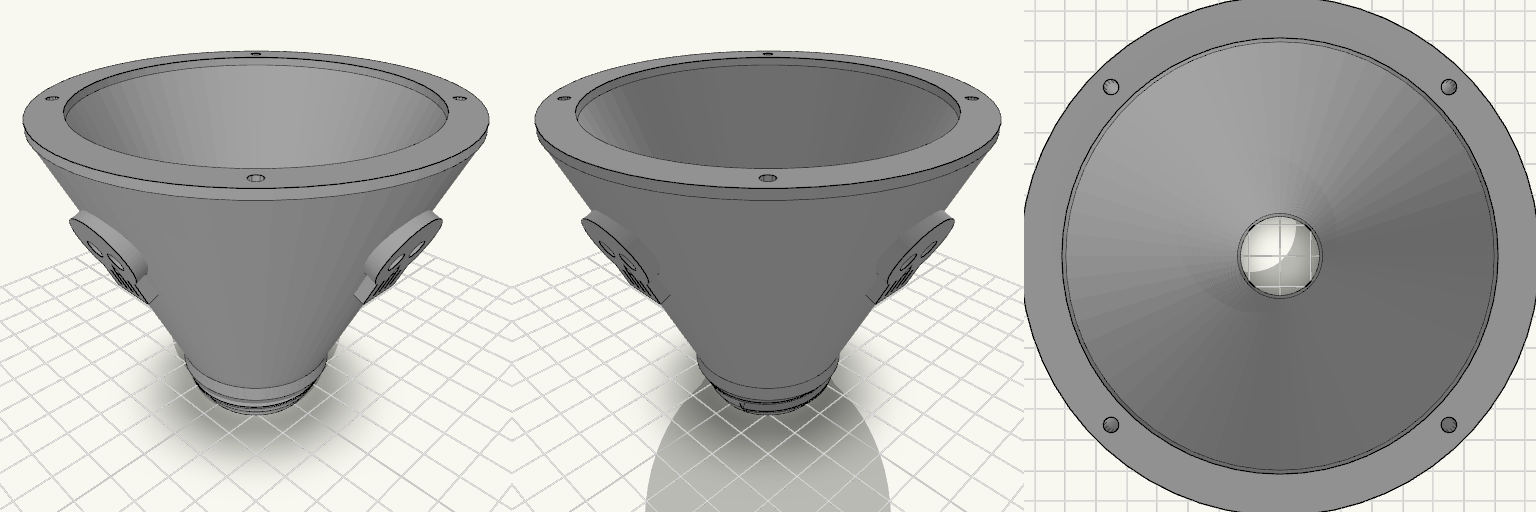
Steep-Shouldered Funnel for Clean, Targeted Pouring
A broad-shouldered funnel with a gothic streak: a 100 mm outside rim (84 mm inside) gathers a jug or bottle mouth, the cone narrows into a 26 mm bore, and the stream drops toward the filler. At 82 mm tall it stays compact enough for a tight engine bay, and the inner cone has no side holes, so the pour runs down the middle. The spout is built around a 36.5 mm major-diameter, 3 mm pitch right-hand screw thread that runs the full 10 mm from the tip up to a 40 mm sealing shoulder. The 26 mm bore keeps the pour path open; the thread is the fit feature, so check the filler neck and gasket stack before printing, since the thread has to match the mating part. Four sealed air tunnels, 3 mm across and spaced 90° apart, run inside the wall from the top rim down through the cone. At the lower end each turns inward and opens through the bore wall about 3 mm above the spout tip, so the bottom face stays solid and air can climb while oil runs down the middle. No holes pierce the side of the cone, so it vents without weeping out. The threaded spout wall carries these passages; at the bore openings the material is thin, so inspect the slicer preview before printing. Four raised skulls ring the cone between the tunnels, one every 90°, angled to follow the slope. Each is about 19 mm wide and stands roughly 2.5 mm proud of the surface, with eye sockets, nose and teeth lines cut into the face; the fine teeth lines may print faintly on a 0.4 mm nozzle. They give the funnel a gothic edge without interrupting the flow path. Fit notes 36.5 mm major-diameter, 3 mm pitch right-hand screw thread on the spout Threaded section runs the full 10 mm from the spout tip to the sealing shoulder 40 mm sealing shoulder for a gasket 26 mm bore through the spout Verify thread fit and gasket compression on the filler neck before printing Check the thin tunnel openings near the bore in the slicer preview Design notes 100 mm outside opening, 84 mm inside — a wide catch area 82 mm overall height Four internal 3 mm air tunnels, evenly spaced, opening into the bore about 3 mm above the tip and exiting at the rim Four raised skulls about 19 mm wide and 2.5 mm proud, set between the tunnels Prints as one piece
Brutalist T-Post Cap with Square Platform
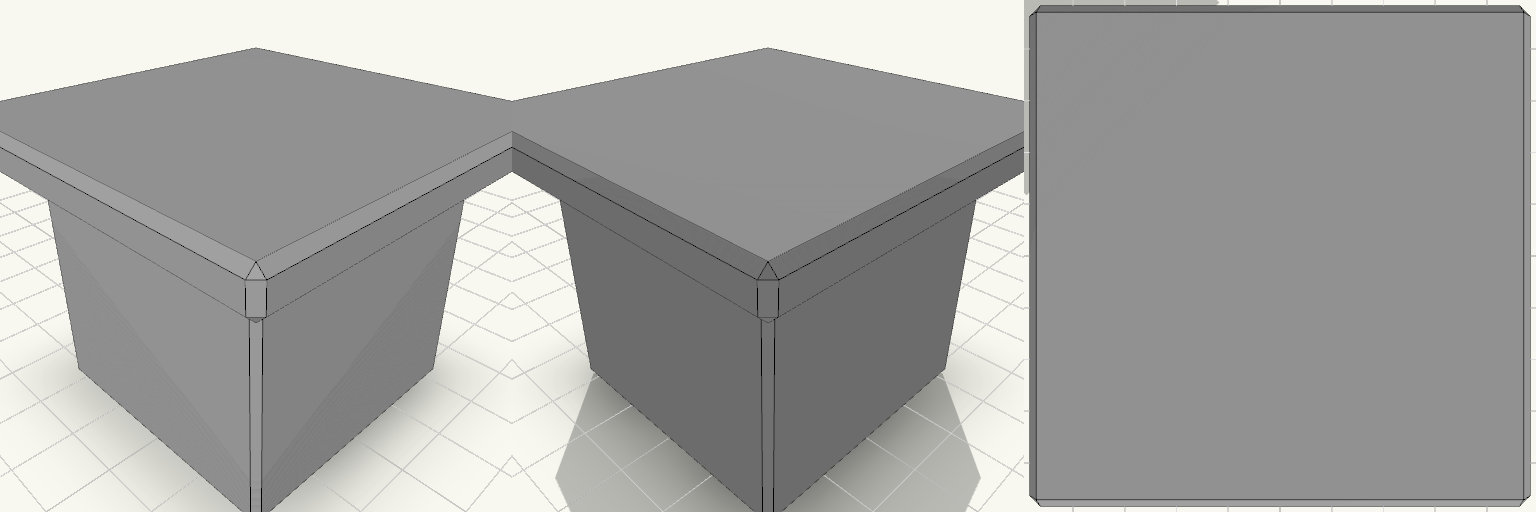
A blocky sleeve that drops over a T-post and carries a flat square platform on top — a brutalist plinth silhouette in cap form, all hard edges and stacked planes. The pocket inside is T-shaped, cut generously around a typical steel fence T-post: a 38 × 7 mm flange opening and a 7 × 38 mm stem slot, leaving roughly a millimetre of play per side so it drops on without a fight. The sleeve is 40 mm deep with 3 mm walls and a 4 mm roof, and the whole cap stands 46 mm tall over a 60 × 60 × 6 mm platform. Design notes T-shaped pocket for a T-post — flange opening 38 × 7 mm, stem slot 7 × 38 mm. Pocket sized with a little slack per side; the 7 mm slot width is the fit-critical dimension on real posts. 40 mm deep sleeve, 3 mm walls, 4 mm roof. 60 × 60 × 6 mm square platform sits on top as one solid piece with the sleeve. Overall footprint on the print plate: 60 × 60 mm, 46 mm tall. Prints as a single part; no assembly and no fasteners. Good to know The pocket is shaped from a typical steel fence T-post rather than a measured one — check your post's flange width, stem length and metal thickness before committing to a long print. Platform size is independent of the pocket, so it can grow or thicken without touching the post fit. Tightening or loosening the pocket is a small change if the cap ends up sloppy or stubborn on the post. The sleeve's outside was widened to 44 mm to keep the walls at a full 3 mm around the bigger pocket, so the cap stays chunky rather than thin-shouldered.
5 Gallon Bucket Urine diverter Funnel With Glue-On Clip
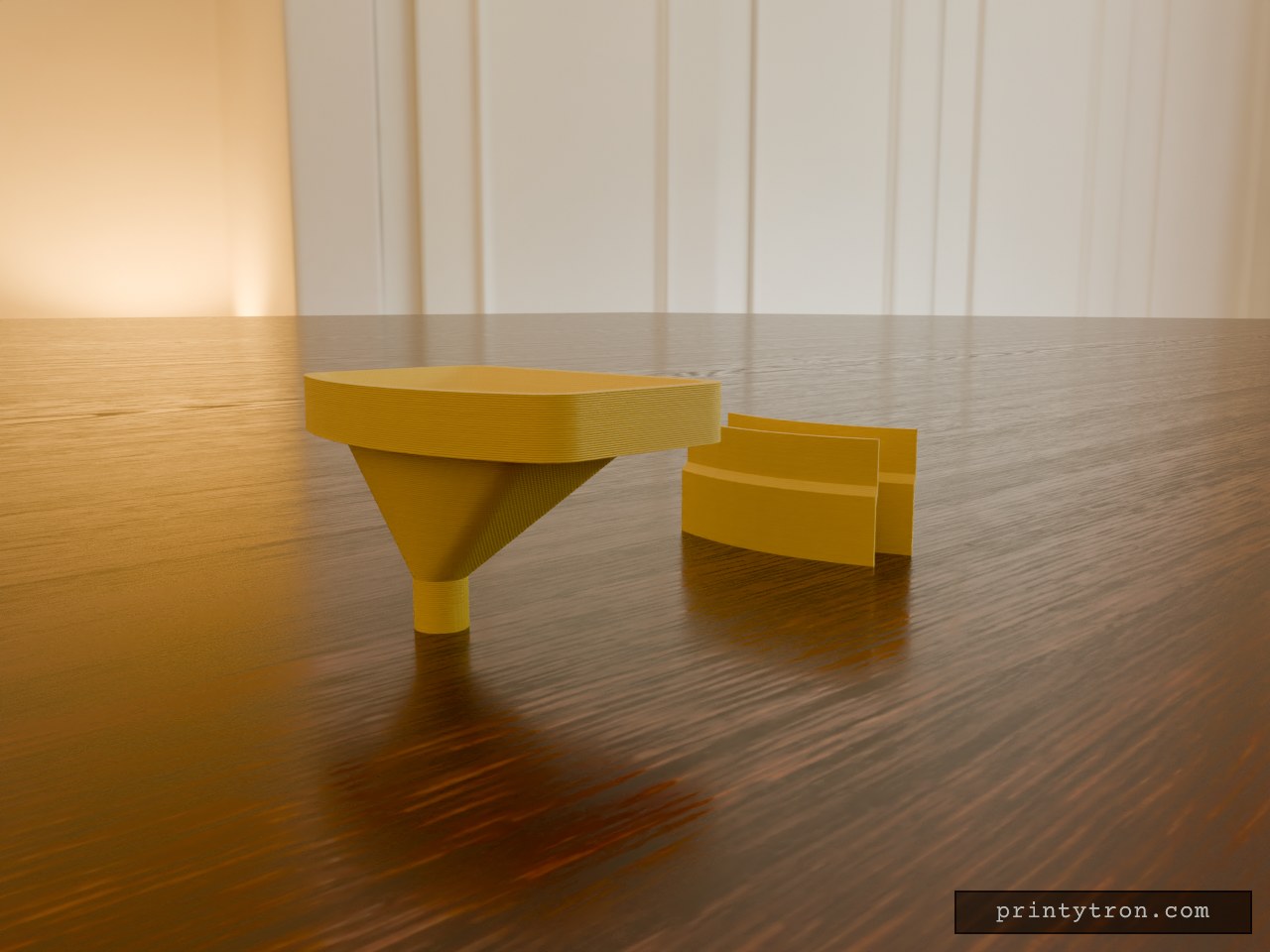
A urine diverter for a 5-gallon bucket. This funnel has a curved outer edge and a skirt, and it comes with a separate curved clip strip that glues to the bucket wall so the skirt hooks over it. I the clip is too near the edge because of taper at the bucket top, just print 2 and glue together (I only printed bottom half of second) Key numbers Bucket inside diameter: 296 mm (clip and funnel curve at 148 mm radius) Clip: about 44° of arc, around 114 mm long, 54 mm tall, 2.5 mm thick Profile: lower section glues flat to the bucket wall, then steps in 2.5 mm so the top stands off the wall by the skirt thickness Skirt: 20 mm tall, 2.5 mm thick, drops into the gap behind the clip's upper lip Spout: 19 mm outside, 15 mm bore Print: clip standing upright, brim needed for support; glue the lower face to the bucket wall
5-Point Star Cookie Cutter
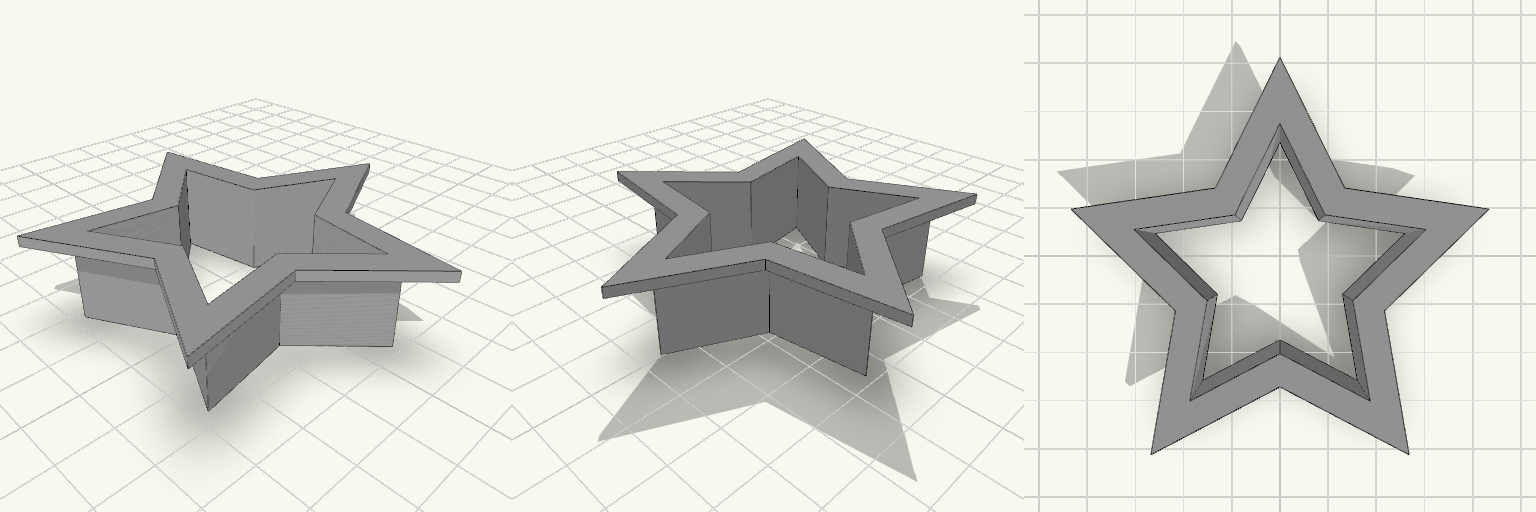
A five-point star cookie cutter, 60 mm tip to tip, with 18 mm tall walls and a wide flat flange around the top edge. The flange gives a thumb a broad surface to press on, so pushing the cutter through dough doesn't put a thin edge against your skin. Remix hooks The values below are the ones worth changing. Everything else follows from them. Star size (R, 30 mm): This is the tip radius, so 60 mm across. Change it to scale the star. At about 40 mm across or less, check that the flange doesn't crowd the inner corners. Point sharpness (ratio, 0.5): This is the inner radius divided by the outer radius. Lower values like 0.4 give spikier points. Higher values like 0.6 give a chubbier, more rounded star. Very spiky points are harder to press out of dough. Flange (flangew 4 mm, flanget 2 mm): Widen it for a more comfortable press, or thicken it for more stiffness. Rounding the flange's outer corners is an easy variant if you want it softer on the thumb. Wall (wall, 1.2 mm): This is about three nozzle widths on a 0.4 mm nozzle. Thinner cuts more cleanly but is more fragile. Thicker is sturdier but pushes dough aside more. Height (H, 18 mm): Lower it for thin cookies, or raise it for thick dough or a deeper grip. Pairs well with A set of different sizes, made by changing R and nothing else. Other shapes that reuse the same wall and flange values, such as a heart or circle, so the whole set feels the same in the hand. A matching stamp or embossing plate that fits inside the cutter opening. Printing Print it flange-up or flange-down on the bed. Flange-down needs no supports, and the thin walls grow straight up from the flange. Use food-safe filament if you want to use it on dough.
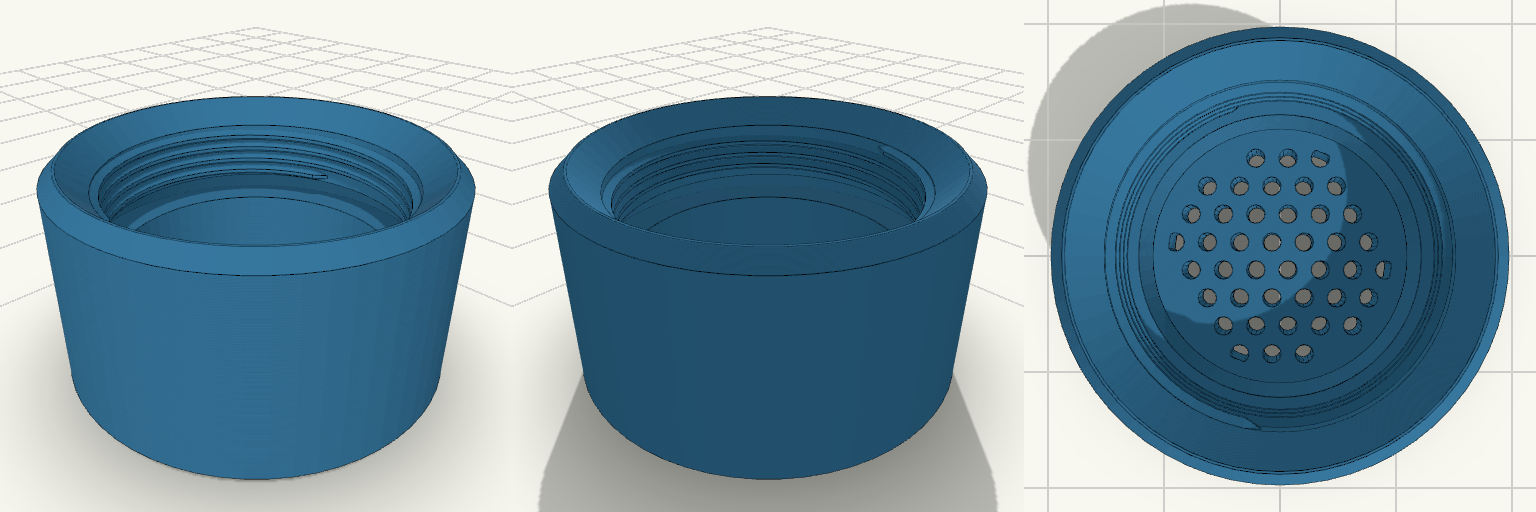
Softflow — M22 Faucet Splash Diffuser
Softflow is a screw-on splash diffuser for faucets with an M22x1 male outlet thread. The base is perforated with a staggered hex grid of small holes, breaking the flow into many fine streams for a softer, wider spray. A short open chamber between the thread and the perforated floor lets water spread across the whole hole pattern before it exits. Features M22x1 female thread, 8 mm deep, with a beveled lead-in at the opening Staggered hex grid of 1.5 mm holes at 2.6 mm spacing, inside an 18 mm circle 3 mm perforated floor with a relief chamber above it Chamfered top and bottom edges on a round body Dimensions Outer diameter: 28 mm Overall height: 16 mm Thread: M22 x 1 mm pitch, 8 mm engagement depth Floor thickness: 3 mm Print notes Print with the perforated face down on the bed, opening facing up; no supports are needed. Thread fit has not been tested against a real faucet. If it binds, increase the thread clearance slightly. A fine layer height (0.12–0.16 mm) keeps the small holes and thread crisp. PETG or ASA suits wet, warm-water use better than PLA.
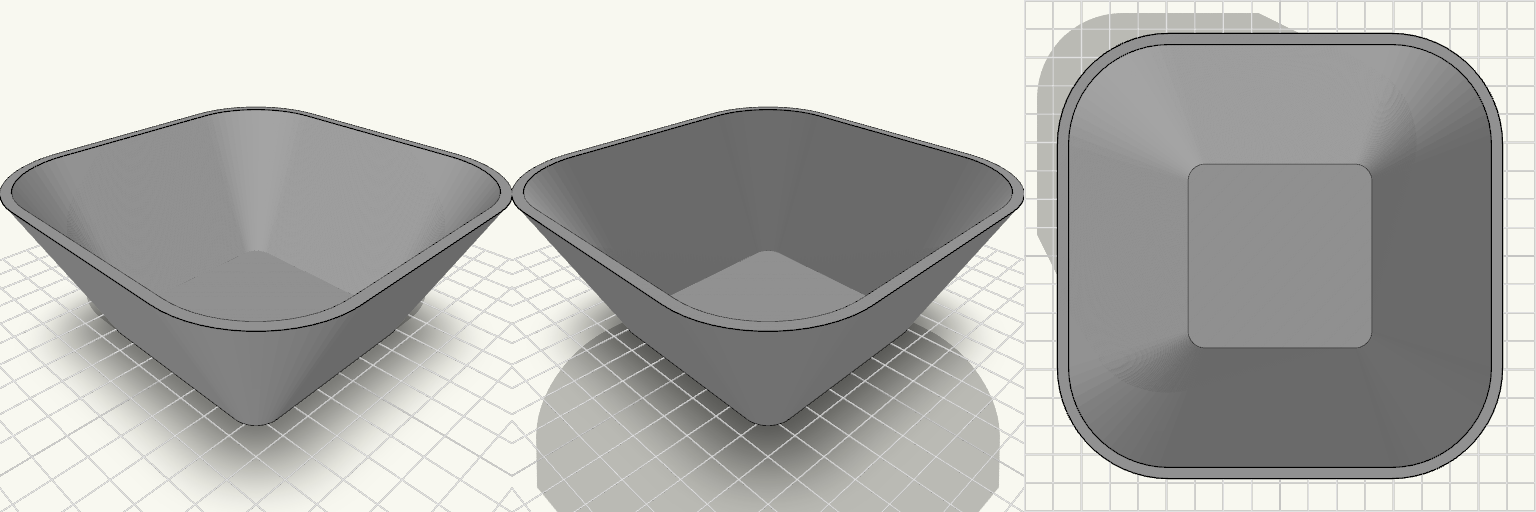
Square-Base Bowl That Stays Put
A bowl that skids across the counter or tips the moment you stir it is the annoyance; this one has an almost square base that keeps it planted. The base is a 70 mm square with rounded corners, so it sits flat instead of rocking, and the walls flare out to a 120 mm rim that is rounder and easier to eat from. What decides the fit Base footprint: 70 mm rounded square — the number to check against your shelf, tray or cupboard. Rim: 120 mm across at the widest point. Height: 50.8 mm (2 in). Walls and floor: 3 mm thick, so it holds its shape without being heavy. It prints as one piece, standing on its flat base, so no supports are needed and the inside comes out clean.