13 mm M&M-Style Candy Discs, 20 Pieces
Created today
Description
Twenty M&M-style candy discs for fake-sprinkle piles and display work: 13 mm across, 5 mm thick, rounded at the edge and topped with a raised white "m". There is no host part, thread or bore to match here, so the number that decides whether a batch works is the disc diameter — 13 mm — measured against the surface, bowl or tray it is going onto.
Sizes (viewer labels: Red Candies, Yellow Candies, Green Candies, Blue Candies, Orange Candies, White m Letters)
- Disc diameter: 13 mm on every piece.
- Thickness: 5 mm at the body; the raised "m" adds 0.5 mm.
- Raised "m": 0.5 mm tall, white, and its own colour region.
- Quantity: 20 pieces in a 5 × 4 grid.
- Spacing: about 16 mm centre to centre, so no two pieces touch. Whole batch footprint on the plate is roughly 77 × 61 mm.
- Colours: five candy regions — red, yellow, green, blue and orange — plus white "m" lettering.
Each candy is a separate loose piece sitting flat on its base, so the batch prints with no supports. The candy colours and the white lettering are separate regions of the print, which means a colour print needs filament changes for the candy colours and another for the white "m"; a single-colour batch will lose the M&M look entirely.
What to check before printing
- The "m" is only 0.5 mm tall and is white as its own colour region. For a clean white letter, switch filament at the layer where the "m" starts, about 5 mm up; at that height it prints as a thin top layer. Without that swap, the lettering prints in the loaded colour and loses contrast.
- At 13 mm across and 16 mm spacing the first layer has plenty of room, but 20 small loose pieces still reward a brim or a slow first layer so nothing gets knocked loose.
What these are not: decoration only — not edible, not real candy, and not a substitute for real sweets on food. They are also not a match for anything with a fixed 14 mm or 15 mm recess; at 13 mm they will sit loose in it.
Photos
Technical views
More like this
Explore more in Decor & Display →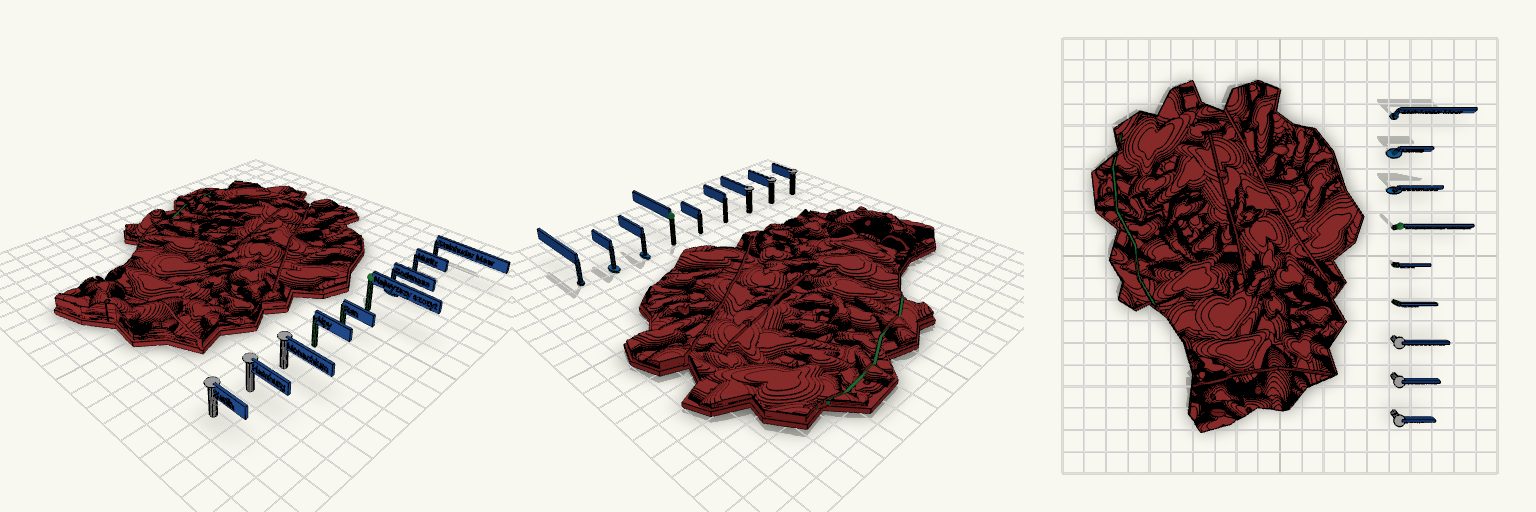
Germania Relief — Wypukła Mapa Niemiec
Germania Relief to wypukła mapa Niemiec z rzeźbą terenu: cała powierzchnia jest lekko falista, także na nizinach, a góry wybijają się ponad nią. Wzniesienia mają gładkie, wielowarstwowe zbocza i nieregularne, powyginane obrysy zamiast regularnych owali. Cztery wyżłobione rzeki przecinają teren, a Ren jest wyróżniony zielonym wypełnieniem koryta, przyciętym do zarysu mapy, oraz tabliczką „Ren”. Znaczniki — trzy miasta, szczyt, Alpy, Ren i jeziora — są osobnymi elementami: leżą płasko obok mapy, bez dodatkowej podstawy, i pasują do gniazd w mapie. Całość czyta się jak dekoracyjna mapa reliefowa, a nie płaski plan. Najważniejsze cechy Ukształtowanie terenu w gładkich, wielowarstwowych zboczach, z Alpami wybijającymi się ponad resztę mapy i zieloną tabliczką „Alpy” Cztery rzeki, w tym Ren z zielonym wypełnieniem koryta przyciętym do zarysu mapy i podpisem; wypełnienie leży w korycie na mapie Trzy największe miasta — Berlin, Hamburg i Monachium — oznaczone wyjmowanymi słupkami z pionową tabliczką z wypukłym napisem Najwyższy szczyt Alp oznaczony wyjmowanym znacznikiem z kulką, kołkiem i tabliczką „Najwyzszy szczyt” Jeziora: Muritz, Bodensee i Steinhuder Meer — niebieskie wkładki w wycięciach, podpisane małymi tabliczkami Wyjmowane znaczniki leżą luzem obok mapy, bez podstawy; po przełożeniu wciska się je w gniazda mapy W zestawie Mapa Niemiec ok. 124 × 160 mm z gniazdami na znaczniki Wyjmowane znaczniki miast, szczytu, Alp, Renu i jezior, leżące płasko obok mapy Znaczniki nie mają osobnej podstawy Druk i montaż Model składa się z mapy i osobnych znaczników. Znaczniki są wciskane w gniazda mapy; pasowanie jest ciasne, więc luzy warto sprawdzić na wydruku. Najdrobniejsze elementy, jak kołek szczytu, są delikatne.
Stackhouse — OO Scale Brick Chimney
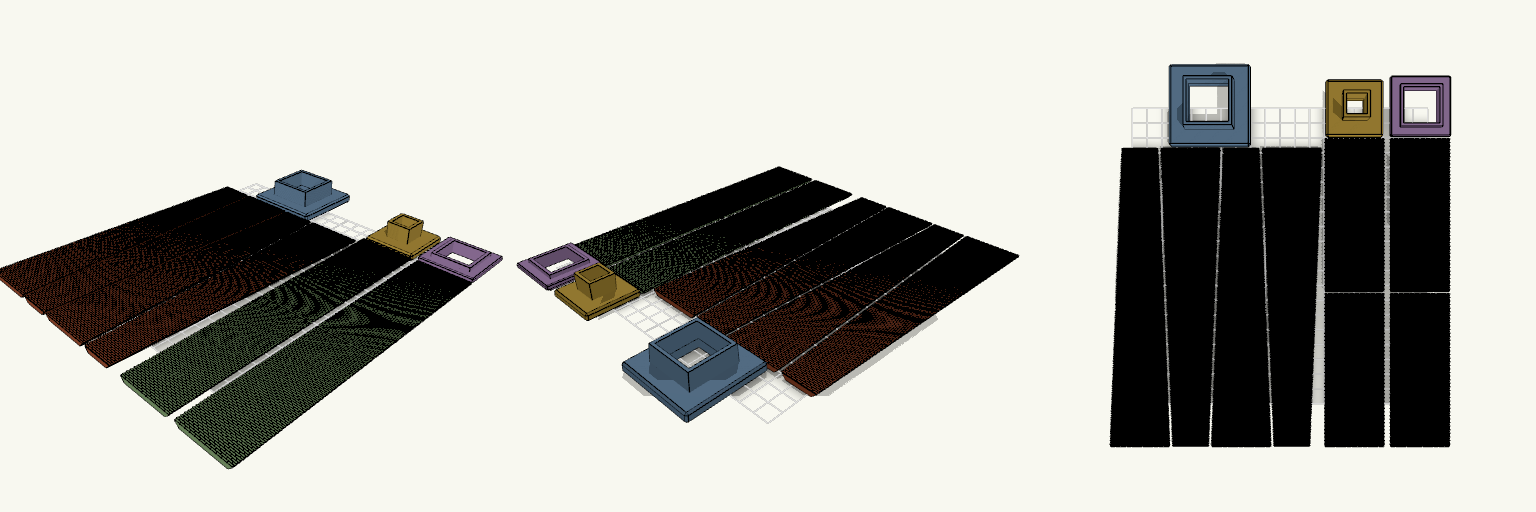
Stackhouse is a tapering industrial chimney in OO scale, built from flat-printing brick-faced panels. A straight square base section sits beneath the tapered stack, and a plinth and cap with locating spigots make assembly simple. Features Four tapered brick panels, 200 mm tall, 40 mm wide at the base and 24 mm at the top, with true mitred edges Straight base section made of four 101.6 mm (4 inch) mitred brick sides, each printed flat Three industrial four-pane windows, one on each of three sides; the fourth side is solid Top plate for the straight section, with a spigot that locates the plinth Plinth with socket and chamfered cap with spigot Print notes Print every panel inner face down, with the bricks facing up. The 45° corner mitres of the straight sides close exactly; glue them together.
Goat Ballerina Christmas Ornament with Hanging Loop
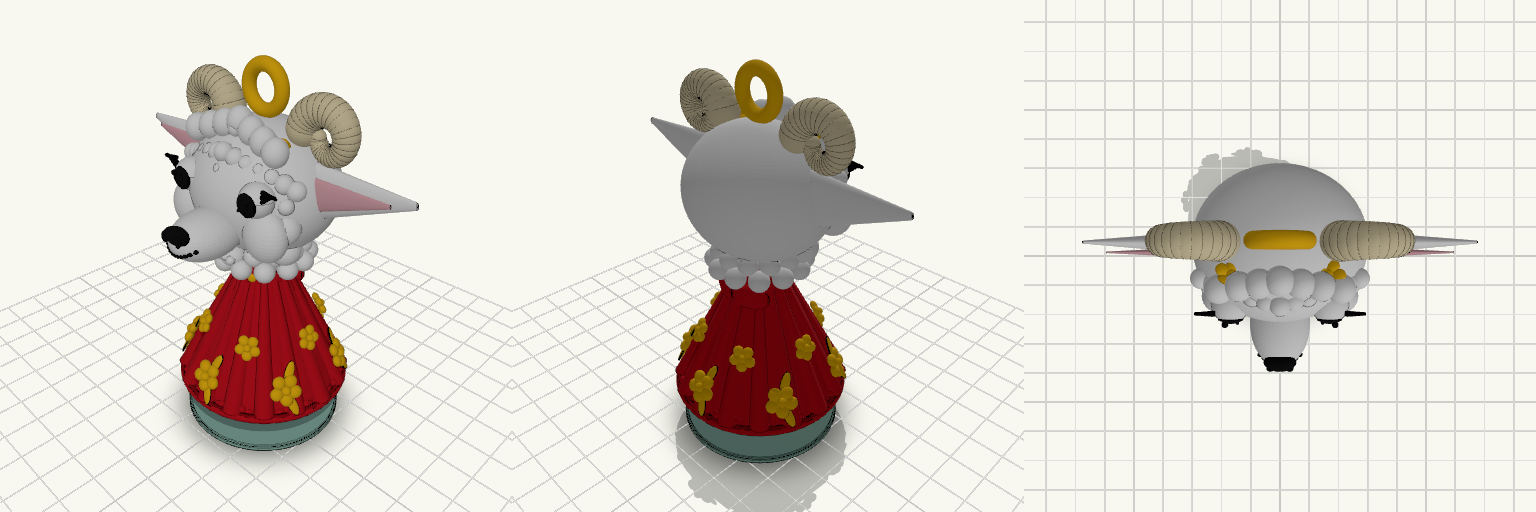
A baby goat ballerina ornament that hangs from a ribbon loop and stands on a small stage disc. The old version tipped on its tiny shoe soles and looked flat. This one stands on a 44 mm base and has a fuller sculpt. Face: lidded eyes with lashes, a highlight in each pupil, rounded cheeks, a nose and a smile line. Horns: ridged spiral curls on each side. Ears: pointed, stretching out sideways, with raised inner ears. Dress: two layers of folds, a beaded hem roll, a sash and a back bow. Flowers: on the skirt, the sash and between the horns. Pose: hands joined under the chin, legs crossed, ankle-strap shoes. Print notes Height: about 100 mm, with the loop at the top. Base disc: 44 mm across and 2 mm thick, so the figure doesn't rely on the shoe soles. Loop: 3.5 mm thick, 7 mm opening for ribbon. Printing upright works for FDM; the horns and ears are the parts most likely to need supports. Resin printing suits the fine detail best.
Steampunk Articulated Dragon with Saddle
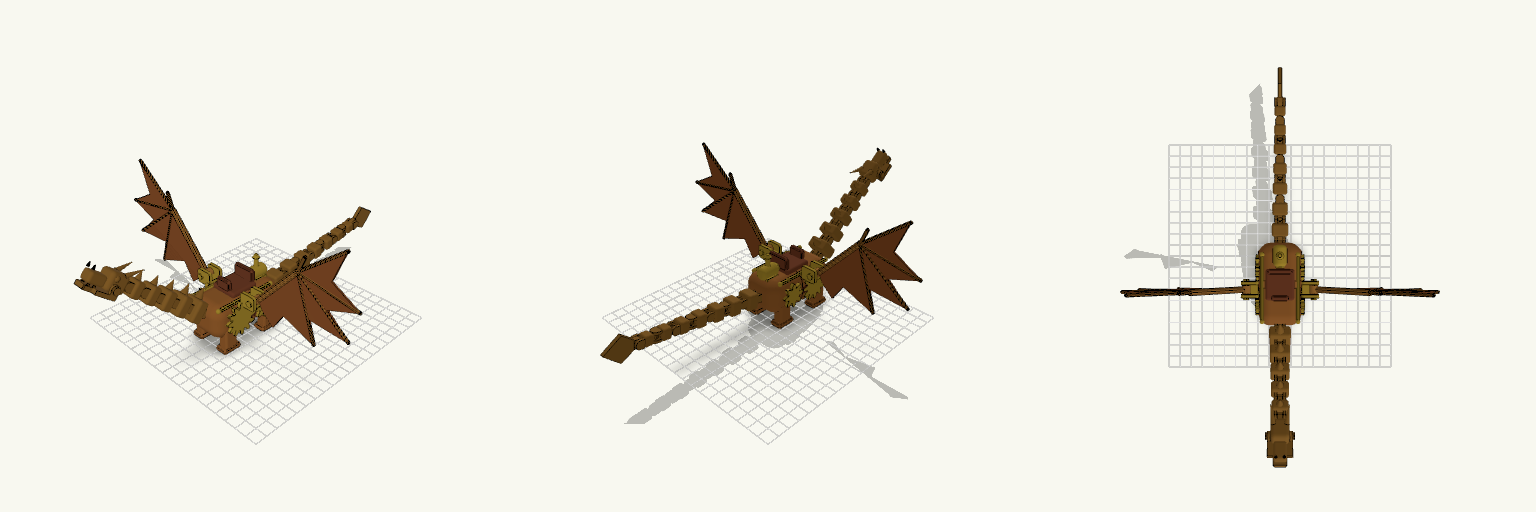
A print-in-place articulated steampunk dragon with a saddle on its back, a hinged neck, a segmented tail and an opening jaw. It is a standalone figure, so the critical dimension is the hinge clearance. What it has Five-segment neck on pin hinges, tilted up from the chest Seven-segment tail with alternating hinge directions, so it swings both up-down and side-to-side, ending in a blade tip Head with a pinned lower jaw that swings open Saddle with pommel, cantle and girth band Brass-style gears on both flanks, side steam pipes and a boiler with a stack Check before printing Hinges use a 0.4 mm gap per side and 3.8 mm holes on 3 mm pins. Printer tolerance has to hold that, or the joints fuse. Print as-is with no rotation. Supports are needed under the jaw, neck and tail hinges. Break each joint free after printing. Does not fit or do The legs are fixed and the figure has no wings. It is not a scale model of any commercial figure.
Paper Fan Wing: Pinned Feather Assembly
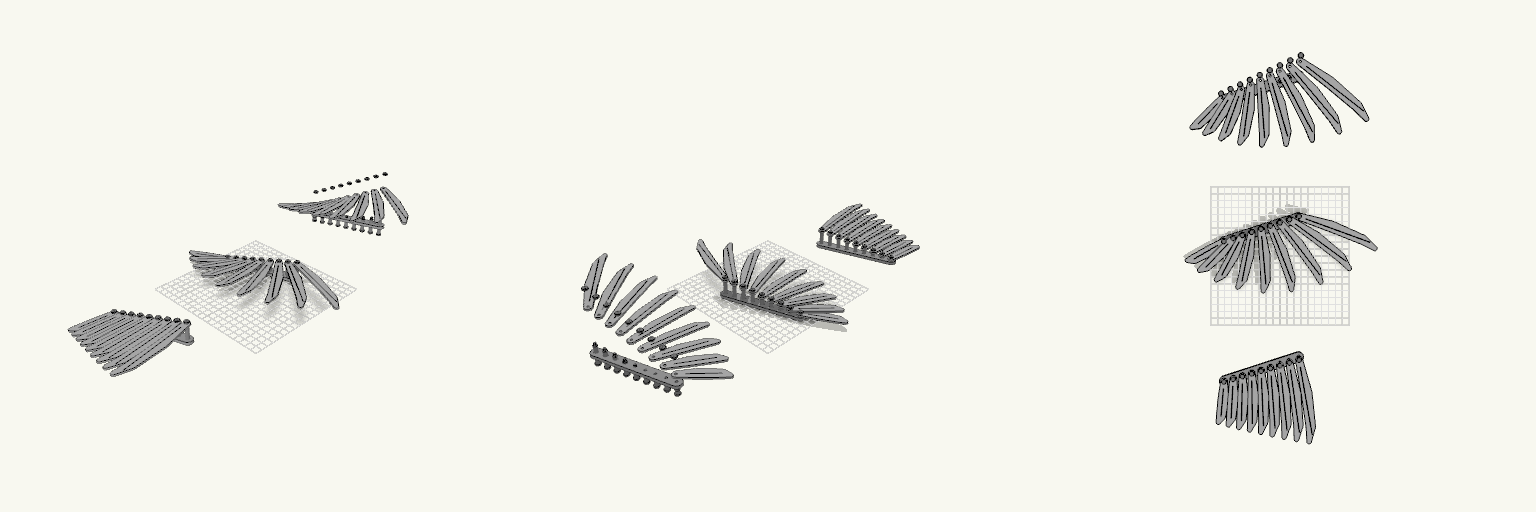
A paper-prototype fan wing translated into printable parts: nine flat, separate feathers, each pinned to its own pivot hole along an angled upper support. The feathers get longer toward the outer end, and their rounded tips overlap to form the curved lower edge of the wing. Each feather has a faint centerline groove. Parts Upper support: one angled bar with nine pivot holes. Feathers (9): flat, 2 mm thick, with a pivot hole at the narrow end. Pins (9): a flat head under the support, then a collar that sets each feather's layer height. Caps (9): push-on retainers that hold the feathers on. Views Open fan, folded stack and exploded layout, all on one plate. Notes Pivots are 0.25 mm clear per side. Feathers are fanned by hand. No linkage is included yet.
Amanda LED Strip Light Sign
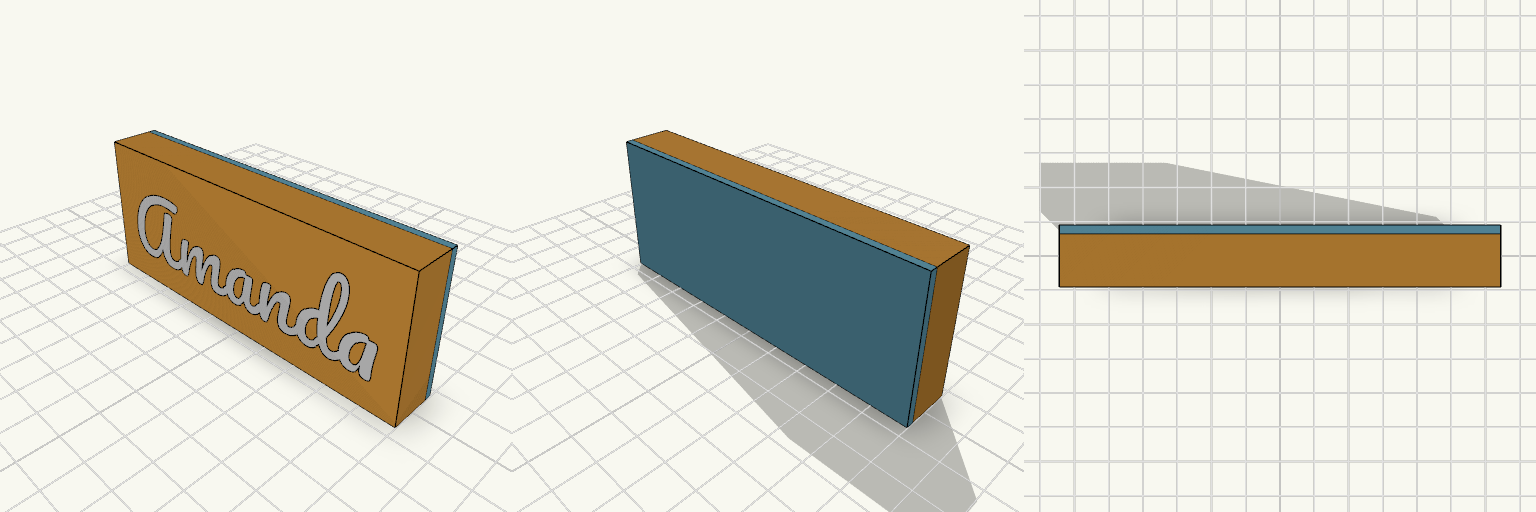
A 100 × 40 mm lighted sign reading "Amanda" in Pacifico, built as three pieces: an opaque body, a thin white translucent letter layer, and a snap-in back cover. Run an LED strip inside the 12 mm deep cavity and the light shows only through the letters. Remix hooks Diffuser thickness (dif, 0.8 mm): thicker glows more evenly and hides LED dots; thinner is brighter. Print in white or natural PLA/PETG. Front wall (face, 1.6 mm): sets how deep the letters are inset. Print the body in a dark or opaque filament so light stays in the letters. Depth (D, 12 mm): increase for a wider strip or a double row of LEDs. Cover fit (clr, 0.2 mm): loosen or tighten for your printer; the 3 mm lip locates the cover. Cord notch: 8 mm wide at the bottom rear; move or widen for a USB lead or barrel jack. Pairs with a USB 5 V LED strip, or a small stand or wall-hanger remix. The counters of the "A" and "d" are separate islands in the body, so glue them to the diffuser sheet.