60mm Projection Coat Hook
Made by a Guest
Created 4 months ago
Description
A robust wall-mounted coat hook designed with a 60mm projection to accommodate heavy winter coats and standard garments. The geometry features a swept upward arm that terminates in a rounded end to prevent fabric stretching while keeping the item securely suspended.
The base plate incorporates two strategically placed countersunk screw holes at a 66mm spacing. The upper hole is positioned to allow clear, unobstructed access for a screwdriver or bit driver during installation.
Specifications and print details:
- 60mm total hook projection
- Countersunk holes sized for M4 or M5 wood screws
- 66mm center-to-center hole spacing
- Print-friendly angles that do not require support structures
- Smoothly rounded contact points to protect fabrics
Images
More like this
Explore more in Home & Fixtures →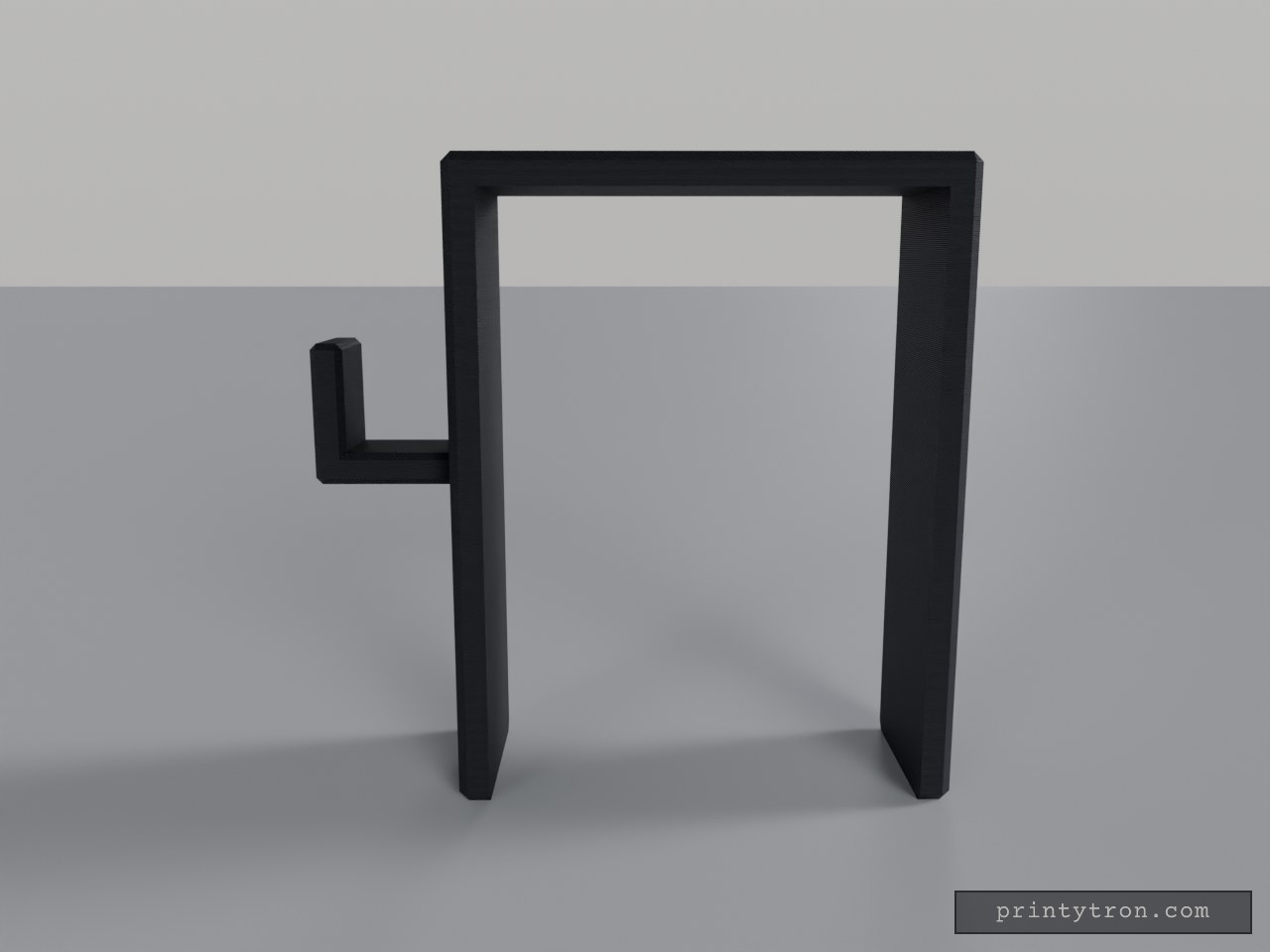
Beam Clamp Clothes Hanger with Side Hook
What it's for A saddle that drops over the top of a support beam and turns it into a place to hang clothes. The inverted U-shaped channel grips the beam from above, and a hook projects from one side with an upturned tip so hangers and garments stay put. Beam Saddle — the U-shaped body that slides down over the beam Hook — the side arm with an upward tip for hangers or coats, set at mid-height of the saddle Both areas print as a single piece; nothing needs assembling. Dimensions Saddle opening: 68 mm inner width, sized for a beam of that width Overall saddle: 78 × 30 mm footprint, 100 mm tall Channel: 95 mm deep, with 5 mm thick walls Hook: 22 × 15 × 22 mm, mounted at mid-height so its tip stays inside the 100 mm envelope The 95 mm channel is generous for a shallow beam — the saddle simply sits lower on it, and the hook rides down with it. Print notes Print the saddle opening facing up so the channel needs no supports A few extra perimeters on the hook help when it carries heavy coats Scale the opening slightly if your beam measures over 68 mm Remix ideas Lengthen the hook for bulky winter coats Shorten the legs for a shallower beam and keep the height with a taller top plate Add a second hook on the opposite side for more hanging room Add a small lip or screw hole at the bottom of the saddle to stop it shifting sideways
Industrial Saddle Wall-Mount Air-Hose Clip
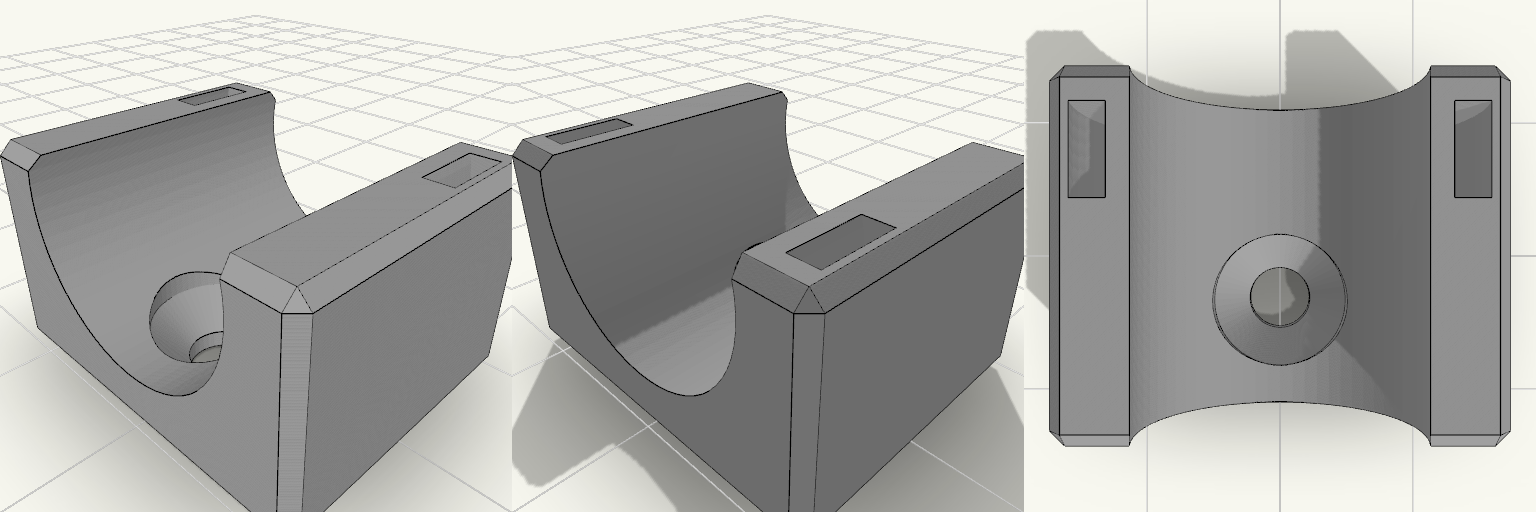
A plain block with a channel across its top and a single hole sunk into the floor of that channel — drive a drywall screw through it, drop the 5/8″ OD air hose in, and the fixing disappears beneath the hose. A slot cuts through the other half of the block, so a zip tie loops down over the hose and cinches it without ever crossing the screw. No side tabs, no bracket ears, nothing protruding past the saddle: a small, purely functional piece of wall hardware with a squared-off, industrial silhouette. Design notes Top channel sized for 5/8″ OD air hose, with a little clearance. Countersunk screw hole sits in the channel floor with a 9 mm countersink, wide enough for a typical drywall screw head and hidden once the hose is seated. Zip tie slot is offset to the far half of the block, clear of the screw area; takes a common tie up to about 5 mm wide. Load order matters: drive the screw first, then lay the hose in and tension the tie. With a single fastener the block can spin before the hose is loaded — snug the screw down before fitting the hose so it stays square to the wall. Block is 20 mm long, 24.3 × 20 × 14.1 mm overall as it sits on the build plate. Prints as a single body; screws and zip ties are separate hardware.
8.35 mm Fiberglass-Rod Joiner with Camera Arm
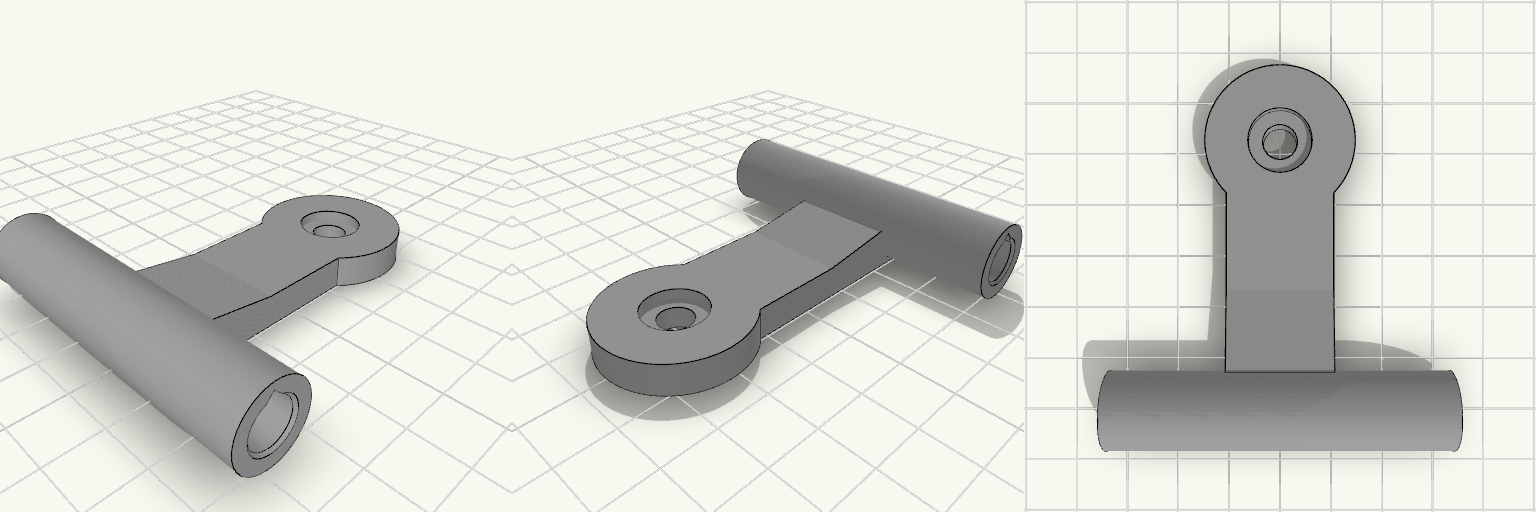
Replacement two-way joiner for the top-front-center of a fiberglass-rod printer enclosure. It splices two nominal 8.2 mm rods end-to-end and carries a flat-lying arm with a screw boss for a Sercomm RC8110 camera. Print it as one piece with the arm flat on the bed, then rotate the part about the rod axis during installation to aim the camera downward and toward the bed center. Specifications Rod sockets: 8.35 mm ID, 30 mm deep per side, 0.5 mm entry chamfers, separated by a 3 mm solid center stop; 63 mm overall sleeve length. Sleeve: approximately 14.35 mm OD with 3.0 mm wall thickness. Arm: 20 mm wide and 6 mm thick, extending 50 mm from the sleeve, with a root block and gusset blending it into the sleeve. Camera boss: 28 mm diameter and 6 mm thick, with a 6.6 mm through-hole and a 12 mm × 2 mm counterbore for a 1/4"-20 camera screw. Print footprint: 63 × 71.2 × 14.4 mm as oriented on the plate; the teardrop socket bores and flat arm are intended to print without support. Fit: press-fit for measured 8.19–8.20 mm rods; PETG wall thickness is sized to resist splitting and bending from the tensioned enclosure fabric.
Flacher S-Haken mit Stift, 14,2 mm
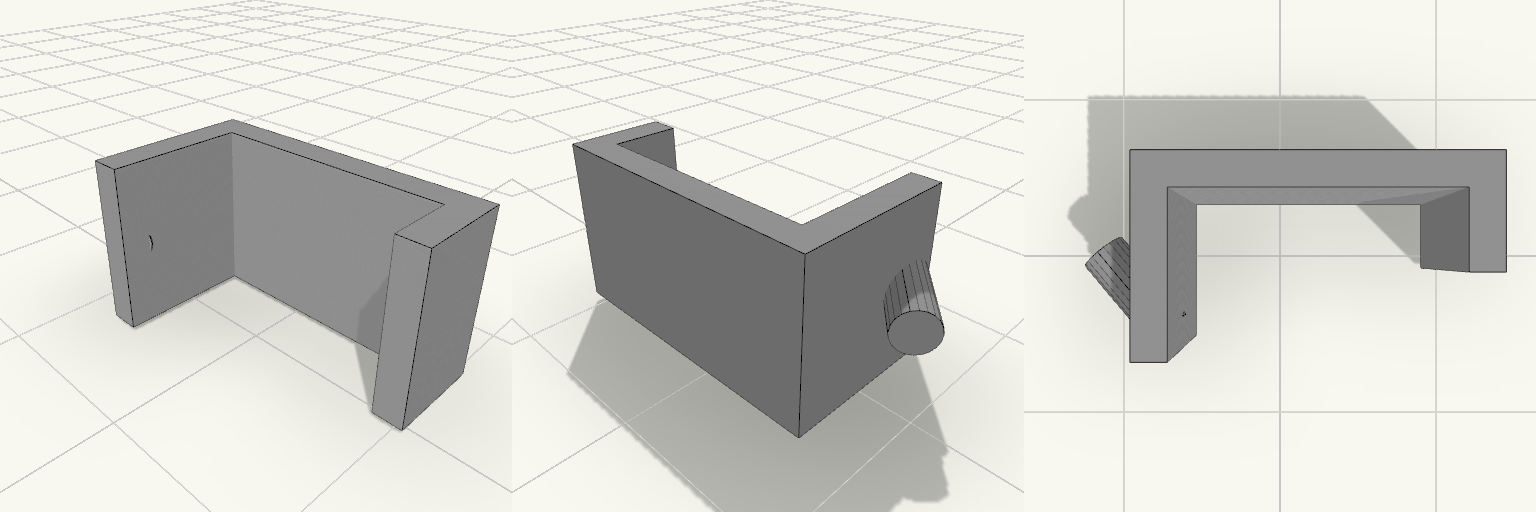
What it's for Flacher Türhaken, der über eine Tür greift. Ein geneigter Stift ersetzt die vordere Wand am unteren Haken. Dimensions Höhe (Z): 10 mm Wandstärke: 1,75 mm Obere Öffnung: 14,2 mm Obere Lippe: 4 mm tief Stift: Ø 2,5 mm, 5,5 mm lang, 40° zur senkrechten Wand geneigt Remix ideas Stift länger oder kürzer für andere Lasten Öffnung an andere Türstärken anpassen Dickere Wand für mehr Tragkraft
Door-Top Hook STOP Sign Hanger
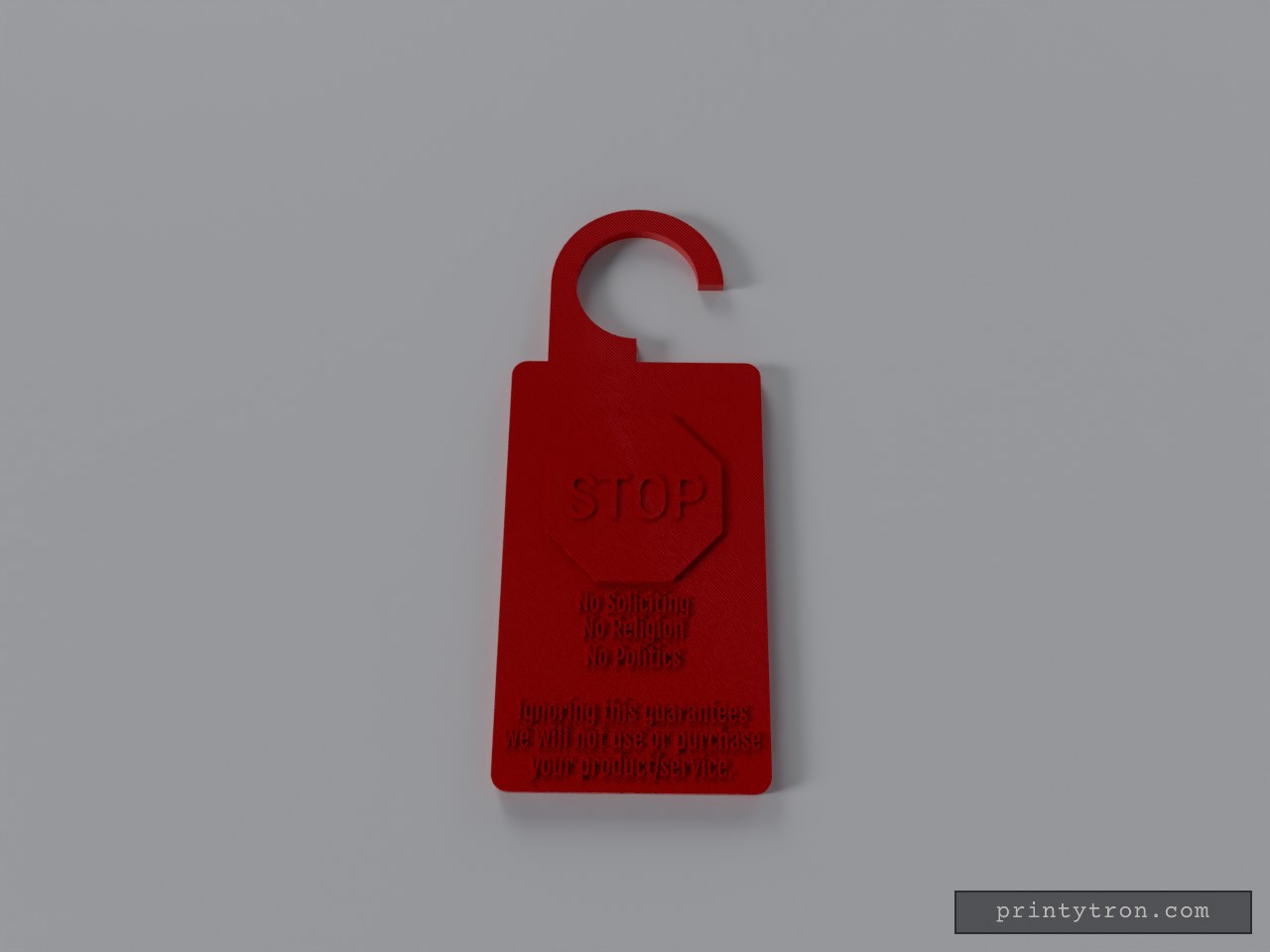
A door-top hook sign for hanging over a door top or peg: a 95 × 160 × 5 mm plate with a one-piece flat hook on its top edge. The hook is a ring with a gap on its lower right, about 68 × 69.4 mm overall and 5 mm thick, reaching roughly 68 mm above the plate. Its ring wall is about 10 mm thick; the opening is fixed and does not adjust. Below the hook is an octagonal STOP sign with white lettering, then the message in dark raised text: six lines at one 6 mm size in a bold condensed face, with a blank line after “No Politics”: No Soliciting No Religion No Politics Ignoring this guarantees we will not use or purchase your product/service. It replaces a paper or card door hanger of similar footprint — nothing to laminate and nothing to tape up. Fits A door top or peg that clears the hook’s fixed opening — measure the opening against the actual door top or peg before printing, as nothing on the part takes up slack. A print bed at least 160 × 95 mm, since the plate prints flat. A one-piece print: plate, text, STOP sign and hook print together; no separate loop, screws, nuts or fasteners. Check before printing Measure the hook opening against your door top or peg. The ring wall is about 10 mm thick and the opening is fixed. Print the plate flat so the layers run along the hook. At roughly 68 mm of reach in a 5 mm section, the hook is a long cantilever; printing it stood on edge risks snapping it. Change filament at the layers where the red, white and dark areas begin if you want clean colour separation. Line spacing is about 9.2 mm pitch. The last line of text sits about 4 mm from the plate’s lower edge, so preview the layout and margin before committing to a long print. Known limits One hook thickness only, 5 mm — there is no heavier version. No through-slot for a knob or handle, and no screw-on loop or M3 hardware. The sign does not clamp or lock to the door; it hangs from the hook and lifts off. The hook opening is fixed; it does not adjust for different door tops or pegs.
LED Strip Corner Routing Bracket
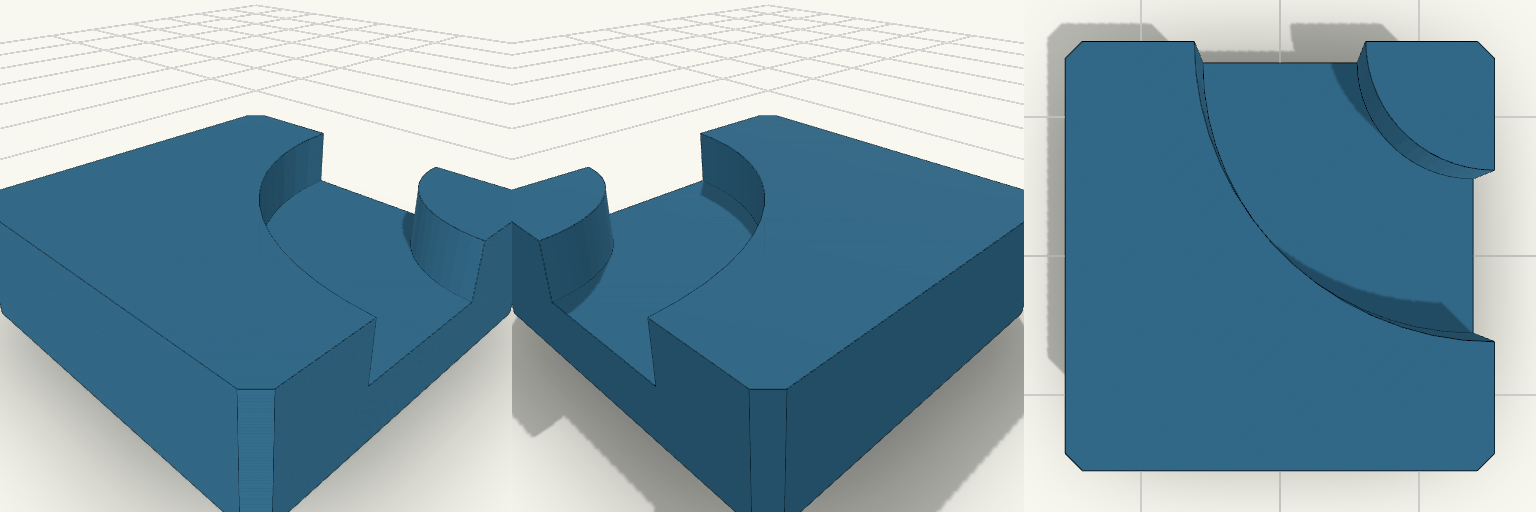
A 25 mm square corner block, 8 mm tall, with a quarter-circle channel on top that seats a 10 mm LED strip and turns it 90 degrees. Made for under-shelf lighting where the strip needs to follow an inside corner without kinking. The underside is flat, so it takes adhesive tape or double-sided foam. The channel is 10 mm wide and 4 mm deep, with a 12.5 mm centerline radius. It enters and exits through the two sides that meet at the far corner. Vertical corners carry a 1 mm chamfer. Remix hooks Block size (25 mm): the main lever. A 35 mm block with a 17.5 mm centerline radius gives a gentler bend for stiffer strips. Centerline radius (12.5 mm): keep it at half the block size so the channel meets the edges, or shrink it for a tighter turn. Channel width (10 mm): add 0.3 to 0.5 mm of clearance for strips with thick silicone sleeves, or narrow it for bare strips. Channel depth (4 mm): deepen it to sink the strip below the surface, or make it shallower and add a diffuser lip. Height (8 mm): can be lowered to about 6 mm and still keep the 4 mm channel with a solid floor. Pairs with Straight strip sections between corners, with one bracket per inside corner. A snap-in diffuser cover cut to the same 10 mm channel width. A mirrored variant for the opposite corner direction. Print notes Print flat on the back, with no supports needed. Use PETG or ABS if the bracket sits near warm drivers.