70mm Santa Face Ornament
Made by PaprikaQuail
Created 1 months ago
Description
A single-piece stylized Santa Claus face ornament, designed to lay flat on the print bed. The model uses raised geometric profiles for the moustache, nose, and hat brim, alongside through-cut eyes and mouth for visual contrast without requiring painted textures.
Specifications
- Dimensions: 70 mm wide, 75 mm tall, 3.5 mm overall thickness.
- Structural Base: 2.5 mm solid backing layer.
- Hanging Interface: 5 mm circular bore located in the top pom-pom.
- Print Settings: Prints flat without supports. A filament swap at Z=2.6 mm allows the raised accents to be printed in an alternate color.
Images
More like this
Explore more in Gifts, Seasonal & Personalized →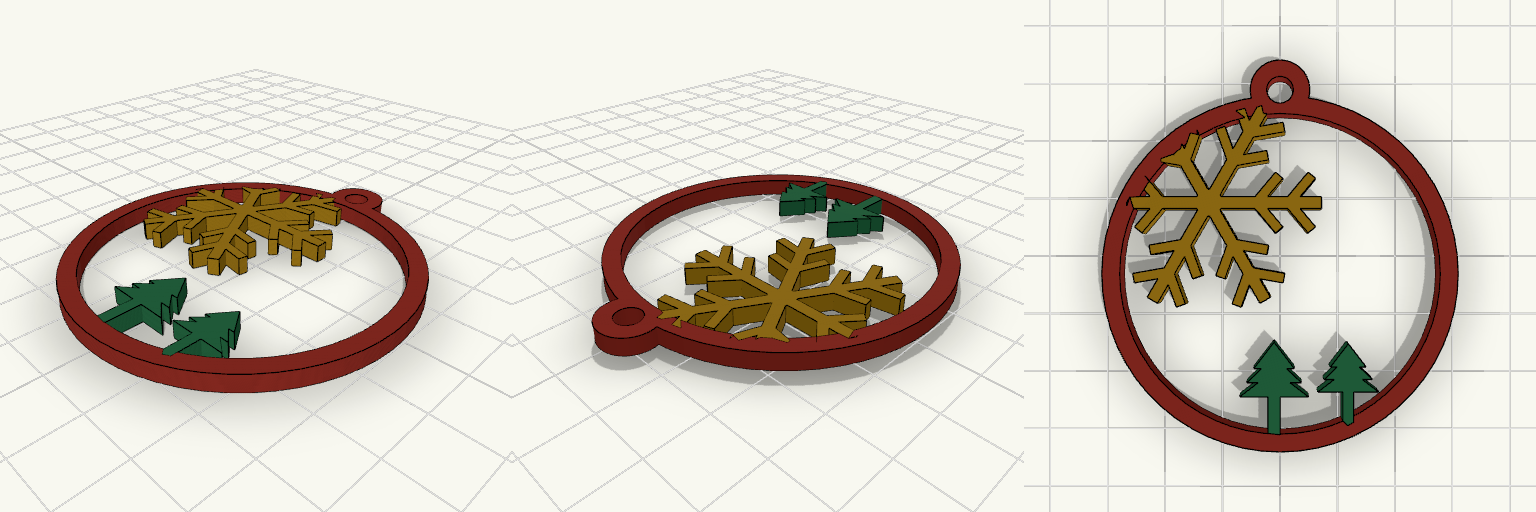
Evergreen Ring — Open Christmas Tree Ornament
Evergreen Ring reduces the Christmas ornament to a clean silhouette: an open circular ring with a hanging loop, a pair of small three-tier trees tucked into the lower-right corner, and a large six-armed snowflake filling the top-left, its outer arms running into the ring and clipped by it. The right-hand tree sits fully inside the hoop, its tiers clear of the ring, with only its trunk running down into the bottom of the ring. The companion tree to the left is about 1.5 mm larger, with roughly 1 mm separating the pair, so the motif reads as a deliberate little grove rather than a repeat. The snowflake is centred about 12 mm in from the corner, and the arms that meet the ring are what hold it in place. Ring, trees and snowflake all stand the same 3 mm tall, giving the piece a single even plane that sits flat against a branch, a window or a gift tag. Every element is joined to the hoop, so the whole ornament prints as one solid piece with no assembly and no loose parts. Dimensions Ring: 60 mm across, 66 mm tall overall including the hanging loop, 3 mm thick Trees: two small trees occupying roughly 23.4 × 15.6 mm combined, 3 mm thick Snowflake: about 32.8 × 34 mm, 3 mm thick Features Open-ring ornament with an integrated hanging loop Two small three-tier trees side by side in the lower-right corner, with the tiers fully clear of the ring One tree about 1.5 mm larger than the other Large branched snowflake in the top-left corner, its outer arms cut off by the ring and fused to it Only the tree trunks and the snowflake's outer arms meet the ring, keeping the scene connected Uniform 3 mm thickness across every part Prints as a single piece, no supports needed Print notes Lay the ornament flat on the plate; the even thickness means no tall overhangs Any filament works — use contrasting colours for the trees and snowflake if you print in multiple colours
Snowflake Shirt Pin with Safety Pin Loops
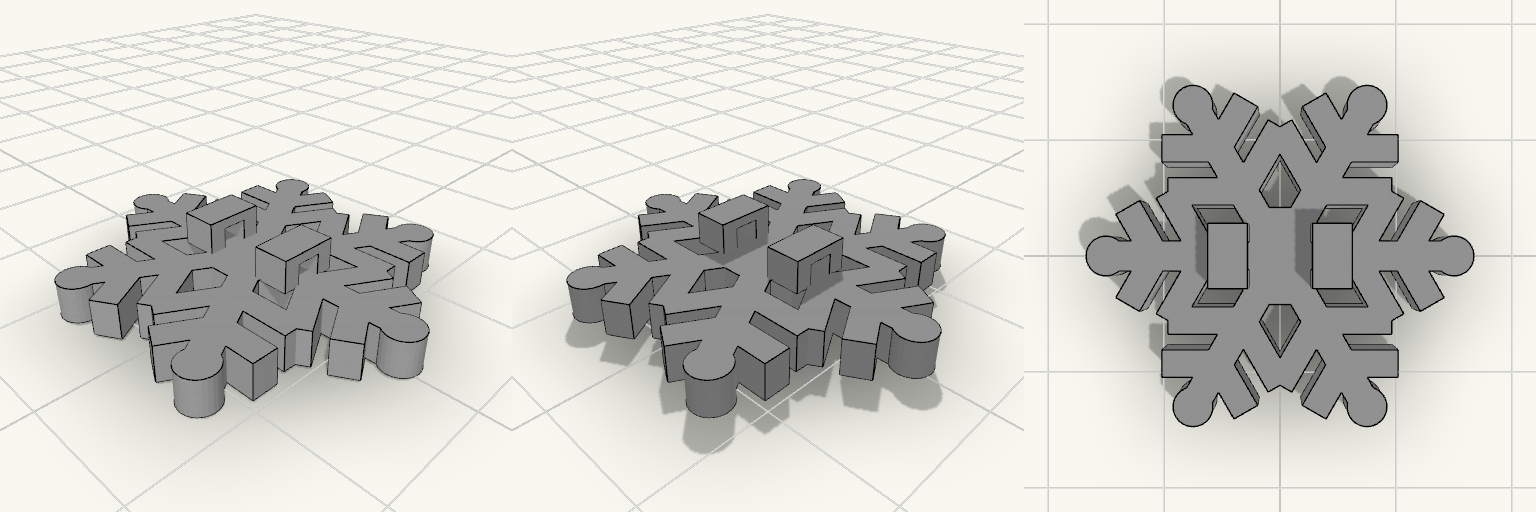
A small snowflake pin with six branched arms, made to be worn on a shirt. Two loops on the back take a standard safety pin, so the snowflake sits on the fabric like a brooch. Six-arm snowflake with side branches and rounded tips Two back loops, 8 mm apart, for threading a safety pin Flat front face prints directly on the plate No supports needed Roughly 31 mm across and under 6 mm thick
Christmas tree fidget
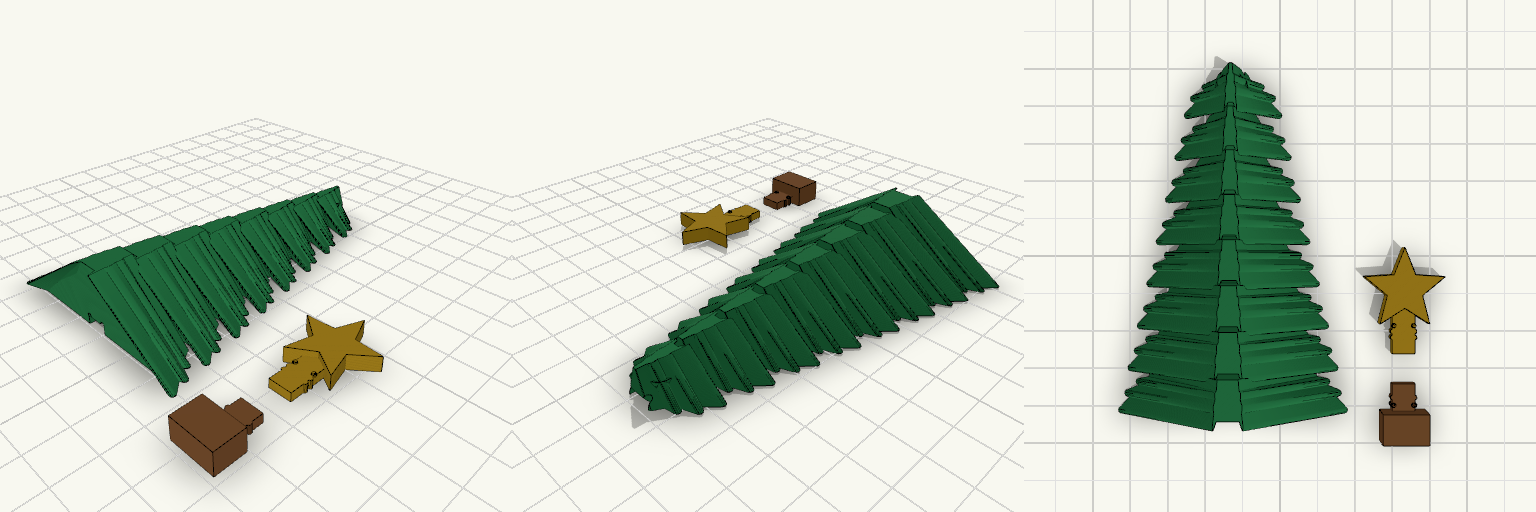
A print-in-place flexi Christmas tree with a separate snap-fit stump and a separate snap-fit star. There is no host device, thread standard or model number to match here: the fit that decides whether it works is the hidden hinge clearance, then the plug-and-slot snap joints that hold the stump and the star. The tree is eight stacked tiers, each a tent shape rising to a centre ridge, cut with jagged, uneven fir-style boughs that swing out past the body, droop at the tips and step back in toward the top. The bottom tier rises 17 mm and each tier above is 1.2 mm lower. The topmost tier carries a slot with two snap dimples for the star; the slot is 8 mm deep, and the star’s plug is 14 mm long. The stump and the star both sit beside the tree on the plate as their own pieces. What it fits and replaces Tilt the tree and the tiers should wiggle on hidden pin hinges; it is a fidget as much as a decoration. The tier-to-tier tabs now reach 1.2 mm further into the solid and each carries an anchor lug, so the tree is meant to stay together when lifted. Each hinge pocket now has a thin floor under it: a 9.8 mm disc, 0.6 mm thick, on seven of the eight tiers. The pin heads sit above the floor instead of resting at bed level, so they cannot drop out the bottom. To make room, the hinge parts were raised 0.9 mm and the pockets deepened to match. The stump plug slides into the slot under the bottom tier; print it, swap it, or leave it off. The tree has no trunk of its own, so the bottom tier’s hinge pocket stays open until the stump is fitted. The star’s 14 mm plug slides into the 8 mm deep slot cut in the top of the highest tier. Its outline is a solid five-point shape with no hanging hole. Both plugs snap in. Each carries two small domed bumps on its top face, and each slot ceiling has two matching dimples: push the stump or star up from below, the bumps ride over the ceiling, and they drop into the dimples. Crush ribs stay in place, two on each side, and the plugs are 0.1 mm thicker, so the fit has friction as well as the click; no glue should be needed. The fits are untested, so shave the ribs or bumps if a plug is too tight, or enlarge them if it is still loose. Print the tree, stump and star in the same filament for one colour; the preview colours only mark the separate parts. Check before printing On the plate the Flexi Tree measures 60.9 × 90.6 mm and rises 17 mm at the bottom tier; the Stump measures 12 × 15.2 × 6 mm; the Star measures 20.9 × 27.9 × 4 mm. Check the hidden hinges first: 4.4 mm pins in 5.6 mm holes leave 0.6 mm per side. The 8.2 mm knuckles, 6 mm tabs, 1.2 mm gaps between tiers and 0.6 mm pocket skins are the rest of that fit. The new hinge floor leaves about 0.3 mm under each tab, so check that the tiers still swing freely and the floor has not fused to the tab; if they stick, open that gap. If the tiers fuse or feel stiff, open the pin clearance rather than forcing them; if a pocket skin looks weak or sags, thicken it. The reinforced tab joints and anchor lugs are untested and not pull-tested; a hard tug could still separate the tiers, in which case thicker pin heads are the next fix. Check the star’s hold in particular: the slot is 8 mm deep and the plug is 14 mm long, so the rest of the plug bridges the gap to the star’s base. The longer hold should cut wobble, but check it on the first print. Check the snap joints: the bumps are 1.2 mm domes and the dimples are 1.8 mm. Snap strength is a guess. If a joint clicks too hard or the slot walls flex too much, shrink the bumps; if it does not hold, enlarge them. The drooping tips on the wide bottom tiers are the thin, spiky parts and come within a couple of millimetres of the tier below; check those gaps on the first print. The topmost tier is the narrowest part and now carries a deep slot, so its walls are thin; check that it does not flex and that its tip prints cleanly. The sloped tier faces overhang heavily near the ridge, so expect rough overhangs without supports, or add them. The model is untested: treat the first print as a fit check, not a finished batch. What it is not It is not a centre-post spinner; nothing rotates around an axle. It carries no name, year or message, so it is not a personalised piece. There is no hanging loop or hole anywhere — the star’s outline is solid — so it is a display fidget, not something to hang. The hinges are hidden from the front, not from the back: the pin heads sit in blind pockets that are open at the rear. It is not a single-piece print. The tree prints in place as one piece; the stump and the star are separate parts. The bough faces are smooth tents with jagged tips; this version has no dimpled texture and no raised rim. Specs as it sits on the plate Flexi Tree: 60.9 × 90.6 mm, 17 mm rise at the bottom tier, eight hinged fir-style tiers Stump: 12 × 15.2 × 6 mm, with snap-fit plug and crush ribs Star: 20.9 × 27.9 × 4 mm, with 14 mm snap-fit plug, solid outline, no hanging hole 8.2 mm knuckles, 4.4 mm pins with domed heads, 5.6 mm pin holes, 0.6 mm per side clearance Hidden hinges: blind pockets with 0.6 mm skins, open at the back; hinge parts raised 0.9 mm; 9.8 mm × 0.6 mm floors under seven pockets; reinforced tab joints with anchor lugs Print-in-place tree; separate stump and star on snap-fit plugs; overhangs near the ridge may need supports

Flat Round Spiral Curl Ornament Medallion, 50 mm
A flat, round hanging ornament shaped as a smooth spiral curl. The spiral is one continuous band that swells through the middle and thins to fine points at both ends, like a calligraphy stroke, with even spacing between turns. It lies flat, so the ornament sits close against a tree branch or a wall instead of projecting outward. A round hanging loop sits at the top at the 12 o'clock position, and the whole ornament prints as one piece in a single color. Specs Overall size: about 45 × 56 mm, 5 mm thick Spiral: one continuous band, tapered to fine points at both ends, heaviest at the middle Turns: about 3.5, evenly spaced Hanging loop at the top, sized for thread, ribbon or a wire hook Single color, one-piece print Flat face: hangs flush against the tree or a wall Prints without supports on its flat face Loop joint: the tapered outer end meets the ring over a small area, so this is the weak point — hang it gently or reinforce that joint if it sees rough use
Hollow 60 mm Snowflake-Cutout Christmas Bauble
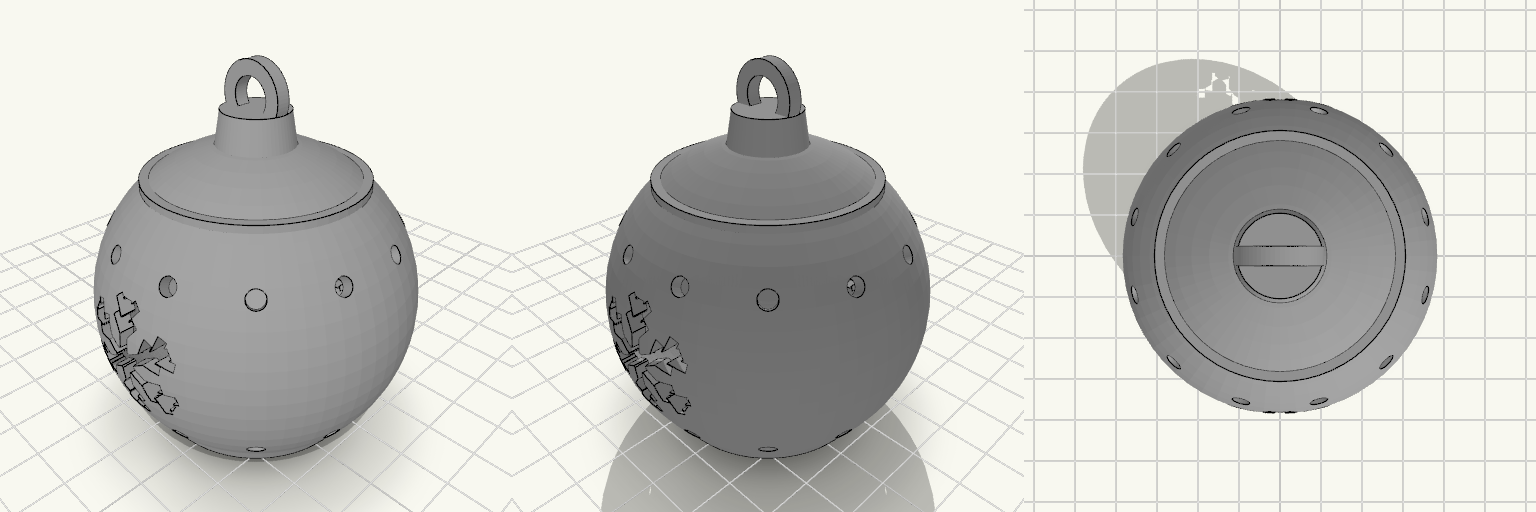
A hollow Christmas bauble with a six-armed snowflake cut through the front and back. The snowflake branches are set at a 40° angle so no island of shell is trapped between them; the cutout stays one connected shape. Rings of small round through-holes sit above and below the middle, and the equator is left plain. Raised bands run above and below the equator, and a cap with a hanging loop sits at the top. The bottom is flattened into a small footing so the ornament can stand upright on the print plate; the curved lower sides generally need supports. Specs Overall size on the print plate: 59.9 mm wide × 59.7 mm deep × 71.5 mm high Ball diameter: 60 mm Wall thickness: 2.5 mm, hollow shell Bottom footing: about 19 mm across Cutouts: one six-armed snowflake through the front and one through the back, about 22 mm across with fine branches around 1.8 mm thick Snowflake branches: 40° branch angle, arranged so no detached wall islands are left inside the cutouts Dot holes: 12 above the middle and 12 below, each a 3.2 mm hole straight through the wall; no hole row at the equator Bands: raised rings above and below the equator Top: cap with hanging loop Printing: single piece; supports needed on the curved sides Use: Christmas tree ornament or hanging decoration; the flattened base also lets it stand on a flat surface
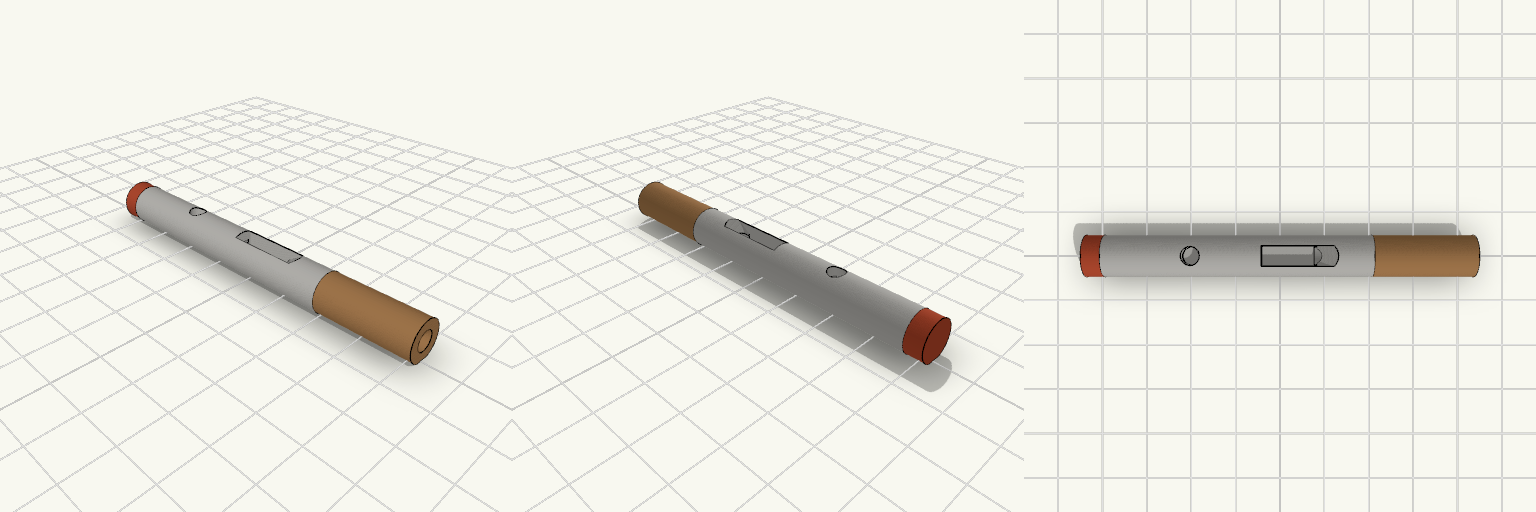
Film-Noir Cigarette Fipple Whistle
A cigarette you can't smoke but can play: an 84 mm-long fipple whistle disguised as a filter-tipped stick, complete with an orange ember tip, a white paper body and a tan filter. Inhale through the filter end and air slips through the intake hole near the ember, runs a thin flat duct across a window and breaks over a sharpened edge — the classic whistle mechanism, wearing a noir prop's silhouette. It is an inhale-only instrument; blowing back out through it will sound weak or not at all. This version is tuned for a softer, lower note: the duct is narrow and shallow, the window is long with a gentle ramp, and the intake is widened a touch to keep the hiss down. A gentle, steady inhale gives the smoothest sound; a hard pull turns breathy. Design notes Three colour-coded sections in the viewer: Ember Tip, Paper Body and Filter, printed as a single piece. The underside is flattened, so it sits stable on the plate and needs no supports. Keep your lips clear of the intake hole while you inhale — that hole is the voice. Tone stays tunable: a longer window takes it darker, a slightly more open duct brings back volume if it comes out too faint. Pairs well with a trench coat, a rainy window, and anyone who appreciates a joke that also functions.