Bat Silhouette Disc, 20 mm
Created 13 days ago
Description
A 20 mm round disc, 2 mm thick, with a bat silhouette cut clean through it: spread wings, pointed ears and a small tail, the cutout now spanning roughly 17 mm of the disc's width. The outer rim is lightly chamfered, and the thin wing tips are the narrowest parts of the cut, so they are the first place to look when checking a print.
Remix hooks
- Diameter — 20 mm. This is a choice, not a constraint. Take it up to coin or badge size and the bat gets more room to read; shrink it much below 20 mm and the wing tips start to crowd.
- Thickness — 2 mm. Thin enough to stay light, thick enough to hold together across the wing tips. Going thinner is where the tips become risky; going thicker makes it a chunkier pendant or token.
- Bat scale — about 17 mm across. This is the tight setting: the wing tips sit roughly 1 mm from the disc edge, so scaling the cutout up any further breaks through the rim. If you want a bigger bat, thin the rim first or narrow the wingspan slightly — scaling the cutout down instead gives a heavier border and a more solid-looking disc.
- Outline. The chamfer on the outer edge is cosmetic — swap it for a flat rim, a rounded edge, or a ring of small holes if you want a different border treatment.
Pairs with
A hole through the rim turns it into a hanging piece; a flat back makes it easy to stick onto a card, a lid or a magnet. Two mirrored copies back to back give a double-sided version, and the same cutout logic works on any flat blank — a square tag, a hex token, an oval.
Treat it as a silhouette template rather than a finished object: any winged shape dropped into a disc of these proportions will read the same way, as long as you watch the rim margin.
Images
More like this
Explore more in Decor & Display →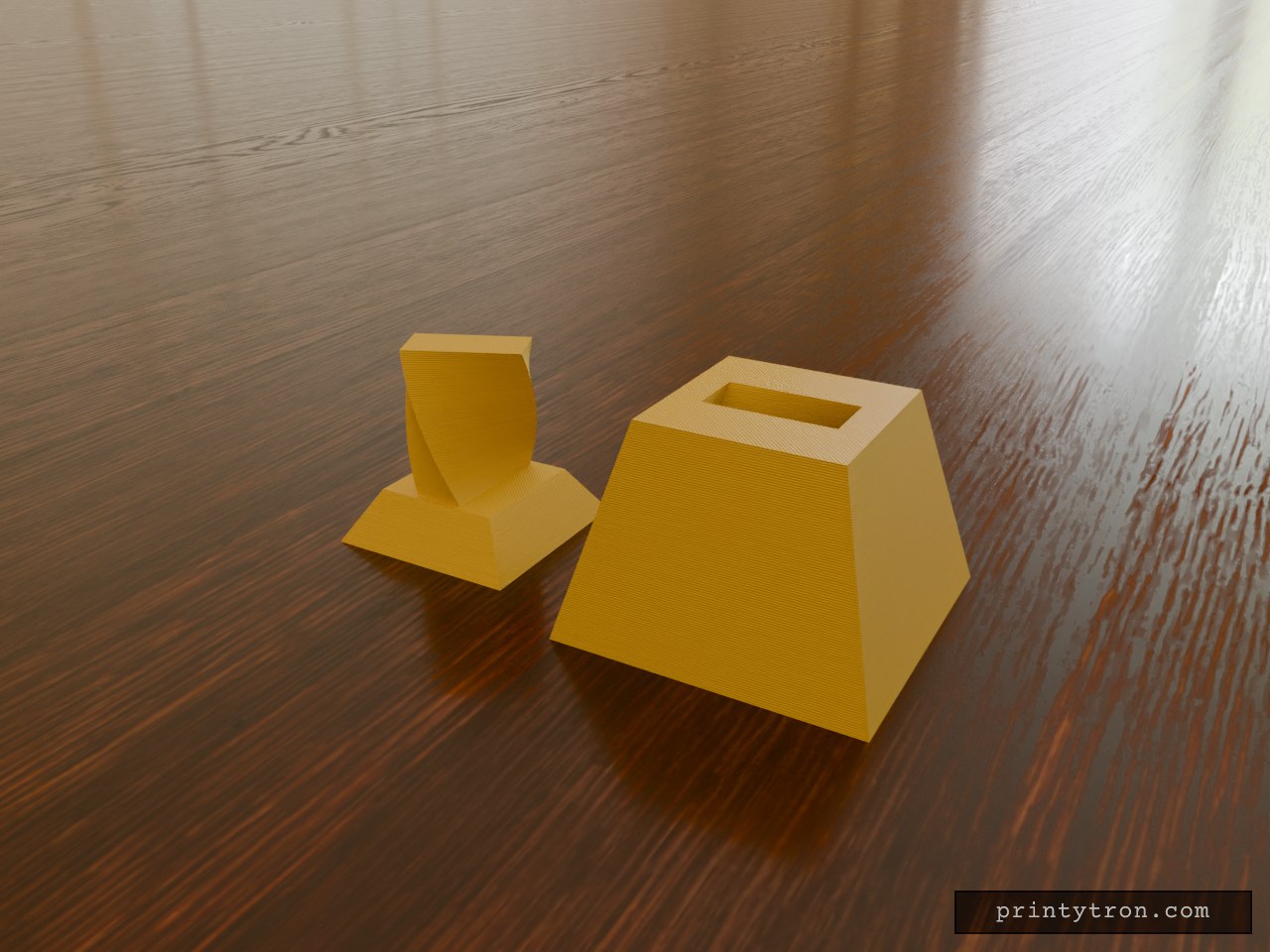
Piramide Twist, puzzle a spirale incastrato
Un piccolo faraone dei puzzle: un blocco a piramide troncata con un foro a spirale e una barra twistata che vi scivola dentro. La barra si infila dal basso, la testa a piramide si adagia nell'incavo e, ruotandola, la spirale la guida fino all'altra estremità. Entrambi i pezzi sono alti 30 mm, così a incastro completato restano a filo. Blocco: base 44 mm, cima 28 mm, altezza 30 mm Barra: sezione 8 × 18 mm, altezza totale 30 mm Gioco 0,3 mm Stampa entrambi con la base sul piano
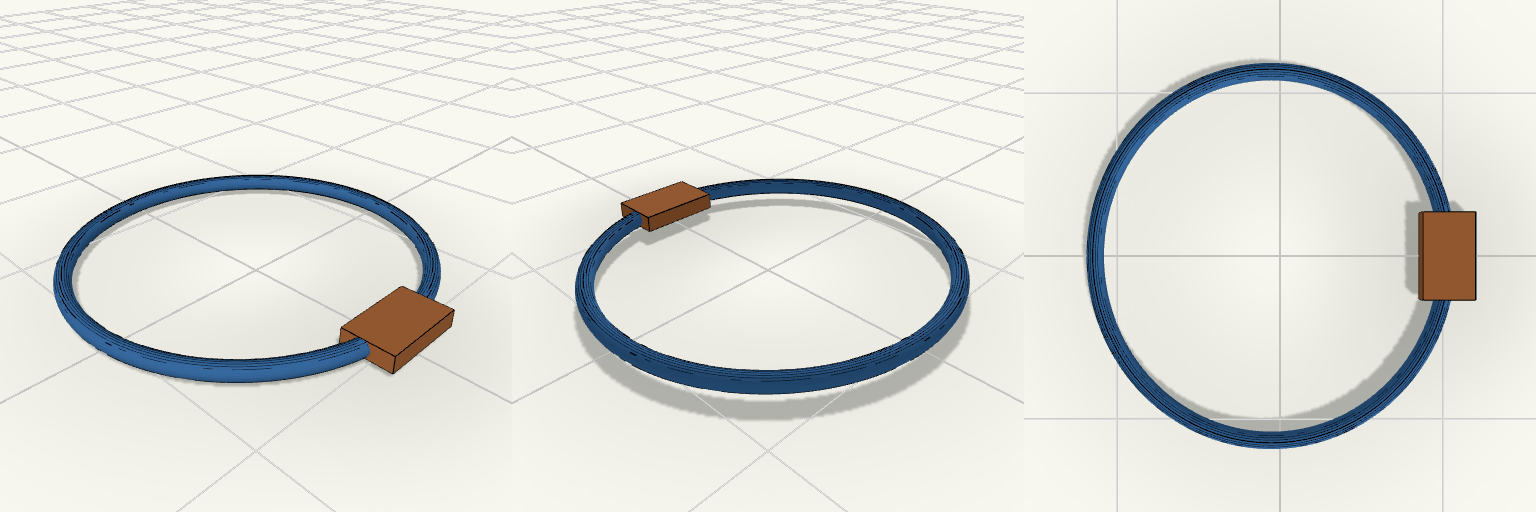
Toroide con caja abierta de 5,2 mm
Un toroide ovalado hueco con una caja abierta integrada en el lateral +X. El anillo mide 21,7 mm en X y 23 mm en Y, y el tubo tiene 2,8 mm por fuera con un canal interior de 1,2 mm, suficiente para pasar un cable de 1 mm sin forzarlo. La caja mide 5,2 mm de largo por 3,1 mm de ancho y 2,8 mm de alto, igual que el tubo, con paredes de 0,8 mm y el fondo interior a 0,8 mm, justo donde el canal desemboca en la cavidad. El tubo no atraviesa la caja: se corta en sus dos lados en Y y el canal se abre hacia el interior, de modo que la caja hace de cámara entre una entrada y una salida. La pieza se apoya en Z = 0 con la abertura de la caja mirando hacia la cama de impresión, así que probablemente necesite soportes o un primer nivel bien ajustado. Todo se imprime como una sola pieza. Puntos para remezclar Toroide: la elipse de 21,7 × 23 mm es la restricción de tamaño; el tubo exterior de 2,8 mm es una elección, y es lo que permite el canal de 1,2 mm con pared de 0,8 mm. Si quieres un canal más ancho o más justo, mueve el diámetro exterior antes que la elipse. Caja: parte de 5,2 × 3,1 × 2,8 mm, con paredes de 0,8 mm y fondo interior a 0,8 mm. Largo y ancho son libres; el alto está atado al del tubo. Engrosa el fondo si buscas resistencia. Entrada y salida: el canal se corta en Y a ambos lados de la caja. Cambia la posición de esos cortes o el recorrido para que la cámara quede más centrada o más discreta. Orientación: la pieza va girada con la abertura hacia la cama. Volver a girarla mejora el primer nivel pero deja la cavidad mirando arriba, con lo que la cámara necesita soportes por otro lado; elige según tu material. Variantes: mueve la caja alrededor del anillo, duplícala en el lado opuesto o añade una tapa. Conserva la proporción 5,2 × 3,1 mm si quieres que la cámara mantenga su escala. Combinaciones: funciona como colgante geométrico, llavero o pieza de exhibición, y la cámara con paso de cable invita a convertirla en contenedor pequeño o en guía para un cordón.
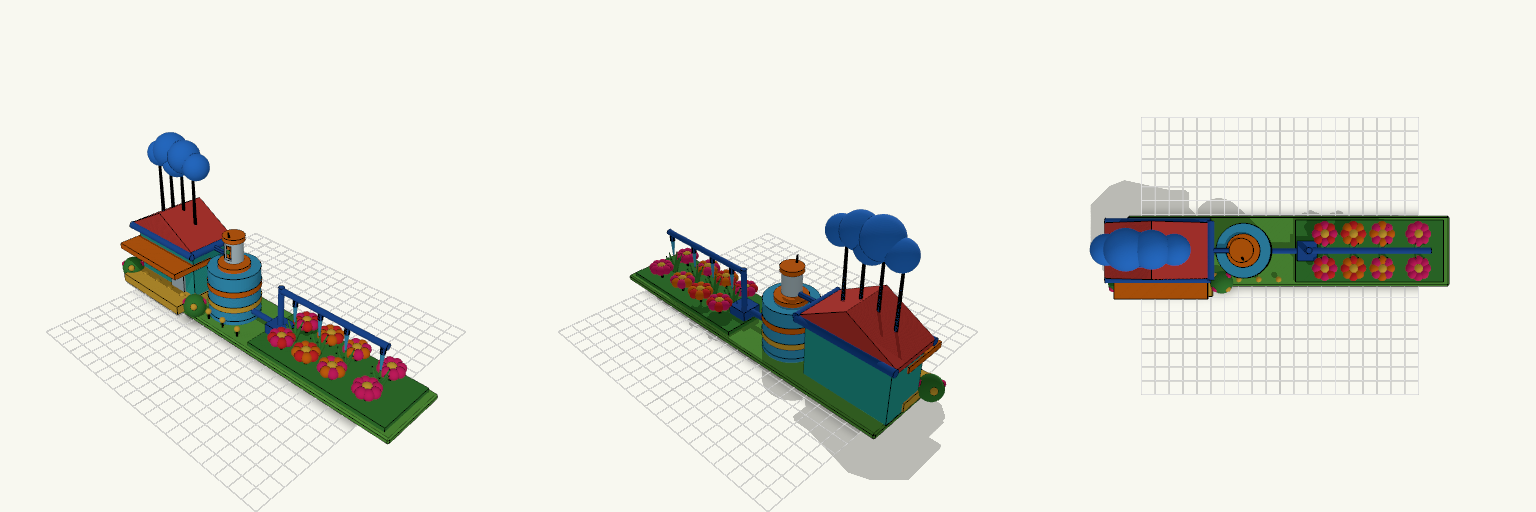
Prototipo Equipo 5
Maqueta de captación de agua de lluvia en estilo de dibujo con marcadores: nube azul, casa turquesa con franjas amarilla y naranja, canaleta, filtro pequeño, tanque, tubería y riego sobre un cultivo florido. Recorrido del agua Nube azul con gotas que caen sobre el techo rojo Canaleta azul en los dos bordes largos del techo Filtro compacto con ventana frontal: hojas verdes y basura naranja atrapada Tanque azul cielo con anillos de color y tapa naranja Tubería azul hacia el riego y cuatro boquillas sobre las plantas con flores
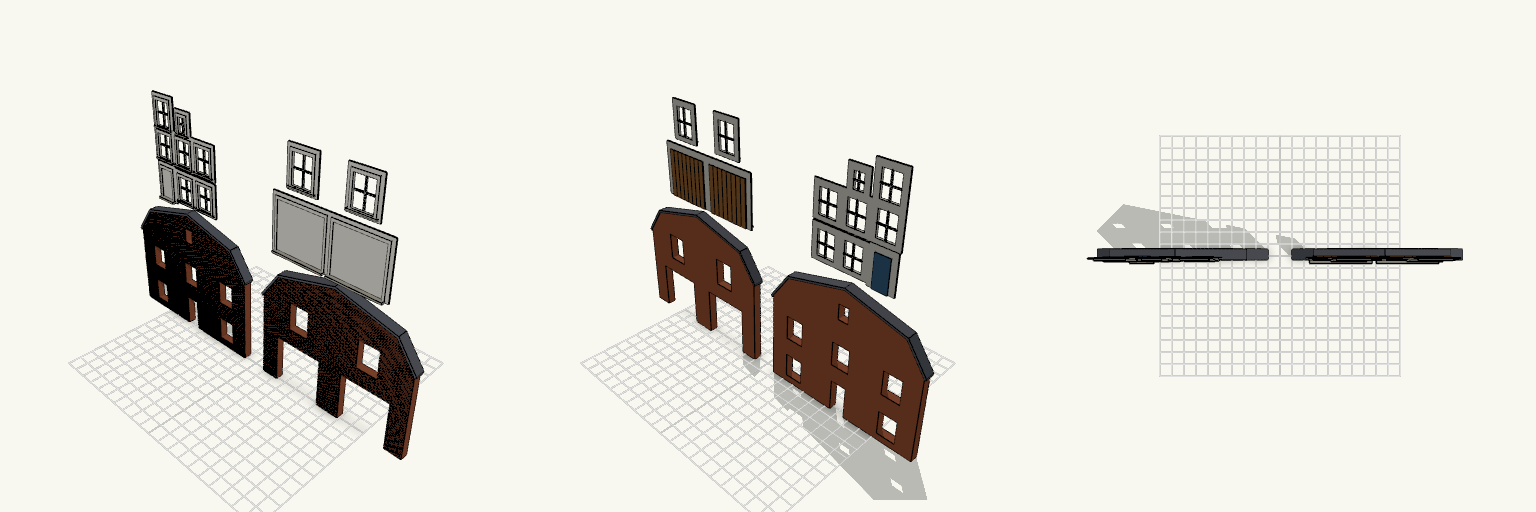
OO Gauge Gable, Dutch barn roof, Wide Low Slat Doors
Half-relief OO gauge (1:76.2) gambrel gable end in Flemish bond brick, shown as two frontages. The second frontage has two wide, low wooden slat doors in the lower wall and two high windows above. Fitment notes Scale: OO, 1:76.2. Wall 120 mm wide, 6 mm deep, 100 mm to the apex. Door openings on the second frontage: 38 × 38 mm each, centred at X=32 and X=88 within the wall. Windows above: 16 × 22 mm, bottom edge at Z=50. Frames, doors and windows print as a separate set above the apex, joined by a thin 0.6 mm sheet. Check before printing: the set is loose, so it must be glued into the openings. Door leaves are 0.8 mm smaller than the frame opening. Not a fit for other scales or for frontages that need a full-depth shell.
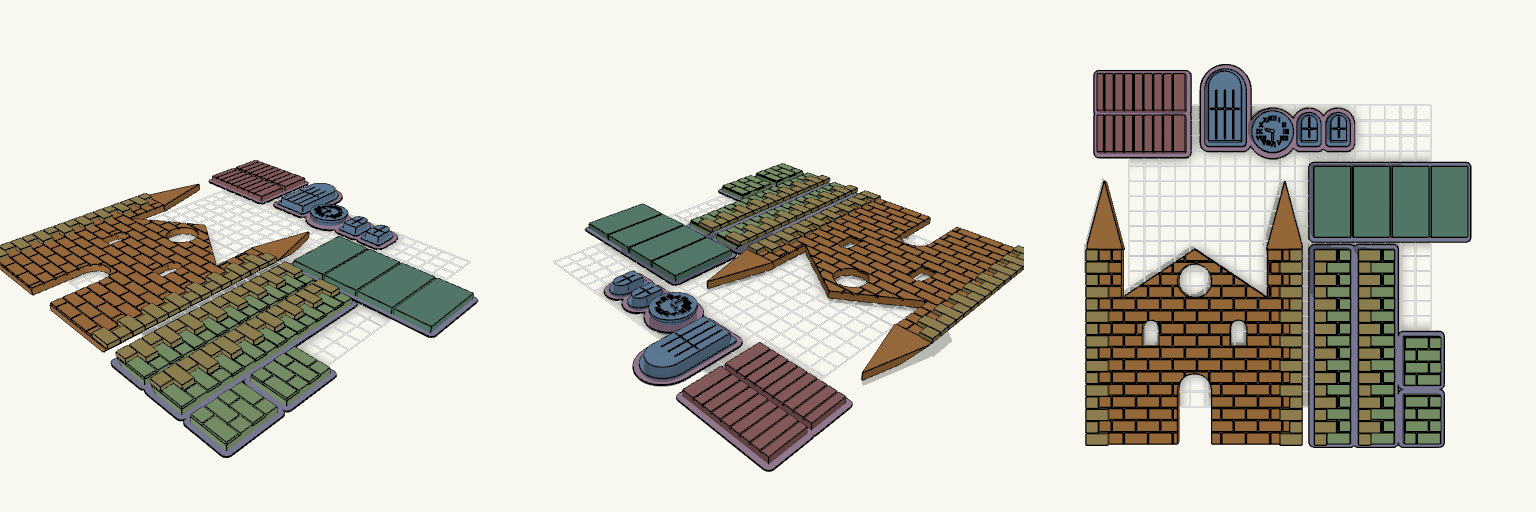
Medieval Church Front Flat-Pack, Bambu A1 Plate
Flat-pack kit for a medieval stone church frontage at 1.6× scale, laid out for a Bambu A1 plate (256 × 256 mm). The one number to check before printing is the plate fit: the layout is about 252 mm across, so leave the skirt and brim off. What is in the kit Front piece: nave, gable and both tower fronts in one 3 mm plate, with the door, clock and lancet openings cut through and quoin blocks built into both outer edges. Tower sides: two panels with quoins moulded along the mitred front edge. Small inner pieces and spire sides: two nave-height inner pieces and four plain spire panels. Roof strips, door insert and clock insert: printed on a separate thin web. Webs A 0.4 mm web surrounds the building side panels, and a second, separate web surrounds the roof strips, door and clock. Cut the parts free with a knife. Not included The two small side windows and their inserts are removed. There are no inserts for the tower lancets or the clock opening other than the clock itself.
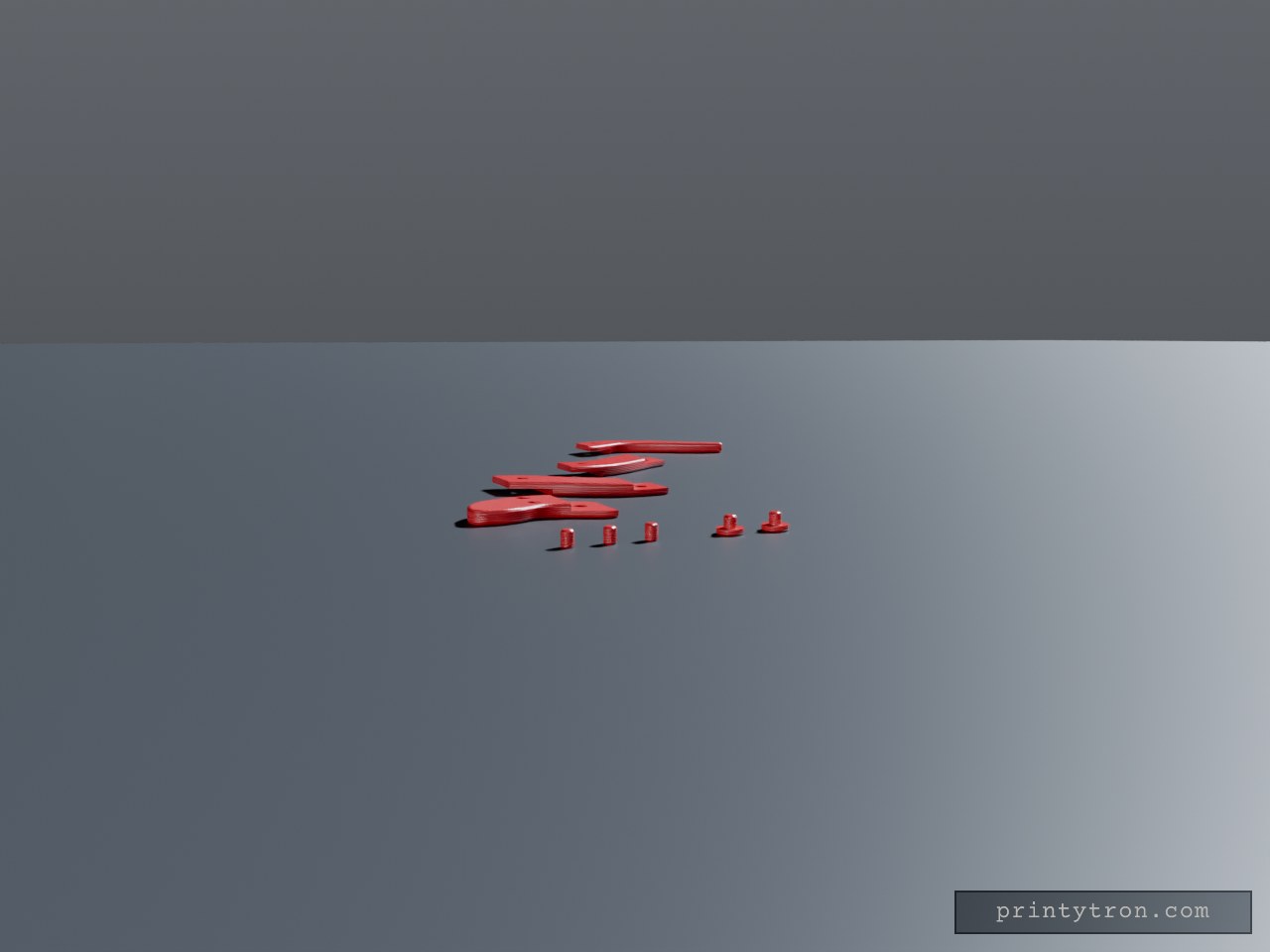
Flat Snake Assembly Kit
What it's for A flat, solid snake that prints as separate pieces and snaps together by hand: head, two body segments, tail, two eyes and three connector pins. Edges are rounded, there is no surface detail, and nothing needs supports. Dimensions Thickness: 4 mm Pin holes: 3.5 mm diameter Pins: 3 mm diameter, 4 mm long Joints: half-thickness lap joints, so the pin passes vertically through both overlapping ends Eyes: 6.5 mm domed discs with a 3 mm peg that fits holes in the head Remix ideas Lengthen the snake with more body segments. Change the wave amplitude for a tighter or straighter snake. Add a keyring hole in the tail.