One-Piece Vintage Car Model
Created 17 days ago
Description
What it's for
This compact one-piece vintage car model has an exposed engine up front, fenders over four wheels, and a gold grille with two round headlamps. The open engine bay holds a blue engine block with six cylinder stacks, a cover plate and an exhaust pipe down each side. Behind it sit a low dash and two open bucket seats with backrests — an open roadster with no cab, and a windshield built as an upright open frame rather than a glazed screen.
The weathered brown frame includes two chassis rails joined by three cross members, the upright windshield frame, and a roll-frame around the seats with four corner posts and a top rail loop. A dark gray steering wheel sits on the left side ahead of the left seat, with a tilted column, a ring and two spokes. A footwell is cut into the floor between the windshield frame and the seats, and the steering column stands on that floor. The body, fenders, seats, wheels, grille/lamp area, exposed engine and frame are separated by colour, which makes it easier to plan a paint scheme or a multi-colour print.
Use it as a small display piece, a shelf ornament or a painting project.
Dimensions
- Body: 24 mm across × 60 mm front-to-back × 8 mm high; seats, engine and frame rise above it.
- Frame: 24.5 × 58 × 24 mm; chassis rails 3 mm thick, corner posts 2.5 mm square.
- Wheels: 38 × 51 × 25.3 mm; the widest point of the car is about 38 mm across at the wheels.
- Fenders: 27 × 54 × 2.5 mm.
- Grille and lamps: 24 × 5.5 × 11 mm.
- Exposed engine: 16.9 × 20 × 12.5 mm.
- Seats: 21 × 12 × 11 mm; backrests stand 11 mm tall and about 3 mm thick.
- Footwell: 18 mm wide × 10 mm long, leaving about 2 mm of floor.
- Steering wheel spokes: 1 mm.
Print notes
- Print the body flat on the bed so the wheels stay clear of the build plate.
- The model prints as one piece and needs no assembly; the wheels are fused to their axles and do not roll freely.
- The exhaust pipes are thin, about 2.5 mm across; handle cleanup gently, or thicken them if they snap.
- The steering wheel spokes are 1 mm and are the weakest detail, so take care when cleaning the print.
- The footwell floor is about 2 mm thick; take care when cleaning it out.
- Check the roll-frame and upright windshield frame when removing the print.
Remix ideas
- Recolour the body, fenders, seats, wheels, grille/lamp area, engine and frame to match a period livery or to highlight the exposed engine.
- Scale the model for a larger display piece or a smaller desk ornament.
- Keep the fused-wheel layout for a simple one-piece print, or use the wheel and axle area as a starting point for a free-rolling variant.
- Change the engine details in the open bay, reshape the seats, or add rivets and bends to the chassis rails to push the weathered look further.
- Extend or simplify the roll-frame, or swap the steering wheel for a different period wheel.
Images
More like this
Explore more in Decor & Display →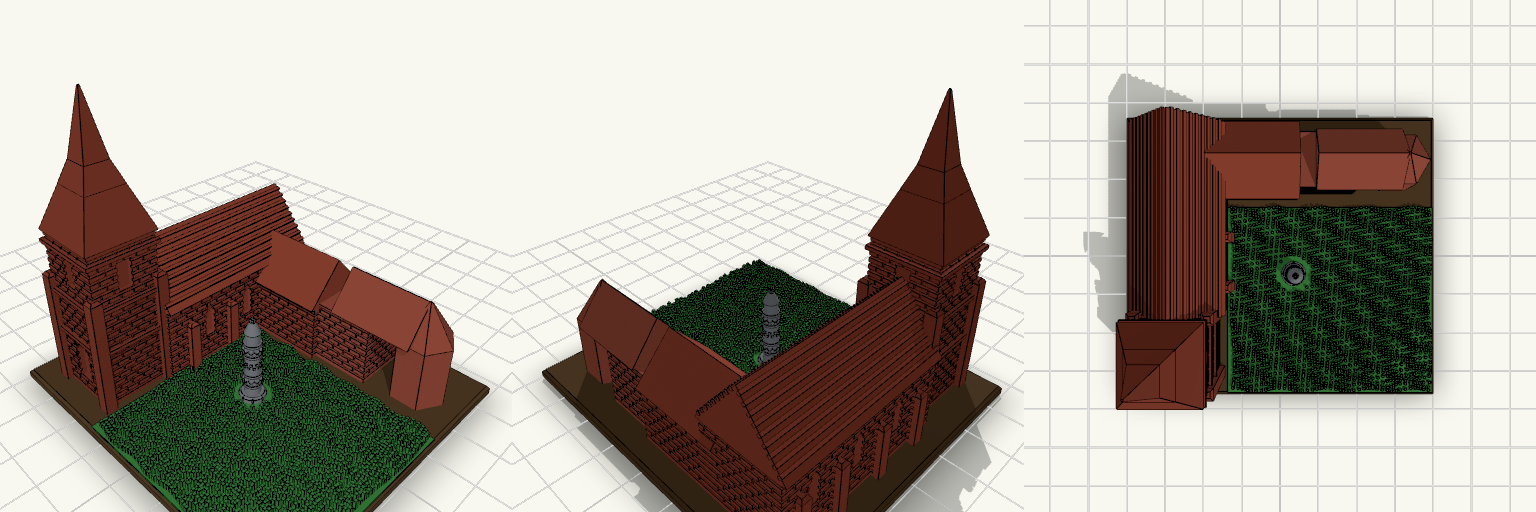
Fara — Uproszczony Model Kościoła
Fara to miniaturowa świątynia w duchu gotyku ceglanego, rozplanowana na literę L. Nawa biegnie wzdłuż jednej osi, a od jej tylnego końca odchodzi w bok skrzydło z dachem dwuspadowym; na jego końcu zamyka całość wieloboczne prezbiterium. Przy froncie wznosi się smukła wieża z ostrym hełmem. W środku wewnętrznego narożnika litery L, odsunięty od ściany nawy i od frontu skrzydła, stoi Słup Koniński — walcowaty trzon na szerszej podstawie ze stożkowym zwieńczeniem i kulką na szczycie. Ściany nawy, wieży i prezbiterium mają ceglaną czerwień oraz relief prawdziwego muru: poziome fugi i przesunięte w co drugiej warstwie pionowe spoiny. Słup zachowuje własny, kamienny charakter i odrębny zestaw ornamentów. Całość stoi na wspólnej, brązowej płycie o lekko ściętej krawędzi. Plac wokół słupa ma zieloną nawierzchnię i porasta go gęsta trawa — źdźbła o różnej wysokości, rozsiane w rozstawie około 1 mm, z wolnym miejscem tuż przy podstawie słupa. Model dobrze czyta się jako dekoracyjna miniatura na półkę, element makiety miasteczka albo pamiątka związana z Koninem. Proporcje są przybliżone — oparte na ogólnym układzie świątyni, a nie na planach budynku — więc detale wieży czy liczba okien mogą odbiegać od oryginału. Słup jest wyraźnie wyższy względem kościoła, niż byłby w skali: prawdziwy jest dużo niższy i przy tej skali wyszedłby zbyt cienki do druku. Wymiary Szerokość × głębokość × wysokość poszczególnych części: Płyta: 79 × 71 × 2 mm, z lekko ściętą krawędzią Trawa (zielony plac ze słupem): 52,6 × 47,8 × 2,3 mm Nawa (ze skrzydłem): 39,8 × 45,2 × 32 mm Wieża: 18,6 × 18,6 × 67 mm Prezbiterium: 30,9 × 14 × 24 mm Słup koniński: 6,1 × 6,1 × 21 mm Wieża jest najwyższym elementem całości — o tym warto pamiętać przy planowaniu wysokości druku. Cechy Plan litery L: nawa i odchodzące od jej tylnego końca skrzydło z dachem dwuspadowym, a na jego końcu wieloboczne prezbiterium Stromy dach nawy, przypory i ostrołukowe okna — czytelny gotycki charakter bryły Mur z cegieł na nawie, wieży i prezbiterium: poziome fugi co około 1,6 mm oraz pionowe spoiny co około 3 mm, przesunięte o pół cegły w co drugiej warstwie Żebra imitujące dachówki na obu połaciach dachu nawy Trzy poziome gzymsy i rząd drobnych rombów pod hełmem wieży Słup ustawiony w środku placu przy wewnętrznym narożniku litery L, odsunięty od kościoła, z podstawą i stożkowym zwieńczeniem z kulką, ozdobiony pierścieniami, dwoma rzędami rombów, zygzakiem i bruzdami na cokole Wspólna płyta pod całością, z zieloną nawierzchnią i trawą na placu wokół słupa — model stoi stabilnie i zaczyna się od płaskiego spodu Uwagi o druku Model nie ma delikatnych, ażurowych detali — okna i przypory są płaskorzeźbione w bryle — więc dobrze znosi typowe ustawienia druku. Fugi mają około 0,4 mm głębokości, a pionowe spoiny rozstawione co 3 mm mogą przy standardowej dyszy 0,4 mm wyjść ledwo widoczne; jeśli drukarka je zaleje, warto zmniejszyć warstwę lub nieco pogłębić rowki w slicerze. Źdźbła trawy mają 0,6 mm szerokości i rozstaw około 1 mm — gęściej nie ma sensu przy dyszy 0,4 mm, bo źdźbła zleją się w jedną plamę. Największą uwagę warto poświęcić wieży z hełmem, która sięga 67 mm, oraz cienkiemu trzonowi słupa o średnicy 6,1 mm. Cały model jest jednym elementem na wspólnej płycie — nie wymaga sklejania.
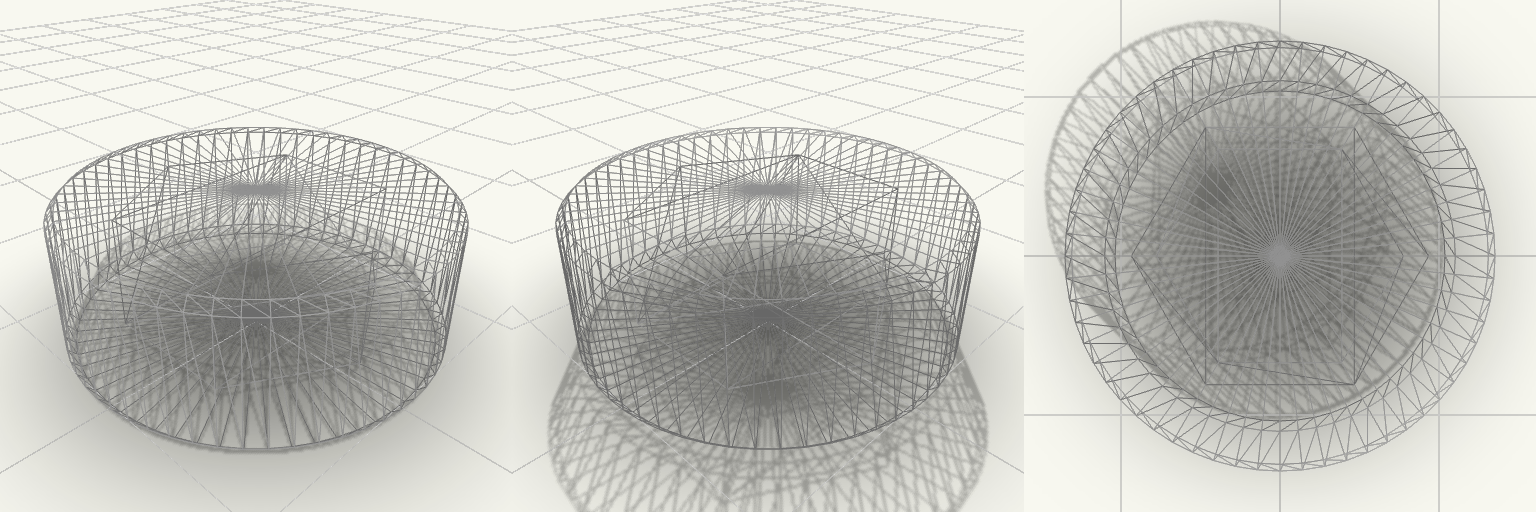
Backgammon Piece with Hidden Hexagon Cavity
What it's for A backgammon checker with a sealed hexagonal cavity hidden inside, suited to holding a small weight or token, or simply to being a hidden-feature piece. Dimensions Outer cylinder: 21.5 mm diameter, 8 mm tall, 0.5 mm edge chamfer Hidden hexagon: 13 mm across flats, 6.4 mm tall Cavity centred vertically, leaving 0.8 mm of material above and below Remix ideas Add a small weight (coin or steel washer) before sealing the cavity by pausing the print Change the cavity to a different shape, such as a star or circle Engrave a number or logo on the top face
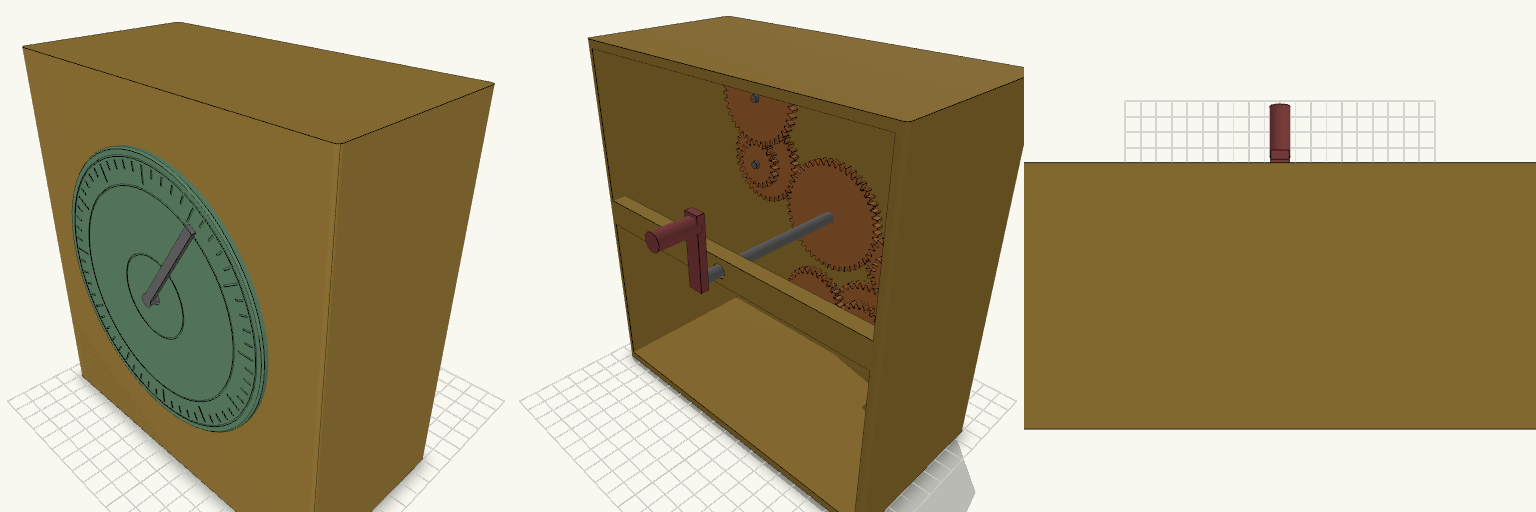
Antikythera Mechanism Desk Model
A simplified, life-size-style display model of the Antikythera mechanism: an upright case with a round front dial, a pointer, an open-backed gear train and a rear hand crank. Case 180 x 90 x 190 mm, open at the back to show the gears 130 mm front dial with ring grooves and 60 tick marks Nine spur gears (20 to 48 teeth, module 1.25) arranged in three layers, with phase-matched teeth so they mesh Fixed 4 mm pegs on the front wall carry the compound gears; the main 48-tooth gear is fused to a 6 mm axle that drives the front pointer Rear bearing bar supports the axle, with a crank handle on the back The gear train is a stylised interpretation, not a tooth-accurate copy of the original 30-plus gear mechanism. Print the case, dial, gears, axle and crank separately; the compound gears sit loose on their pegs with 0.3 mm clearance.
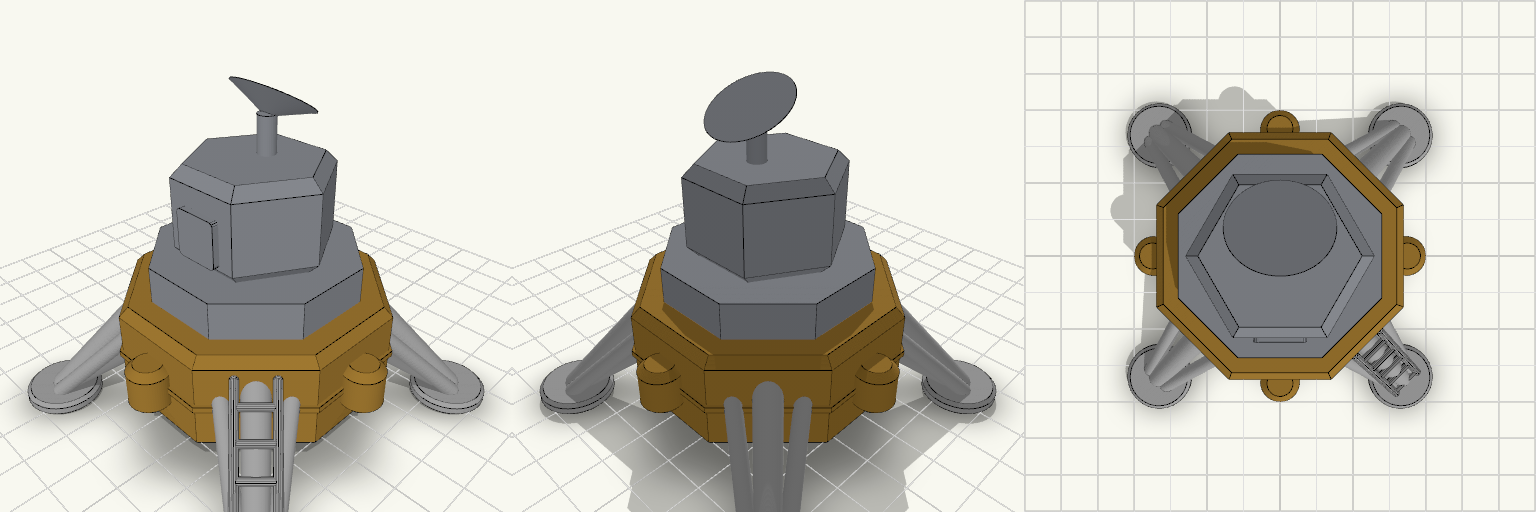
Apollo-Style Lunar Lander Model, 82 mm Footprint
This is a stylized Apollo-style lunar lander display model. It has an octagonal descent stage with four shallow fuel-tank bulges and a panel band around the middle, a faceted hexagonal ascent cabin with a raised front hatch, an engine bell underneath, and four splayed A-frame legs with chamfered footpads. One leg — the front-right — carries a ladder with two rails and rungs, and a tilted dish on an 8 mm mast sits toward the rear of the cabin roof. At roughly 82 mm across the footpads, it is sized as a compact desk or shelf piece. The cabin front is clean apart from the hatch, so the model reads as a lander rather than anything else. The legs are the widest part of the print; the body sits well inside that spread. Specs Footprint: approx. 82 mm across the footpads Descent stage: octagonal, approx. 68 mm across × 22 mm tall, with four shallow fuel-tank bulges and a mid panel band Ascent stage: faceted hexagonal cabin, approx. 42.5 mm across × 43.5 mm tall, with a raised front hatch and a tilted dish on an 8 mm mast Engine bell: approx. 18 mm across × 9 mm tall, mounted low under the central body about 1 mm above the plate, so it reads best from a low viewing angle Legs: four A-frame legs, each with a thick main strut anchored into the descent stage, a lower angled strut and two side struts; chamfered footpads approx. 17 mm Ladder: two rails and rungs on the front-right leg Use: display model for a desk, shelf, or space-themed collection Printing notes The splayed legs and footpads set the build plate footprint; check the 82 mm spread against your plate before scaling up The dish mast, ladder rungs and hatch are the finest features — a smaller layer height keeps them crisp
55كعبة مجزءة
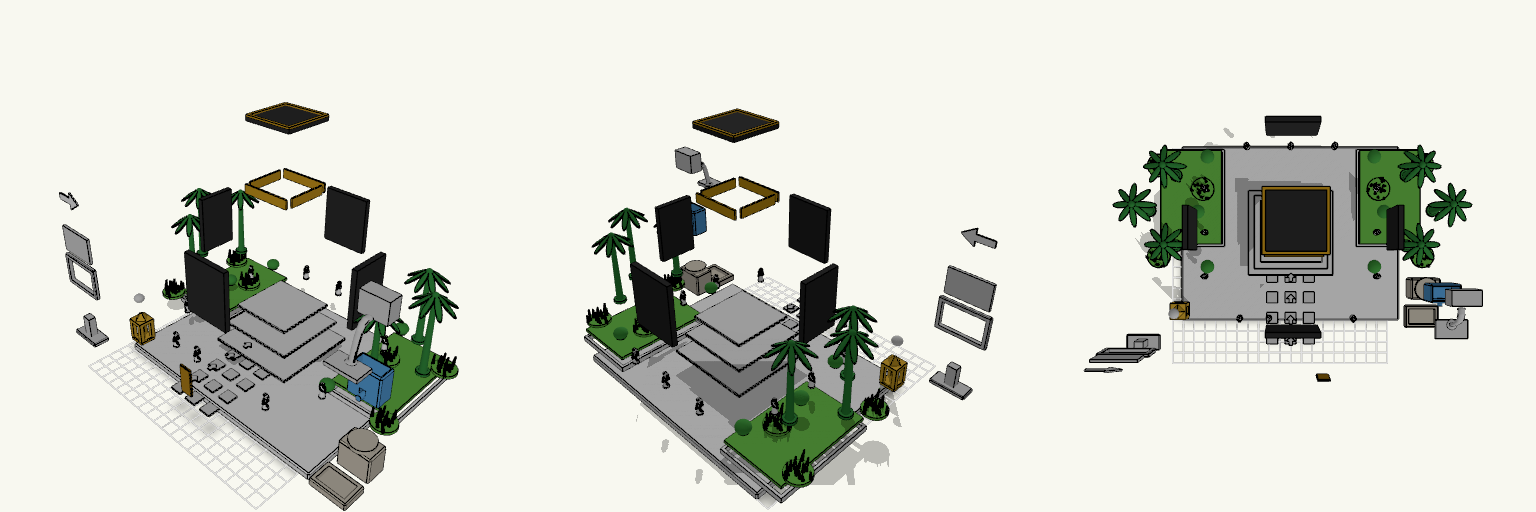
Exploded miniature of a masjid scene with every component spread apart with visible gaps. Parts: white base, platform tiers, four black Kaaba walls, roof, door, gold bands, walkway tiles, arrows, palms, bushes, grass, pilgrims, Zamzam station, Maqam Ibrahim and blue sign parts. Layout: exploded only, no assembled copy. Export: the download is one file; separating individual parts happens outside this model.
Miniature Suitcase with Handle, Wheels and Weight Display
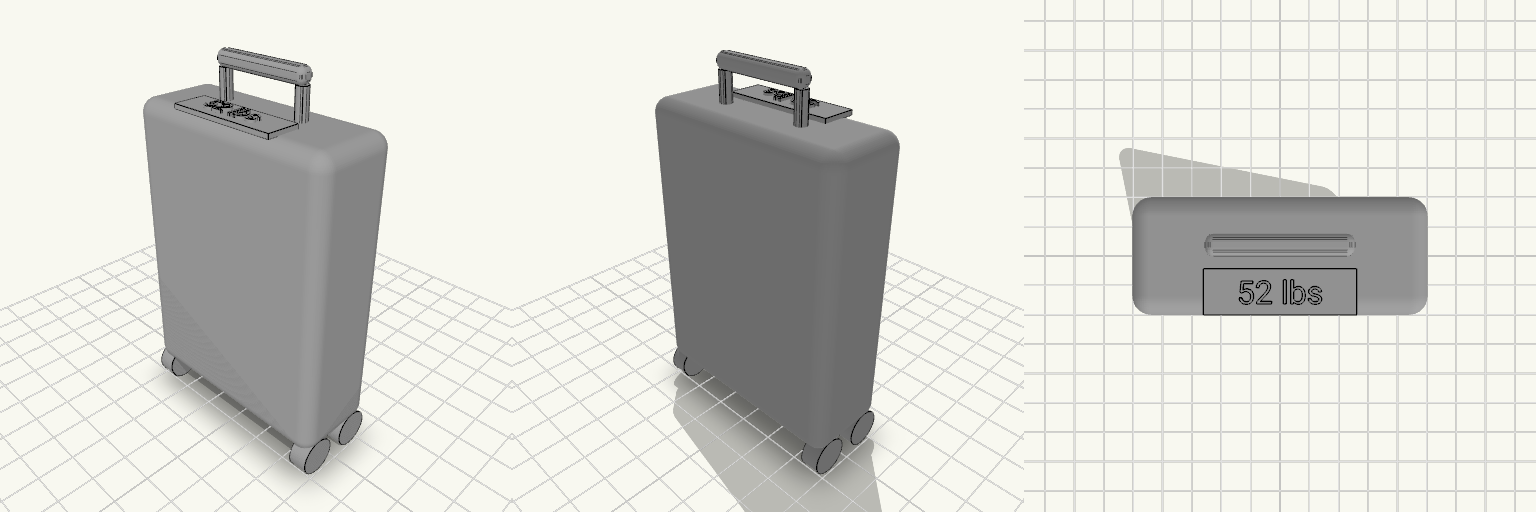
What it's for A miniature suitcase standing upright on four sideways-mounted wheels, with a pull handle on top and a small thin scale plate set into the top face just in front of the handle. The plate carries a raised readout of 52 lbs, so the piece reads as a luggage scale at a glance. It works as a small desk ornament, a travel-themed display piece, or a scale prop for a dollhouse or diorama. The whole thing is one plain neutral finish, with no colour coding or recessed front screen. Dimensions Overall footprint: 60 × 24 × 100 mm (width × depth × height, as it sits on the print plate) Wheels: mounted sideways, axles running across the width of the case, so the body rests on them Weight plate: a small thin panel on the top face, in front of the handle Readout: raised 52 lbs lettering, picked as a believable airline-limit weight — say if you want a different figure Print notes The model prints as a single piece lying on its wheels, so no supports are needed under the body. The raised readout is small — a 0.4 mm nozzle with fine layer heights keeps the digits and the "lbs" legible, and a 0.25 mm nozzle gives crisper text. The thin top plate is shallow, so check that your bridging over that area is clean. Remix ideas Change the readout to a different weight, or leave the plate blank for a custom label. Swap the handle for a telescoping version, or add corner guards to the body. Scale the case up to hold small items, or down to keyring size. Finish A single neutral colour suits the plain, serious look — the design relies on shape and the raised text rather than colour contrast, so any filament works.