Familystan-2
Made by RafterJabiru
Created 1 months ago
Description
What it's for
A custom desktop display featuring three names—Anwar, Shireen, and Aadheen—arranged in a triangle. The names lean inward to meet at the corners, sitting on top of a double base consisting of a triangular connecting frame and a wider circular footing.
Dimensions
- Overall footprint: 70 mm x 70 mm (dictated by the circular base)
- Height: ~33 mm
- Base thickness: 4 mm combined (2 mm ring, 2 mm triangle)
Print notes
- No supports required; the text is angled comfortably at 45 degrees.
- The names and frames are modeled distinctly for easy multi-color painting or layered printing.
Images
More like this
Explore more in Decor & Display →
Dual xvideos plate print 180 mm
A two-up XVIDEOS nameplate set intended as a gift sign for a friend, for desk or shelf display. The model contains two identical horizontal plates, each with a solid black base, a red uppercase “X” at the left, and white “VIDEOS” lettering across the rest of the width. Each plate has a flat back and three underside pockets for 4×2 mm disc magnets. The plates are laid out with a gap and print as two separate pieces. Layout: two identical plates, each 180 × 44.3 mm at about 4.06:1; overall footprint 180 × 99.3 mm with roughly a 10 mm gap; prints as two separate plates. Base: black, 6.5 mm thick, flat back, no supports required. Lettering: single word XVIDEOS, all uppercase; cap height 29.7 mm, about 67% of plate height; text spans about 164 mm with even side margins; heavy geometric sans; letters set tight. Colors: red “X” (#E02A00), white “VIDEOS”, black base; aligned color regions for clean multi-color boundaries. Relief: letters stand about 1.8 mm above the base; raised faces are left square. Magnets: three round pockets per plate, 4.2 mm across × 2.1 mm deep, for 4×2 mm disc magnets; on the long centerline at X = -60, 0 and +60 mm; 120 mm end to end, with the outer pockets 30 mm in from the short ends. Magnet fit: 0.2 mm of play in diameter and depth for a snug fit; about 4.4 mm of base remains above each pocket. Printing: FDM-friendly, flat backside, no supports required.
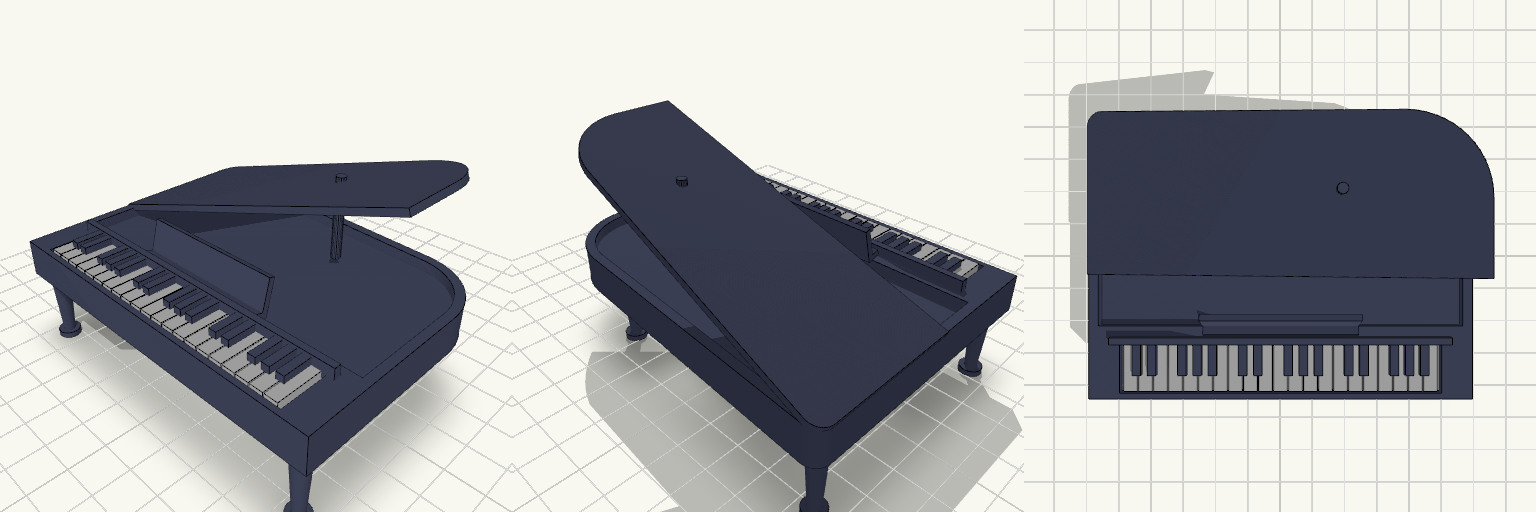
Miniature Two-Material Grand Piano, 100 mm Wide
A miniature grand piano that prints as one assembled piece: a curved case with a propped-open lid, four tapered legs, a music stand and a keyboard of 21 white keys running nearly the full width of the front. The body and black keys are PLA; the white keys are PETG, carried on a plate that drops into a recessed pocket in the case and is held in place by the key slip in front, so the two materials are retained mechanically rather than relying on PLA/PETG adhesion. Overall size: 100 × 75 × 61 mm. White key plate: 84 × 14 × 5.2 mm, 21 white keys with black keys in standard groups of two and three. PLA: case, lid, legs, music stand and black keys. PETG: white keys only. Print upright on its legs; the tilted lid overhangs and needs supports — keep them clear of the key pocket. Two separate colour regions: assign PLA and PETG to them in the slicer, use a purge tower and expect a fair amount of purge waste. The black keys are PLA, the same colour as the body, so they read as body colour unless the material is swapped. The model is a single watertight piece with no glue and no post-print fitting of keys or trim. Detail is sized for a 0.4 mm nozzle, and the widened keyboard leaves only a couple of millimetres of case wall at the front corners, so a well-tuned first layer helps there.
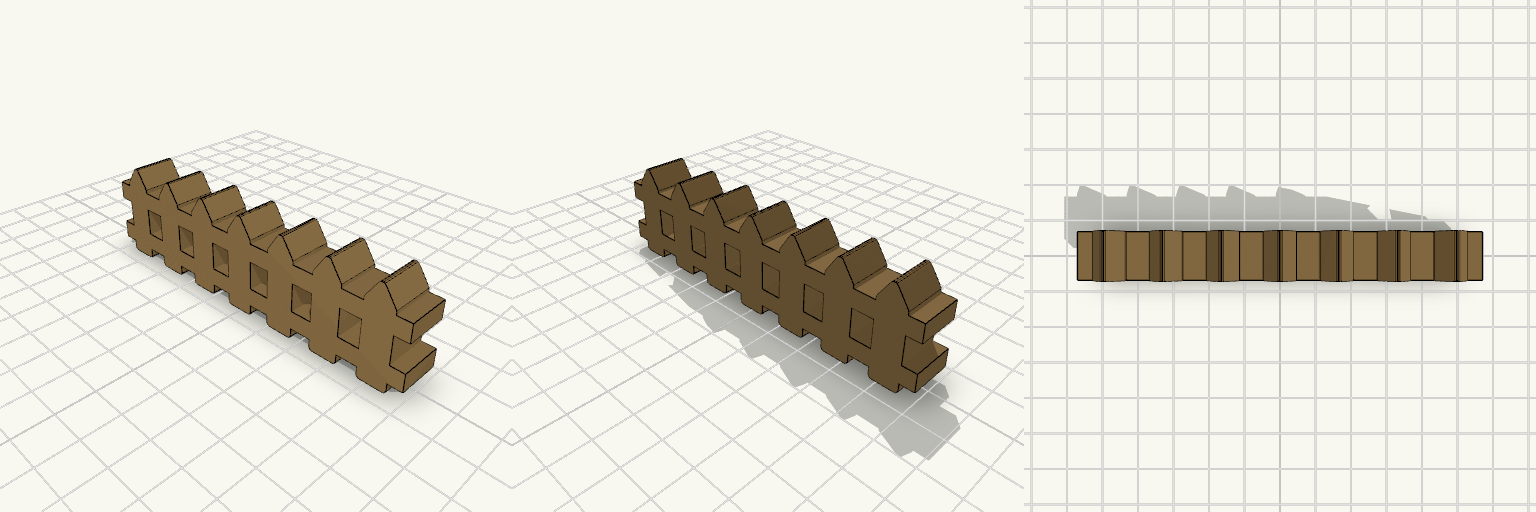
Flat Picket Fence Panel, 100 mm
A single flat picket fence panel, 100 mm long and 12 mm thick, with seven vertical pickets set 8 mm wide with 6 mm gaps between them. Two horizontal rails run the full length near the top and bottom, and the picket tips are rounded points that top out at about 27.2 mm. The pickets sit 4 mm in from each end, with the rails running through to the edges. The model is stored standing upright but is meant to print on its back face: laid flat, the 12 mm thickness becomes the print height and no supports are needed. Walls are 3 mm and the rails are 5 mm tall, so the part is sturdy at a small scale. Seven pickets, 8 mm wide with 6 mm gaps Two full-length rails, 5 mm tall Rounded pointed tips, roughly 27.2 mm overall height Print flat on the back face, no supports 3 mm walls, suited to PLA Use it as a miniature garden border, a diorama or model-railway accessory, or a small decorative edging piece.
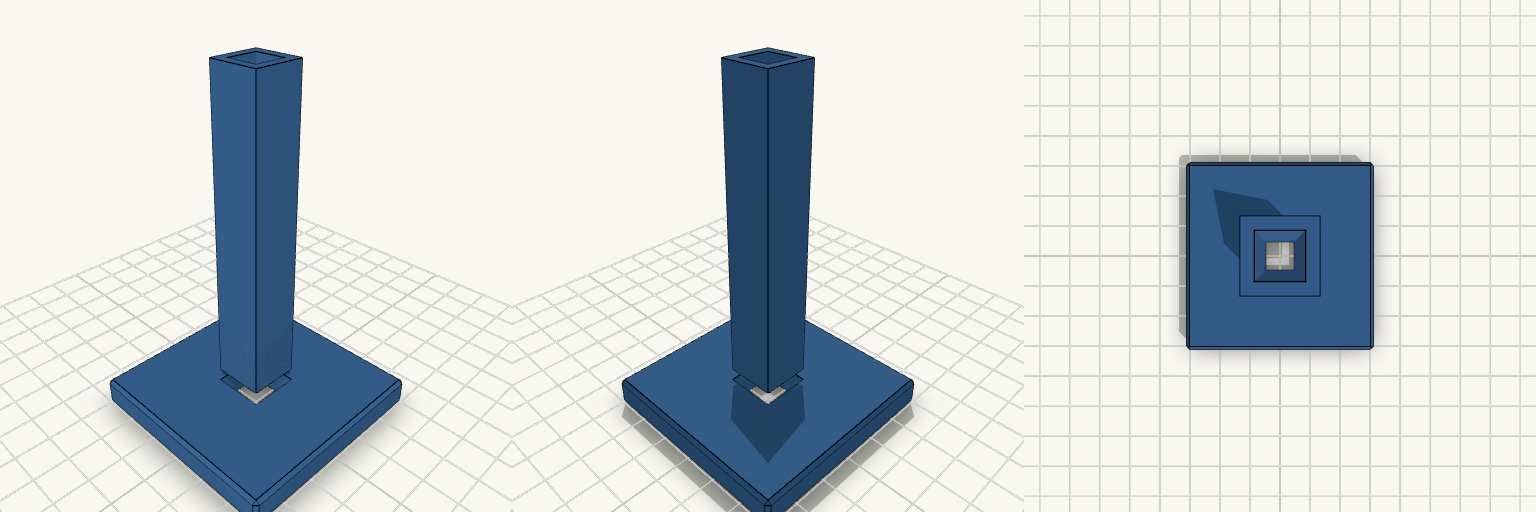
Square-Foot Tabletop Post Stand
What it's for A one-piece tabletop stand: a flat square foot with a single 14 mm square post rising from its centre. The broad 60 mm foot keeps the post stable on a desk or shelf, and the post gives you a square, straight upright to build onto, hang something from, or slot a part over. The underside carries a square sleeve socket with a wire hole through its floor, so a cable can be fed up through the post and out of the open top instead of running loose down the outside. It prints as one piece — nothing to glue or assemble. Dimensions Footprint: 60 × 60 mm, 8 mm thick, with a 1 mm chamfer around its edges. Post: 14 × 14 mm square, rising 90 mm from the centre of the foot. Overall height: 98 mm as it sits on the print plate. Underside socket: 14.5 × 14.5 mm square, 12 mm deep, centred in the foot and running 4 mm up into the post. Wire bore: 9 × 9 mm, running the full length of the post from the socket floor out through the open top, leaving about 2.5 mm of wall around it. Print notes Material: PLA on an FDM printer. Orientation: stands upright on its foot, so it prints with no supports. Walls: the post is bored out, so its walls are about 2.5 mm — a 3 mm perimeter setting will not fit them evenly; two or three perimeters gives a cleaner result. Slicing: set 20% infill in your slicer; the model itself does not carry an infill value. Remix ideas Change the post cross-section to match whatever has to slide over it, keeping roughly 0.5 mm clearance per side. Resize the socket to take a different sleeve, or cap the top of the bore to make a closed internal channel. Scale the foot wider or thinner for a heavier load or a tighter shelf space.
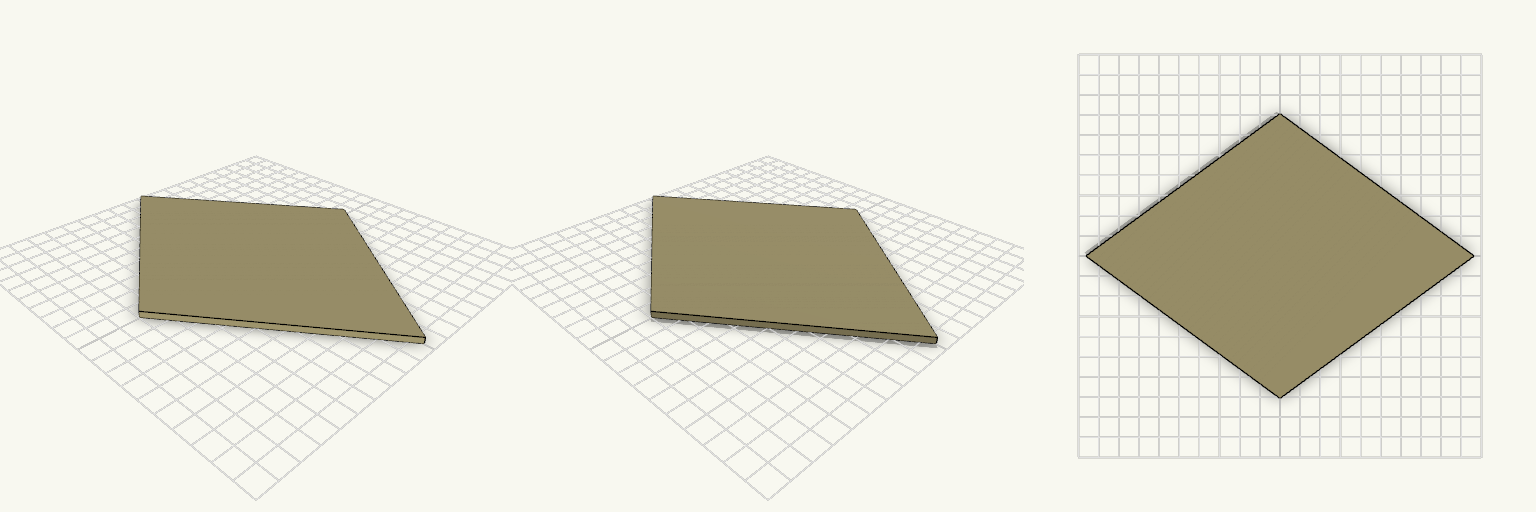
Goldenrow — Flat Diamond Panel
Goldenrow is a plain, flat diamond panel: a clean blank with a 7.5 in diagonal along X and a 5.5 in diagonal along Y. With no raised artwork, it is a single flat slab that prints quickly with no supports. Dimensions Diagonals: 190.5 mm (7.5 in) along X, 139.7 mm (5.5 in) along Y Thickness: 3 mm Print notes Flat on the bed, no supports needed For speed: 0.6 mm nozzle, 0.3–0.4 mm layers, 2 walls, low infill (10–15%) and a fast top-surface setting Fits a bed of roughly 200 x 150 mm or larger
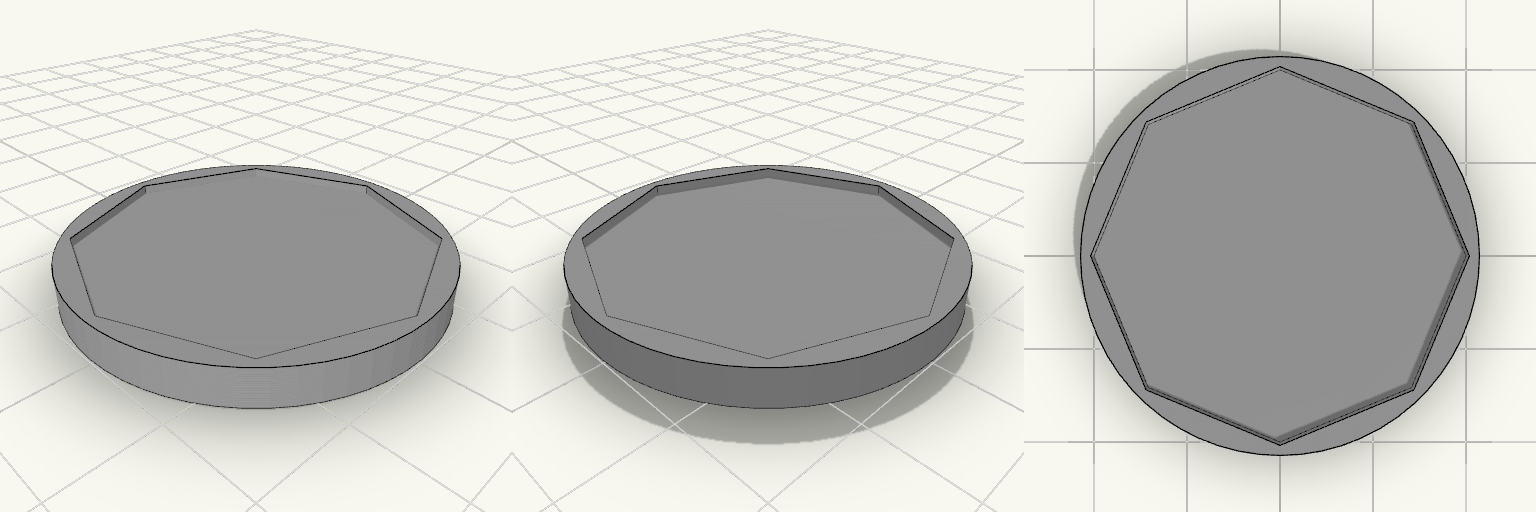
40mm Round Coin Octagon Recess
A 40 mm diameter, 4 mm thick round coin with an octagonal recess on each face. The recess is 1 mm deep, and its corners stop 1 mm short of the rim, so the edge stays a continuous ring. Diameter: 40 mm Thickness: 4 mm Recess: octagon, 19 mm corner radius, 1 mm deep, both faces Rim: unbroken, about 1 mm wide at the octagon corners Print: flat on either face, no supports needed