Kaugummiautomat im Heißluftballon-Stil für 18-mm-Kaugummis
Created today
Description
Der Kaugummiautomat gibt einzelne Kaugummis vorne aus dem Zylinderfuß aus. Die Kugel sitzt mittig über dem Fuß und lässt sich über einen abnehmbaren Deckel befüllen. Vier gerade, senkrechte Streben tragen die Kugel vom Fußrand bis in die Kugelwand. Ein Rohr führt von der Kugelmitte über einen schrägen Trichter zur Drehmechanik im Zylinder: Eine Drehscheibe mit einem Loch für je ein Kaugummi wird von außen durch die Seitenfenster gedreht, sodass pro halber Umdrehung ein Kaugummi zur vorderen Öffnung rollt. Vor der 22-mm-Öffnung liegt eine mitgedruckte Ablagerampe, die das Kaugummi auffängt und nach vorn führt.
- Gesamtgröße (Druckplatte): 82 × 91 × 129 mm
- Kaugummi-Durchmesser: ca. 18 mm
- Deckel: 55,8 × 55,8 × 19 mm, abnehmbar
- Drehscheibe: 55 × 55 × 20 mm, im Fuß mit ca. 0,3 mm Luft eingebaut
- Streben: vier Stück, gerade und senkrecht vom Fußrand bis in die Kugelwand
- Rohr: oben mittig unter der Kugel, unten zum versetzten Loch der Drehscheibe abgewinkelt; ein Trichter in der Kugel leitet die Kaugummis dorthin
- Ausgabe: 22 mm breite Öffnung vorn, davor eine 26 mm breite Ablagerampe mit 2 mm Seitenwänden, 20 mm Länge, 6 mm hoher Frontkante und Abfall von 4 mm auf 1,5 mm
- Druck: als ein Stück; im Bereich der Drehscheibe Stützmaterial einplanen oder die Scheibe nach dem Druck kurz lösen
Images
More like this
Explore more in Storage & Organization →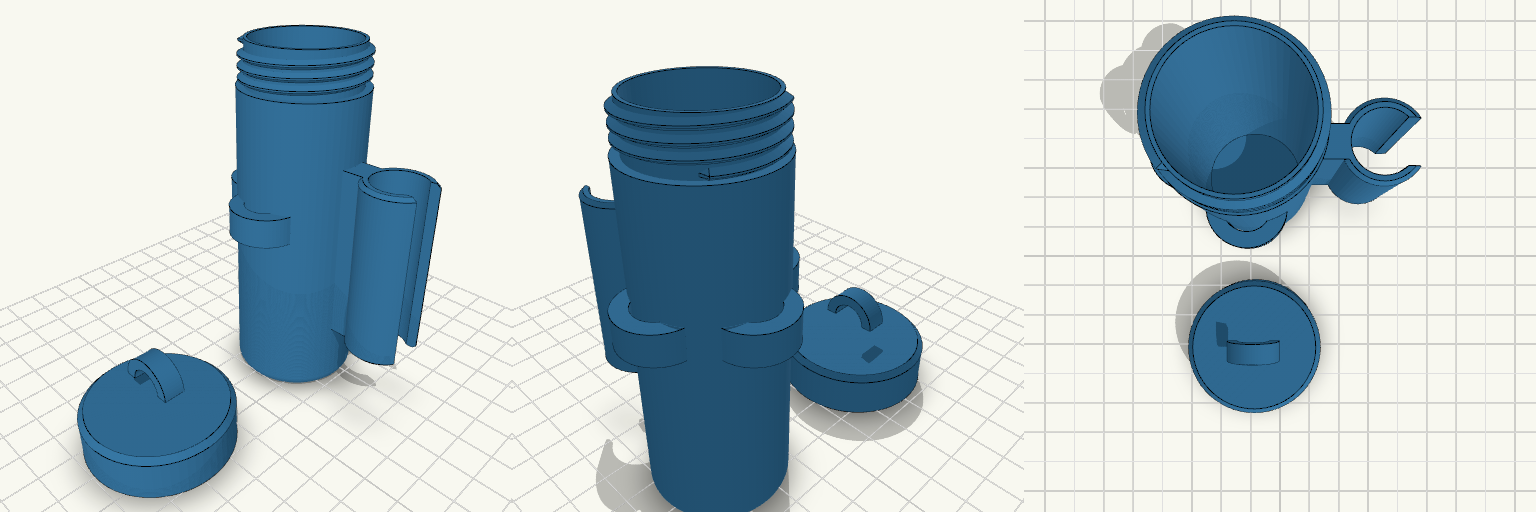
RigPot — Bankstick Jar with Rig Loops
RigPot is a 30 mm bore, 100 mm tall screw-top jar built for carp tackle. It has a 50 mm side clip for a 15 mm bankstick, and three half-round loops for hanging rigs. Features 30 mm inside diameter, 100 mm tall Screw lid printed separately beside the jar Bankstick clip, 50 mm long, 15.4 mm bore with a snap-in slot Three flat half-ring rig loops at 90°, 180° and 270°, both ends fused into the jar wall Print notes The jar, clip and loops print as one body The lid is a separate piece and prints beside the jar
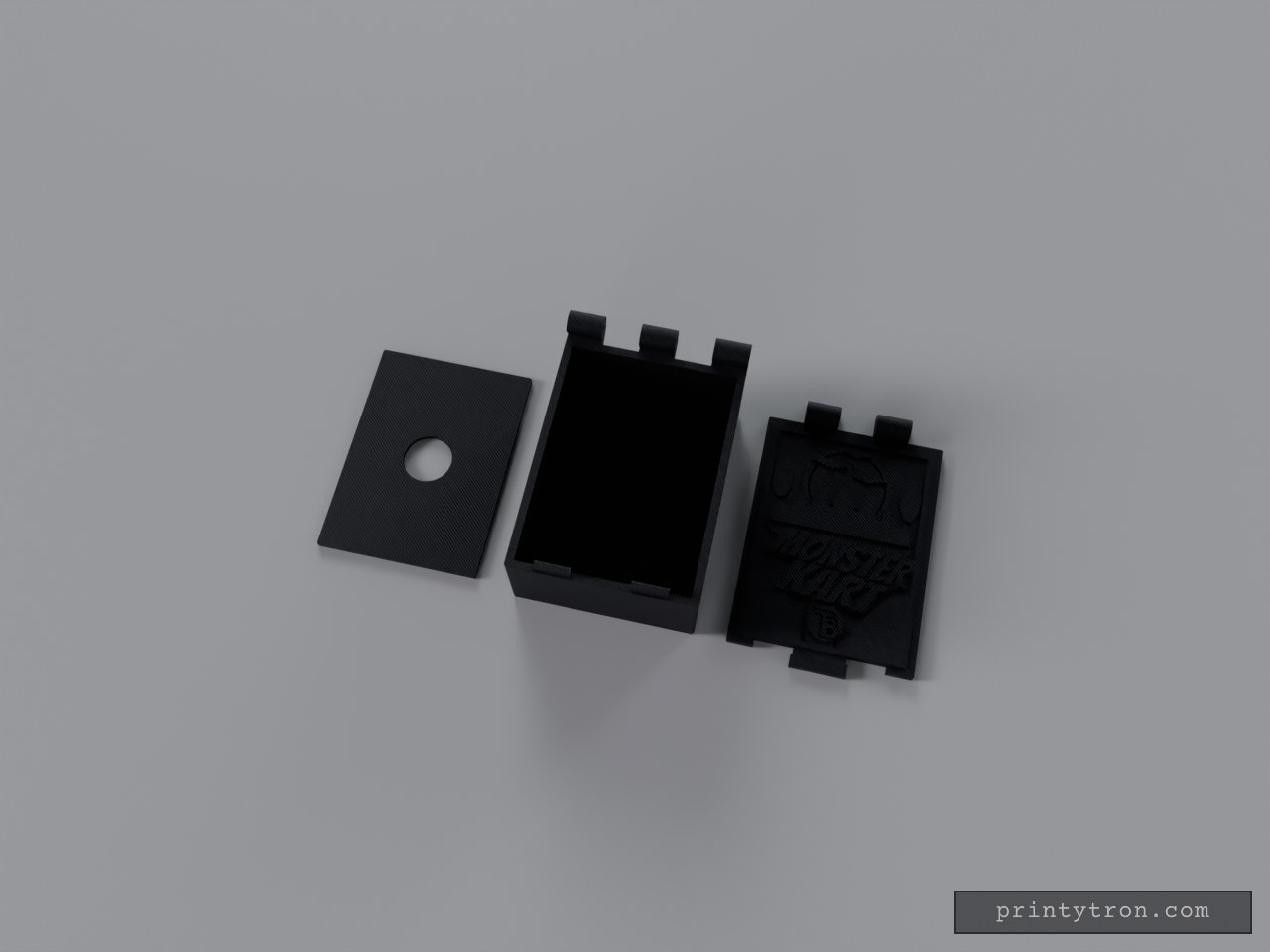
Monster Kart box
A hinged-lid card game box for a deck of 63 × 88 mm cards, sized for about 50 cards. The lid pivots on a mechanical barrel hinge along the back: three knuckles on the box and two on the lid, interleaved and held by a removable 1.75 mm filament pin. A front snap latch keeps the lid closed, and the hinge axis sits behind the back wall so the lid corner clears the rear wall and knuckle supports through 120°. Beneath the card stack, a removable divider plate with a 20 mm finger hole covers a hidden 12.7 mm compartment for paper inserts or original drawings. The box and divider plate are plain black to limit AMS waste; only the lid top carries the four-colour relief artwork. Specifications Box: 72.4 × 106.8 × 45.7 mm overall; card space approximately 66 × 91 × 20 mm for about 50 cards. Hidden compartment: 12.7 mm high under the card stack, with four corner posts supporting the divider plate. Divider plate: flat and removable, 2 mm thick, with a 20 mm finger hole. Hinge: five interlocking 9 mm knuckles with 0.4 mm axial gaps; moving-part clearance approximately 0.3–0.4 mm; 2.1 mm bores on one straight coaxial axis. The axis sits 4.9 mm behind the back wall. A 1.75 mm filament pin feeds in from one end through a flared lead-in and is held by friction; the opposite end is closed 1.2 mm short of the face, so the pin is pulled back out from the entry side. Latch: two flexing front posts with sloped hooks snap into lid notches; a thumb tab at the front centre releases it. Lid artwork: red rectangular border; dark black/purple background; large white moon near the upper centre; black haunted-castle silhouette with varied pointed towers; black bat silhouettes that read mainly as two long curved wings with very small bodies, sharp tips and scalloped trailing edges; purple hills and mist; a curved purple path; angled MONSTER in white and KART in red with black outlines; a 16 mm interlocking TB monogram centred near the bottom — a white glyph inside a red disc separated by a 0.5 mm black gap. The T carries an 8 mm top bar and a 1.8 mm full-height stem. The B shares the stem as a flat left spine, with a smaller upper bowl and fuller lower bowl, a pinched waist, and D-shaped counters rather than circular holes. A gap of about 1 mm separates the T bar from the top of the B. Only black, red, purple and white are used. Printing: support-free geometry for a 0.4 mm nozzle; latch posts are 1.4 mm thick; bat membranes come to about 1 mm. In the TB monogram the upper counter is about 1.1 mm tall — check it on a first print. Assembly: three printed pieces — box, divider plate and lid — plus a 1.75 mm filament pin. The lid's colour layers are grouped as one multi-colour object for four-slot AMS printing.
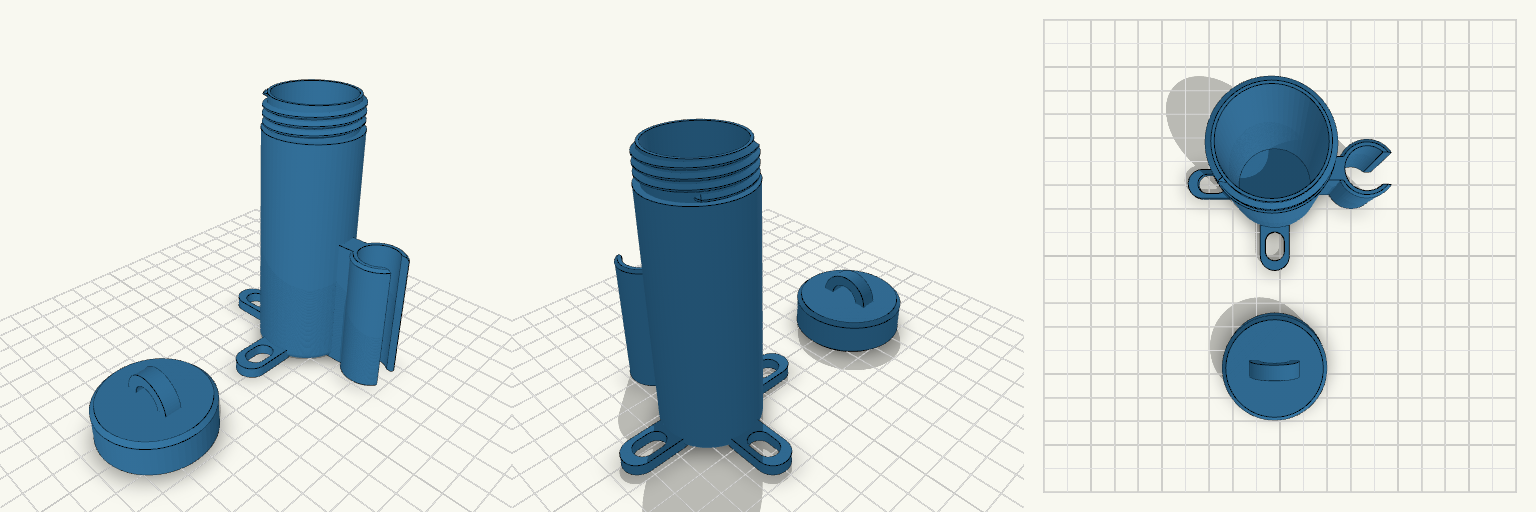
Stickpot
A screw-top tackle jar in the spirit of a carp angler's bankstick kit: tall bore, flat slotted tabs at the base, and a half-circle arch standing on the lid for hanging rigs. Design notes 30 mm bore, 100 mm tall Bankstick clip now runs from the base of the jar upward, 50 mm long, with a snap-in slot Three flat slotted loops at the base, printing flat with no overhang Lid with a 6 mm wide half-circle arch, printed upside-down beside the jar
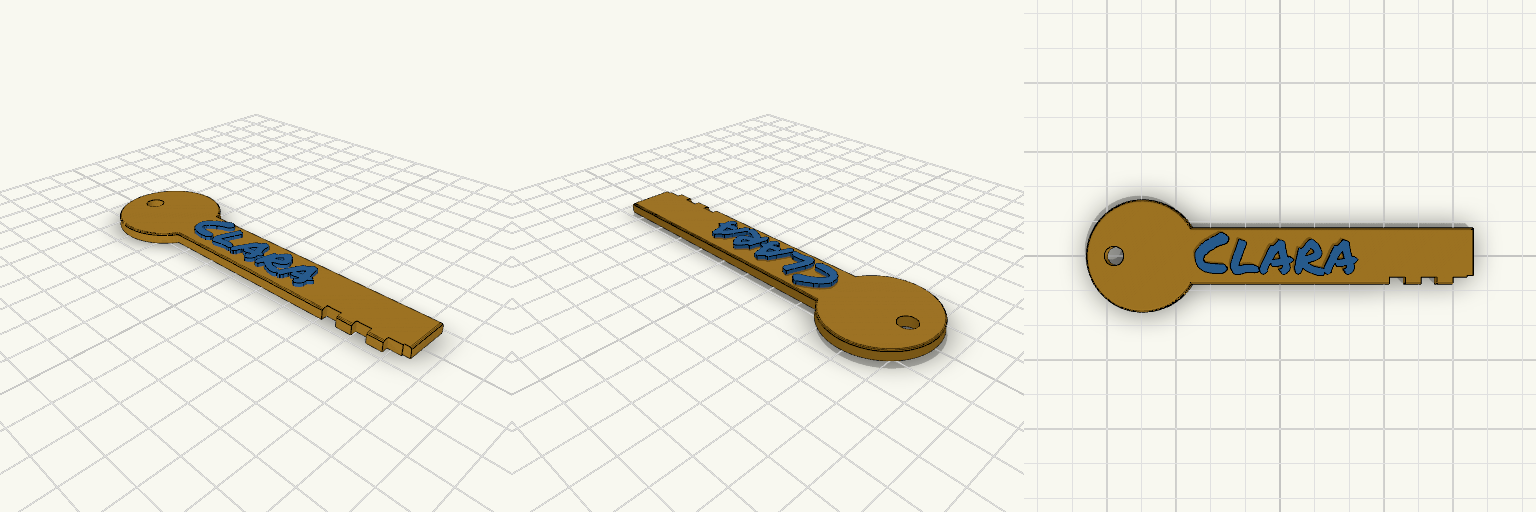
Clara Key 01
A flat, key-shaped keychain with "Clara" raised on the blade in a marker-style hand. The round bow carries a 5.5 mm ring hole, and the tip has a few simple teeth cut into the lower edge. Remix hooks Name: swap "Clara" for any other name. The lettering is scaled to a 46 mm width, so longer names get shorter letters. Widen the blade past 82 mm if you want them to stay tall. Thickness: the plate is 3 mm with 1.2 mm raised text. For a two-colour print, pause at layer 3 mm and swap filament. Bow: 32 mm diameter. Shrink it for a slimmer fob, or enlarge it and add a second hole. Teeth: three 4.5 mm notches plus a tip notch. Change the spacing or depth for a different silhouette. Pairs with: a split ring, a small lobster clasp, or a matching set with other names. Prints flat with no supports. The overall length is about 96 mm.
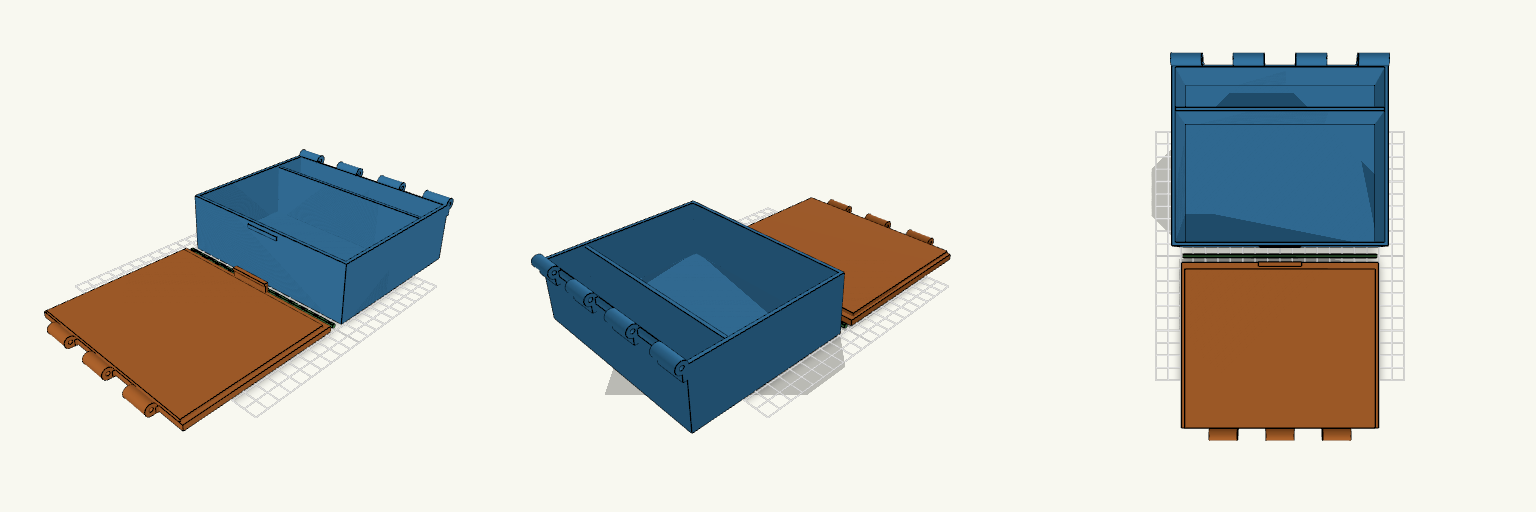
Hinged Latching Box With Front Divider
Small parts slide into one pile the moment the lid comes off; this hinged latching box keeps two bays apart and snaps shut. The clear interior is 152 × 127 × 45 mm, split by a 2.5 mm divider set 97 mm back from the front, so the front bay is 97 mm deep and the rear bay is about 52.5 mm. The walls stand 2 mm taller than the divider, and the divider top sits level with the underside of the lid lip, so the full 45 mm of clear height is usable rather than eaten by the lid. Fit and compartments Clear interior: 152 × 127 × 45 mm (length × width × height). Divider: 2.5 mm thick, 97 mm back from the front; front bay 97 mm deep, rear bay about 52.5 mm. Walls and floor: 2.5 mm; the divider is 2 mm shorter than the walls so the lid lip clears it. Lid: 2 mm inner lip locates it on the base. Hinge clearance The lid's back edge has notches where the base's hinge knuckles pass through it. The base's back wall is cut away where the lid's knuckles swing down into it. Both cuts carry roughly 0.3 mm of play, so the lid closes without catching. Latch The hooked tab on the lid is kept short so the hook sits close over the catch bump instead of rattling. Closed, the gap between the top of the hook and the underside of the catch bump is about 0.3 mm. If it prints too loose to hold, or too tight to snap over, adjust the hook by a fraction of a millimetre. Printing and assembly Prints as three separate pieces: base, lid, and hinge pin. The pieces sit apart on the plate with gaps: the lid is flipped so its flat top face is on the bed, and the 3 mm pin lies flat in the gap. None of the three touch. If your slicer imports it as one body, use Split to objects or Separate parts. Hinge: seven interleaved knuckles with a 3 mm pin (155 × 3 × 3 mm). Use a 3 mm rod or filament, or print the pin. Slide the pin through the knuckles after printing; the lid hinges on it and the front latch holds it shut.
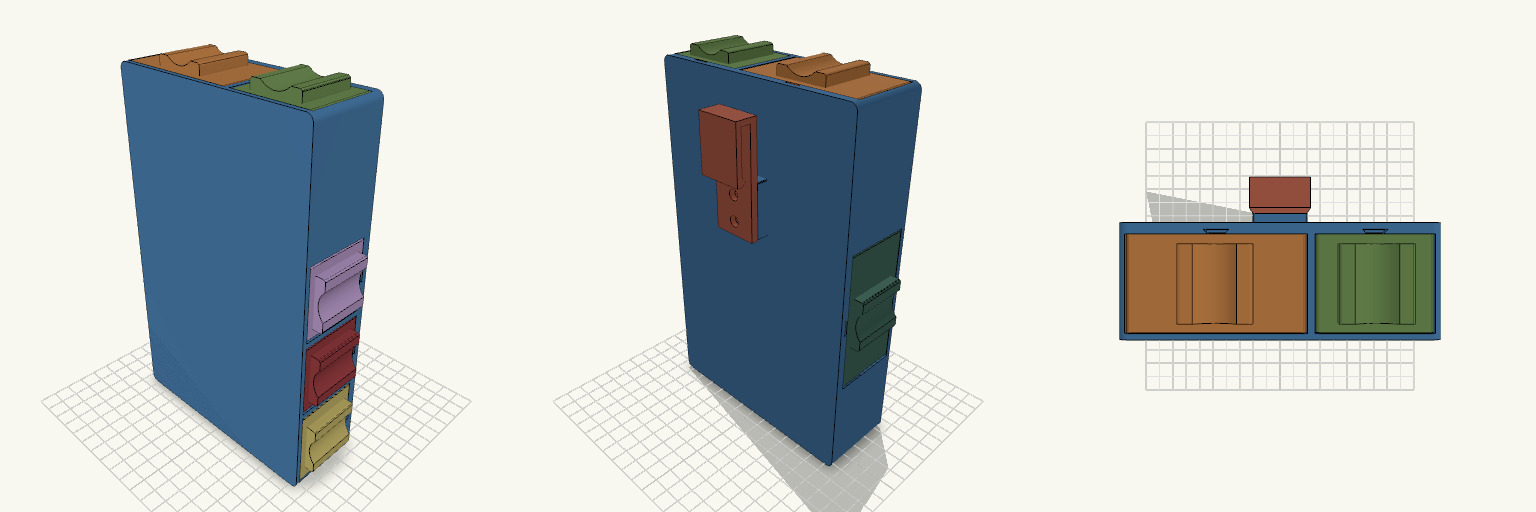
Estojo de gavetas para materiais de APH
Estojo de seis gavetas independentes (A–F) para materiais de APH, com corpo inteiriço e clipe traseiro para prender no cinto ou na borda do bolso do uniforme. O corpo é uma peça única, com placa traseira, placa frontal e divisórias compartilhadas entre gavetas vizinhas; as seis gavetas e o clipe são peças separadas, para imprimir e montar depois. Cada gaveta corre no seu próprio trilho curto em cauda de andorinha de 45° e sai por completo quando liberada de propósito — o batente de fim de curso abre cerca de 77%, com cerca de 0,5 mm de sobreposição com o trilho, e só deixa passar inclinando a gaveta com a unha. O clipe é aparafusado ao reforço traseiro com dois parafusos M3×10: os furos de 3,4 mm atravessam todo o reforço, cada porca sextavada tem bolso próprio a 2,5 mm da face do corpo e uma fenda lateral para inserção; a fenda não tem trava, e uma gota de cola resolve. Dimensões de partida Corpo: cerca de 130,6 × 54 × 213,6 mm (L × A × E). O clipe separado acrescenta cerca de 13 mm de profundidade, levando o conjunto a cerca de 67 mm. Cavidades internas: A com 67,5 × 60 mm, B com 42,5 × 60 mm, C com 77 × 77 mm, D e E com 35 × 37,5 mm cada, F com 112 mm no sentido do curso (para a atadura de 110 mm) e 40 mm de altura útil. Profundidade útil de 35 mm em todas, mais folga. Em A e B, o curso da gaveta tem 62 mm para o item de 60 mm, com 1 mm de folga por lado. Paredes das gavetas de 2,5 mm, divisórias de 3 mm, folga de deslizamento de 0,4 mm por lado. O conjunto fica maior que a área útil de referência de 110 × 175 mm — é a consequência direta de manter as cavidades exatas com essas paredes e folgas, não um erro de montagem. O que vale ajustar numa remixagem Profundidade das gavetas: 35 mm é o valor de partida; reduza se o material guardado for mais fino, e o conjunto encolhe sobretudo em profundidade. Parede da gaveta e divisória: 2,5 mm e 3 mm são o mínimo que mantém a lingueta com massa suficiente; engrossar melhora a resistência dos trilhos, mas cada milímetro aparece no tamanho externo. Folga do trilho: 0,4 mm por lado funciona em PETG; afrouxe para 0,5 mm se a sua máquina estiver com sobre-extrusão. Batente de fim de curso: cerca de 0,5 mm de sobreposição com o trilho — é o ponto mais provável de precisar de ajuste fino, e o primeiro a testar. Lingueta de retenção: detente com rampa na parede de 2,5 mm, com fendas laterais de 1,2 mm e raio maior na raiz para flexionar sem esforço. Nas gavetas A, B, C e F ela tem cerca de 21,5 mm; nas D e E tem desenho próprio, com cerca de 16 mm, para caber na face de 35 mm. A versão curta é mais rígida, então a força de abertura de D e E é o número a conferir na primeira impressão — se ficar dura, aumente só o comprimento da fenda dessa gaveta, sem tocar no resto. Não é uma pinça de duas alavancas. Puxador: rebaixado, com concavidade para o dedo e saliência máxima de 6 mm, pensado para uso com luva de procedimento. Gaveta F: acompanha o padrão das gavetas da direita e vai até a face direita do corpo, com o puxador saindo 6 mm quando fechada. Tem um bloco interno de cerca de 10 mm no fundo, perto da parede fechada, que reduz a cavidade para 112 mm e impede a atadura de 110 mm de correr; o bloco não mexe no trilho, no batente nem na trava. É o ponto para redimensionar ou remover o batente interno se o conteúdo mudar. Gavetas D e E: dimensionadas como 35 × 37,5 mm úteis sem um item definido — é o par óbvio para redesenhar em torno do que for guardado ali, e o primeiro a imprimir para conferir o encaixe e a trava. Clipe: sai como peça à parte, com 0,2 mm de vão em relação ao reforço traseiro — dá para substituí-lo sem refazer o corpo, e é o lugar natural para variantes de fixação, como uma aba de cinto mais larga ou outra furação. Fileira superior: A e B somam 110 mm de cavidade e, com as paredes e divisórias, definem a largura mínima do corpo; qualquer variante mais compacta passa por rever a cavidade dos itens, não só a caixa. Impressão PETG, sem suportes, em Bambu Lab A1. Gavetas com o fundo para baixo e a face aberta para cima, deixando o trilho apoiado na mesa. Corpo com a placa traseira na mesa e a frente para cima; com cerca de 214 mm de altura, ocupa quase toda a mesa da A1 e só cabe na diagonal ou em linha reta, então imprima-o sozinho e deixe as gavetas para um segundo trabalho. O clipe imprime deitado de lado, para a flexão ocorrer no plano das camadas. Um primeiro teste econômico é imprimir o corpo e uma única gaveta D ou E, para sentir o encaixe e a força da trava antes de gastar o resto do filamento. Os trilhos são curtos, então o guiamento vem principalmente das paredes do alvéolo — mantenha as cavidades lisas para não criar pontos de travamento.