Keyring Loop Registration Plate
Made by OnyxZebra
Created 1 months ago
Description
Registration plate tag, scaled for a standard keychain layout.
- Mating Surface: 5mm bore fits standard split rings or small wire carabiners.
- Geometry: 80x26mm overall footprint with a flat 2.4mm back to sit flush against other keys.
- Clearances: The border and text sit 1.2mm proud of the base plate, allowing for a mid-print filament swap if printed horizontally on a single-extruder machine.
Images
More like this
Explore more in Keychains & EDC →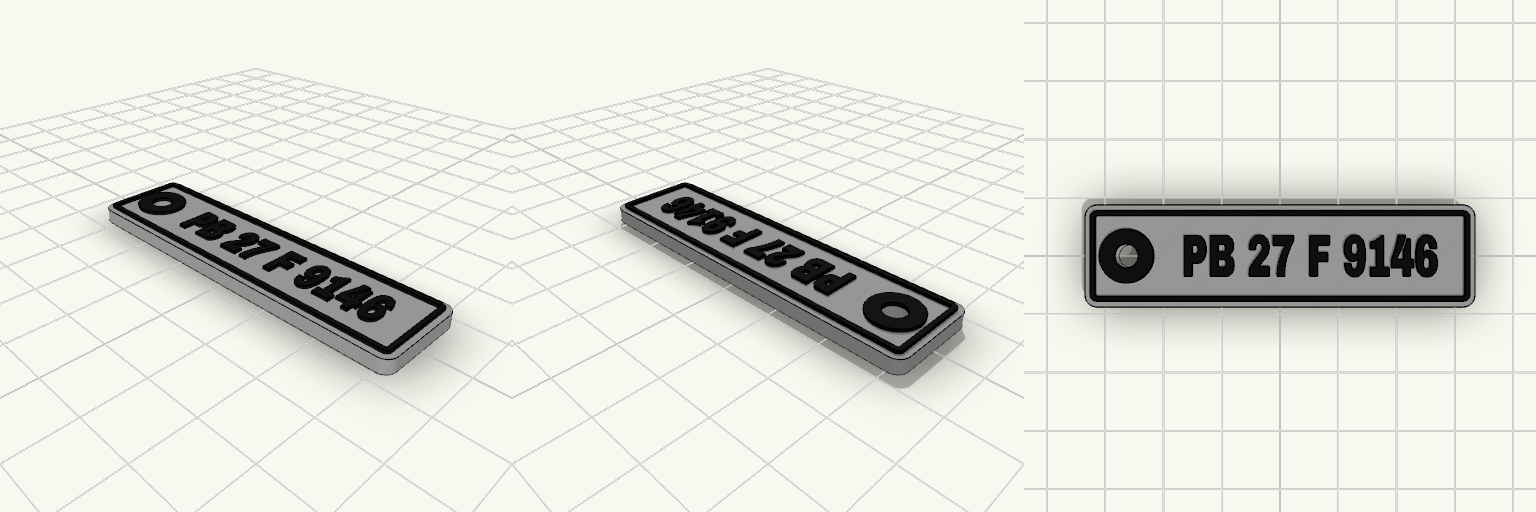
Number Plate Keychain with 4 mm Keyring Hole
A flat 65 × 17 mm number plate keychain built around the three things that ruin a printed tag: a hole that tears out, lettering that runs off the right edge of the plate, and a border crowded with extra frames. The hole sits inside a raised black ring instead of hanging on a thin web of plastic, so a heavy bunch of keys has something solid to pull against. The registration line sits on one horizontal line, raised 0.6 mm so it stays readable instead of rubbing smooth in a week, and it starts clear of the ring so nothing touches the hole. Print and fit Plate: 65 × 17 × 2.5 mm, corners rounded, smooth flat back. Keyring hole: one 4 mm through-hole at the far left, 7 mm in from the end so its ring clears the border, fully open through the base, with its own clear area so it never meets the text. Hole ring: a 9 mm black raised ring around the hole, kept neat and with no other decoration around it. Lettering: "PB 27 F 9146" on one line, raised 0.6 mm in a heavy bold face with even spacing, sized to fit the space between the ring and the right border. Border: a single thin black raised border around the whole plate, 0.6 mm high — no inner frame. Base: light grey, flat and unbroken underneath, prints without supports; the detail all sits on the raised top face, so a two-colour print or a paint fill both work. The text sits a little right of the plate's true centre because the hole takes up the left end — a truly centred line would run into the ring. If you change the registration, shorten the text rather than the plate, or the line will overrun the border on the right side.
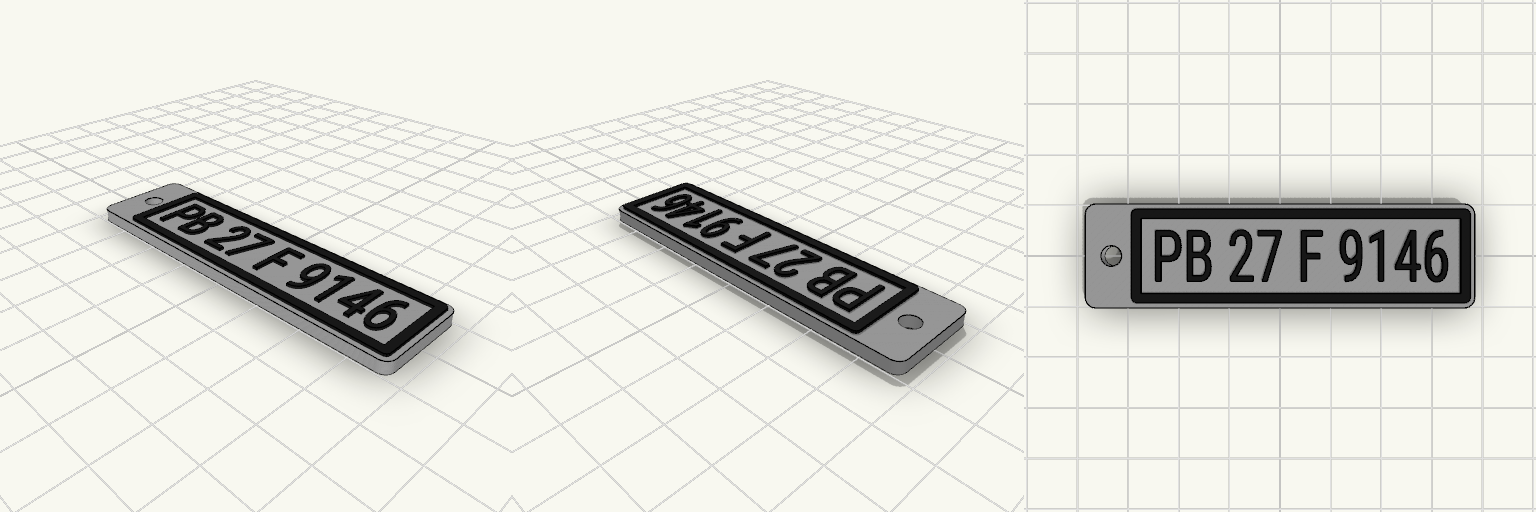
PB 27 F 9146 Number Plate Keychain
A miniature Indian-style number plate keychain reading PB 27 F 9146 on a single line, with a thin raised border and a 4 mm keyring hole at the left end. Size: 75 × 20 mm, 2.5 mm base Raised text and border: 0.6 mm Light grey base with black text and border Rounded corners, flat smooth back One 4 mm hole at the left end No flag, IND strip or blue section For a two-colour print, pause for a filament change at the 2.5 mm layer. The text is centred in the area to the right of the hole.
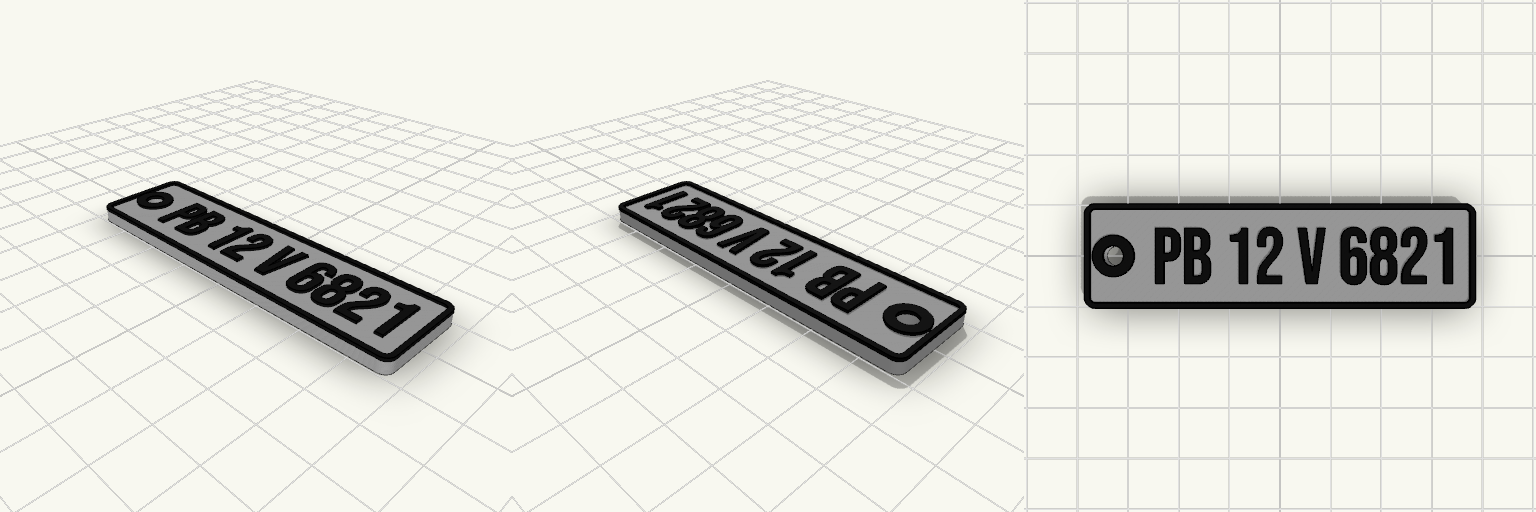
Bharat Key — Mini Number Plate Keychain
Bharat Key is a miniature Indian-style number plate keychain made to carry the exact registration PB 12 V 6821. The long, slim plate pairs a light grey/white base with a thin raised black border and bold black lettering raised on a single horizontal line. The keyring hole sits at the extreme left, ringed with raised black for strength, while the registration stays centred in the space that remains. No blue IND strip, flag, extra colour or decoration is present, so the tag keeps a clean number-plate look while staying sturdy enough for a keyring. Dimensions Plate: 75 × 20 × 2.5 mm Raised border and text: 0.6 mm above the base; border 1 mm wide Keyring hole: 4 mm diameter, cut fully through at the extreme left Hole ring: raised black ring around the hole for extra strength Features Exact registration text: PB 12 V 6821 on one horizontal line Bold black lettering raised above a light grey/white base Thin raised black border around the whole plate One circular keyring hole at the extreme left, fully through the plate Raised black ring around the hole to reinforce the keyring area Flat rectangular body with slightly rounded corners and a smooth flat backside Light grey/white base and black details only — no blue, no flag, no logos or decorations Print notes Print flat on the back; no supports are needed. The raised border and lettering sit 0.6 mm above the base and read clearly at miniature scale. Keep the 4 mm hole clear so the plate hangs cleanly on a keyring.
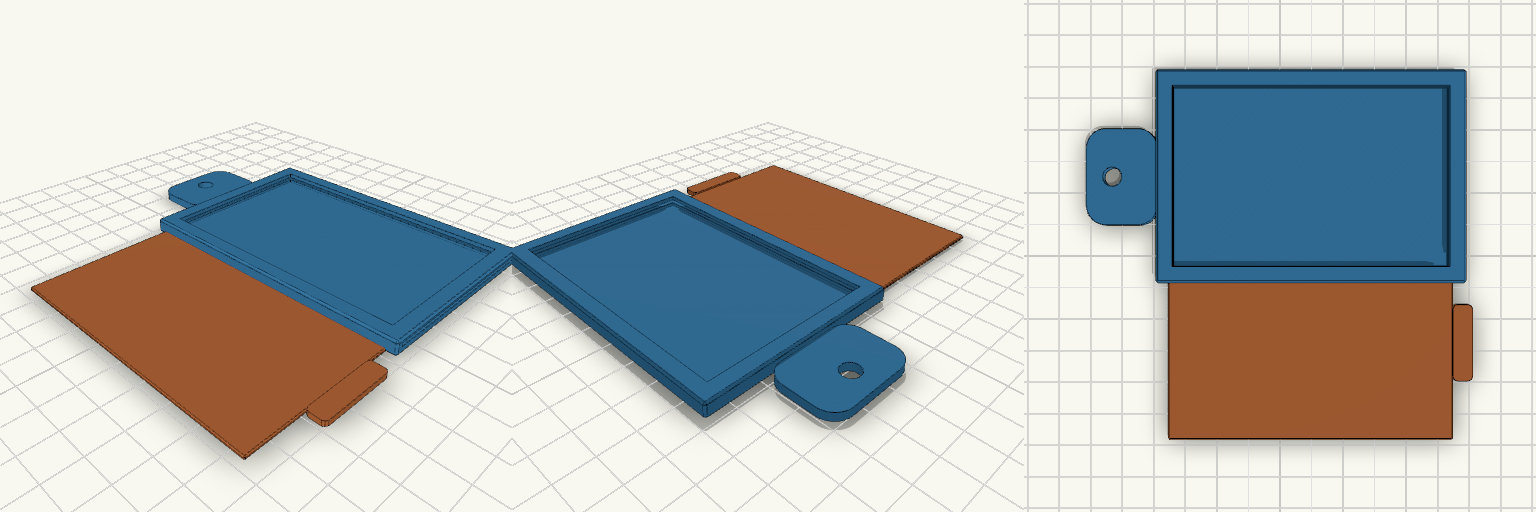
Luggage Tag with Sliding Cover
A two-piece luggage tag that holds a standard business card and hides the address behind a sliding cover panel. The body is 96 × 66 mm with an 86 × 56 mm card window (a 5 mm border on every side) and a side tab with a 6 mm strap hole. The cover prints flat beside the body and slides in from the right end through grooves in the border. Remix hooks Card window (86 × 56 mm): sized for an 85 × 55 mm card with 0.5 mm play per side. Change both numbers together for other card sizes, and adjust the body size to keep the border. Border width (5 mm): the body is window size plus 10 mm per axis. A wider border gives more room for the grooves and a sturdier tag. Groove clearance: the groove has 0.8 mm of side play and 0.2 mm of height play around the cover. Tighten or loosen these to suit your printer, since this is the fit most likely to need tuning. Detent bump: the cover can slide open on its own, and the card drops in from the top, so it is the only thing keeping the card in. A small bump on the cover and a matching dimple in the groove would hold it shut. Strap tab: 22 × 30 mm and 2.6 mm thick, with a 6 mm hole. Enlarge the hole for wider straps or cable loops. Body thickness: 4.6 mm overall. Thinning it saves filament but shortens the groove and window walls. Pairs well with Split-ring or lanyard clip through the strap hole A different colour for the cover, so the sliding piece reads at a glance Embossed or engraved text on the cover top, such as a name or a "contact owner" line Print notes Print both pieces flat, as laid out on the plate. Check the cover fit after the first print before committing to a batch.
Pocket Lighter With Spark Wheel
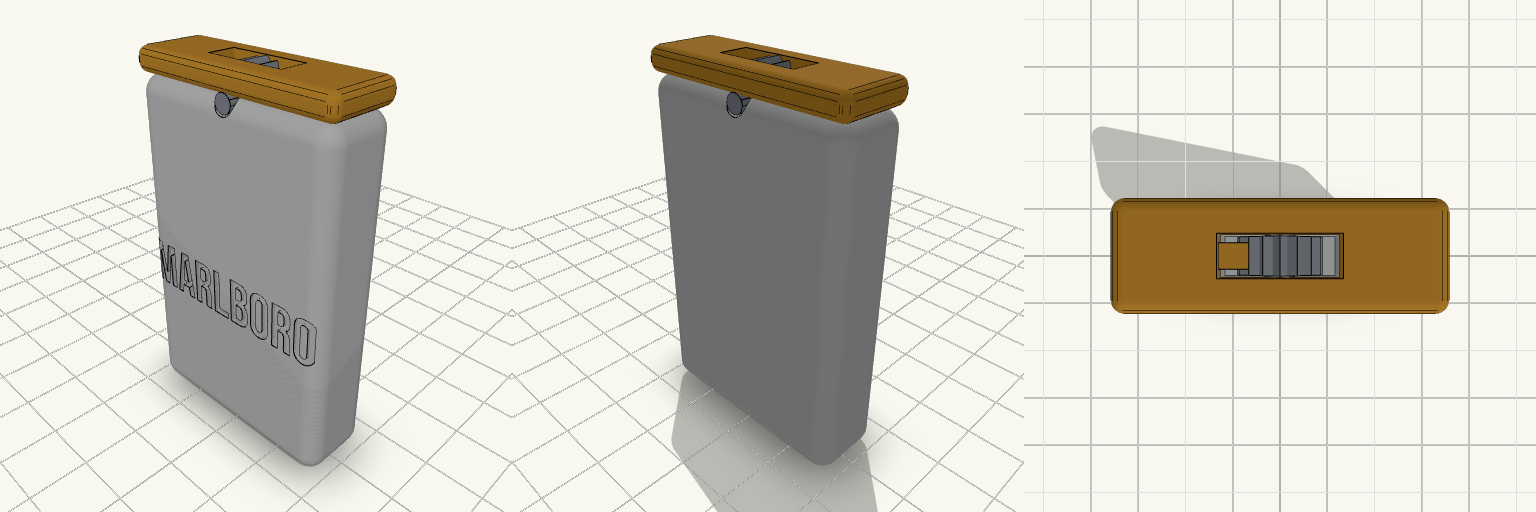
A pocket lighter body with a hinged lid and a spark wheel that clicks as it turns. The wheel carries ratchet teeth and rides on a 3 mm axle spanning both side walls, and a thin flexible pawl in the lid presses against those teeth, so flicking the wheel snaps it tooth to tooth for a mechanical click. The body, the lid and the wheel sit side by side on the plate as separate pieces, so the wheel can be printed in a contrasting colour and dropped in afterwards. The front face is engraved 0.6 mm deep with "MARLBORO" in tall condensed capitals, easy to swap for your own lettering. Overall it measures 38 × 13 × 62 mm with the lid on, a footprint that matches a classic 38 × 13 mm lighter case almost exactly; the height runs about 4 mm over because of the 4 mm lid, which is the simplest thing to change if you want a flush match. Nothing here is final: the click mechanism is the one part worth test-printing before you commit, since the pawl's thickness sets both how loud the snap is and how freely the wheel spins. Remix hooks Click pawl: the thinnest feature and the first thing to tune. A thinner tab gives a softer, quieter click and less drag; a thicker one snaps harder but can bind the wheel. Trim or shim it after a test print. Spark wheel: 10 × 12.6 × 10 mm with 16 teeth. Tooth count and tooth depth carry the character of the click — more, finer teeth give a rapid tick, fewer coarse ones a single heavy snap — and a knurled or coarser profile swaps in without touching anything else. Axle: 3 mm and the one genuinely tight constraint, since it runs through both side walls. Change the wheel and the axle has to change with it. Lid: 38 × 13 × 4 mm. Its wheel opening and the pawl seat are the fitted areas; remove material from the lid face rather than from the wheel seat if a wheel runs tight. Shortening the body by 4 mm brings the closed height down to a flush match. Body: the largest free variable. Profile, height and wall thickness are all open; roughly 1.6–2 mm walls keep the shell printable upright without supports, and anything thinner shows the cavity through the side. Front engraving: the brand text, font width and depth all change independently of the shell — deeper letters catch more shadow, shallower ones survive a fast print better. Keep the text clear of the hinge line so the lid still seats. Hinge: loosen the pin or knuckle a touch for a lid that swings freely, tighten it for one that stays put. Add-ons and variants: a lanyard hole or pocket clip on the base, a textured grip band, or a small tray that holds the lighter with the lid open. If you want a real sound rather than a mechanical one, a pocket for a small buzzer replaces the pawl entirely. Colour changes at the wheel and at the lid boundary do most of the visual work, and the lid reprints on its own if you change your mind about the wheel seat.
35 mm Threaded Keychain Container, Rosette Lid
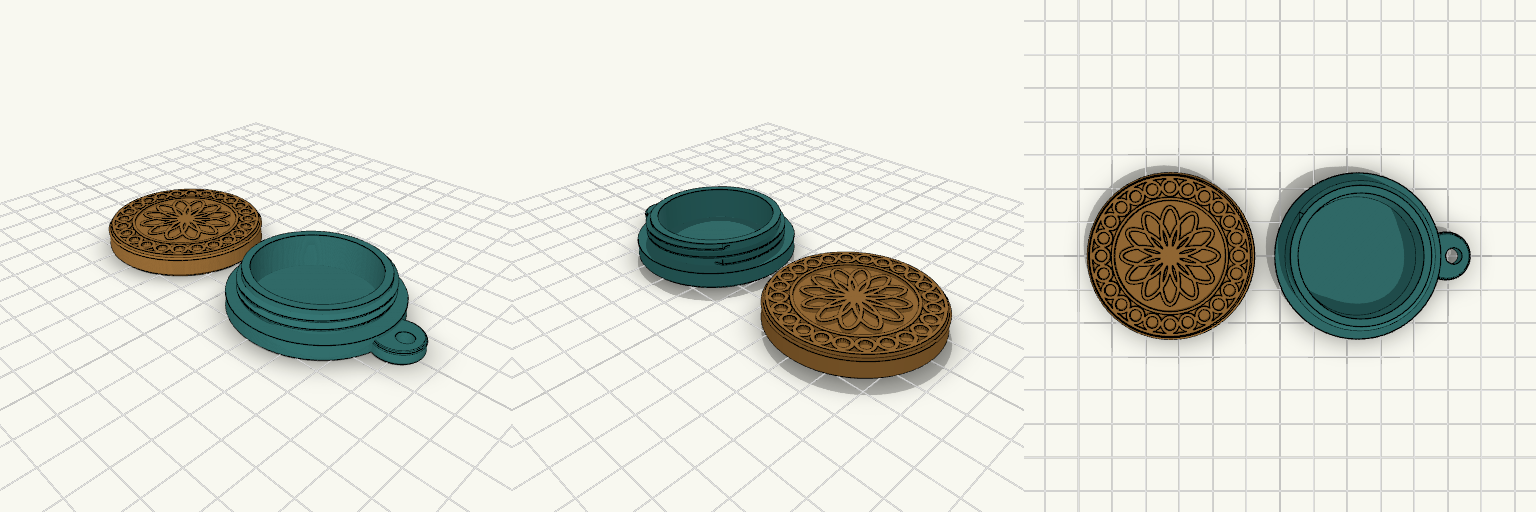
Round screw-top keychain container: a deep base with a 35 mm bore and a thin matching lid with an ornamental rim and a twelve-petal rosette centre. Fit Bore: 35 mm diameter, 10 mm deep. Thread: 42 mm major diameter, 2.5 mm pitch, lid cut 0.7 mm oversize. Outer diameter: 48 mm on both pieces. Keyring tab: 4.8 mm hole, on the outside of the base. Check before printing Measure how your printer holds the 35 mm bore. Print the lid first to test the thread fit. Not included No Arabic calligraphy. The lid uses a geometric rosette and scalloped border.