Miniature Lifting Trolley Prototype
Created today
Description
A demonstration-scale lifting trolley for a mechanical engineering project: rectangular frame, flat platform, four swivel casters, four corner stabilizer legs, a rotating boom base, a bottle jack, a hook with chain, and a push handle. Display model only. The real design targets 900 kg, but this print cannot lift loads.
Remix hooks
- Frame: 80 x 130 x 8 mm. Scale it for a longer platform.
- Boom: 95 mm at 50 degrees. Change the angle or length to alter reach.
- Legs: 5 mm rods, 22 mm long. Lengthen them for a higher stance.
- Pairs with: a small printed crate as a payload.
Images
More like this
Explore more in Decor & Display →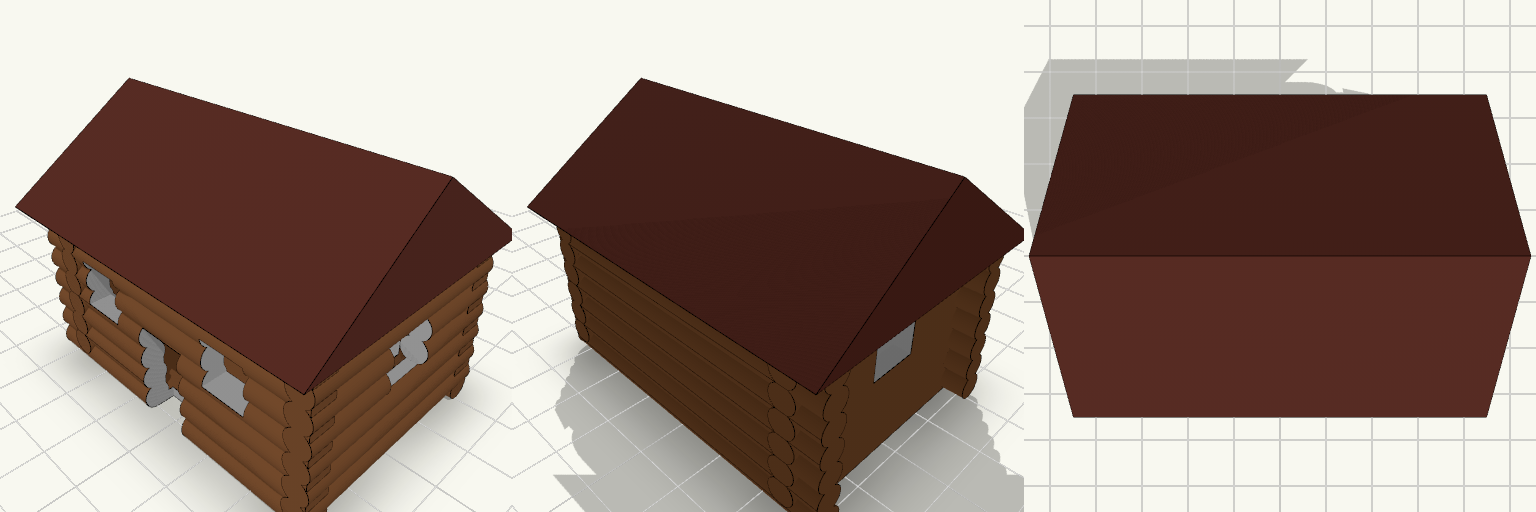
Miniature Log Cabin for Toy Trains
A small log cabin for model railway layouts and toy train sets. Stacked round logs with overlapping corners form the walls, with a front door, side windows and a gable roof. Footprint about 60 x 45 mm, wall height 32 mm plus roof Door and window openings on the walls Hollow interior with open underside Two colour regions: log walls and roof Print upright on the flat base; the roof overhang is shallow and prints without supports in most cases.
Cutaway Gearbox Desk Display
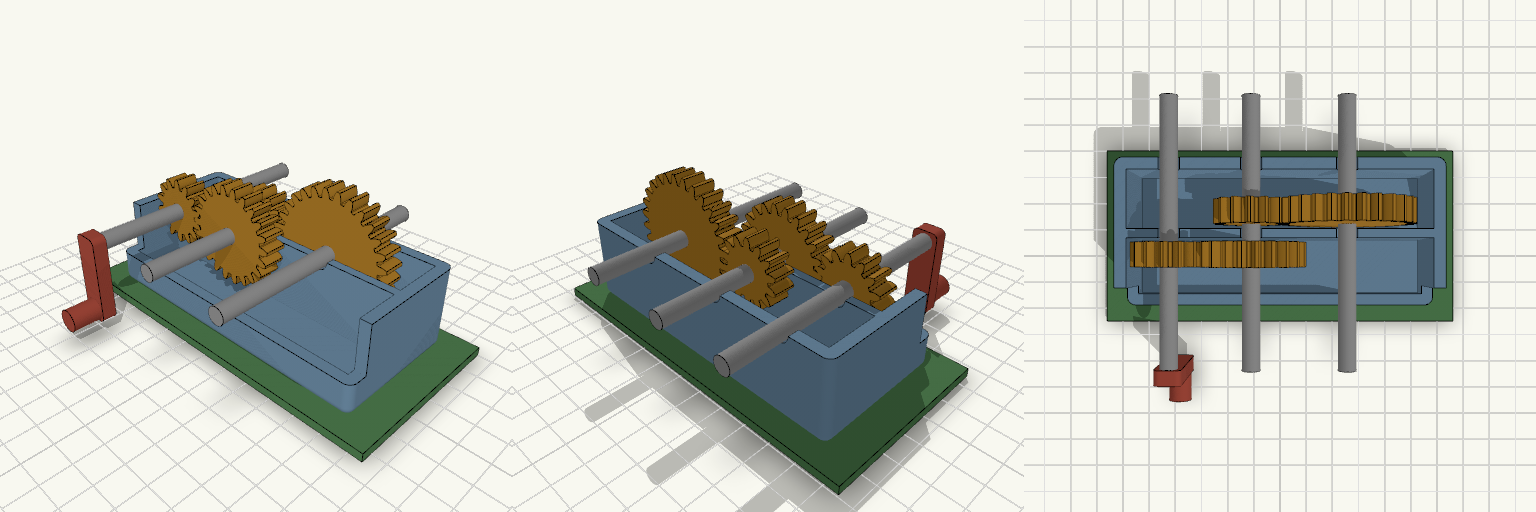
A cutaway gearbox in the spirit of a museum engineering sectional: a boxy housing with the front and top sliced open so the meshing gears and cross shafts sit in plain view. Two spur gears (14 and 22 teeth) on 6 mm shafts Open front and top reveal the mesh Shafts pass through the housing sides Flat base plate for stable desk display Pairs well with a small crank on one shaft.
Helix — Open-Frame Twisted Fin Lamp Shade
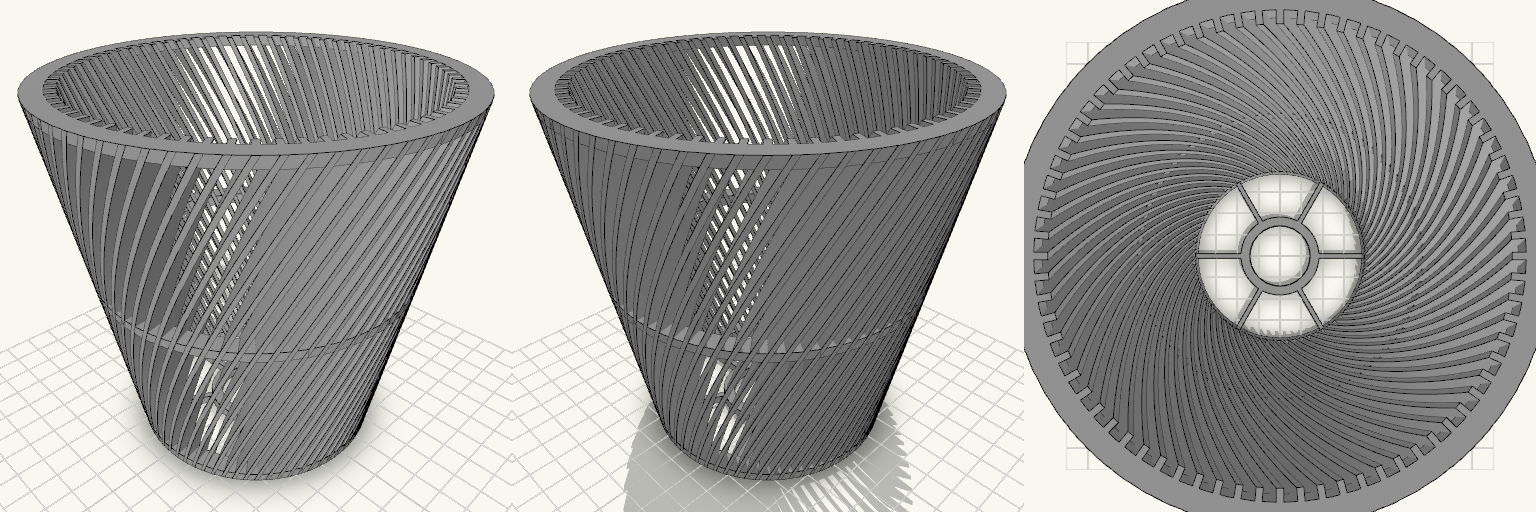
Helix is a flared lamp shade with no solid wall. 72 thin fins spiral through a 60° twist as the shade widens from the base to the top, and three low reinforcing rings hold the whole frame together. The result reads like a lantern or woven cage, and the light comes through as spiralling slats of shadow. The fins and rings are matched on purpose: each fin reaches inward only as far as the rings do, so the inner edge stays clean from bottom to top. A small spoked fitter ring at the base seats the shade over a lamp holder. Dimensions Height: 130 mm Base diameter: about 90 mm Top diameter: about 140 mm Twist: 60° over the full height Features 72 twisted, flared fins, 1.2 mm thick Three low-profile rings at the bottom, middle and top, 3.5 mm tall Fin depth matched to the ring depth (about 6.6 mm at the base, scaling with the flare) Spoked fitter ring at the base, 3 mm tall Print notes Print upright with the fitter ring on the plate. Slow speeds help, since the fins are thin. Use a cool LED bulb only. Fit to a specific socket is untested, so check the fitter ring against your holder.
Sectioned Amniotic Egg Anatomy Model
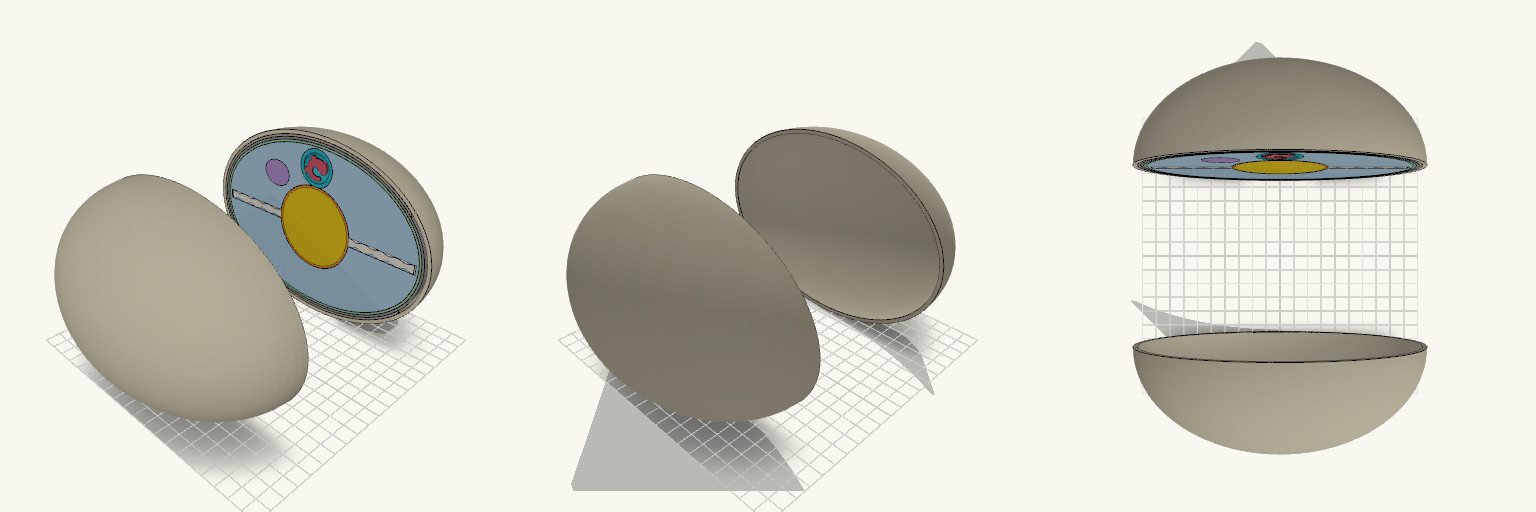
A 180 × 130 × 130 mm egg cut in half along its length. The back half holds every anatomical layer nested with about 0.4 mm gaps. The front shell half is a separate lid you lift away to see inside. Each layer prints flat on its cut face. Layers, outside in Eggshell: 2.5 mm, in two halves Outer and inner shell membranes: 1.4 mm each Chorion: 1.4 mm Albumen: fills the space around the yolk and sac, with channels for the chalazae Yolk, r 28 mm, inside a 1.6 mm vitelline membrane Amnion: a 13 mm sphere with a 10.5 mm cavity, opening at the cut face Embryo: curled, with head, tail and two limb buds Allantois: a sac beside the amnion Chalazae: two twisted cords, each about 50 mm long Air cell: an open void at the wide (+X) end, between the shell membranes Remix hooks Layer offsets (0, 2.9, 4.7, 6.5, 8.3 mm): change these to thicken or thin any membrane. Cut plane: moving it off y = 0 gives a wider or narrower window. A quarter-cut is also an easy variant. Air cell: set by the 72 mm start of its void. Move it to resize the cell. Not included: pins, label plates and a reference chart. Small tags or a printed key card would pair well with this model. Scaling: the model scales cleanly for a smaller, faster print.

Aerocord — Wire Heart Frame
A smooth, continuous 10mm tubular loop mathematically traced into a classic heart shape, scaled to a full 20cm span. Ideal as a minimalist wall piece, a wreath frame, or a standalone desk feature. Dimensions Width: 200 mm Cord Diameter: 10 mm Overall Profile: Sits flat with a 10 mm Z-height Features Continuous Sweep: A closed tubular loop with no hard joints. Classic Proportions: Driven by standard parametric heart equations for a familiar, balanced shape. Ready to Print: Sits perfectly flat on the bed, requiring zero supports.
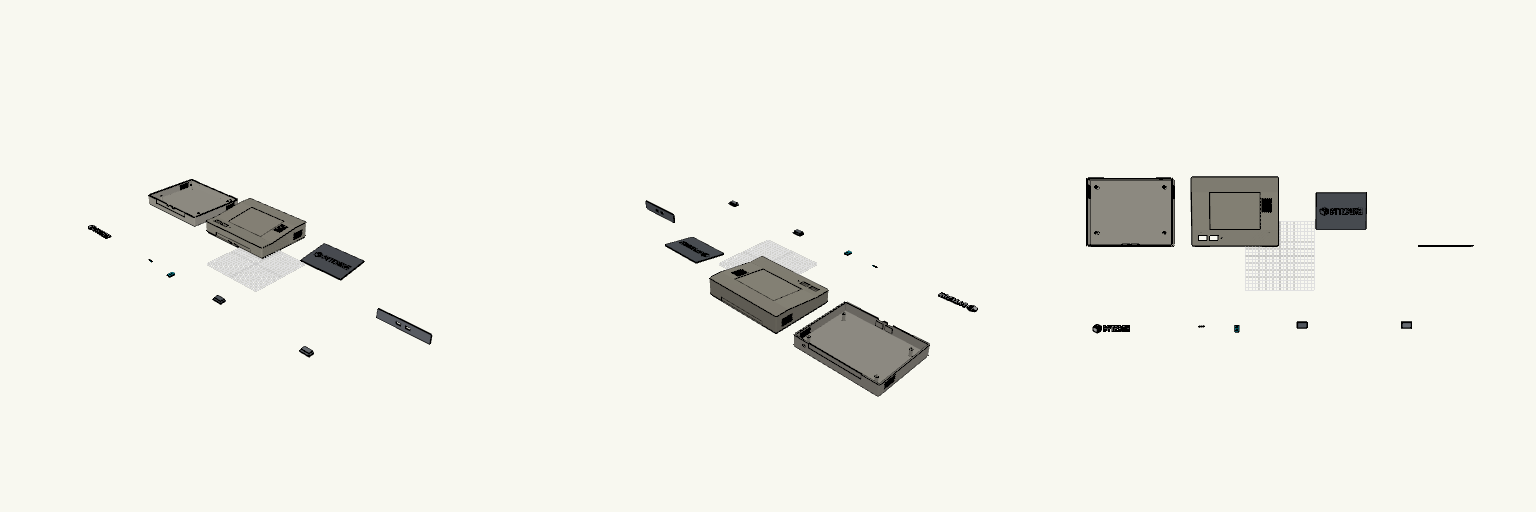
Frontlader — Zweiteiliges Retro-Konsolengehäuse
Frontlader ist ein breites, keilförmiges Konsolengehäuse im Stil der klassischen Frontlader-Konsolen, aufgeteilt in Unterteil und Oberteil zum Verschrauben mit M3. Dunkle Einsätze für Cartridge-Abdeckung, Frontblende und Tasten setzen sich vom hellgrauen Gehäuse ab. Features Unterteil mit Boden, Wänden und vier Schraubsäulen Durchgehende 3,4-mm-Löcher von unten bis zur Trennfuge Oberteil mit Schraubdomen und 2,7-mm-Pilotlöchern Zwei USB-A-Öffnungen in der Front Lüftungsschlitze an Seiten und Oberseite Zwei einzeln druckbare Tasten Dimensions 254 × 203 × 76 mm Trennfuge bei Z 30