Nothing Phone (1) Case with Flipper Zero Cradle
Created today
Description
A snap-on case for the Nothing Phone (1) with an integrated cradle on the back for a Flipper Zero. The phone enters from the screen side and is held by a 1.5 mm lip, while side-button slots and a bottom opening keep the buttons, USB-C port and speaker clear. The cradle sits on the lower two-thirds of the back, clear of the camera, and holds the Flipper Zero with snap ridges and finger notches. Corners on both the case and the cradle are rounded generously for a softer outline.
Specs
- Phone fit: Nothing Phone (1); open front with a 1.5 mm retaining lip; side-button slots; USB-C and speaker opening.
- Back window: opening over the camera and glyph area.
- Flipper cradle: lower two-thirds of the back; 13 mm pocket height; port slots at both ends; finger notches on the long sides; snap ridges to hold the Flipper Zero.
- Flipper clearance: the Flipper Zero is 25 mm thick, so about half of it sits above the cradle rim.
- Corners: case outline 11 mm radius, cradle 10 mm radius; pockets and screen opening rounded to match; the cradle rim's top edges are still square.
- Overall size: the case is about 80 mm wide and 164 mm tall; the cradle is about 46 mm wide and 106 mm tall.
- Wireless charging: the cradle covers the phone’s wireless-charging area.
- Printing: print screen-side down with the cradle opening facing up. TPU is recommended for the 1.5 mm lip; PLA makes the lip stiff.
- Print status: this version has not been test-printed.
Photos
Technical views
More like this
Explore more in Desk & Tech →
FoldDeck — Phone Shell and Printed-Hinge Keyboard Cover
FoldDeck is a clamshell-style phone-and-keyboard case built around a Galaxy A14 5G and a K808 Mini keyboard. The cover folds shut over the phone like a pocket flip-style mini laptop, and the hinge is printed as part of the design, so no pin, screw or other outside hardware is needed. Features Phone shell that replaces the phone's back, with snap hooks, a USB-C slot and flexing button covers Keyboard tray with screw posts for the K808 board Snap-on face plate with a window over the keys and touchpad Printed hinge: 3 mm round stubs on the tray knuckles seat in 3.6 mm blind bores in the shell knuckles Print notes Print the hinge parts with the stubs lying along the bed PETG or ASA is recommended for the snap hooks and hinge Port, button and camera positions are placeholders until measured
Phone
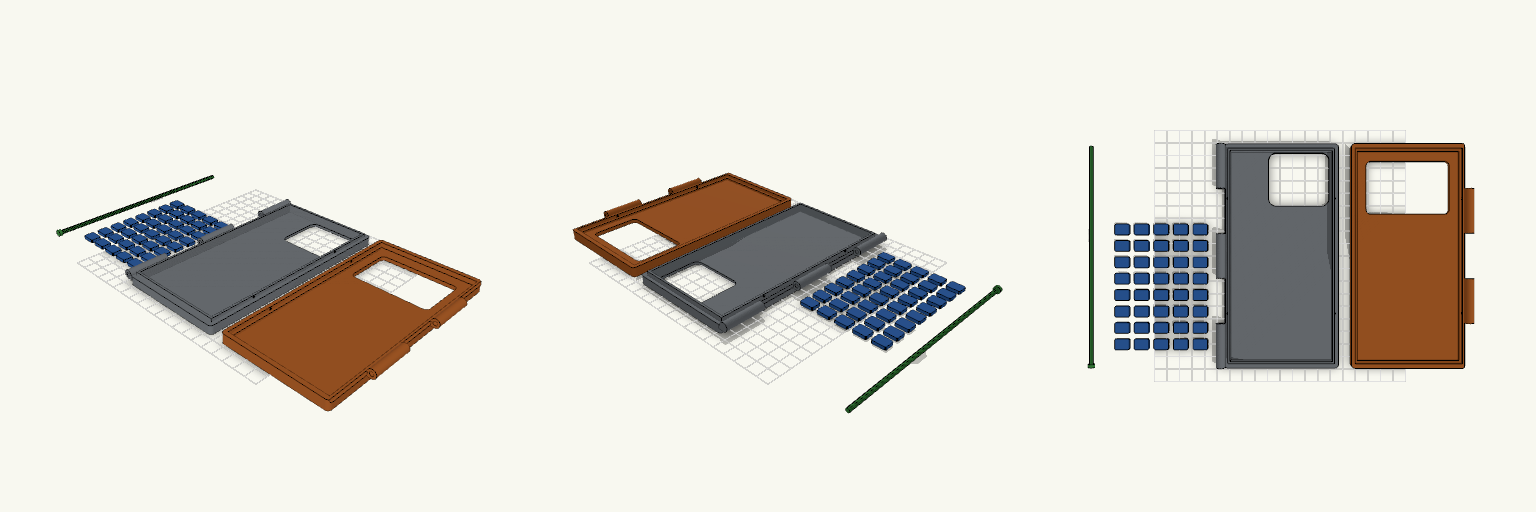
A calculator-shaped phone case styled after the TI-30Xa, with the top shell hinged along the right long edge so it folds open like a book and lies back behind the bottom shell, exposing the whole phone. Lay the phone screen-up in the bottom shell, close the top, and it clicks shut on the other three sides; the screen sits behind an oversized 66 × 42 mm window where the LCD would be. The keypad is 40 recessed divots in a 5 × 8 grid, with the buttons printed as a separate set 0.5 mm smaller on each side so they drop in and sit slightly proud. A camera opening sits in the back of the bottom shell, "TI-30Xa SOLAR" is engraved above the window, and a separate hinge pin runs the full length of the hinge. It prints as four separate parts: bottom shell, top shell, buttons and hinge pin. Remix hooks Shells: each about 96 × 176 mm on the plate; the top shell is 11.5 mm thick and the bottom shell 10.5 mm. The 176 mm length is the real constraint — shorten it and the 5 × 8 button grid has to lose rows, and the hinge spacing follows the same length. Hinge: a full-length piano hinge set into a notch along the right edge, so nothing protrudes past the outline. Five knuckles about 7 mm across, three on one half and two on the other, with 0.5 mm gaps and round clearance cutouts where the opposite knuckles pass. The body is a little wider overall to swallow it. This is the part worth redesigning first: move the notch to the left edge for a left-handed fold, or lengthen the knuckles for more stiffness. Hinge pin: 3 mm thick with a 5.5 mm head, 174.5 mm long, running in 3.5 mm holes and stopped by a closed end so it cannot slide through. Print it lying flat. A 3 mm metal rod is a direct drop-in substitute if you want it tougher. Phone cavity: 80 × 165 mm and 10 mm deep, closed at both ends when shut. That clears an iPhone 17 (about 71.5 mm wide) and the Pro Max sizes (about 77.6 mm). This is the first number to touch for fit; narrowing toward 76 mm tightens things up for standard phones, and going past about 82 mm starts to thin the side walls. Screen window: 66 × 42 mm, deliberately oversized so the cutout does not fight the phone's own bezels. Shrink it to hide more of the display, grow it for more live screen. Camera opening: 48 × 42 mm in the back of the bottom shell, sized around a large camera bump — a smaller phone just gets extra opening, so this is a safe one to trim down to your own lens. Button divots: 12.5 × 9.5 mm, 1.2 mm deep, in a 5 × 8 grid; the separate button set lays out on a 73.5 × 99.5 mm plate at 11.5 × 8.5 mm each — 0.5 mm clearance per side — so they drop in without binding and sit slightly proud. Deepen the divots to 1.6 mm if you want them flush. Obvious directions to take it: swap the uniform 5 × 8 grid for a true TI-30Xa layout, engrave the legends onto the buttons instead of leaving them blank, add a raised lip around the rear camera opening, add a lanyard loop, or print the shells in contrasting colours. The snap closure is the easiest thing to tune — deepen or shave the rim bumps if the lid is too tight or too loose. It pairs well with a second-colour button set and with any phone that fits the slot dimensions above.
iPhone 17 Pro Max Hülle mit Kameraausschnitt
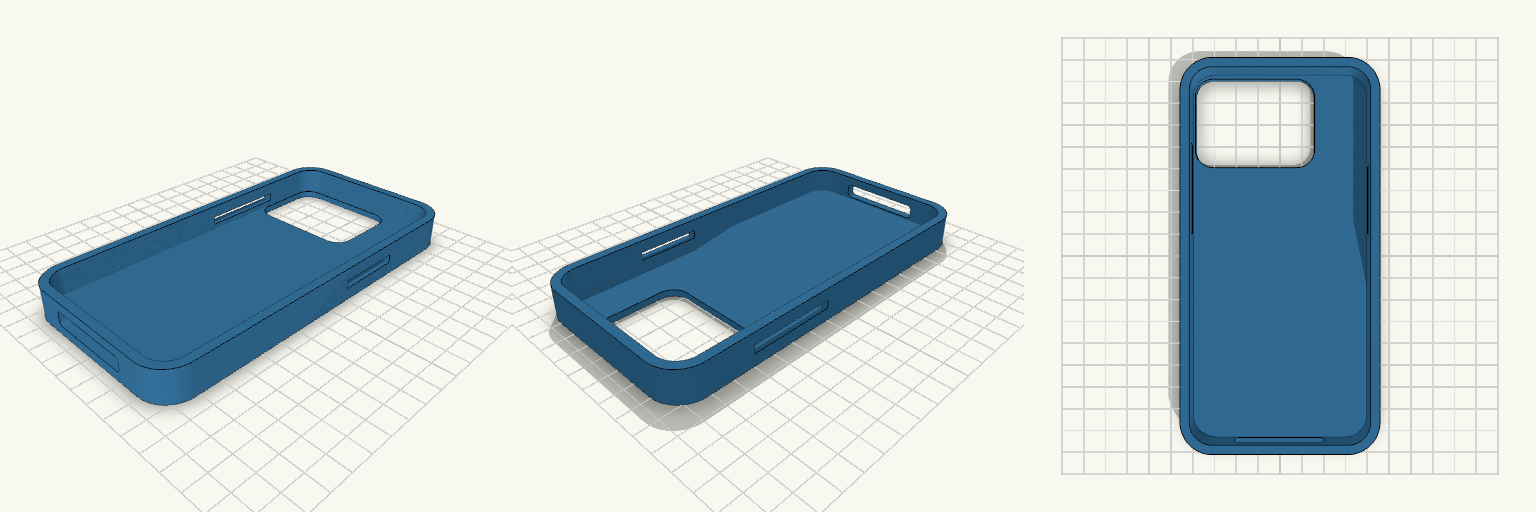
Massive Schutzhülle für das iPhone 17 Pro Max: 4 mm Wände, 3 mm Rückseite und eine 3 mm breite Frontlippe, die höher über das Display steht. Kameraausschnitt, Öffnungen für die Seitentasten und eine Öffnung unten für den Anschluss sind vorgesehen. Die Hülle wird in einem Stück gedruckt. Auf der Druckplatte misst das Teil etwa 86,6 × 172 × 15,1 mm. Auf der Rückseite ist ein eigenes Logo eingraviert: ein Doppelring mit „09“ in der Mitte, umlaufen vom Bogen-Schriftzug „BORUSSIA DORTMUND“. Die Gravur ist etwa 66 mm breit und 1 mm tief. Von hinten gesehen ist sie lesbar und sitzt unter dem Kameraausschnitt. Bei 3 mm Rückseite bleiben 2 mm Material unter der Gravur. Es ist kein offizielles Vereinswappen. Passt für iPhone 17 Pro Max (Gehäuse 163,4 × 78 × 8,75 mm; die Hülle ist mit etwas Spiel darauf ausgelegt) Vor dem Drucken prüfen Die Lage der Kamera- und Tastenausschnitte ist geschätzt und nicht an einem echten Gerät kontrolliert. Miss vor dem Druck die Positionen an deinem Gerät nach und verschiebe die Ausschnitte bei Bedarf. Durch die dickeren Wände sind die Tastenöffnungen tiefer; die Tasten lassen sich dadurch schwerer drücken. Prüfe, ob das für dich noch passt. Für den Bau ist TPU statt PLA sinnvoller, weil es Stöße besser abfedert. Passt nicht Andere iPhone-Modelle, auch nicht die früheren Pro-Max-Größen mit anderem Gehäusemaß.
双舱护甲 — 小米5分体电池外壳
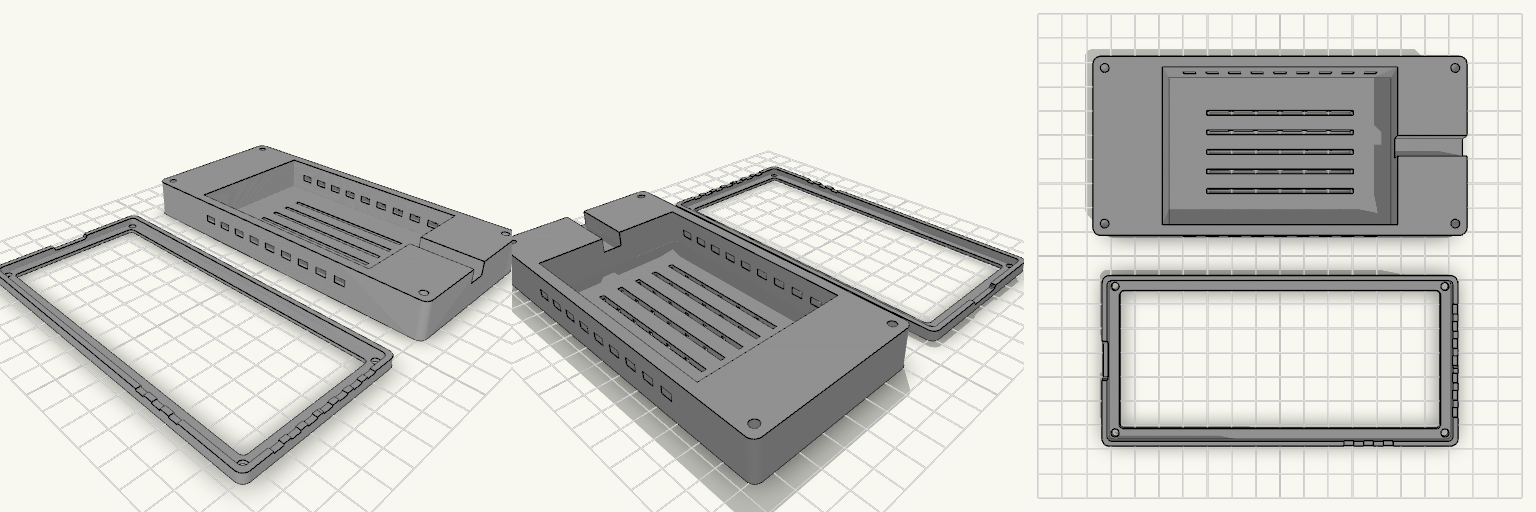
双舱护甲是一款为小米5设计的两件式保护外壳:前框固定手机,后盖内置独立电池仓,四角用M3螺丝对锁合拢。分体结构让手机与电池各自拥有独立容纳空间,装配和检修时不必拆散整机。后盖为整体方正的长方体,背面没有凸起,总高16.2 mm,电池仓下沉到块体内部,开口朝向前框。 结构 前框:外形144.55×69.2 mm,厚度4 mm,壁厚2.2 mm,边框加强至4 mm;手机腔留0.5 mm装配间隙。 后盖:与前框同外尺寸的方正长方体,无凸起;电池仓下沉,净空90×60×14 mm,单边留0.5 mm间隙。 开孔:底部16 mm宽Type-C孔,侧边两个按键孔;四角各一个M3通孔。电池仓经一条8 mm宽排线槽通到后盖+X端面。 主板散热:前框+X端墙有7条横向通风槽,–Y长边有9条横向槽,均通向手机腔;+Y侧保留按键开孔。 电池散热:后盖背面有横竖浅格栅槽、5条贯通长槽直达电池仓,两条长边侧壁各有一排通到仓内的槽。 打印与装配 两个零件分开打印,并排摆放在平台上时整体占地约144.6×154.4 mm,总高16.2 mm。前框与后盖通过四角M3螺丝连接。背面的贯通槽、侧壁槽以及前框的主板通风槽都直通内部空间,因此壳体不防水;若需要防水,应去掉贯通槽并在接合面增加密封圈槽。 兼容 适配小米5。按键孔与Type-C孔按常见布局布置;主板散热槽按常见布局布置在+X端和–Y长边。装配前请核对实物位置。
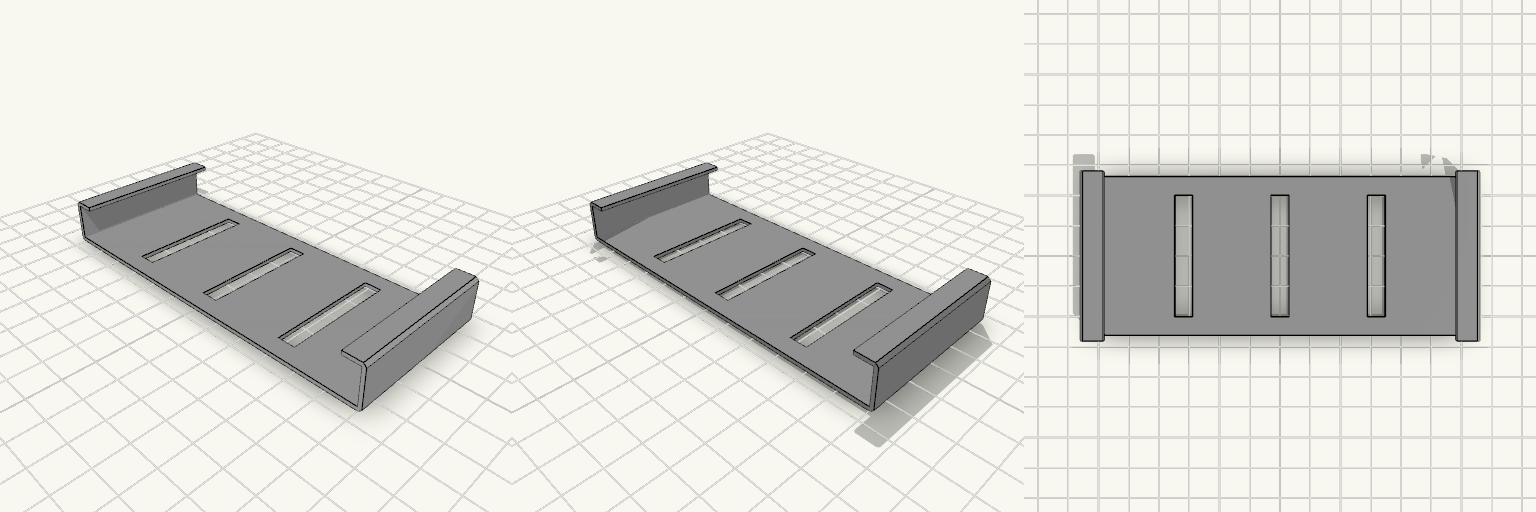
C-Shaped Lamp Sleeve With Slots
A single-piece C-channel sleeve that slides onto a 120 x 40 mm, 12 mm thick LED lamp panel and blocks light except through three evenly spaced slots. The front plate and side walls are 2.4 mm thick, enough to be opaque in PLA. Back lips hold the panel in place, and the cavity has 0.2 mm clearance per side for a sliding fit. Two 6 mm bridges at the ends keep the strips between the slots connected. Cavity: 120.4 x 12.4 mm Slots: three, 6 x 40 mm, equal spacing Sleeve length: 52 mm Prints in one piece, front face down, no supports needed for the walls Fits the Bambu A1 mini bed
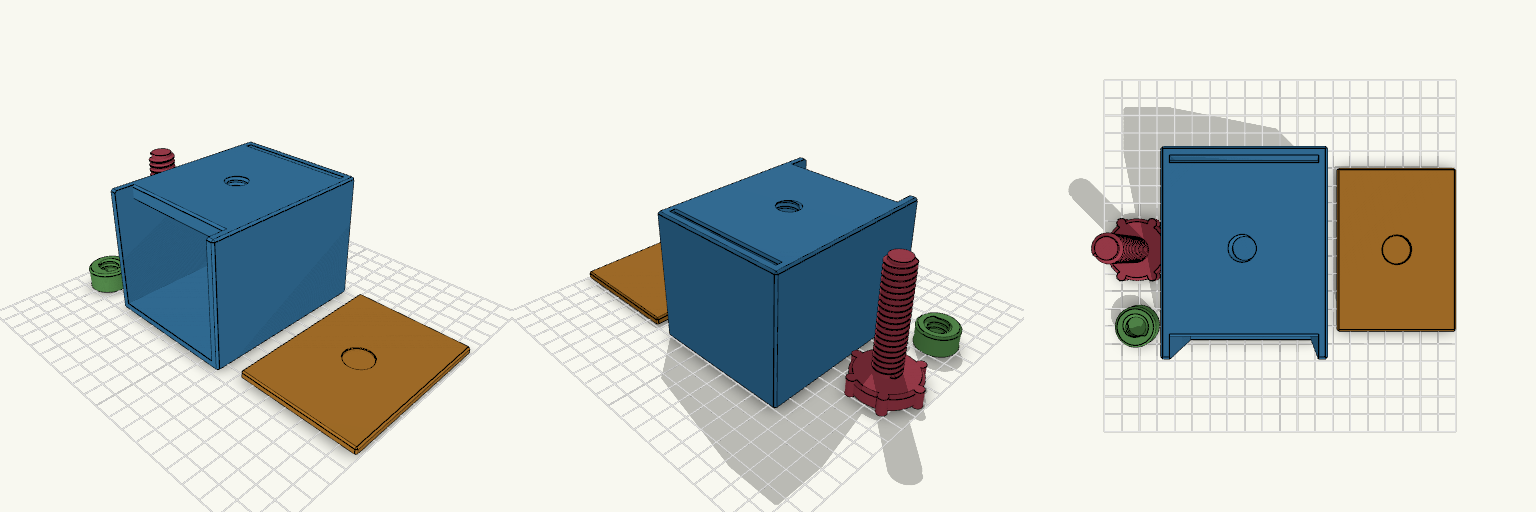
Card Press met Schroefdop
Een persbakje voor Pokémon-kaarten, bestaand uit vier losse printdelen: een bakje, een persplaat, een draaischroef en een schroefdop. Het bakje is dicht aan de achter- en zijkanten, heeft een vingeruitsparing aan de voorkant en een brug met schroefdraad over de bovenkant. De plaat ligt op de kaarten en heeft een ronde inzinking in het midden. De draaischroef zet de plaat onder druk. De schroefdop draait op de punt van de schroef en heeft een ronde voet die in de inzinking past. Binnenruimte bakje: 68 × 93 mm Schroefdraad: 14 mm, spoed 3 mm Inzinking in de plaat: 16 mm doorsnede Schroefdop: 15 mm voet, 22 mm doorsnede Print de dop met de voet naar beneden, zonder support