Pizza Angel Cookie Cutter
Created 3 months ago
Remixed once
Description
The worst part about custom cookie cutters is the razor-thin top edge that digs straight into your palms when you press down on cold dough. This cutter stamps out the silhouette of a flying baby angel holding a pizza slice, but more importantly, it includes a wide, flat rim so you can actually use it without bruising your hands.
Cutter Dimensions
- Overall Size: Roughly 80mm wide.
- Flange: 4.5mm wide base for pressing.
- Wall Height: 15mm total depth for thick dough.
- Cutting Edge: Tapers to a sharp 0.6mm at the top.
Print this upside down (flange flat on the bed) in PETG or another food-safe material. No supports needed.
Images
More like this
Explore more in Kitchen & Bathroom →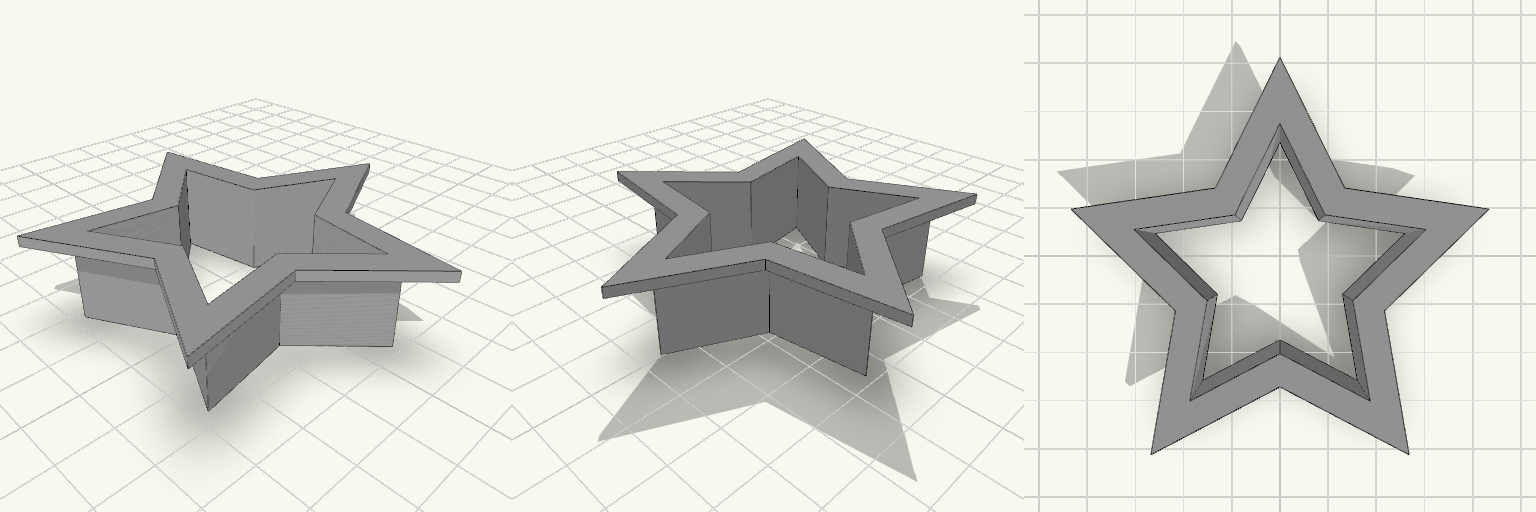
5-Point Star Cookie Cutter
A five-point star cookie cutter, 60 mm tip to tip, with 18 mm tall walls and a wide flat flange around the top edge. The flange gives a thumb a broad surface to press on, so pushing the cutter through dough doesn't put a thin edge against your skin. Remix hooks The values below are the ones worth changing. Everything else follows from them. Star size (R, 30 mm): This is the tip radius, so 60 mm across. Change it to scale the star. At about 40 mm across or less, check that the flange doesn't crowd the inner corners. Point sharpness (ratio, 0.5): This is the inner radius divided by the outer radius. Lower values like 0.4 give spikier points. Higher values like 0.6 give a chubbier, more rounded star. Very spiky points are harder to press out of dough. Flange (flangew 4 mm, flanget 2 mm): Widen it for a more comfortable press, or thicken it for more stiffness. Rounding the flange's outer corners is an easy variant if you want it softer on the thumb. Wall (wall, 1.2 mm): This is about three nozzle widths on a 0.4 mm nozzle. Thinner cuts more cleanly but is more fragile. Thicker is sturdier but pushes dough aside more. Height (H, 18 mm): Lower it for thin cookies, or raise it for thick dough or a deeper grip. Pairs well with A set of different sizes, made by changing R and nothing else. Other shapes that reuse the same wall and flange values, such as a heart or circle, so the whole set feels the same in the hand. A matching stamp or embossing plate that fits inside the cutter opening. Printing Print it flange-up or flange-down on the bed. Flange-down needs no supports, and the thin walls grow straight up from the flange. Use food-safe filament if you want to use it on dough.
Bag Holder Stand with Spring Clamp Ring
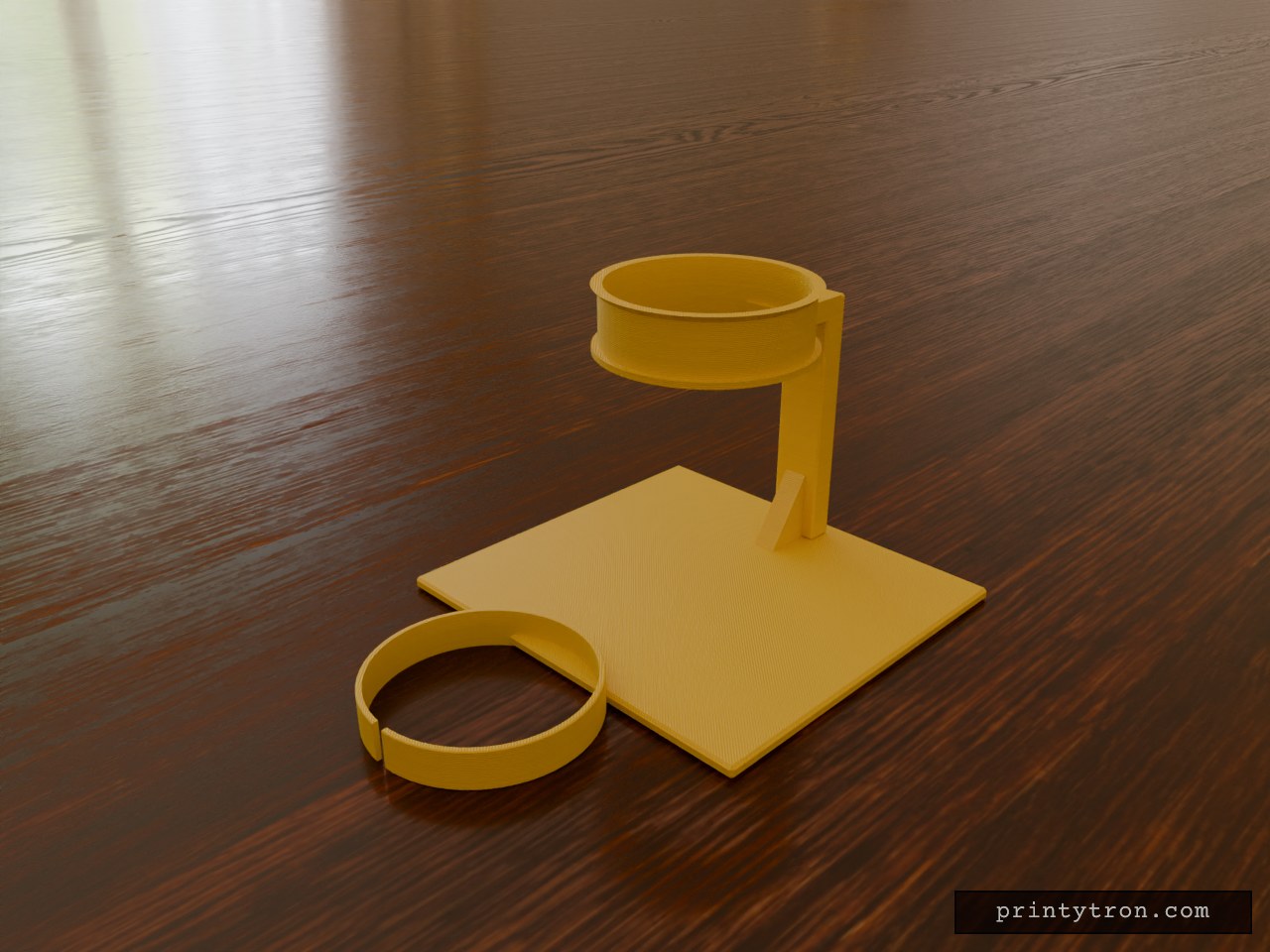
A freestanding stand that holds a freezer or piping bag open so both hands are free for filling. The bag mouth is pulled through a 120 mm inside-diameter ring, folded over the outside, and secured with a separate split clip that grips the folded rim all the way round. The base is a wide 270 × 250 mm plate with a rear post, so the stand resists tipping when a bag is loaded. The ring sits at the top of the post, 165 mm above the plate, with a flared lip to keep the fold from slipping off. Ring: 120 mm inside diameter, 40 mm tall, on a short arm off the post Base: 270 × 250 mm, 8 mm thick, chamfered edges, with a gusset on the post Clip: split spring ring, 24 mm tall, with finger tabs for opening Parts: base with post, ring, and clip are colour-labelled; the clip prints separately Material: PETG suggested for the clip so it keeps its spring To use, pull the bag mouth up through the ring, fold it down over the outside, then snap the clip over the fold. The ring height suits bags up to roughly 165 mm long; longer bags will rest on the base. The clip's grip has not been test-printed, so the gap may need adjusting for thicker or thinner bag film.
65° Kitchen Counter iPad Stand
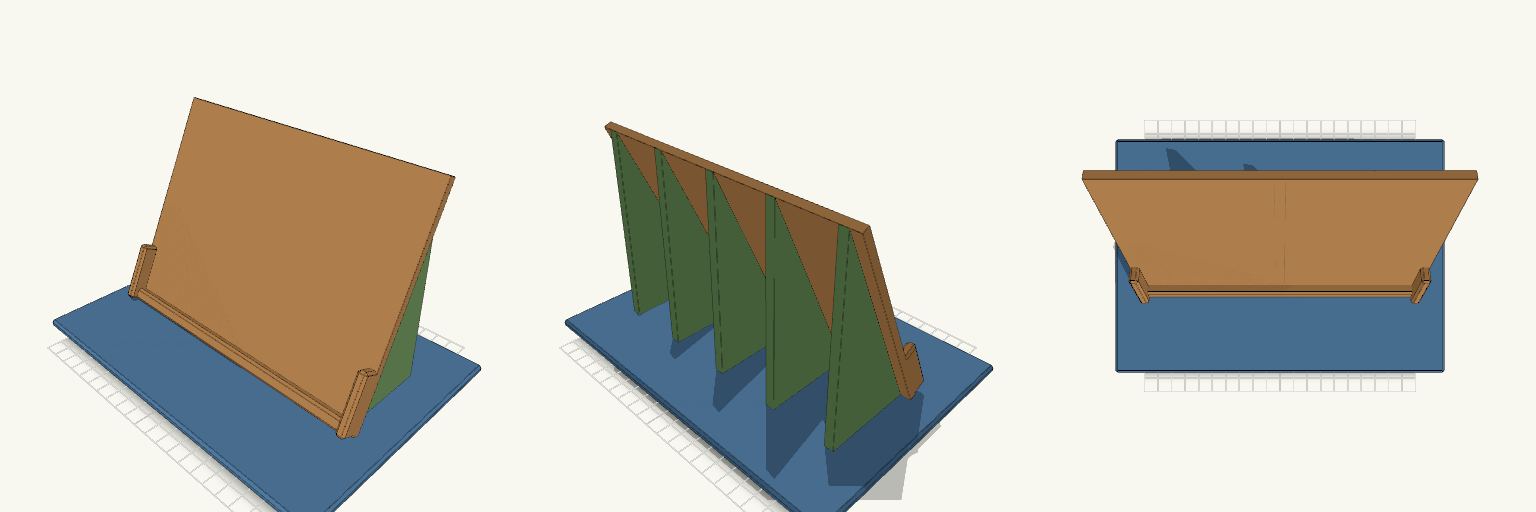
A wide, flat iPad stand for kitchen counters. The cradle sits at 65° from horizontal, a steep reading angle for recipes while standing. The underside of the base has a shallow recess that leaves a perimeter rim, so the edge seals against the counter and crumbs and flour are less likely to creep under. What it's for Reading recipes on an iPad at standing height without bending over. Use on a kitchen counter, where the wide base resists tipping. The stopper at the bottom of the cradle holds the iPad's lower edge, and the two side tabs keep it from sliding sideways. Dimensions Base: 240 × 170 × 5 mm, with 1.5 mm chamfered edges. Underside recess: 228 × 158 mm, 1.6 mm deep, leaving a rim around the perimeter. Cradle plate: 200 × 150 × 5 mm, tilted at 65° from horizontal. Bottom stopper: 8 mm deep and 11 mm tall, measured from the plate. Side tabs: 6 mm wide, 40 mm long and 16 mm tall, one on each side. Supports: five ribs, each 6 mm thick, spaced 45 mm apart under the cradle. Overall height: about 143 mm. Print notes Print the base face-down on the bed. The underside recess then faces up and needs no supports. PETG or ASA suits a kitchen better than PLA, which softens in heat. The cradle prints as one piece with the base and ribs, so no assembly is needed. Remix ideas Add a raised lip on top of the base to catch spills. Change the tilt angle for a lower or steeper view. Narrow the cradle and tabs for a smaller tablet. Add a cable slot in the stopper for charging while reading. Stick a thin rubber or silicone pad inside the rim for extra grip.
Softflow — M22 Faucet Splash Diffuser
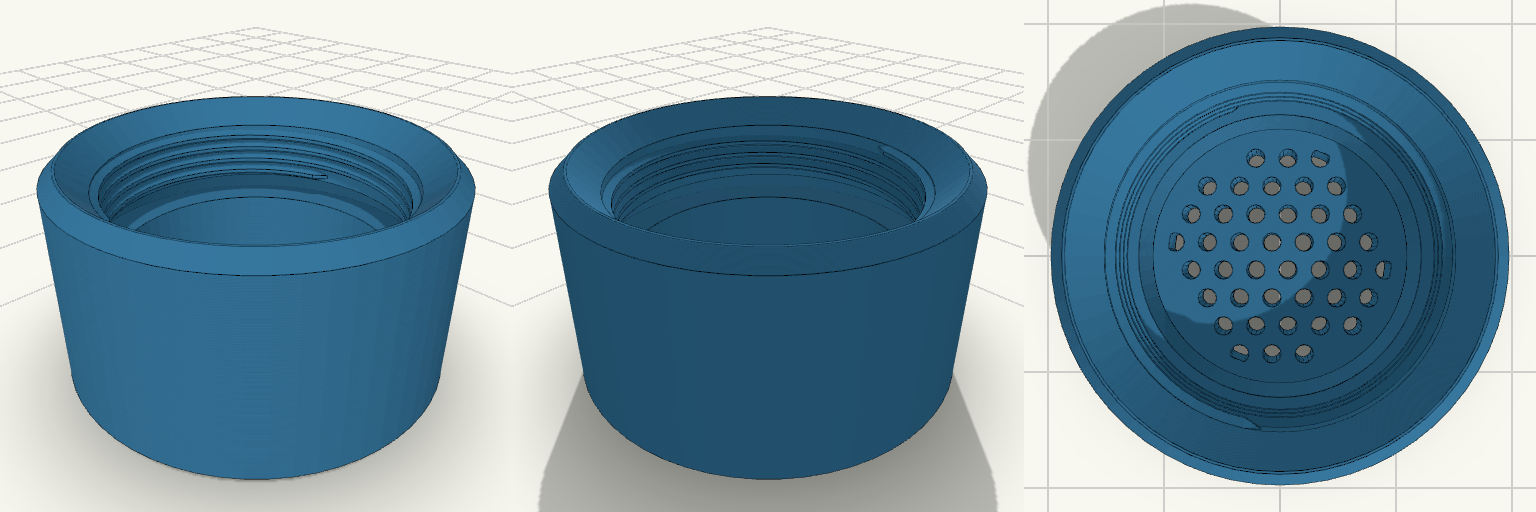
Softflow is a screw-on splash diffuser for faucets with an M22x1 male outlet thread. The base is perforated with a staggered hex grid of small holes, breaking the flow into many fine streams for a softer, wider spray. A short open chamber between the thread and the perforated floor lets water spread across the whole hole pattern before it exits. Features M22x1 female thread, 8 mm deep, with a beveled lead-in at the opening Staggered hex grid of 1.5 mm holes at 2.6 mm spacing, inside an 18 mm circle 3 mm perforated floor with a relief chamber above it Chamfered top and bottom edges on a round body Dimensions Outer diameter: 28 mm Overall height: 16 mm Thread: M22 x 1 mm pitch, 8 mm engagement depth Floor thickness: 3 mm Print notes Print with the perforated face down on the bed, opening facing up; no supports are needed. Thread fit has not been tested against a real faucet. If it binds, increase the thread clearance slightly. A fine layer height (0.12–0.16 mm) keeps the small holes and thread crisp. PETG or ASA suits wet, warm-water use better than PLA.
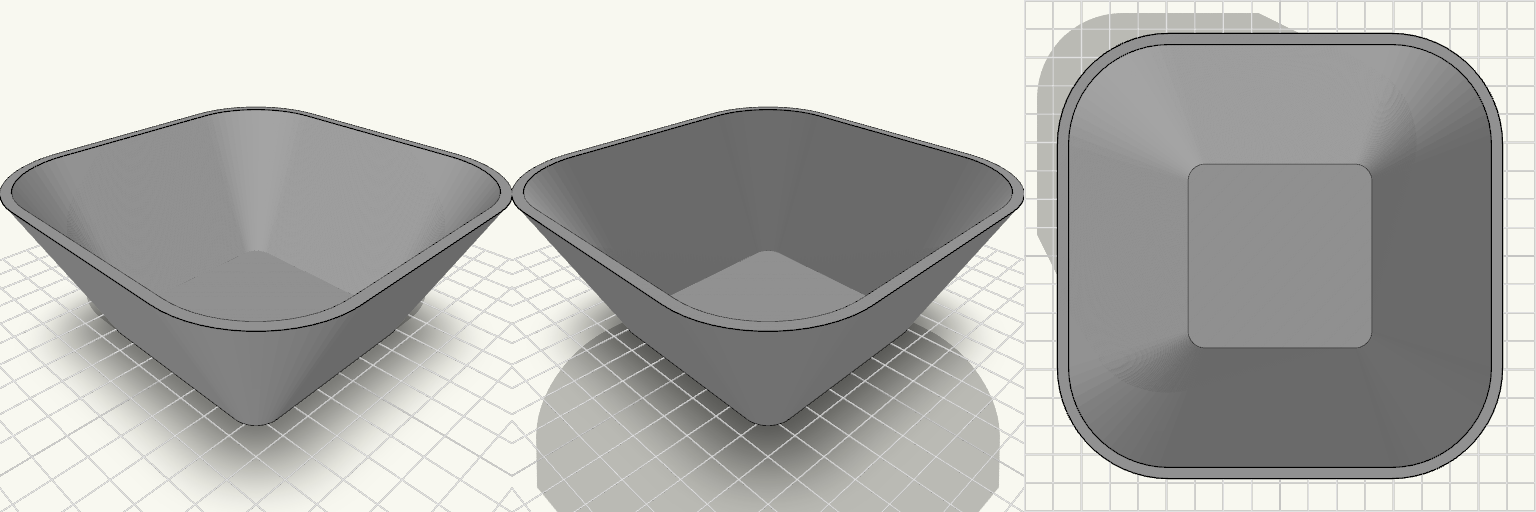
Square-Base Bowl That Stays Put
A bowl that skids across the counter or tips the moment you stir it is the annoyance; this one has an almost square base that keeps it planted. The base is a 70 mm square with rounded corners, so it sits flat instead of rocking, and the walls flare out to a 120 mm rim that is rounder and easier to eat from. What decides the fit Base footprint: 70 mm rounded square — the number to check against your shelf, tray or cupboard. Rim: 120 mm across at the widest point. Height: 50.8 mm (2 in). Walls and floor: 3 mm thick, so it holds its shape without being heavy. It prints as one piece, standing on its flat base, so no supports are needed and the inside comes out clean.
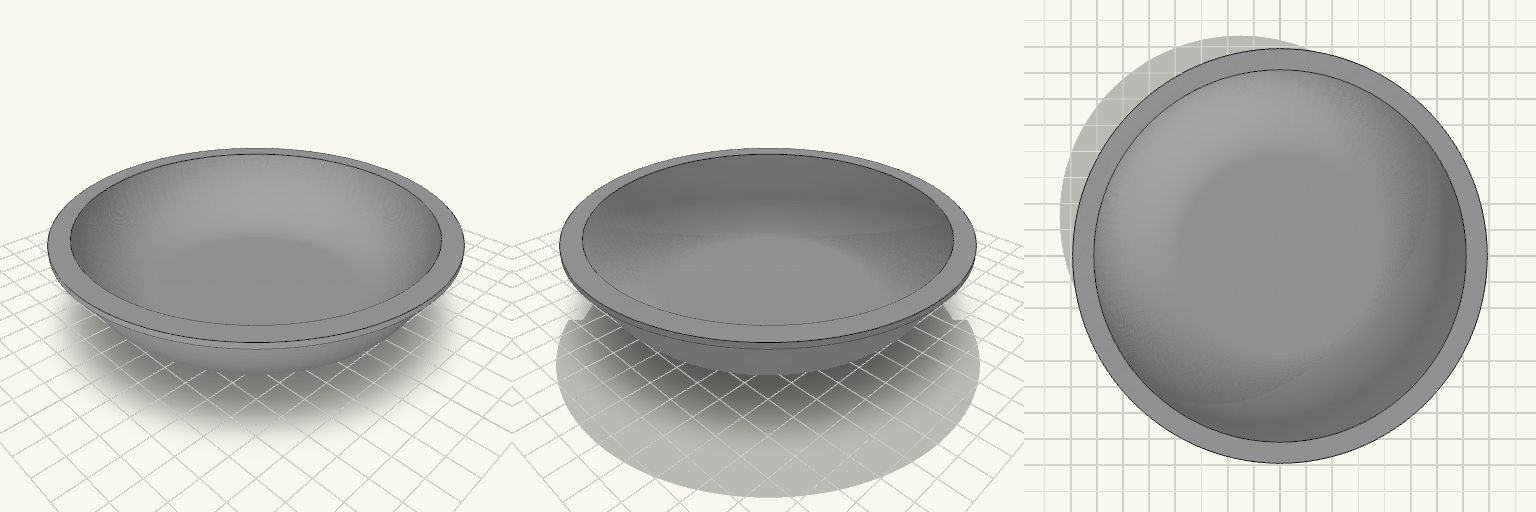
Brim — Flat-Bottom Rounded Bowl
Brim is a shallow serving bowl with a flat 75 mm base that sweeps up in a smooth curve to a wide, flat rim. The flat base keeps it stable on a table and easy to print without supports on the bottom face. Dimensions Outer rim diameter: 138 mm Rim width: 5 mm, flat and horizontal Opening inside the rim: 128 mm Depth: 30 mm Flat bottom diameter: 75 mm Wall thickness: 2 mm throughout Print notes Print rim-up or base-down; base-down is the natural orientation. The steepening curve near the rim may need supports or slow cooling.