Tea Light Skull
Made by HandyHacksaw
Created 1 months ago
Description
A geometric, stylized skull designed to hold a standard tea light. The model stands roughly 4 inches (100mm) tall and features a hollow inner chamber connected to the eyes and nose, allowing light to cast outwards.
- Height: ~101mm (4 inches)
- Base Opening: 42mm diameter (fits standard 38mm tea lights)
- Printability: Designed with a flat base. Supports are recommended for the eye sockets and inner ceiling depending on your printer's bridging capability.
- Material Note: White or off-white PLA is recommended to diffuse the light effectively. Ensure you only use battery-operated LED tea lights, as a real flame will melt the PLA.
Images
More like this
Explore more in Decor & Display →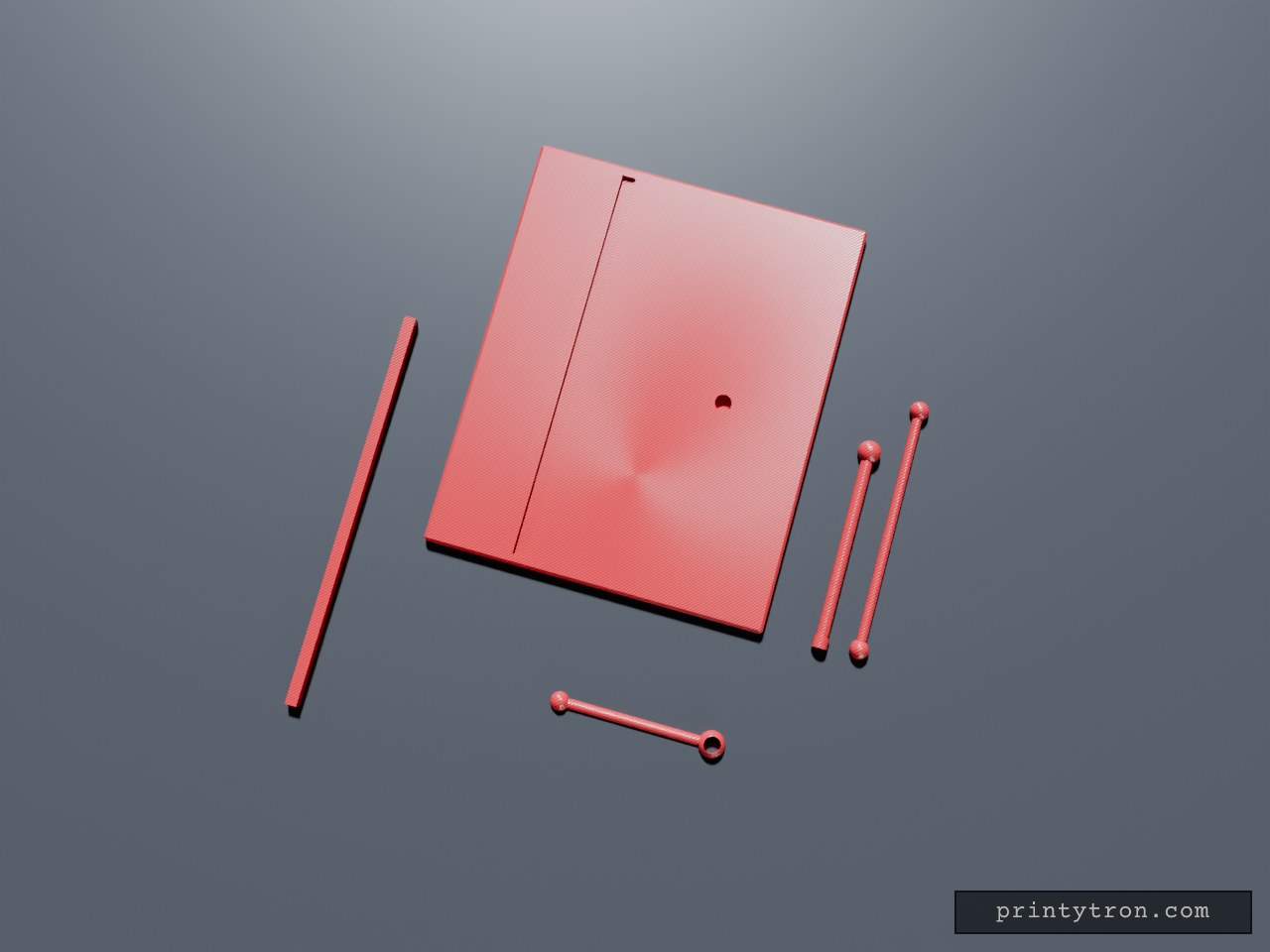
Teorema Celor Trei Perpendiculare — Model Geometric
Un model geometric tridimensional care ilustrează teorema celor trei perpendiculare: un plan, o dreaptă d conținută în plan, perpendiculara pe plan, proiecția acesteia și oblica ce închide demonstrația. Fiecare element este o piesă separată, așezată culcat pe masa de printare, astfel încât să poată fi tipărită într-o singură culoare și apoi asamblată — relațiile de perpendicularitate se citesc astfel direct pe obiect, prin culori, nu doar pe desen. Componente Plan — baza pe care se construiește figura (110 × 90 mm), cu un locaș pentru perpendiculară și un canal pentru dreapta d. Dreapta d — dreapta din plan, față de care se verifică perpendicularitatea (bară de 104 mm). Perpendiculara AO — segmentul ridicat perpendicular pe plan, cu cep de îmbinare de 4 mm la un capăt. Proiecția OB — urma lui AB în plan, perpendiculară pe d, cu gaură de 4,4 mm pentru cep. Oblica AB — segmentul înclinat, perpendicular pe d prin teorema celor trei perpendiculare (bară de legătură de 69 mm). Asamblare Piesele se printează separat, fiecare în culoarea ei, și se îmbină apoi prin cep și gaură. Verifică potrivirea cepului în gaură pe prima piesă printată: toleranța depinde de imprimantă. Dacă toate piesele nu încap pe masa imprimantei, printează-le în mai multe runde. Note de printare Piesele sunt subțiri și se printează ușor culcat, fără suporturi. O înălțime de strat mică păstrează muchiile netede la segmentele subțiri. Utilizare Potrivită pentru ore de geometrie, explicații la tablă sau ca obiect de birou pentru vizualizarea rapidă a teoremei.
Flat Picket Fence Panel, 100 mm
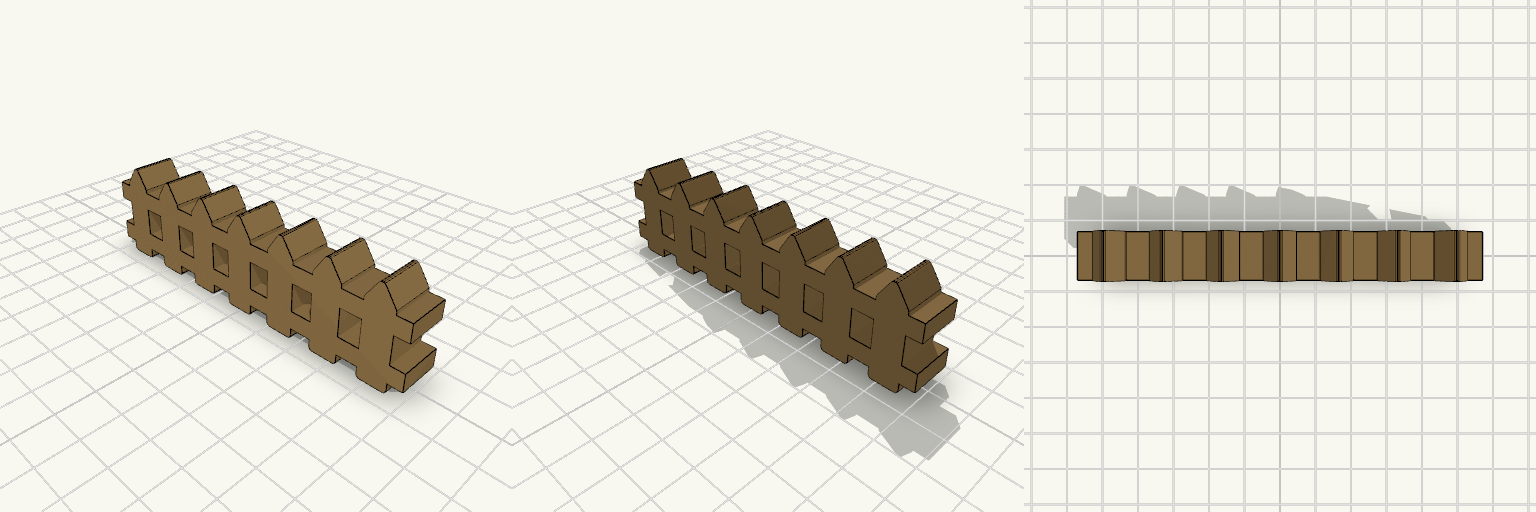
A single flat picket fence panel, 100 mm long and 12 mm thick, with seven vertical pickets set 8 mm wide with 6 mm gaps between them. Two horizontal rails run the full length near the top and bottom, and the picket tips are rounded points that top out at about 27.2 mm. The pickets sit 4 mm in from each end, with the rails running through to the edges. The model is stored standing upright but is meant to print on its back face: laid flat, the 12 mm thickness becomes the print height and no supports are needed. Walls are 3 mm and the rails are 5 mm tall, so the part is sturdy at a small scale. Seven pickets, 8 mm wide with 6 mm gaps Two full-length rails, 5 mm tall Rounded pointed tips, roughly 27.2 mm overall height Print flat on the back face, no supports 3 mm walls, suited to PLA Use it as a miniature garden border, a diorama or model-railway accessory, or a small decorative edging piece.
Square-Foot Tabletop Post Stand
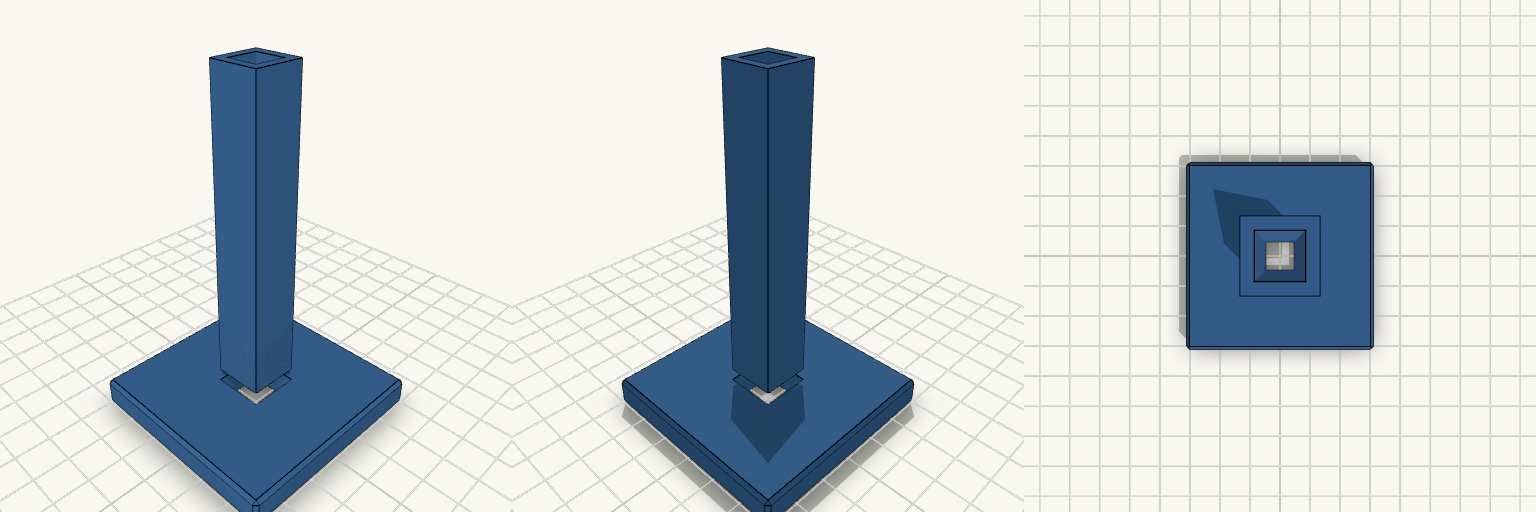
What it's for A one-piece tabletop stand: a flat square foot with a single 14 mm square post rising from its centre. The broad 60 mm foot keeps the post stable on a desk or shelf, and the post gives you a square, straight upright to build onto, hang something from, or slot a part over. The underside carries a square sleeve socket with a wire hole through its floor, so a cable can be fed up through the post and out of the open top instead of running loose down the outside. It prints as one piece — nothing to glue or assemble. Dimensions Footprint: 60 × 60 mm, 8 mm thick, with a 1 mm chamfer around its edges. Post: 14 × 14 mm square, rising 90 mm from the centre of the foot. Overall height: 98 mm as it sits on the print plate. Underside socket: 14.5 × 14.5 mm square, 12 mm deep, centred in the foot and running 4 mm up into the post. Wire bore: 9 × 9 mm, running the full length of the post from the socket floor out through the open top, leaving about 2.5 mm of wall around it. Print notes Material: PLA on an FDM printer. Orientation: stands upright on its foot, so it prints with no supports. Walls: the post is bored out, so its walls are about 2.5 mm — a 3 mm perimeter setting will not fit them evenly; two or three perimeters gives a cleaner result. Slicing: set 20% infill in your slicer; the model itself does not carry an infill value. Remix ideas Change the post cross-section to match whatever has to slide over it, keeping roughly 0.5 mm clearance per side. Resize the socket to take a different sleeve, or cap the top of the bore to make a closed internal channel. Scale the foot wider or thinner for a heavier load or a tighter shelf space.
Two 100 mm Picket Fence Panels
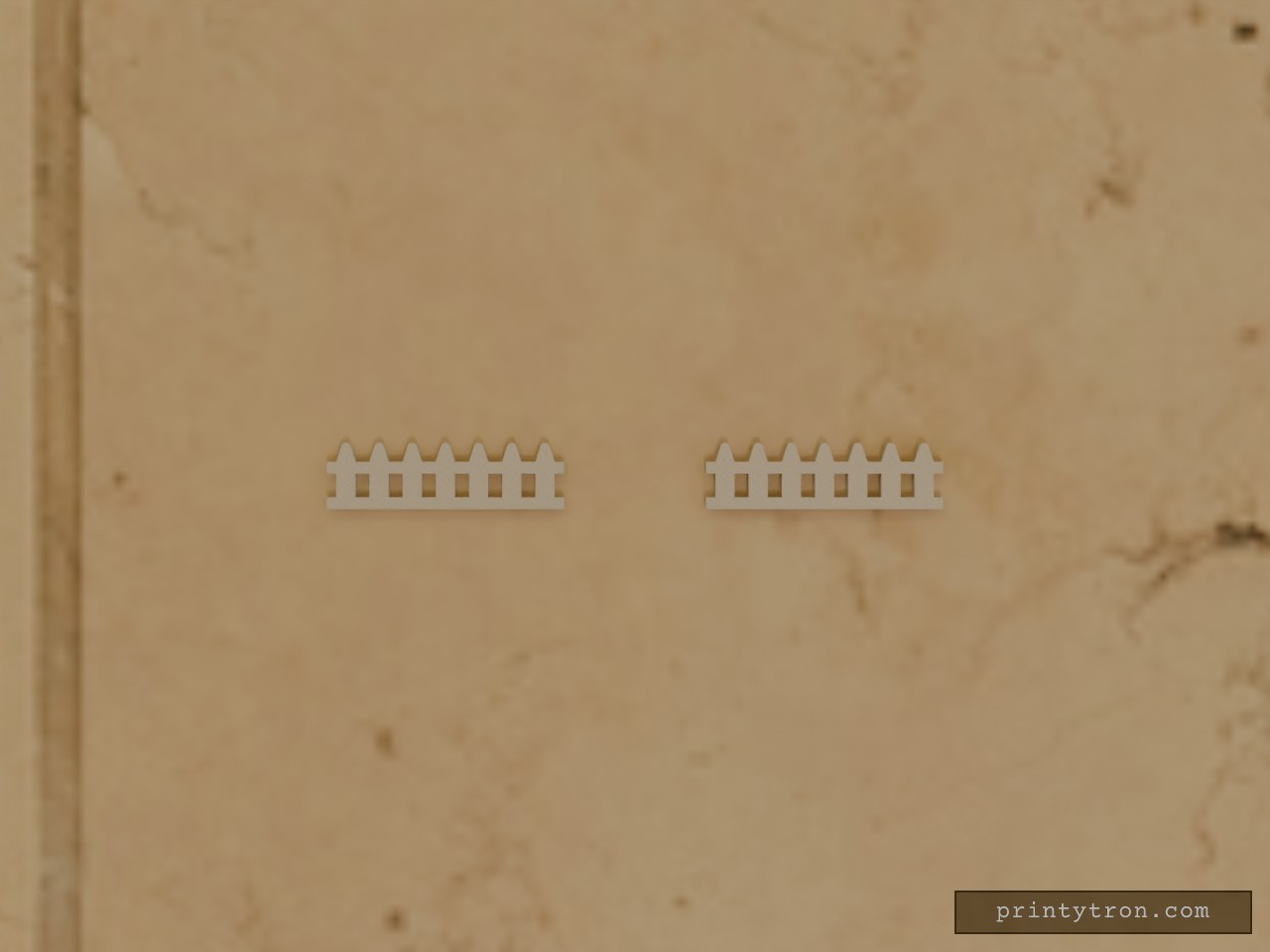
Two mirrored flat picket fence panels for either side of a pedestrian crossing diorama. Each panel is 100 × 28 × 3 mm with seven rounded-point pickets joined by two horizontal rails. The pair spans 260 mm with a 60 mm gap for the crossing, fitting A4 landscape. Pickets: 8 mm wide, 6 mm gaps, rounded pointed tops Rails: 5 mm tall, near top and bottom, full 100 mm length Thickness: 3 mm throughout Print: flat on the bed, no supports, no holes, no text Material: PLA or PETG Footprint: 260 × 28 mm
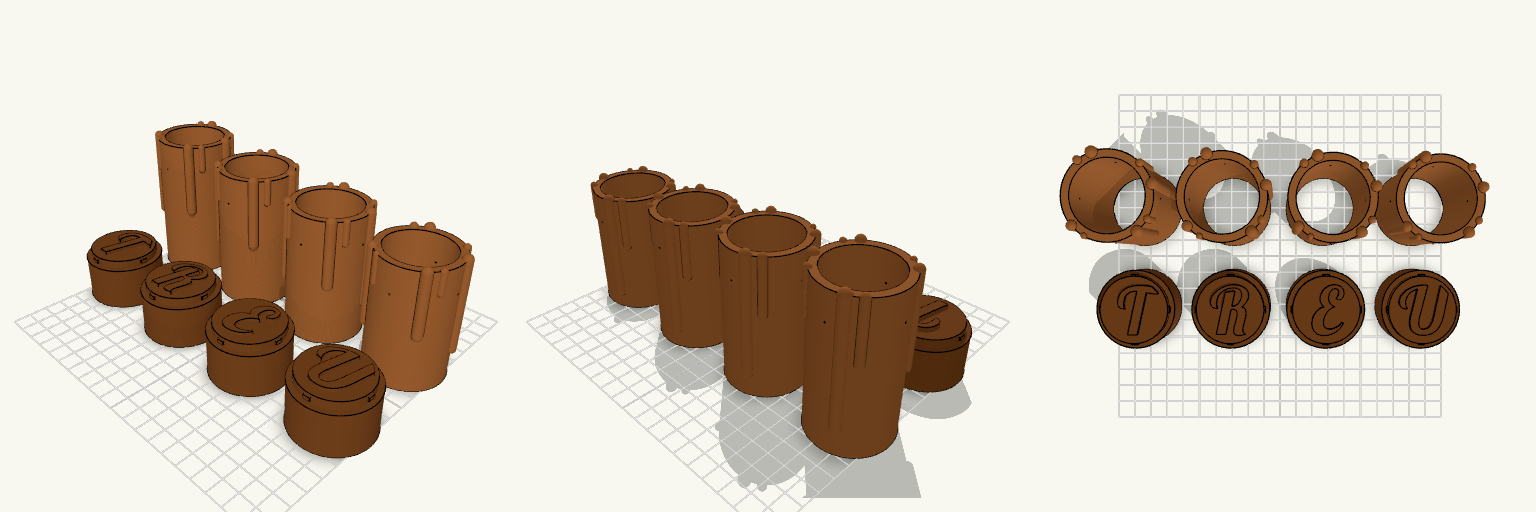
Sonderkerzen 2.0
What it's for Vier Kerzenkörper in abgestuften Höhen, die eine brennende Kerze simulieren. An der Außenseite laufen unregelmäßige Wachstropfen unterschiedlich weit herunter; einige Bereiche des oberen Randes bleiben frei. Jede Kerze ist in ein Oberteil und ein Unterteil geteilt. Der Bajonettverschluss mit Rastnase hält die Teile zusammen und soll sich nicht unbeabsichtigt lösen. Die Unterteile sind bis zur Lippenfläche massiv gefüllt und tragen je einen erhabenen Buchstaben: T, R, E und U in einer verspielten Schreibschrift. Der Buchstabe steht 2 mm über der Lippenfläche und ist dadurch als Stempel nutzbar. Die Schrift ist nicht gespiegelt; Abdrücke wären seitenverkehrt, zum Stempeln müsste sie gespiegelt werden. Der Innenraum der Oberteile bleibt frei; der Innendurchmesser von 37 mm und die vier 1-mm-Löcher bleiben unverändert. Dimensions Gesamthöhen: 110, 105, 100 und 95 mm Außendurchmesser: 45 mm; Innendurchmesser: 37 mm Teilung: 25 mm über dem Boden Vier durchgehende Löcher von 1 mm, 16 mm unter der jeweiligen Oberkante, bei 12, 3, 6 und 9 Uhr Buchstaben: ca. 27 mm groß, auf einen 34-mm-Kreis begrenzt, 2 mm über der Lippenfläche erhaben Print notes Das Set besteht aus acht Einzelteilen: vier Oberteile und vier Unterteile. Die Teile lassen sich im Slicer trennen und auf einer 180-mm-Platte verteilen. Der Bajonettverschluss ist für den Druck ohne Supportmaterial ausgelegt. Die Rastnase ist 0,6 mm hoch und sitzt vor der Endposition; sie ist bewusst dezent, sodass die Haltekraft von Material und Drucker abhängt. Für den ersten Testdruck sind PETG oder PLA sinnvoll. Die Buchstaben vor dem Druck in der Vorschau prüfen, da feine Verbindungsstriche bei sehr feinen Düsen an Schärfe verlieren können. Remix ideas Rastnase höher oder niedriger auslegen, um die Haltekraft anzupassen Andere Höhenstufen oder mehr bzw. weniger Wachstropfen Buchstaben austauschen, eine andere verspielte Schrift verwenden oder die Schrift für Stempelabdrücke spiegeln
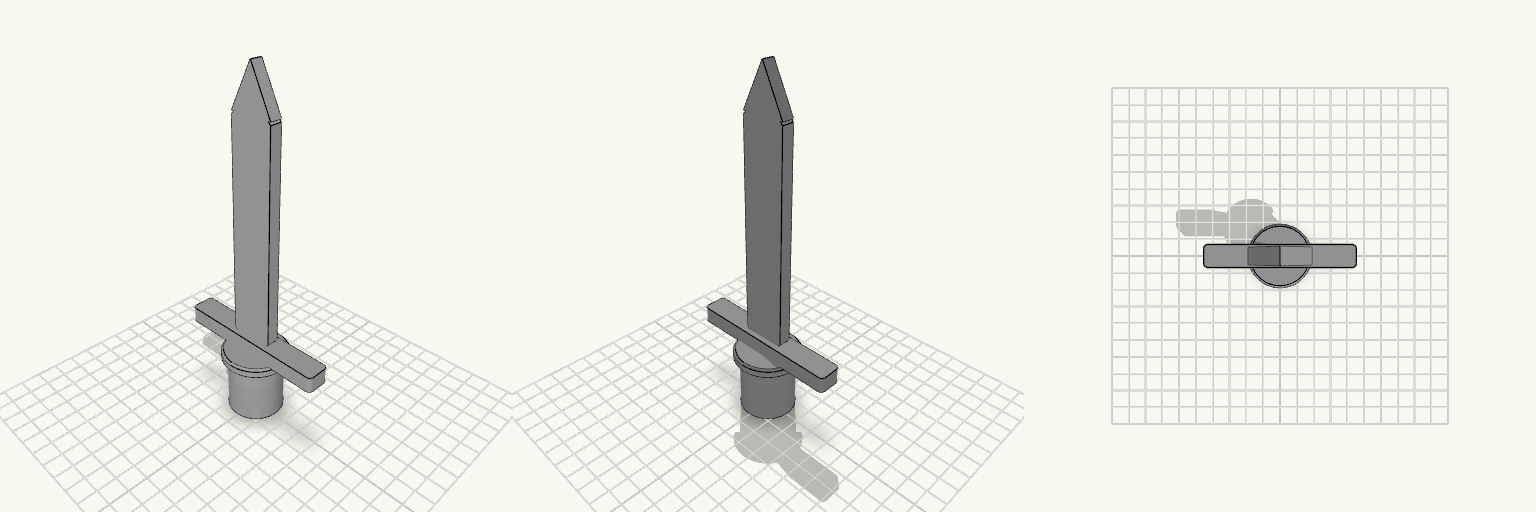
Broom-Handle Sword End with Threaded Socket
A screw-on sword end that turns a broom handle into a toy sword. The grip has a socket in its base sized for a standard 3/4" broom thread — 22 mm diameter, 4.5 mm pitch, 26 mm deep — so the blade threads onto the handle and unscrews again for carrying or storage. Above the grip sit an 80 mm crossguard and a 110 mm blade with a pointed tip. The finished piece measures about 80 × 34 × 175 mm as it sits on the plate. Broom threads are not identical across brands, so check your handle's diameter and pitch before committing to a full print; a short thread test piece is cheaper than a wasted blade. Remix hooks Socket diameter and pitch (22 mm / 4.5 mm) — the first thing to change. Match your own handle and the sword fits anything from a broom to a mop or a dowel. Socket depth (26 mm) — deepen it for a handle with a long exposed thread, or shorten it if the blade sits too high off the grip. Blade length (110 mm) — trim it for a dagger or stretch it for a two-hander; the crossguard scales along with it. Crossguard width (80 mm) — widen it for a more toy-like silhouette, narrow it for something closer to a real arming sword. Tip profile — the point can be rounded off further for younger wielders without touching anything else. Pairs naturally with a printed pommel or a wrapped grip sleeve, and the same socket can be reused on an axe, spear or halberd head for a matching set.