Thumb Wrestling Ring Mat
Created 1 months ago
Description
A miniature desktop arena designed specifically for thumb wrestling. You insert your thumbs up through the floor cutouts, giving you a confined, roped-in stage to settle disputes.
It’s completely absurd, but it prints in place and works exactly as advertised. I left the geometry simple so you can tweak it to your liking.
Remix Hooks
- Thumb clearance: The floor holes are currently set to 24.5mm. If you're printing this for kids, scale that down; for larger hands, you might need to bump it up.
- Stakes and ropes: The turnbuckle posts are 5mm thick and the ropes are 2mm tall frames at 17mm and 26mm off the deck. You could easily swap the solid ropes for small holes in the posts and thread real elastic through them instead.
- Mat thickness: The base is 10mm thick, which gives it enough rigidity to survive a match without snapping.
Images
More like this
Explore more in Gifts, Seasonal & Personalized →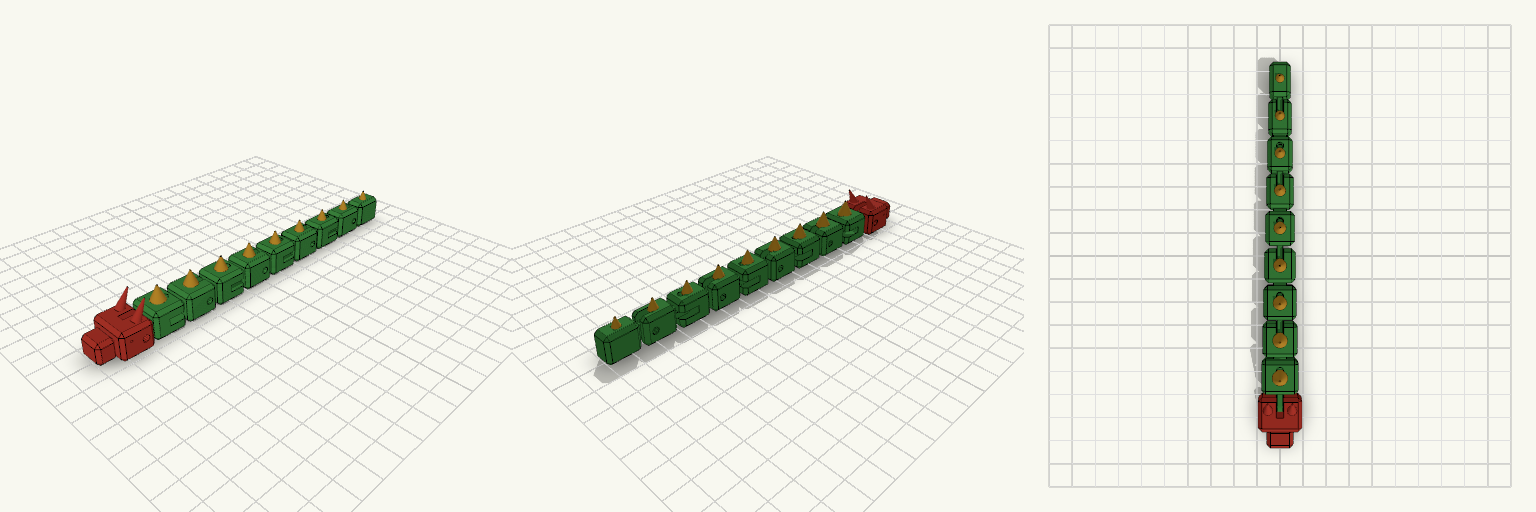
Print-in-Place Articulated Dragon Fidget Toy
Articulated dragon with a horned head, ten hinged body segments and back spikes. It prints as one piece with no assembly, and the body flexes in a wave when held. Joints: pin hinges with 0.4 mm clearance per side, alternating between side-to-side and up-down bending Segments: 10, tapering from an 18 mm wide head to a narrow tail Size: about 155 mm long, 12 mm tall without spikes Print: lay flat, no supports intended for the body; 0.2 mm layers, PLA or PETG After printing: bend each joint back and forth to break the hinges free Use: desk fidget, sensory toy
Yuletide Vault — 24-Drawer Advent Calendar
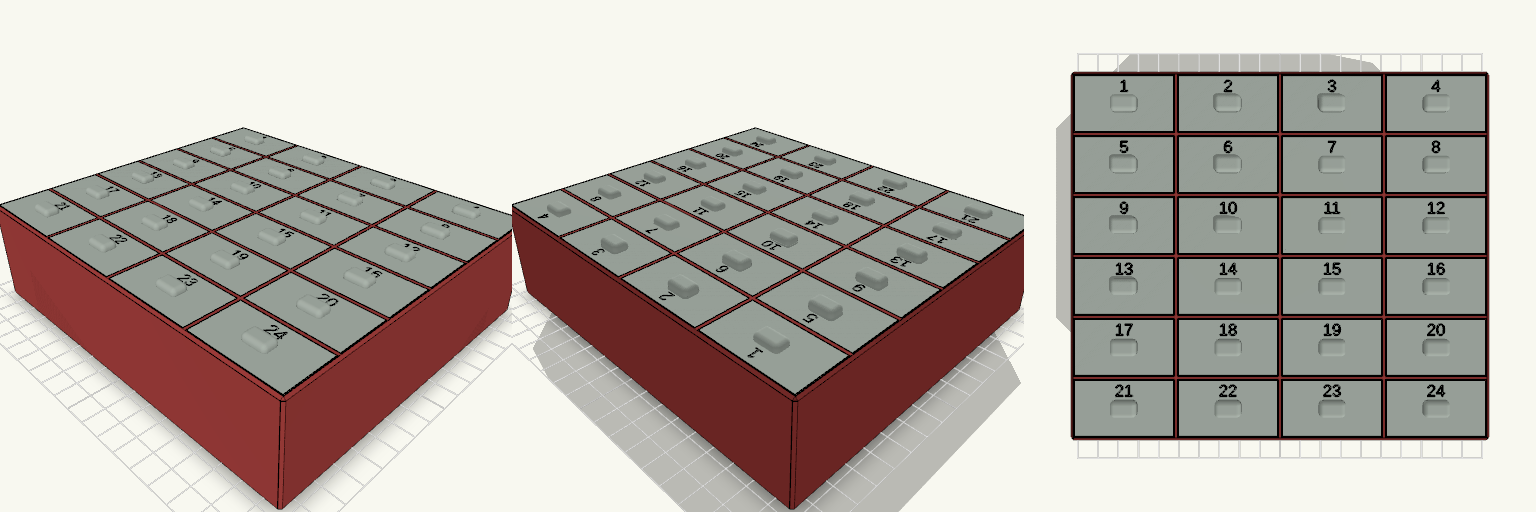
A print-in-place advent calendar with 24 identical sliding drawers in a 4 × 6 grid. Every drawer front carries an engraved number from 1 to 24 and a soft-edged finger handle, so the countdown opens one small compartment at a time. The drawer bodies, fronts and matching frame openings keep clean square corners; only the handles are rounded, giving a comfortable grip without softening the rest of the geometry. Each cavity is sized around a 35 mm × 20 mm candle, making the drawers practical for a daily treat or a small gift. The whole assembly fits the Bambu Lab A1 Mini build plate and prints without supports in the sliding channels. Features 24 identical drawers arranged in 4 columns and 6 rows, numbered 1–24. Square drawer bodies, fronts and frame openings; only the handles are softened, with an edge radius of about 1.5–2 mm. Each drawer has an 11 × 7 mm handle that protrudes 3 mm, centred on the front. Engraved numbers sit 0.6 mm deep in the strip above each handle, clear of the grip area. 0.4 mm clearance on every side and at the back keeps the drawers sliding freely. A stop ridge inside each pocket catches the drawer's back wall after about 40 mm of travel, so drawers cannot fall out accidentally. Drawer cavity: 38.5 × 42 × 22 mm, sized to hold a 35 × 20 mm candle. Dimensions Overall footprint: 175.2 × 154.2 × 49.6 mm including handles — fits the A1 Mini's 180 mm plate. Drawer outside: 41.5 × 45 × 23.5 mm; wall and floor thickness: 1.5 mm. Frame divider walls: 1.2 mm. Print notes The calendar prints as one piece with the drawers already seated in the frame. The back face lies flat on the plate and the fronts and handles face up, which avoids supports in the channels. Print in white PLA for the intended look.
Festive Headstand: Upside-Down Pineapple with Ball Gag
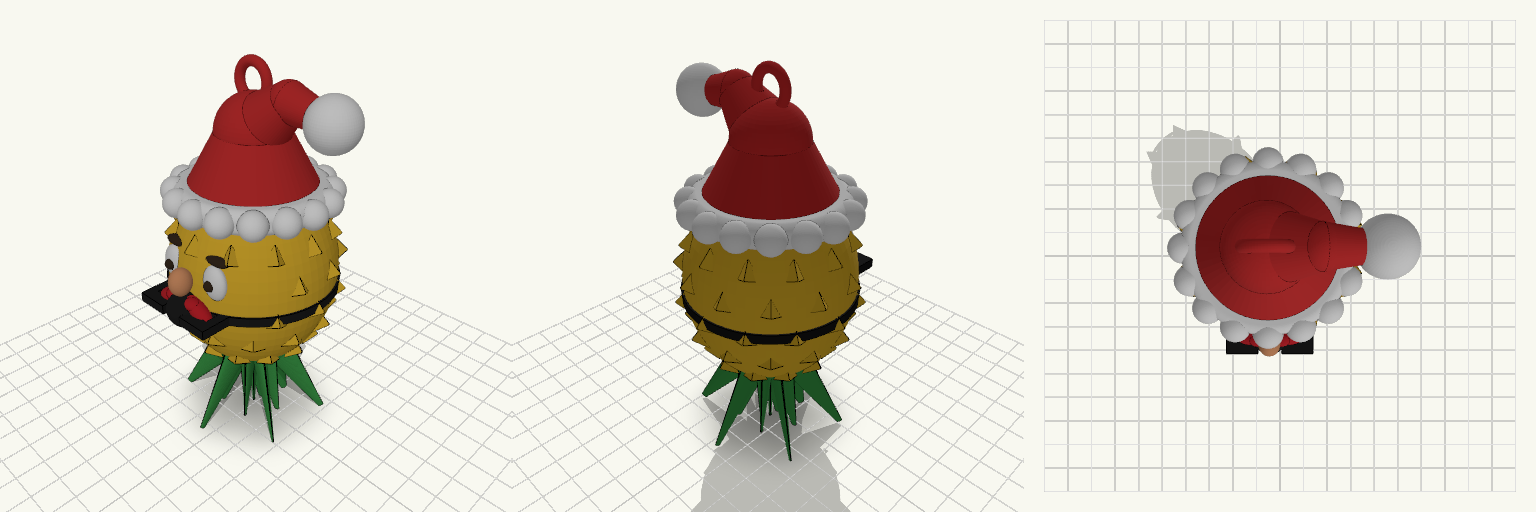
A cartoon pineapple does a festive headstand: it balances on an oversized leafy crown, the fruit body rising above, and a big fluffy red Christmas hat droops off to one side, ending in a single large rounded bobble. Two wide-open eyes with dark pupils and brows sit on the fruit, a small skin-toned nose between them, and a black ball gag framed by small red puckered kissing lips takes the place of a mouth. The lips form a compact ring with cupid's-bow lobes on top and a fuller lower lip, set back into the fruit's surface around the ball so the black shows through the middle. The strap runs around the head and across the front, outside the lips, lying against them as it passes over their corners and into the ball, so the lips sit behind it. The leaves are the star of the stand: a dozen broad blades plus a ring of shorter ones fan out beneath the fruit and lift it clear of the surface, giving the upside-down pose its height and silhouette. The body is scaled in staggered rows of triangular scales, kept clear of the face, so the fruit reads as a pineapple from any angle. And yes — the inverted pineapple is the classic swinger sign, worn here in full holiday dress. Use it as intended, or simply as a seasonal oddity. Made to hang A loop sits upright on the hat's peak, ready for a hook, ribbon or tree branch. With no base disc under the crown, the pineapple rests on its leaf tips — perfect for hanging, less so for standing on a shelf. The hat's tip droops to one side and ends in one large rounded bobble, so check clearance around the hook. Design notes Tall, wide leaf crown with 12 broad leaves and a ring of shorter ones; it doubles as the stand. Face: two open eyes with pupils and brows, a small nose, a black ball gag, and small red puckered kissing lips with a cupid's bow. The lips are sunk back into the face around the ball rather than standing proud of it, so the strap sits in front and the red shows as a ring. Strap wraps the back of the head and bands across the front outside the lips, resting against the face and covering their corners. Staggered triangular scales wrap the body in rows, with the face left smooth. Oversized hat with a thick trim of rounded puffs and a smooth bobble, finished with the hanging loop. The fluffy hat trim is the widest point, so check your bed size before printing.
Tasse chocolat 100 mm et père Noël en pièces
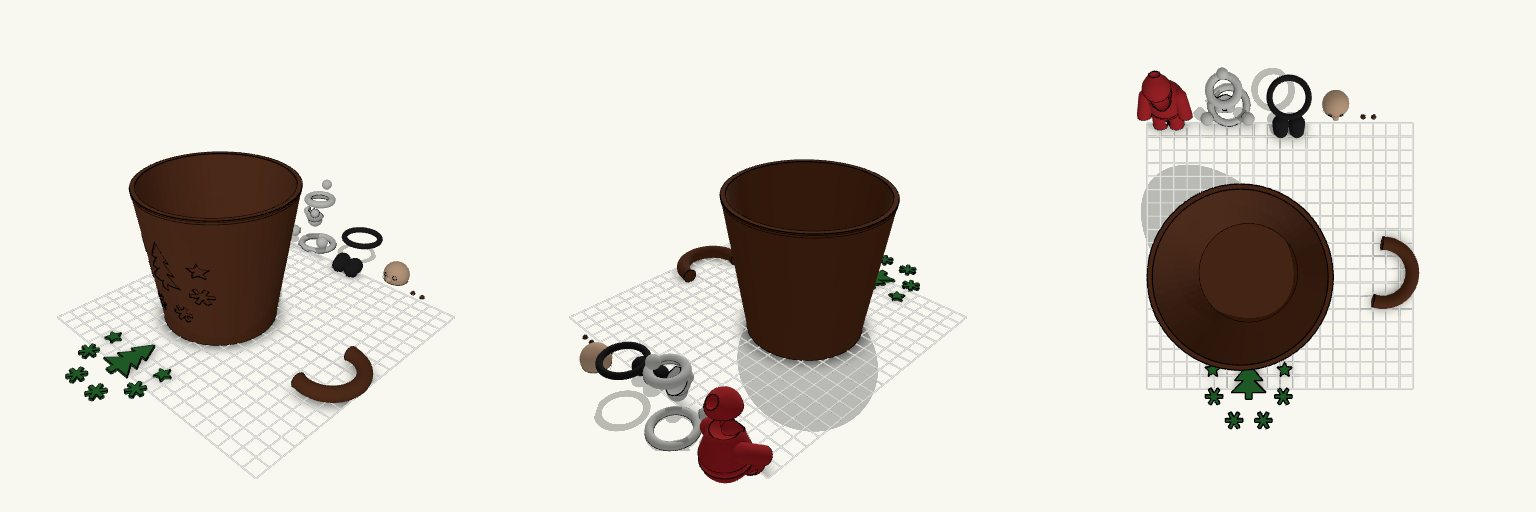
Ensemble de pièces distinctes posées sur le plateau : une tasse à chocolat creuse de 100 mm de haut, son anse détachée à droite, un père Noël en cinq pièces, une par couleur, et un jeu de décorations de Noël plates à coller sur la tasse. La tasse est ouverte en haut, sans couvercle, avec une base plate et une paroi lisse puisqu'elle n'a plus d'anse. Sa face avant porte des creux à la forme exacte des décorations, à la position qu'elles occupaient auparavant en relief, pour les recevoir avec un peu de colle. Le père Noël est posé derrière la tasse, côté +Y, en cinq pièces qui s'emboîtent comme un puzzle et se collent sans surépaisseur. L'anse se colle sur le côté +X de la tasse. Tasse : 100 mm de haut, 80 mm de diamètre en bas, 110 mm en haut, parois de 3 mm, fond de 5 mm, rebord arrondi, intérieur entièrement creux, paroi lisse sans anse Anse séparée : posée à plat à droite de la tasse côté +X, même couleur chocolat, rayon de 22 mm et épaisseur de 10 mm ; extrémités découpées pour épouser la paroi ; se colle à la tasse ; aucun creux de guidage dans la paroi ; s'imprime sans support sur sa face large Décorations séparées : sapin à trois étages et tronc sans étoile au sommet, deux étoiles latérales et quatre flocons, tous verts, 1,4 mm d'épaisseur, posés à plat sur le plateau devant la tasse côté −Y ; les deux flocons latéraux sont à environ 26 mm du centre et 42 mm de haut pour limiter la déformation due à la courbure Creux d'encastrement : profondeur d'environ 1,5 mm avec 0,3 mm de jeu tout autour pour la colle ; la paroi garde environ 1,5 mm sous les creux et l'intérieur reste creux Père Noël en 5 pièces : manteau et bonnet rouges (environ 40 × 33 × 57 mm), fourrure et barbe blanches (environ 40 × 34 × 57 mm), ceinture et bottes noires (environ 32 × 42 × 25 mm), visage couleur chair (environ 20 × 23 × 14 mm), yeux bruns (environ 11 × 3 × 2 mm) Pose des pièces : chaque pièce est aplanie sur 0,8 à 2 mm à son dessous pour tenir à plat sur le plateau ; elles se découpent là où une autre prend sa place, donc aucun chevauchement Pièces délicates : les yeux et le visage sont de petites pièces ; à imprimer et coller avec soin Impression sans AMS : chaque pièce se place sur le plateau avec sa propre couleur, sans changement de filament en cours de pièce ; exporter en 3MF pour conserver les couleurs séparées, le STL ne les conserve pas Impression : prévu pour une imprimante FDM domestique ; les branches des flocons font environ 2,4 mm de large, ce qui est fin pour une buse de 0,4 mm ; un flocon plat sur une paroi courbe reste une approximation La tasse sert de contenant pour des bonbons ou du chocolat chaud. L'anse, les décorations et les cinq pièces du père Noël s'impriment à part, chacune dans sa couleur, puis se collent : l'anse sur le côté de la tasse, les décorations dans leurs creux sur la face avant, le père Noël reconstitué à côté, sur une étagère ou au pied du sapin.
110 mm pot à bonbons pain d'épice
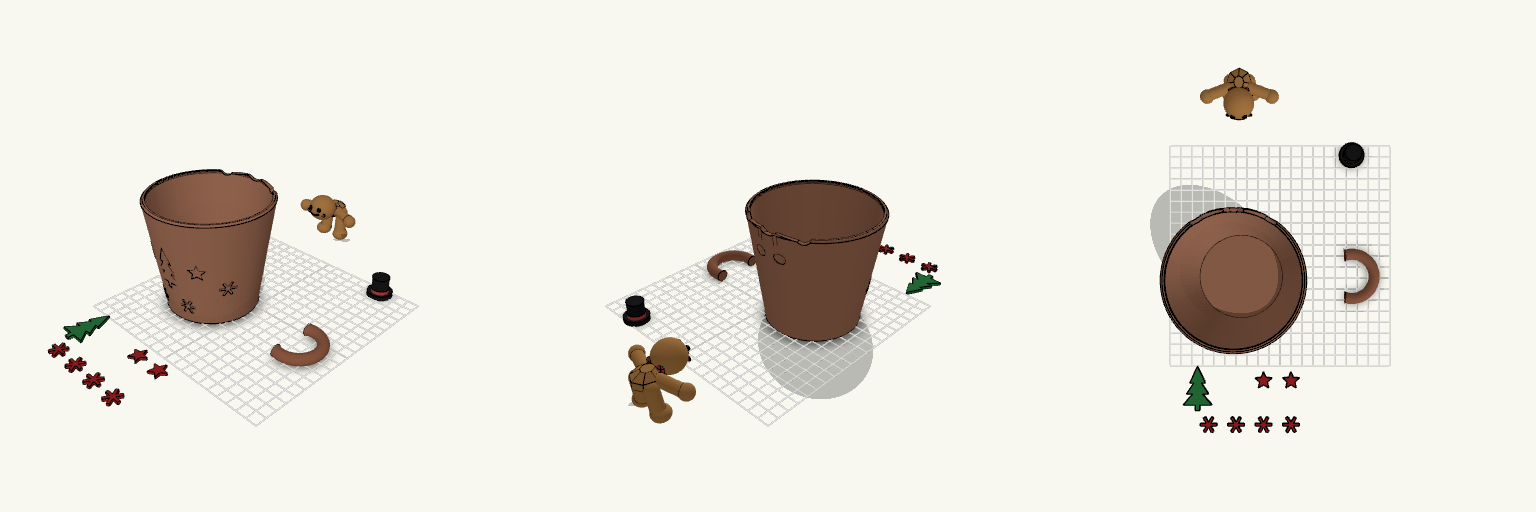
Pot à bonbons en forme de tasse de chocolat chaud, avec un bonhomme en pain d'épice couché sur le rebord arrière. Il n'y a pas de couvercle : le dessus reste ouvert et les bonbons se prennent par le haut. Le modèle se présente en volumes séparés, posés à plat sur le plateau, à réunir à la colle après impression — l'anse comprise, qui n'est plus attachée à la tasse. La cote qui commande tout, c'est le diamètre au sommet de la tasse : 110 mm. C'est lui qui définit l'ouverture et l'encombrement du pot une fois monté. La tasse mesure 100 mm de haut, son diamètre passe de 80 mm au pied à 110 mm au sommet, avec des parois de 3 mm, un fond de 5 mm et une base parfaitement plate. Sans son anse, elle occupe environ 110 × 110 mm au sol. Une fois l'anse collée sur le côté, l'emprise passe à environ 130 mm de large, avec une saillie d'environ 25 mm ; ses extrémités s'arrêtent dans l'épaisseur de la paroi, donc l'intérieur reste entièrement dégagé pour les bonbons. Les pièces du plateau Tasse : 110 × 110 × 100 mm environ, paroi lisse côté anse, avec les creux des motifs sur la face avant et l'emplacement du bonhomme creusé dans le rebord arrière. Anse : demi-anneau posé à plat, 31 × 50 × 10 mm, les deux bouts coupés droit pour le collage. Elle s'imprime sur son tube rond, donc la première couche est étroite. Bonhomme pain d'épice : debout sur ses pieds, 68 × 44 × 51 mm ; le corps ne touche pas le plateau. Sapin de Noël : à plat, 26 × 40 × 2 mm — trois étages, un petit tronc et une étoile au sommet. Décors rouges : à plat, 2 mm d'épaisseur — deux étoiles et quatre flocons ; les perles ont été retirées. Visage (yeux et sourire), Nœud et joues, Chapeau haut de forme (22 mm de large, 17,5 mm de haut, ruban rouge à part) : chacun traité comme une pièce distincte. Une fois collé, le bonhomme repose sur le rebord par le torse, les bras et les jambes, la tête relevée vers l'avant, coiffé du haut de forme noir incliné vers l'arrière. Le sapin vert occupe le centre de la face avant, entouré des décors rouges en relief de 2 mm, sur une paroi de 3 mm qui s'évase. À vérifier avant de lancer Ouverture : 110 mm de diamètre au sommet, la référence pour la tasse. Plateau : la tasse seule occupe environ 110 × 110 mm ; l'anse, le sapin, les décors et le bonhomme se répartissent à côté, sans se toucher. Bonhomme : il est modélisé debout et son corps ne porte pas sur le plateau — il faut le coucher sur le dos dans le logiciel d'impression, sinon il s'imprime dans le vide. Anse : première couche étroite ; si l'adhérence est mauvaise, faites-la reposer sur une face plate dans le slicer. Chapeau : le bord large reste en porte-à-faux ; prévoyez un support dessous. Rebord arrière : l'emplacement du bonhomme laisse de petites encoches dans le rebord, il n'est pas parfaitement lisse à cet endroit. Couleurs : chaque pièce séparée reçoit son filament dans le logiciel d'impression (tasse chocolat, sapin vert, décors rouges, chapeau noir). Un export monochrome ne contient aucune couleur. Ce à quoi ce modèle ne convient pas Aucun couvercle n'est prévu, ni à visser ni à poser : ce n'est pas un pot fermé. Aucune pièce n'a d'ergots d'emboîtement, l'anse pas plus que les autres. Tout se pose bord à bord et demande de la colle ; sans collage, l'ensemble ne tient pas. L'anse est coupée pour cette tasse : ses deux faces de collage suivent la paroi de ce pot, pas celle d'un autre récipient. Le bonhomme n'est pas une figurine libre : sa découpe suit le rebord arrière de cette tasse précise. Le chapeau et le visage sont des pièces rapportées, pas des éléments venus de matière avec la tête. L'anse ne convient pas à une prise en main de grande tasse à boire : le passage pour les doigts fait environ 30 mm de haut.
Flat Six-Tier Christmas Tree Cutout
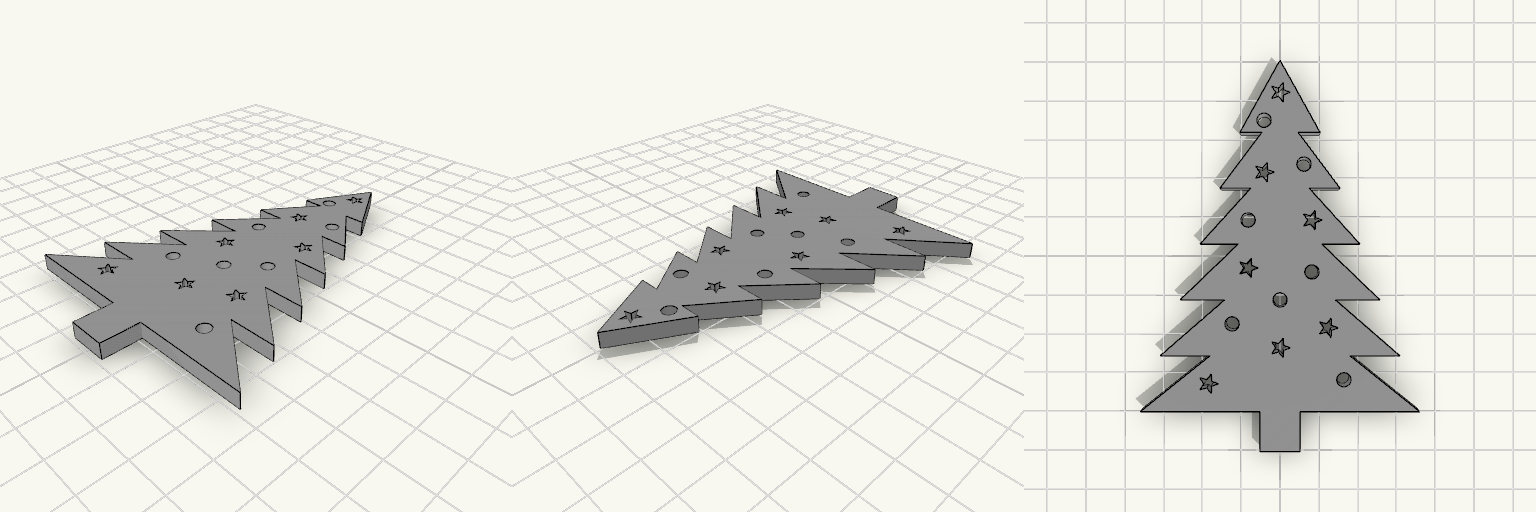
What it's for A flat, two-dimensional Christmas tree cutout with six stacked, tapering tiers over a short trunk. The tip is a plain point — no star, no topper — and the silhouette stays clean and unbroken. Seven small stars and seven small circles are scattered across the tiers as through-holes in those same shapes, punching light through the flat body and adding detail without any surface relief. It prints as one flat piece and comes off the plate ready to use, with no assembly and no supports. Dimensions Overall footprint: 70 mm wide × 98 mm tall Thickness: a constant 4 mm Tiers: six stacked branches Star holes: 7 through-holes, roughly 2.6 mm across the points Circle holes: 7 through-holes, 3.6 mm across Top: plain pointed tip, no star All of the star and circle holes sit inside the tree's outline, including the ones near the tip, so nothing breaks the outer silhouette. Print notes Print flat on the plate. The constant 4 mm body means there are no overhangs and no supports are needed. The holes are small, so a 0.4 mm nozzle prints them cleanly; the star points are sharp and may round off slightly. The flat faces are a good place for a colour change or a two-tone filament swap. Remix ideas Scale the outline up or down for a larger wall piece or a small tag. Thin the body to 2–3 mm for a lighter decoration, or thicken it for a freestanding table piece. Enlarge the star and circle holes for a stronger see-through effect, or change their count for a denser or sparser look. Add a name across the trunk, or add a hanging hole if you want to suspend it.