Fireplace Advent Calendar, Printable Multi-Piece
Created today
Description
What it's for
A 24-day advent calendar styled as a brick chimney on a fireplace. Pull a day's divider and the prize drops down the flue into the firebox. Santa is stuck at the top.
Dimensions
- Two chimney sections, split at 204 mm
- 12 levels with 2 compartments each, 20 mm clear height
- 24 flat dividers and a separate Santa
- Removable firebox filler, 60 mm wide, with pull tab and break-away nubs. It leaves open gaps at the sides and clears the firewood.
Remix ideas
- Change the garland to lights or holly
- Add a name or year to the mantel
- Resize the compartments for larger prizes
Images
More like this
Explore more in Decor & Display →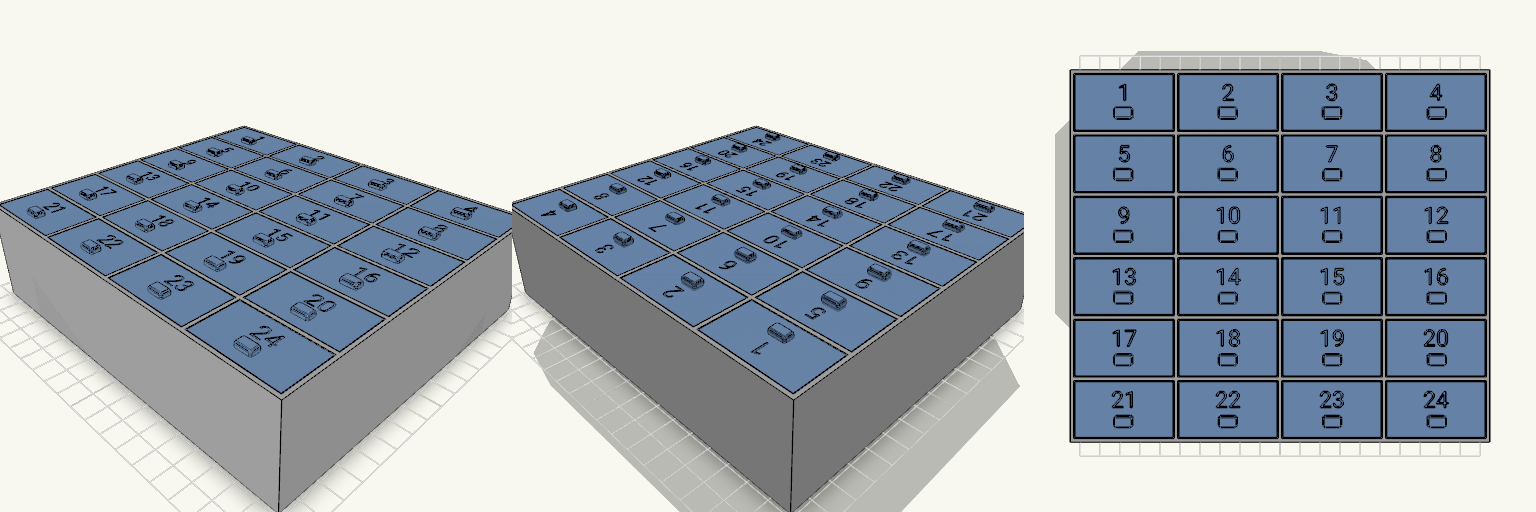
Advent Calendar With 24 Drawers
Advent calendar drawers that stick, fuse, or have nothing to grab. Each of the 24 drawers has a rounded finger grip on the front, a numbered face, and 0.5 mm clearance all round, so it slides out freely after printing in place. Key numbers Footprint: 177.5 × 157.5 mm (fits a 180 × 180 mm bed) Height: about 49.9 mm including grips Layout: 4 columns × 6 rows, printed lying on its back, front facing up Drawer interior: 38.5 × 22 × 42.5 mm Walls: 1.5 mm; grips 8 × 5 mm, 2.5 mm proud Print: white PLA, 0.4 mm nozzle, no supports inside the drawers; the drawer back walls hover 0.4 mm above the frame back, so expect a thin first-layer bridge
Christmas Tree Lantern for LED Tealight
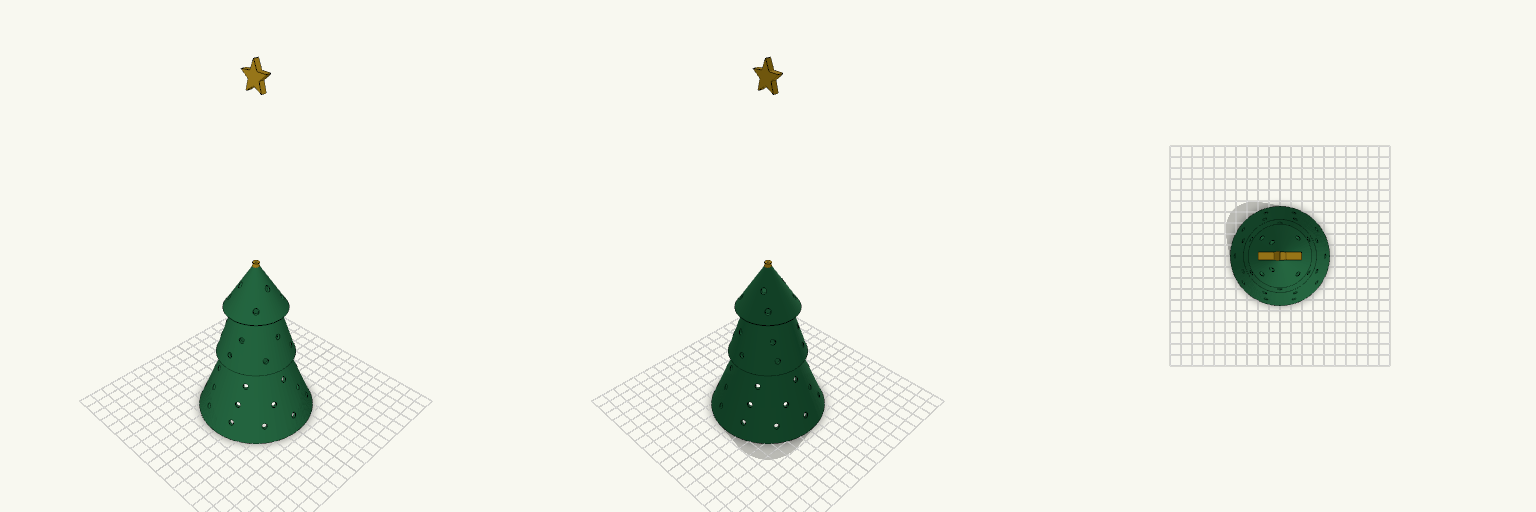
A Christmas tree lantern that sits over a battery LED tealight, so the light stays hidden inside instead of glaring from a bare tealight on the table. The walls are perforated with rings of small round holes that throw dots of light, and the bottom is open so the LED can be placed or swapped without taking anything apart. Key numbers Height: about 135 mm including star Base diameter: 90 mm, open underneath (inner opening about 87 mm) Wall: 1.6 mm, three stacked tiers Perforations: 4.2 mm holes, staggered rings Star: separate colour, peg-mounted into the top tier Printing Print upright, open end down, no supports needed for the cone walls Green for the tree, gold or yellow for the star Use a 0.4 mm nozzle; a lighter or translucent filament glows more
Christmas Tree Lantern with LED Holder
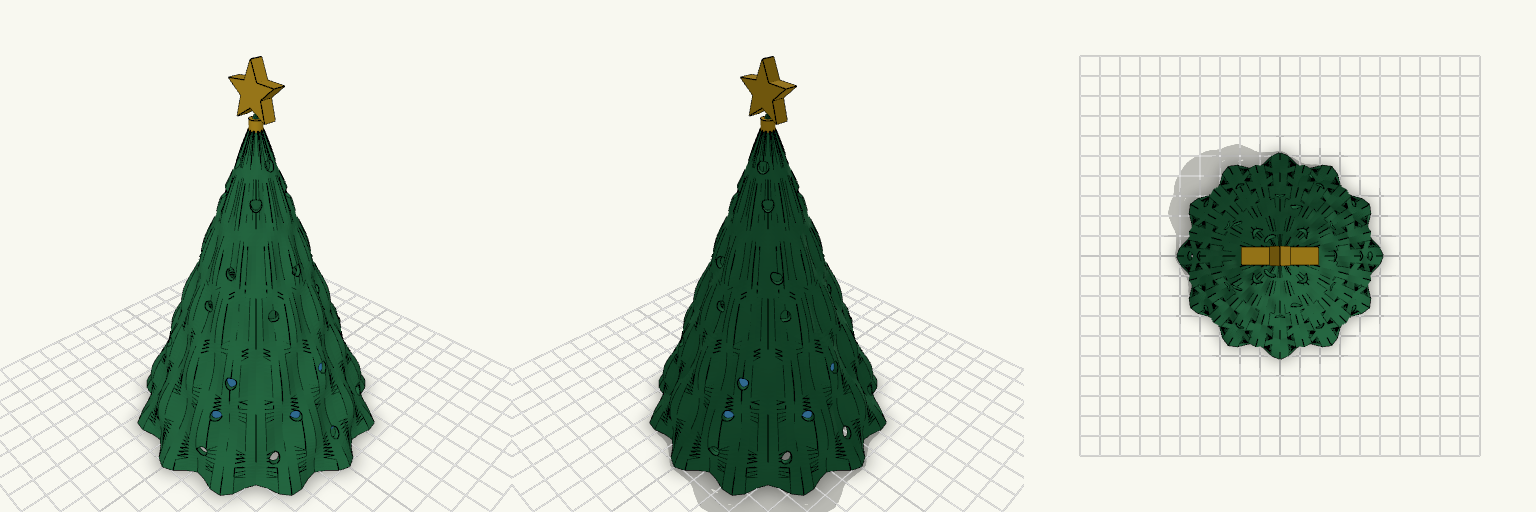
What it's for A Christmas tree lantern with perforated walls that hides a 38 mm battery LED light. A removable twist-lock tray inside the base holds the light, so it stays in the tree when the tree is carried or moved. Dimensions Base diameter: 90 mm, open underneath Total height: about 140 mm including the star Wall thickness: 1.6 mm Light ring: 39.4 mm inside diameter, 6 mm tall Tray: 66 mm disc with three locking lugs Assembly Line the tray lugs up with the gaps between the three tabs inside the wall. Push the tray up past the tabs, turn it about 60°, and lower it onto the tabs. Place the light in the ring. Remix ideas Make the ring taller for a deeper hold. Add a thumb notch to the tray for easier twisting. Change the hole pattern for different light dots.
Miniature Pop-Up Toaster, 70x46x45 mm
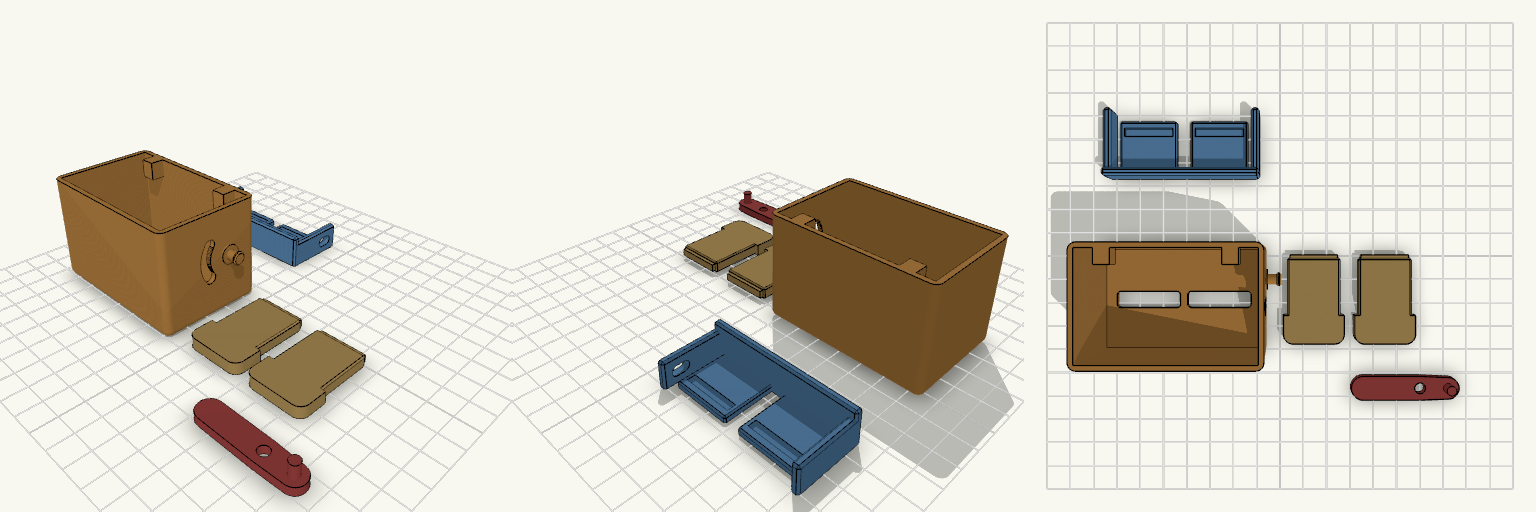
A small mechanical toaster printed as separate parts: body, toast carriage, two toast slices and a side lever. Pressing the lever handle down raises the carriage and pops both slices up out of the slots. No springs are used. Lowering the lever pulls the toast back down. How it works The lever pivots on a pin moulded into the right side wall. A peg on the lever passes through an arc slot in the wall into a horizontal slot in the carriage side plate. The peg's travel lifts the carriage about 14 mm. The ends of the arc slot are the up and down stops. Two floor blocks inside the body act as backup low stops. Each toast slice has a tenon that locates in a pocket on its carriage tray. Specs Body: 70 x 46 x 45 mm, open bottom. Print it upside down with the top plate on the bed. Overall assembled size: about 76 W x 52 D x 60 H mm with the toast raised. Carriage: 1 mm side clearance to the walls. Slice tenon clearance 0.3 mm per side. Slots: 27 x 7 mm for slices 25.5 x 5 mm. Print settings: PLA, 0.2 mm layers, 3 walls, 10-12% infill. No supports are needed. Estimated filament: roughly 35-45 g. This is below the 50-60 g target, so walls can be thickened if more weight is wanted. Assembly Slide the carriage into the body through the open bottom. Slice tenons face up. Press the lever hub onto the pivot pin, feeding the peg through the arc slot into the carriage slot. Add a dab of glue to the pin head if the snap fit is loose. Drop the slices into the slots.
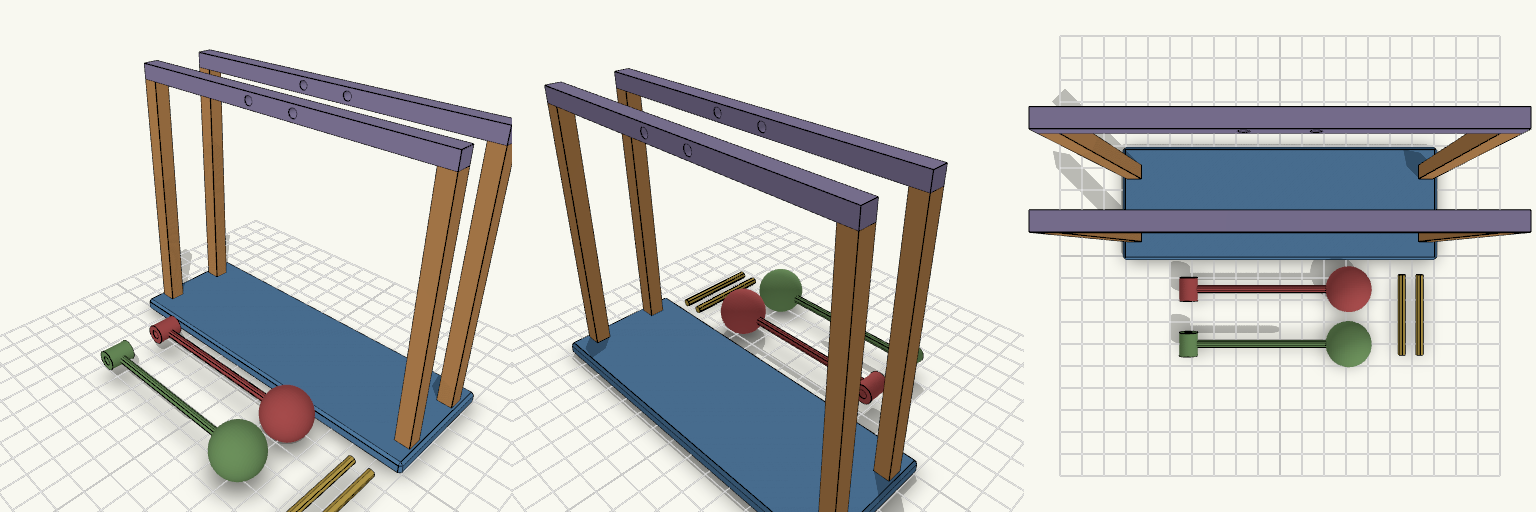
验证质量守恒定律改进实验
A two-ball Newton's cradle that splits into separate pieces for easy printing: base, four posts, two top rails, two axles and two swinging ball pendulums. Both balls hang at rest, touching at the centre. The pendulum hubs ride freely on loose 3 mm axles. Remix hooks Pendulum length: 70 mm arm, 10 mm radius balls. Longer arms give a slower swing. Joint clearance: pegs are 5.6 mm / 4 mm in 6.4 mm / 4.4 mm pockets. Tighten or loosen for your printer. Axle fit: 3 mm axle in a 3.8 mm hub bore and 3.4 mm rail holes. Frame height: the pivot sits 110 mm above the base on a 140 x 50 mm plate. Pairs with: a printed or drawn angle scale or height ruler placed beside the frame, for mass and height experiments. Variants: add more pendulums by adding axle positions along the rails.
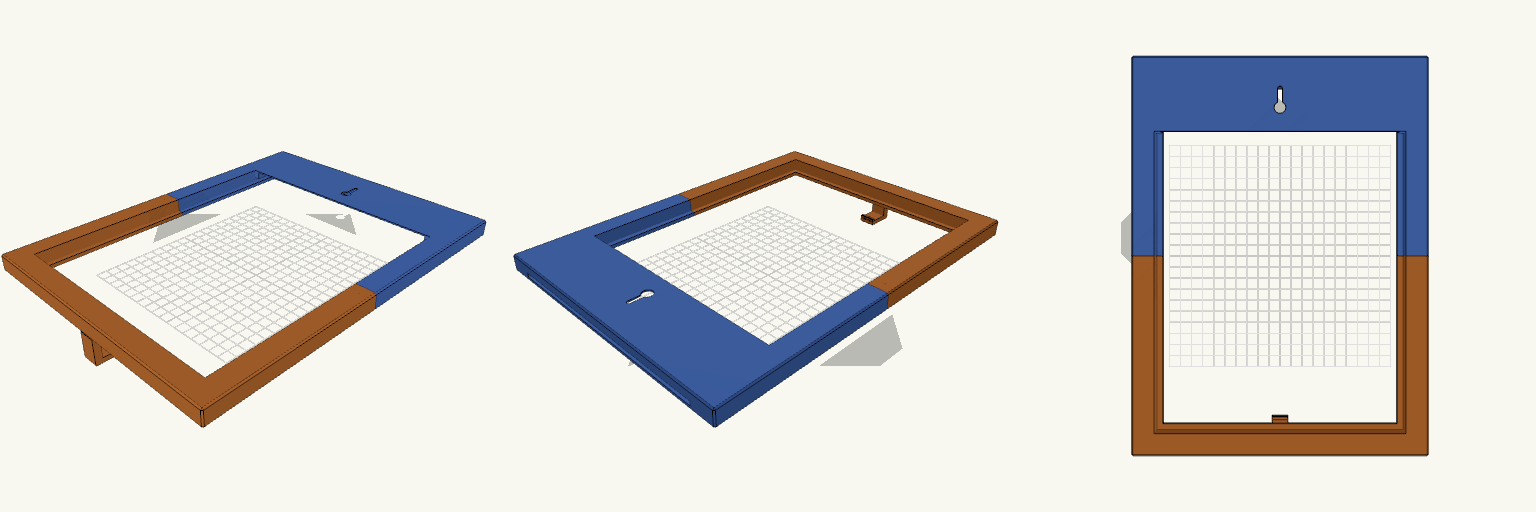
Moldura A4 Vertical 250 × 337 mm, Fundo Aberto
Moldura para folha A4 (210 × 297 mm) na vertical, em duas metades unidas por pinos-guia, com a folha entrando por uma fresta na travessa superior. Medidas Externo: 250 × 337 × 15 mm Abertura visível: 202 × 289 mm, lábio frontal de 5 mm Bolso do papel: 212 × 299 mm Fresta superior: 206 mm de largura Fixação e encaixes 4 pinos-guia de Ø5 × 8 mm na metade superior, com alojamentos de Ø5,6 mm na inferior Keyhole para prego: entrada de Ø10 mm e fenda de 4,2 mm, na travessa traseira superior Gancho na borda inferior frontal Verifique antes de imprimir Cada metade mede 250 mm de largura, acima dos 220 mm de uma impressora comum. A traseira é aberta abaixo da travessa do keyhole, então nada segura a folha por trás. Não serve para papel muito fino ou ondulado.