Wired Coffee Sign Assembly
Created 1 months ago
Description
This is a complete projecting storefront sign assembly, built with physical raised lettering on both faces and a classic diagonal-brace wall bracket. The details project 2mm from the flat base panel on each side, allowing the coffee bean logo and text to catch the light nicely while keeping print layers straightforward.
Remix Hooks
This is a standard display rig designed for easy adaptation:
- The Panel: Sized at a tidy 100x120mm with a 6mm core. You can drop in any custom perimeter or shape as long as you keep the 60mm hole spacing on the tabs.
- The Branding: The "WIRED COFFEE" text and center bean logo sit cleanly on the outer surfaces. Swap the
sign_text()module for your own typography or logo mark. - The Bracket: The arm extends 140mm from the wall. The backplate spans 120mm in height. If you need it for a much heavier outdoor print, I'd suggest beefing up the wall plate thickness and swapping the printed C-clips for metal S-hooks.
- Printing: The panel and details are split by colour in the file. To run this flat on an FDM bed without supports, you'll want to slice the panel straight down the middle (along the X-Z plane) into two identical 3mm-thick halves, print them face-up, and glue them back-to-back.
Images
More like this
Explore more in Decor & Display →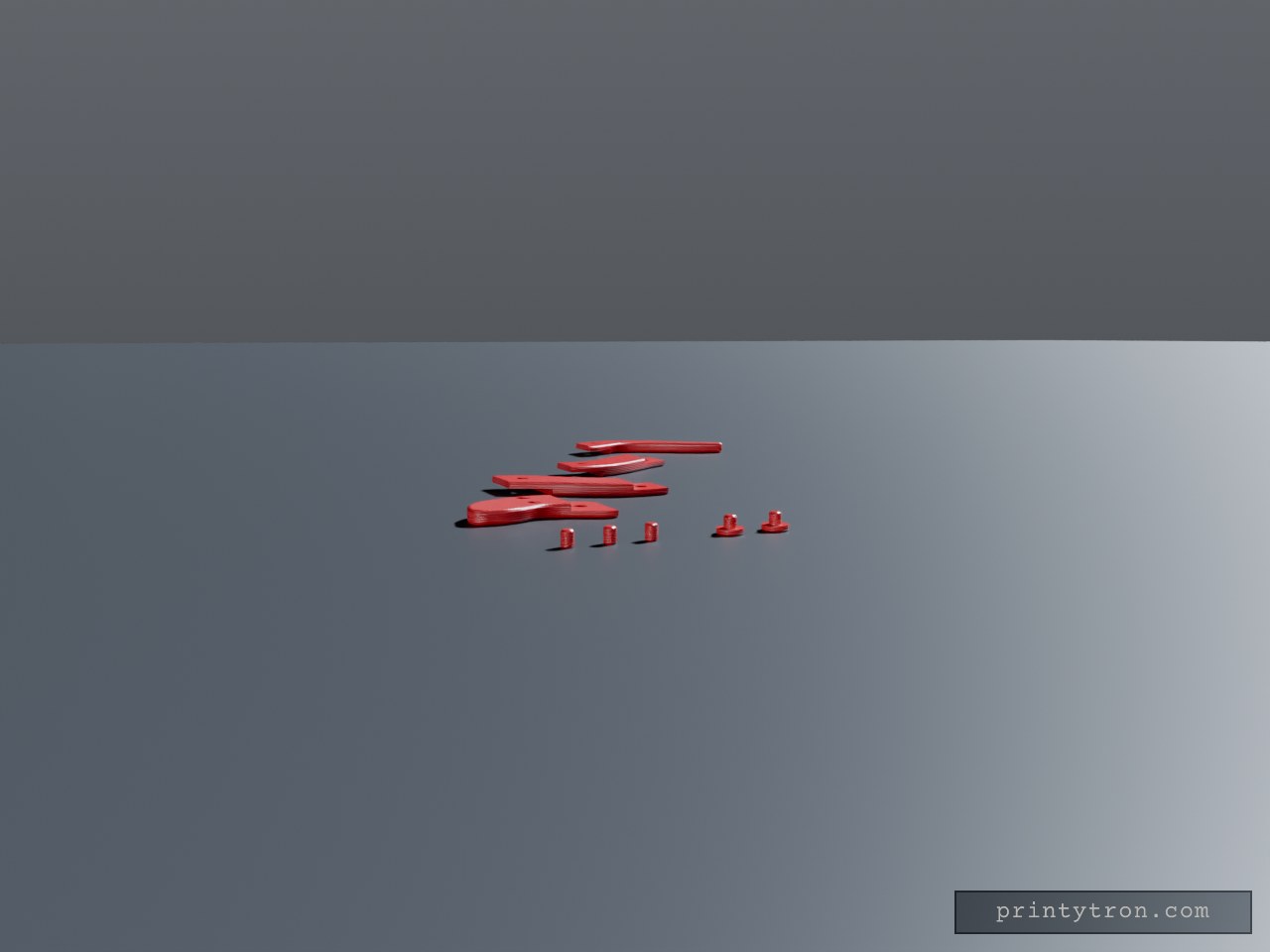
Flat Snake Assembly Kit
What it's for A flat, solid snake that prints as separate pieces and snaps together by hand: head, two body segments, tail, two eyes and three connector pins. Edges are rounded, there is no surface detail, and nothing needs supports. Dimensions Thickness: 4 mm Pin holes: 3.5 mm diameter Pins: 3 mm diameter, 4 mm long Joints: half-thickness lap joints, so the pin passes vertically through both overlapping ends Eyes: 6.5 mm domed discs with a 3 mm peg that fits holes in the head Remix ideas Lengthen the snake with more body segments. Change the wave amplitude for a tighter or straighter snake. Add a keyring hole in the tail.
Pokéball Trainer Graded Card Stand 2 cgc
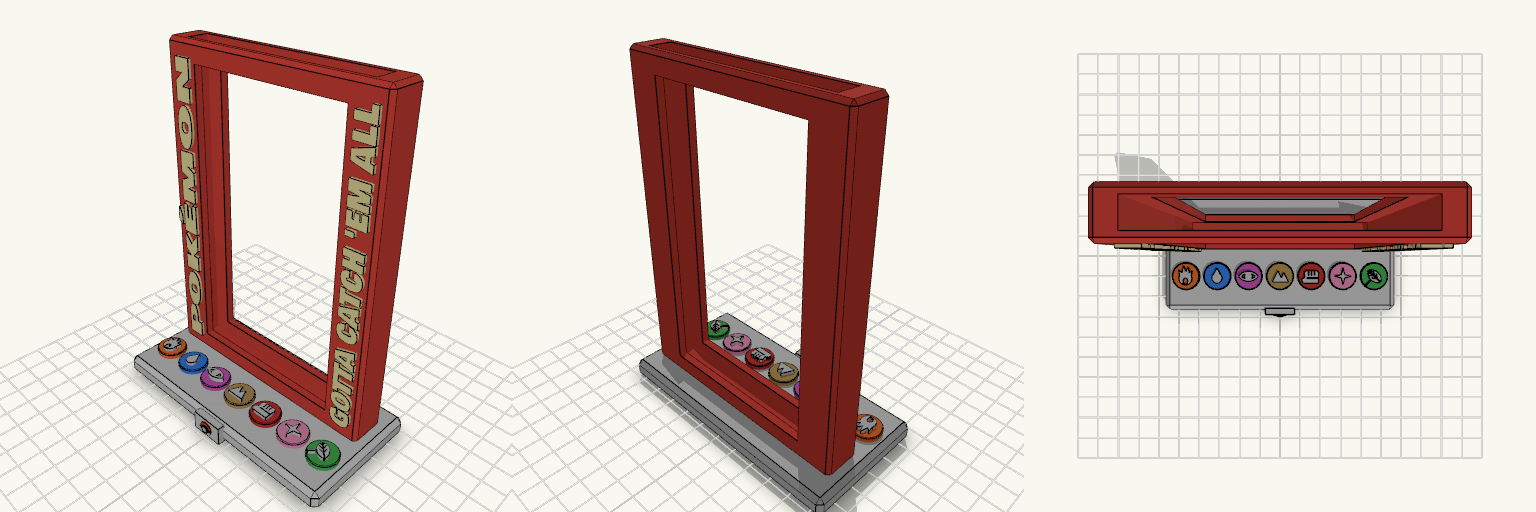
Freestanding display stand for a CGC graded card slab, with a Pokéball button on the base front and seven element badges. The slab drops into an open-top pocket in the frame, and the frame sides carry vertical POKÉMON and GOTTA CATCH 'EM ALL lettering. Base: 110 mm wide, 8 mm tall, with a raised plinth carrying the Pokéball button Pocket: 84 mm wide, 9.5 mm deep, open at the top Badges: fire, water, psychic, ground, fighting, fairy, grass on 13 mm discs, icons raised 1.5 mm Frame: 100 mm wide, 145.5 mm overall height Pokéball plinth overlaps the button back so the two print as one piece
Antikythera Mechanism Desk Model
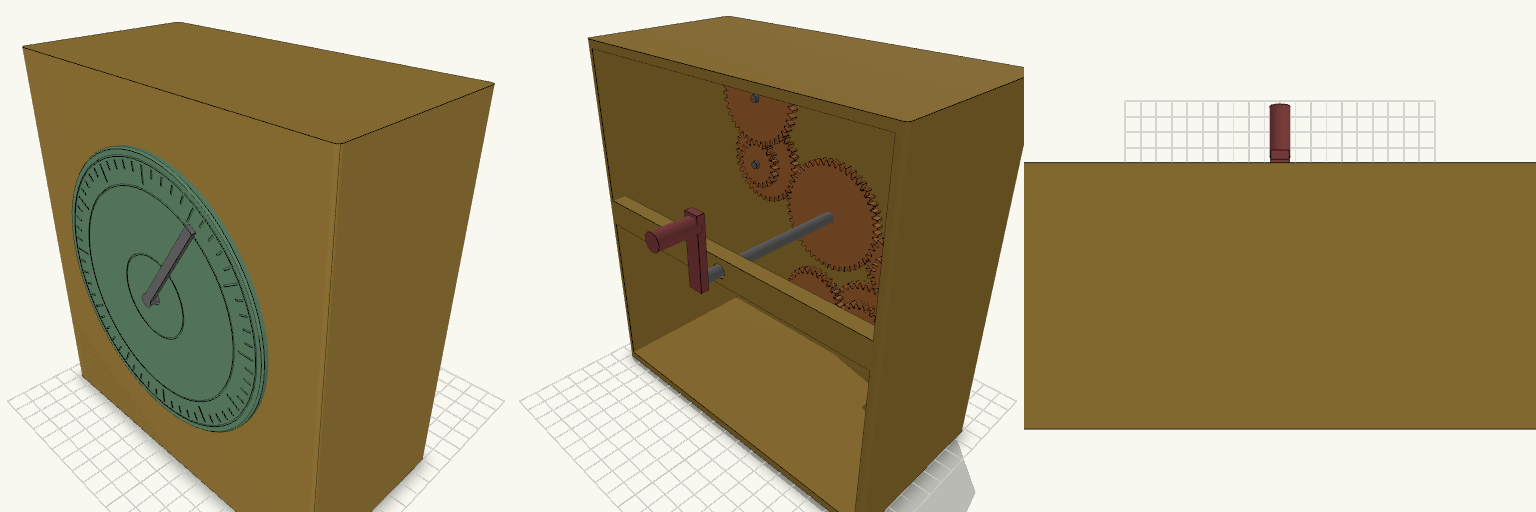
A simplified, life-size-style display model of the Antikythera mechanism: an upright case with a round front dial, a pointer, an open-backed gear train and a rear hand crank. Case 180 x 90 x 190 mm, open at the back to show the gears 130 mm front dial with ring grooves and 60 tick marks Nine spur gears (20 to 48 teeth, module 1.25) arranged in three layers, with phase-matched teeth so they mesh Fixed 4 mm pegs on the front wall carry the compound gears; the main 48-tooth gear is fused to a 6 mm axle that drives the front pointer Rear bearing bar supports the axle, with a crank handle on the back The gear train is a stylised interpretation, not a tooth-accurate copy of the original 30-plus gear mechanism. Print the case, dial, gears, axle and crank separately; the compound gears sit loose on their pegs with 0.3 mm clearance.
OO Gauge Flat-Pack Thatched Cottage with Dormers
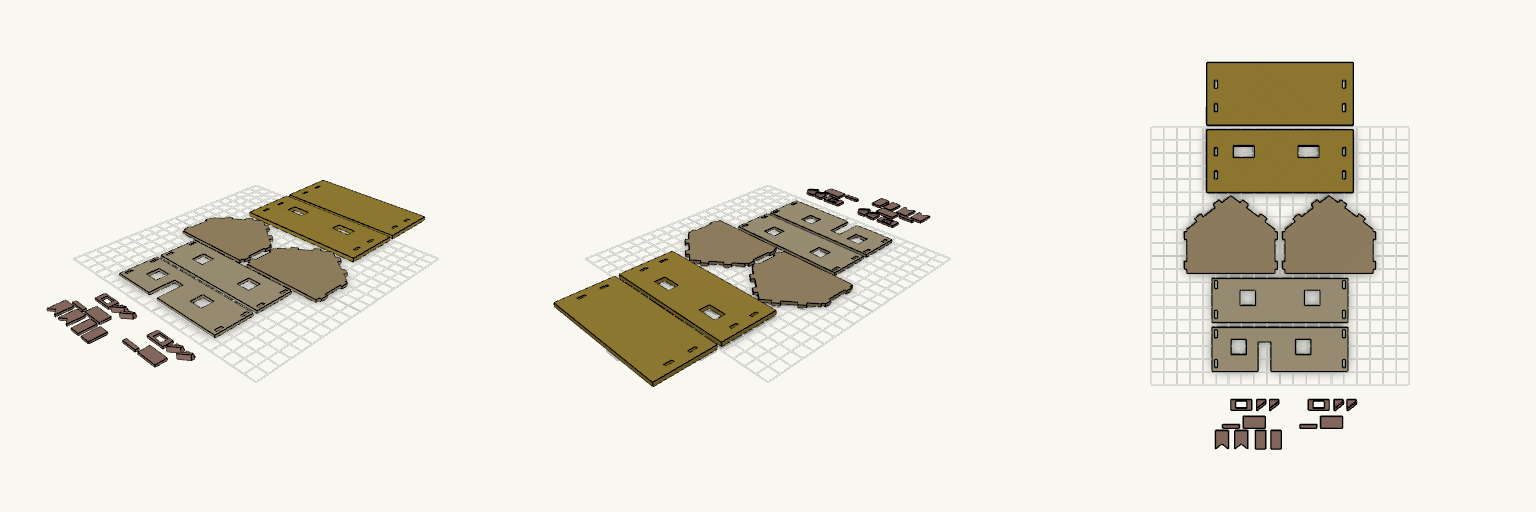
Flat-pack 1:76 (OO gauge) detached cottage with thatched roof panels, dormer windows and a chimney, all printed lying flat. Fit notes Host: OO gauge, 1:76 scale; footprint 105 × 72 mm, 34 mm walls. Wall tabs use 2.4 mm slots for 2 mm tabs; test one tab first. Roof dormer openings are 16.4 × 9.4 mm; check one dormer against them before printing the rest. Each dormer cheek has a 4 mm tall gluing lip along its sloped lower edge, cut to the 37.4° roof pitch, to glue under the roof panel. Not a fit for other scales (N, HO) without resizing.
OO Mill Front and part-tapered Chimney Set
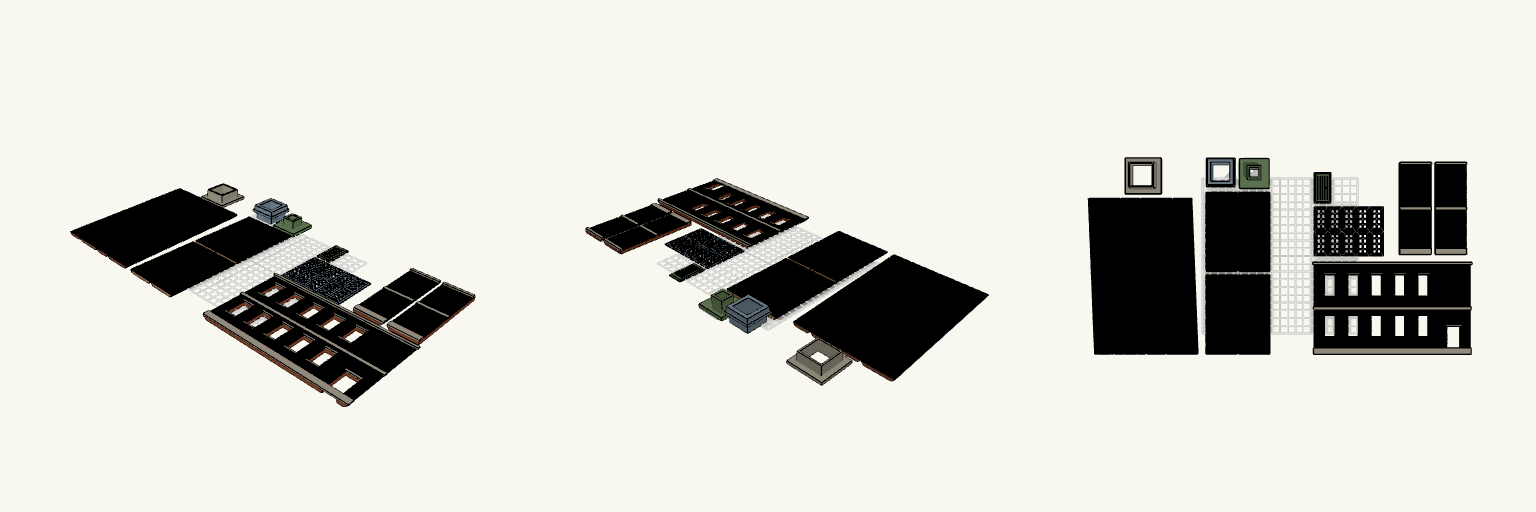
A four-panel tapered chimney with a straight brick base, paired with a half-relief two-storey mill front in OO scale. The wall, ten window frames and plank door all print flat. Each window frame and the door now carries a thin web around its outside edge to hold it down during printing. Remix hooks Web width (webw, 1.8 mm): wider grips better; keep it under half the 4 mm spacing so neighbouring webs stay separate. Web thickness (webt, 0.3 mm): roughly one or two layers. Thinner peels off easier, thicker holds harder. Window grid (14 x 28 mm frames, 4 mm spacing): change the spacing if the web is widened. Pairs with: the chimney set on the same plate layout, and a clear or painted glazing insert behind the frames. Print notes Trim the web with a hobby knife after printing, before fitting frames into the wall openings. Wall is 200 mm long and needs its own print separate from the chimney set.
OO Scale Picket Fences and Brick Walls
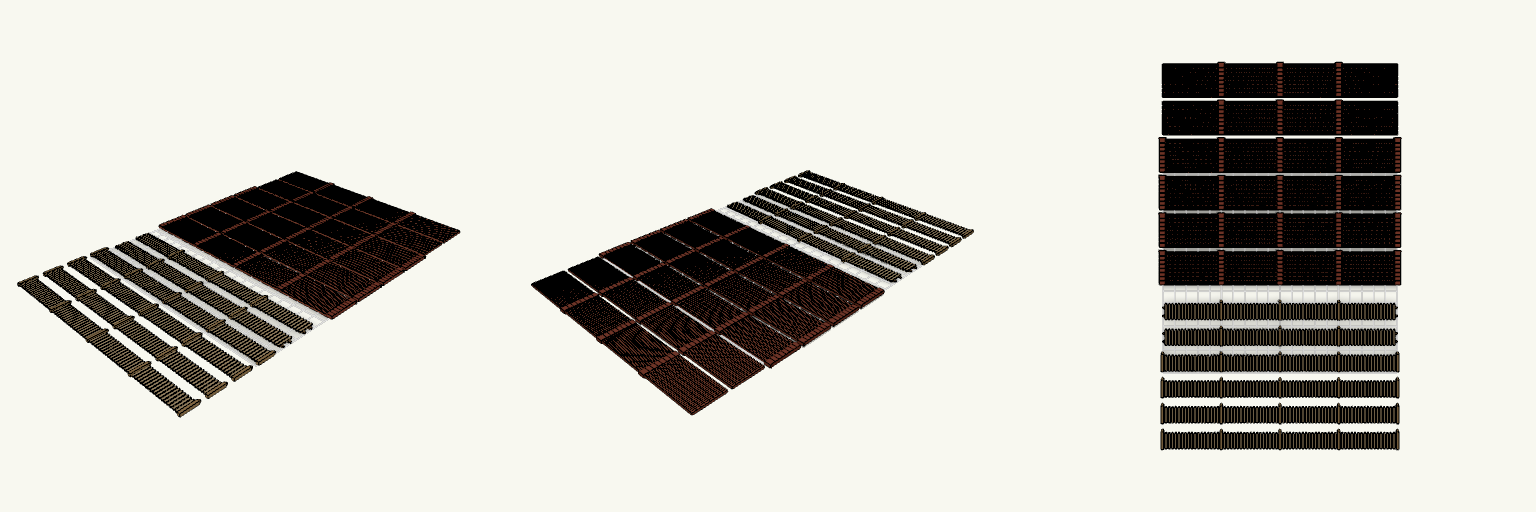
Flat-pack OO scale (1:76) boundary set: six 200 mm wooden picket fence panels and six 200 mm brick wall panels, all printing on one bed in separate rows. Fences: four with five posts, two with only the three centre posts (50, 100, 150 mm). Posts are 17 mm tall with pyramid tips; slats are 1.6 mm wide, 14 mm tall and pointed. Brick walls: 28 mm tall (7 ft), 1.6 mm thick, soldier bond: upright bricks, with 0.4 mm mortar grooves every 1.4 mm and a course line every 3.5 mm. Pillars are 5 mm wide, 2.4 mm thick, with a small cap, spaced 50 mm apart. Two walls have only the three centre pillars. Remix hooks wh (28) sets wall height; crs (3.5) sets course spacing. pitch (1.4) and gw (0.4) set brick width and mortar line; keep gw at or above one nozzle width. pwid (5) widens the pillars; wall wt (1.6) sets thickness. Swap the pillar count or spacing to match the fence posts. Pairs with the fences as a mixed boundary run; glue panels to a base strip for display.