90mm USB Fan Guard Cloth Comb Clip
Created today
Description
A cloth-hanging clip for the wire guard of a small USB desk fan, roughly 90 mm across. It holds a damp cloth in front of the grille so the airflow picks up moisture and cools a little as it passes, a basic evaporative cooler for a desk.
What it fits
- Small USB fans with a wire or rim guard around 90 mm across.
- Damp cloths, such as a thin cotton towel or tea towel, pinched along one edge.
What it does
- Rear arm at Y=0 sits on the guard side. A 30 mm deep spine runs across the top.
- Front arm at Y=27–30 hangs the cloth side.
- Eleven thin fingers, 2.4 mm wide and pitched at 5.4 mm, pinch the cloth edge so it hangs flat instead of bunching.
- Overall size: 60 mm wide, 30 mm deep, 22 mm tall.
Check before printing
- Guard wire or rim thickness. No slot is sized to a specific wire yet. Measure the guard wire or rim and adjust the gap before relying on the grip.
- Cloth standoff. The cloth sits about 27 mm from the guard-side arm, not the 15 mm originally targeted. Shorten the spine if the cloth needs to sit closer.
Known incompatibilities
- Not intended for fans with a solid or thick moulded frame in place of a wire guard.
- Not tested against any particular fan model. Verify the guard dimensions first.
- Keep the cloth damp, not dripping, and keep water and wet cloth away from USB connections and the fan's electronics.
Images
More like this
Explore more in Desk & Tech →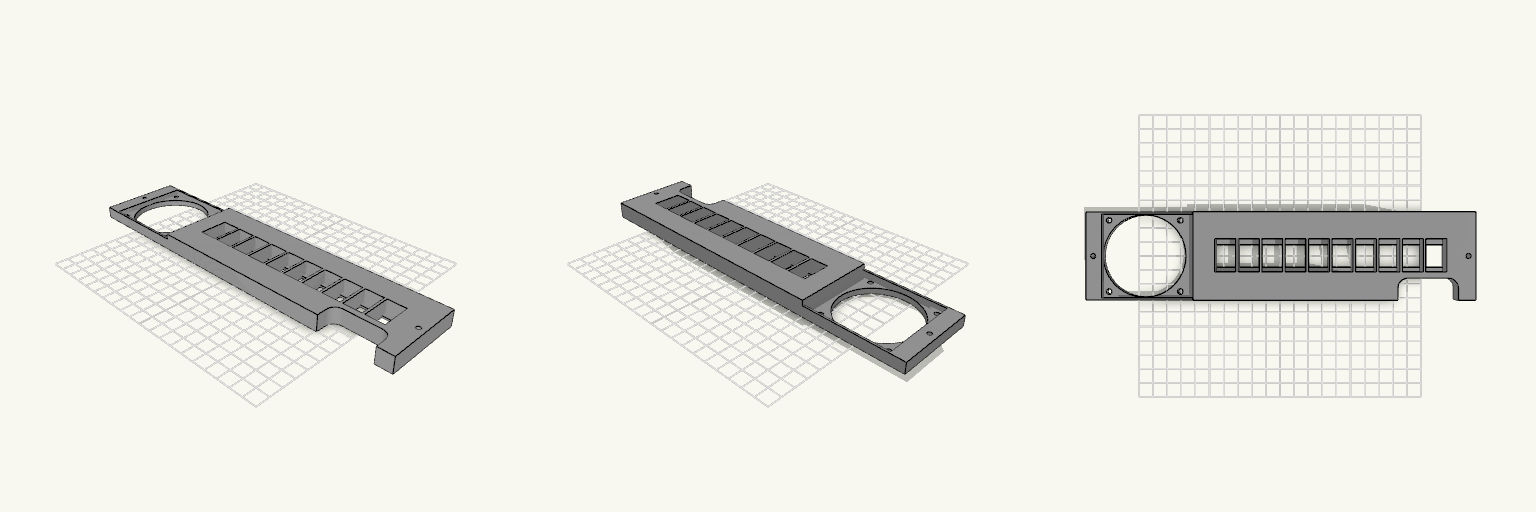
Ten-Port Keystone Panel With Fan
A 270 × 61 mm mounting panel with a 60 mm fan opening on the left and ten snap-in keystone ports on the right. A rounded, squircle-style notch is cut into one long edge near the right end. Remix hooks Notch span: runs from 216.25 mm to 258 mm along X, 15.25 mm deep in Y. Move either end to resize it. Corner radius: both inner corners use a 7 mm radius. Raise it for a softer shape; keep it under about 7.6 mm to stay within the notch depth. Corner material: the notch stops at 258 mm, leaving the right-end 3.5 mm mounting hole (5 mm from the end) fully surrounded. Keystones: 14.5 × 16 mm openings with a 1.8 mm front lip and rear clip relief. Dimensions are provisional, so test one jack before printing all ten. Pairs with: a cable-management bar or a fan grille over the 58 mm vent. It's meant for a particular 12U rack.
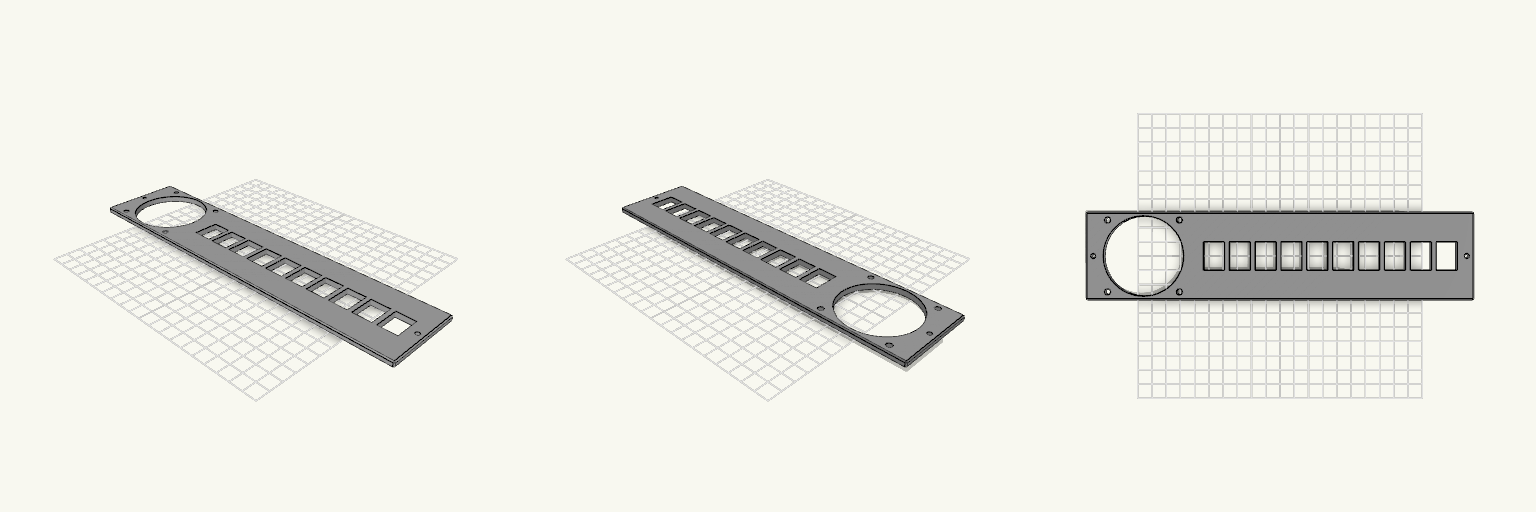
Fan and Keystone Mounting Plate
A 270 x 61 mm flat plate, 4 mm thick, combining a 60 mm fan mount with a row of ten keystone jack openings. The fan opening sits at the left end with four screw holes on the standard 50 mm spacing. The right side carries ten rectangular openings on an 18 mm pitch for standard keystone jacks. A 3.5 mm mounting hole sits 5 mm from each end on the centerline. Plate: 270 x 61 x 4 mm Fan: 56 mm opening, 4.3 mm screw holes at 50 mm spacing Keystones: 10 openings, 14.8 x 19.8 mm Mounting: 2 x 3.5 mm holes
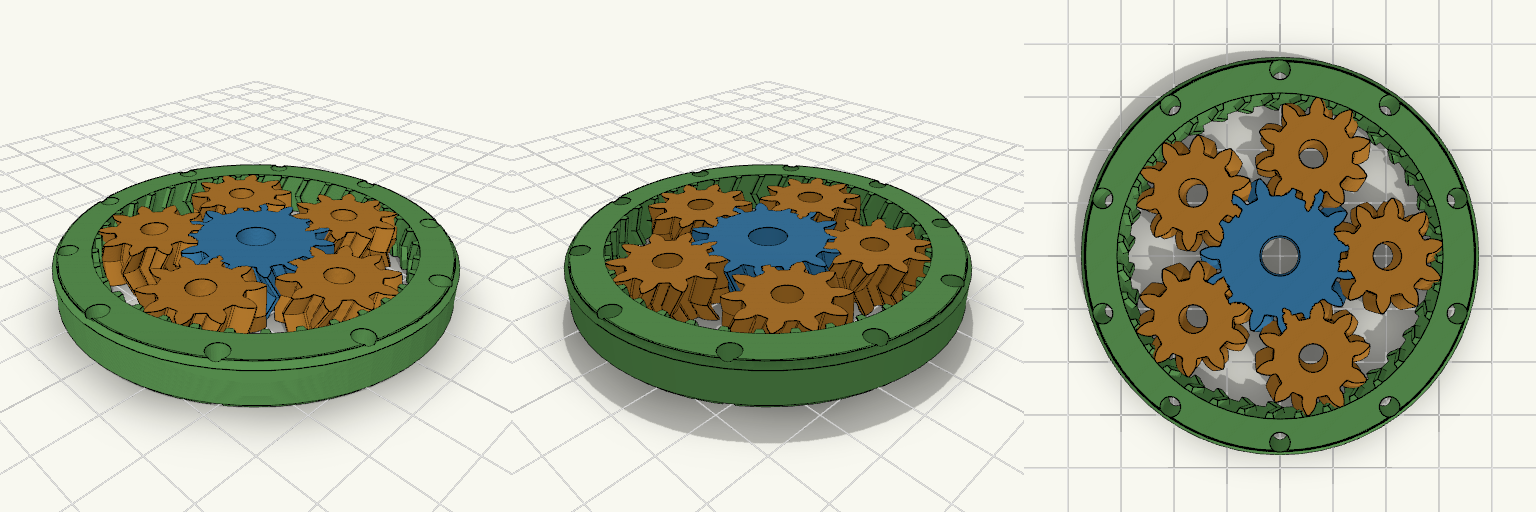
Fidget Spinner Planetario Ø70 mm
Fidget spinner a ingranaggi planetari stampabile in un solo pezzo (print-in-place), diametro esterno 70 mm, con ingranaggio solare centrale, 5 satelliti e anello esterno dentato internamente. L'anello è alleggerito da 10 fori passanti e non ha coperchi, così gli ingranaggi restano visibili. Diametro esterno: 70 mm, spessore 8 mm Modulo 1,5; solare 15 denti, satelliti 10 denti, corona 35 denti Denti elicoidali a spina di pesce (25°) che trattengono i satelliti senza assi Gioco sui denti: 0,25 mm Fori centrali Ø7 mm (solare) e Ø5 mm (satelliti) per alleggerire Stampa piatta, senza supporti; PLA o PETG
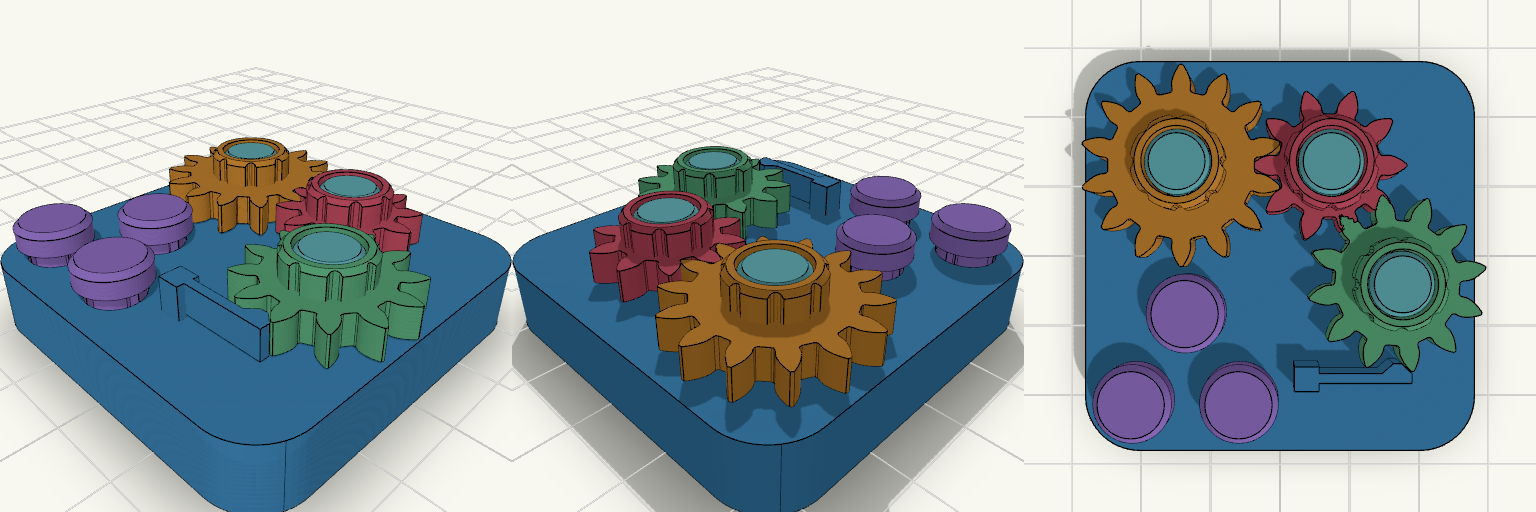
Fidget toy à trois engrenages et boutons
Fidget toy mécanique compact, imprimable en PLA sans supports, sans ressort métallique ni pièce achetée. Les trois engrenages sont en prise : en tourner un entraîne les deux autres. Chacun porte une molette à encoches sur le dessus, et le troisième clique contre une languette flexible imprimée avec la base. Les engrenages tournent sur des axes séparés qui se clipsent par le dessus dans la base. Chaque roue repose à 0,5 mm au-dessus de la base et est retenue par la tête de son axe. Les trois boutons poussoirs se clipsent eux aussi par le dessus et se verrouillent avec un clic en position haute et en position basse. Base arrondie de 50 × 50 mm, hauteur totale 17 mm Engrenages de 14, 10 et 12 dents, module 1,5, jeu entre dents de 0,4 mm 3 axes clipsables, pied fendu avec ergot, jeu de 0,3 mm dans la roue 3 boutons avec 2 mm de course et deux crans de maintien Languette de cliquet imprimée avec la base Pièces à imprimer séparément : base, 3 engrenages, 3 axes, 3 boutons
Gear Locker Housing and Parts Kit
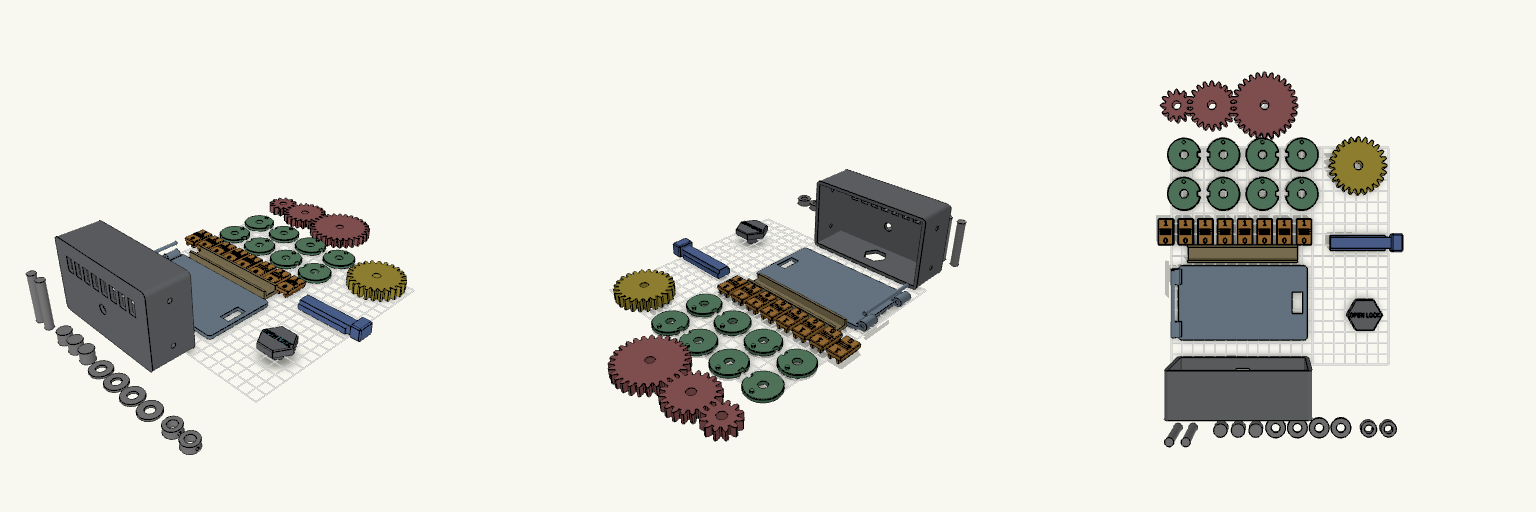
A parts layout for a small mechanical binary gear locker: the housing, door and hinge pin, selector rail, eight 0/1 selectors, eight checking discs, a three-gear train, a main turning gear, a sliding bolt, a hexagonal OPEN LOCK button, and loose shafts, spacers, washers and collars. Fit notes Gears are module 2 spur gears: 12, 20 and 28 teeth in the train, 24 teeth for the main gear. Shaft bore is 8 mm. Shafts are 7.6 mm, spacers and washers are bored 8.4 mm, collars 8 mm with a 3 mm set-screw hole. Housing: 120 x 40 x 70 mm, open back, eight 8 x 14 mm selector slots, 9 mm shaft opening, 23 mm hex bottom opening, 4.5 mm side holes. Door hinge bores are 3.6 mm for a 3.2 mm pin. Check before printing Measure your printed shaft against the 8 mm bores. The housing selector slots (8 mm wide) are not matched to the 14 mm selector bodies; the selector grip sits behind the panel. The mechanism is not tuned for a specific commercial lock, and no electronics are included.
Phone
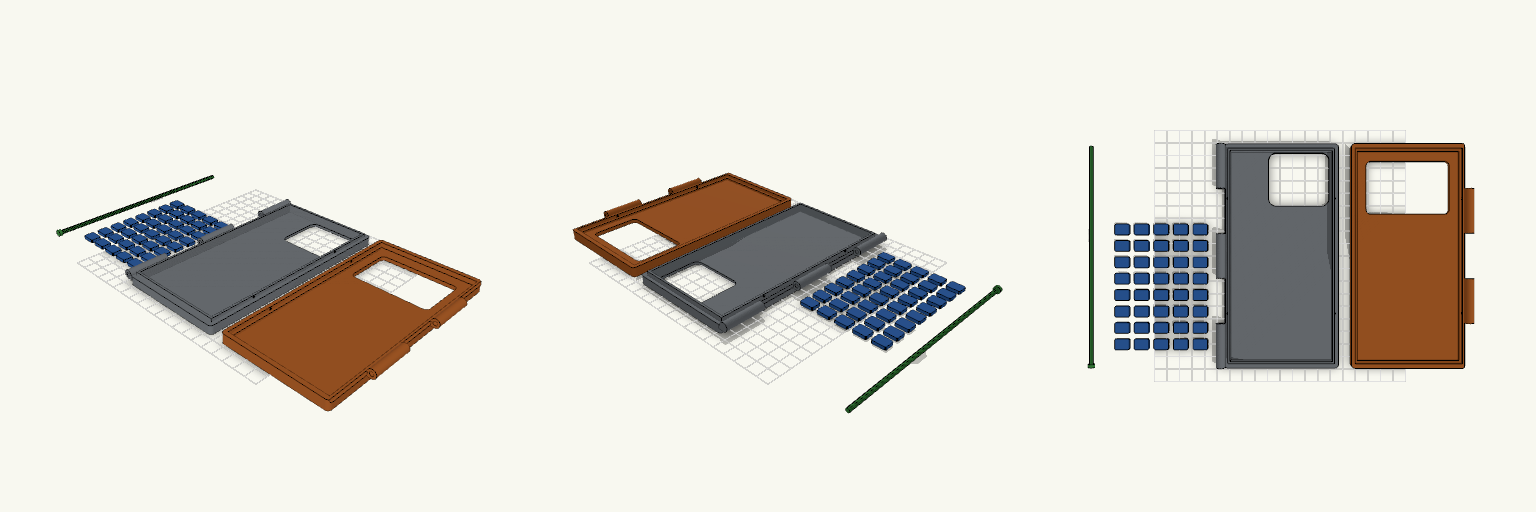
A calculator-shaped phone case styled after the TI-30Xa, with the top shell hinged along the right long edge so it folds open like a book and lies back behind the bottom shell, exposing the whole phone. Lay the phone screen-up in the bottom shell, close the top, and it clicks shut on the other three sides; the screen sits behind an oversized 66 × 42 mm window where the LCD would be. The keypad is 40 recessed divots in a 5 × 8 grid, with the buttons printed as a separate set 0.5 mm smaller on each side so they drop in and sit slightly proud. A camera opening sits in the back of the bottom shell, "TI-30Xa SOLAR" is engraved above the window, and a separate hinge pin runs the full length of the hinge. It prints as four separate parts: bottom shell, top shell, buttons and hinge pin. Remix hooks Shells: each about 96 × 176 mm on the plate; the top shell is 11.5 mm thick and the bottom shell 10.5 mm. The 176 mm length is the real constraint — shorten it and the 5 × 8 button grid has to lose rows, and the hinge spacing follows the same length. Hinge: a full-length piano hinge set into a notch along the right edge, so nothing protrudes past the outline. Five knuckles about 7 mm across, three on one half and two on the other, with 0.5 mm gaps and round clearance cutouts where the opposite knuckles pass. The body is a little wider overall to swallow it. This is the part worth redesigning first: move the notch to the left edge for a left-handed fold, or lengthen the knuckles for more stiffness. Hinge pin: 3 mm thick with a 5.5 mm head, 174.5 mm long, running in 3.5 mm holes and stopped by a closed end so it cannot slide through. Print it lying flat. A 3 mm metal rod is a direct drop-in substitute if you want it tougher. Phone cavity: 80 × 165 mm and 10 mm deep, closed at both ends when shut. That clears an iPhone 17 (about 71.5 mm wide) and the Pro Max sizes (about 77.6 mm). This is the first number to touch for fit; narrowing toward 76 mm tightens things up for standard phones, and going past about 82 mm starts to thin the side walls. Screen window: 66 × 42 mm, deliberately oversized so the cutout does not fight the phone's own bezels. Shrink it to hide more of the display, grow it for more live screen. Camera opening: 48 × 42 mm in the back of the bottom shell, sized around a large camera bump — a smaller phone just gets extra opening, so this is a safe one to trim down to your own lens. Button divots: 12.5 × 9.5 mm, 1.2 mm deep, in a 5 × 8 grid; the separate button set lays out on a 73.5 × 99.5 mm plate at 11.5 × 8.5 mm each — 0.5 mm clearance per side — so they drop in without binding and sit slightly proud. Deepen the divots to 1.6 mm if you want them flush. Obvious directions to take it: swap the uniform 5 × 8 grid for a true TI-30Xa layout, engrave the legends onto the buttons instead of leaving them blank, add a raised lip around the rear camera opening, add a lanyard loop, or print the shells in contrasting colours. The snap closure is the easiest thing to tune — deepen or shave the rim bumps if the lid is too tight or too loose. It pairs well with a second-colour button set and with any phone that fits the slot dimensions above.