Drill Bit Index for 1–6.5 mm Bits
Created yesterday
Description
A drill bit index that stops you digging through a drawer to find which bit is a 4 mm. Thirteen sized holes fan out along an arc, each with its size embossed beside it, so you can read the number and pull the bit without guessing.
Each hole is cut 0.3 mm over the nominal bit diameter. That is enough for the bit to drop in and lift out, and tight enough that it does not rattle around.
Numbers that decide fit and print
- Bits: 13 holes, 1 mm to 6.5 mm in 0.5 mm steps
- Clearance: +0.3 mm on every hole (a 1 mm bit gets a 1.3 mm hole)
- Hole depth: 12 mm
- Layout: 60 mm radius arc, 10° between holes, fanned like piano keys
- Overall size: about 144 mm wide, 58 mm deep, 14 mm thick
- Labels: raised 0.6 mm, with the left-half labels flipped to read upright
Printing
- Print flat with the labels facing up. No supports are needed.
- Use a 0.2 mm layer height or finer so the 1.3 mm hole stays open.
- Ream the smallest holes with the bit itself if your printer shrinks them.
- The labels are a separate colour region, so they suit a filament swap at layer 14 mm.
Photos
Technical views
More like this
Explore more in Workshop & Tools →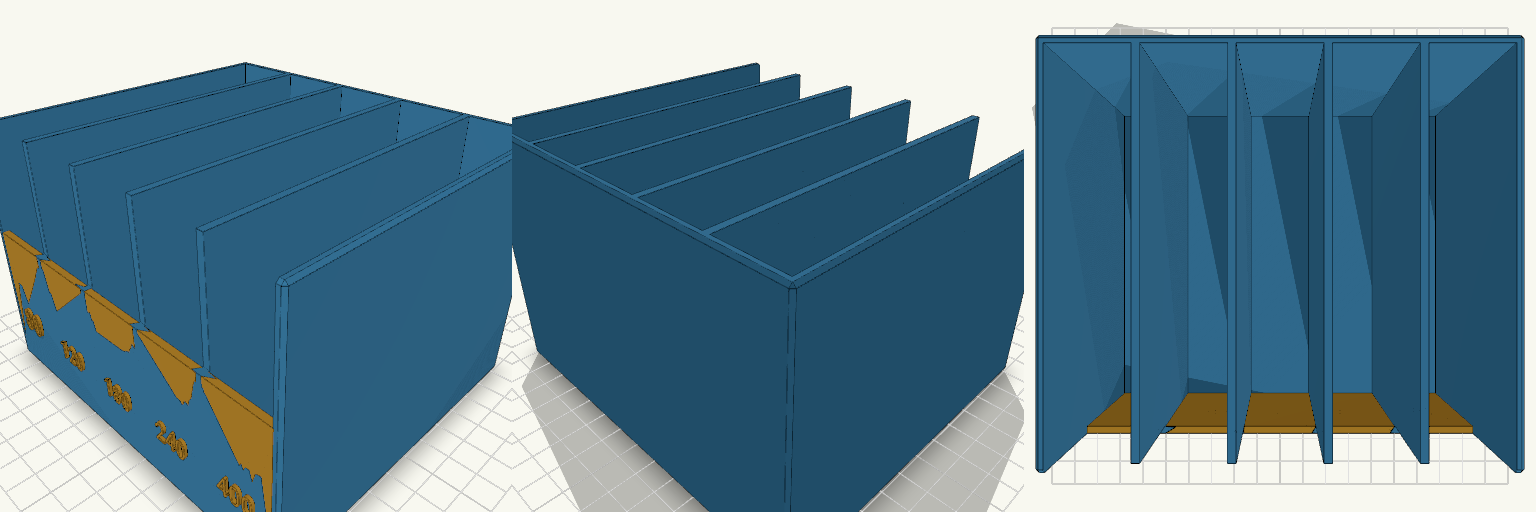
GritHouse — Five-Slot Sandpaper Rack
GritHouse is a bench-top sorting rack that gives every grit of sandpaper its own slot, so a 400 never gets pulled out when a 40 was the target. Five upright slots hold quarter-sheets, and each slot has a front tab with its grit number embossed in raised, easy-to-read digits: 80, 120, 180, 240 and 400, left to right. A tall back wall keeps sheets standing, while the lower front tabs leave room to grip a sheet and pull it out. Features Five slots, each 25 mm wide and 120 mm deep, sized for quarter-sheets Embossed grit labels on the front tabs: 80, 120, 180, 240, 400 Back wall 95 mm tall, front tabs 55 mm tall for easy grabbing Finger scoops cut into the front of each slot Chamfered outer edges for a cleaner print Two colour regions: the rack body and the front tabs with numbers Dimensions Overall: about 139 × 126 × 95 mm (W × D × H) Slot interior: 25 × 120 mm Divider and outer wall thickness: 2.4 mm Floor thickness: 3 mm Print notes Prints upright on its base with no supports needed for the main body. Raised numbers face forward; a 0.2 mm layer height keeps the digits crisp. Use a contrasting filament for the tabs to make the grit numbers stand out.
Funnelpour — Screw Sorting Tray
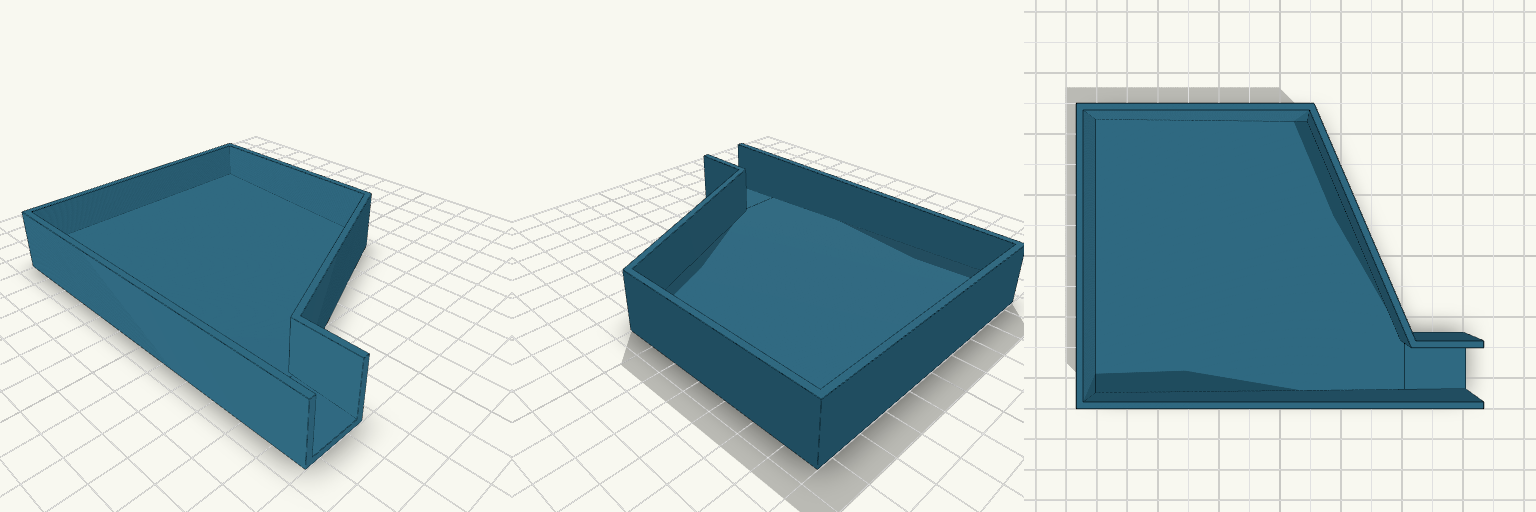
Funnelpour is a shallow sorting tray built for one job: tip a handful of loose screws in, pick out what you need, then pour the rest back into the jar without scattering them across the bench. The floor slopes toward a single open spout in one corner, and the walls taper inward to funnel everything into a 20 mm pour opening. Features Sloped floor: about 8 mm thick at the far end, falling to 2 mm at the spout, so screws roll toward the pour edge. Funnelled walls: the back-right wall angles inward from the main body down to the spout. Open spout: a 20 mm wide opening with no lip, sized to feed a jar mouth. Wall height: 20 mm walls with 2 mm wall thickness keep screws contained while sorting. Dimensions Overall footprint: 120 × 90 mm Height: 20 mm Spout width: 20 mm Print notes Prints flat on the base with no supports needed. The slope runs along the length rather than diagonally, so a slight tilt of the tray helps clear the far back corner when pouring.
Apothecary Drawer Hex Key Rack
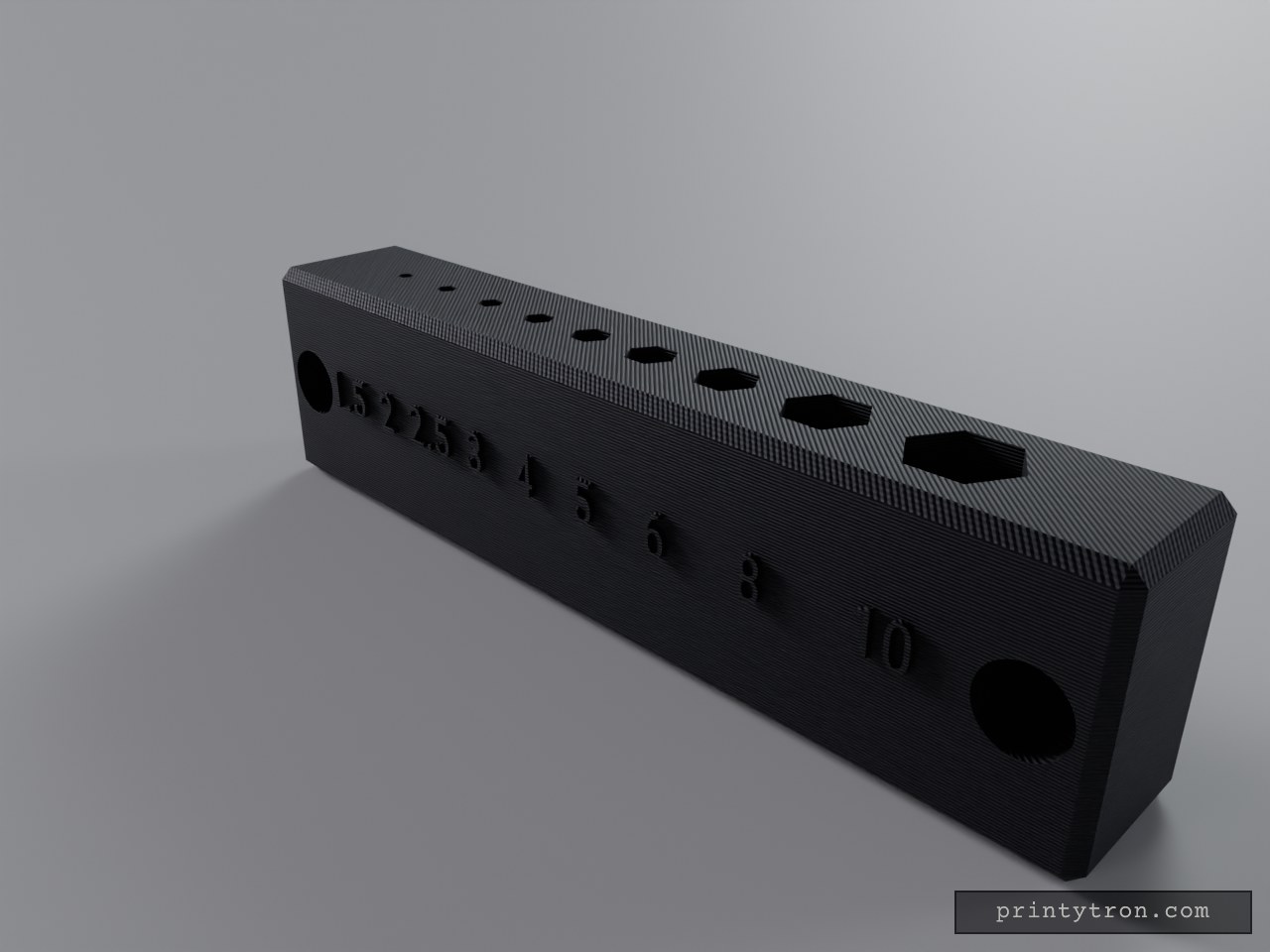
A row of nine upright hex pockets, like a pharmacist's labelled vial rack, scaled down for the workshop wall. Each long-arm Allen key stands in its own slot, sorted from 1.5 mm up to 10 mm, with the metric size embossed on the front face beside it so the right key is readable at a glance. Every pocket is a hex cut to its key's across-flats size plus 0.3 mm of clearance, 22 mm deep, so keys drop in and lift out without wobbling loose. Two counterbored screw holes near the ends let the rack mount flat to a wall. Design notes Fits the standard metric set: 1.5, 2, 2.5, 3, 4, 5, 6, 8 and 10 mm Overall size about 120 mm wide, 20 mm deep, 30 mm tall Embossed labels are a separate colour region for multi-colour prints or a filament swap Chamfered outer edges for a cleaner print and a softer look The 1.5 mm slot is the tightest fit, so check it on a first print Remix hooks: change pocket depth, enlarge the label text, or add more slots for imperial sizes
Tape Measure Holster with Label Window
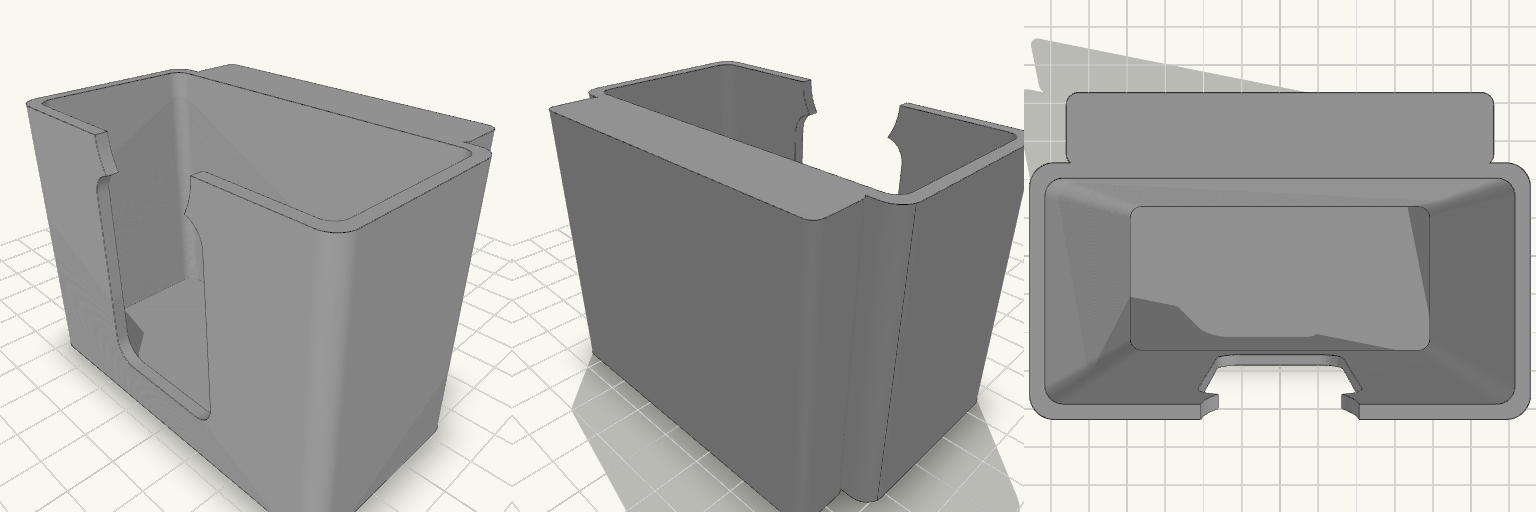
A belt-worn holster cup for a 5 m tape measure, sized for a body of about 75 × 75 × 35 mm with 2 mm of total clearance. A vertical window in the front lets you read the size label without pulling the tape out, and a round thumb scoop at the top edge makes it easier to grip and lift. A loop on the back takes a belt. The cup is open at the top and covers the lower 80% of the tape (60 mm). Outer size is 82 × 42 mm, with 2.5 mm walls and a 2.5 mm floor. Remix hooks Tape size: the tape width, height and thickness (75 / 75 / 35 mm) and the 2 mm clearance are the main numbers. Change them and the cup, loop and window all follow. Other tape brands or 3 m / 8 m sizes are a quick swap. Cup height: set at 80% of tape height (60 mm). Lower it for easier draw, raise it for a more secure hold. Label window: 30 mm wide, with rounded ends, centred on the front. Widen it for a bigger label, or move it to the side for a tape with an offset label. Thumb scoop: 26 mm diameter cut at the top front. Shrink it for a snugger hold. Belt loop: the slot is about 5 mm deep and the loop spans the back at 70 mm wide. Thicker or wider belts need a deeper slot, which is the first thing worth testing against your own belt. Wall thickness: 2.5 mm. Go thicker for rigidity, or thinner to save material. Pairs well with A flexible filament such as TPU for a grippier cup, or PETG for a stiffer loop. A second window on the back or side if you want to read the metric scale as well. A small retention tab or friction bump inside the cup rim if the tape needs a firmer hold.
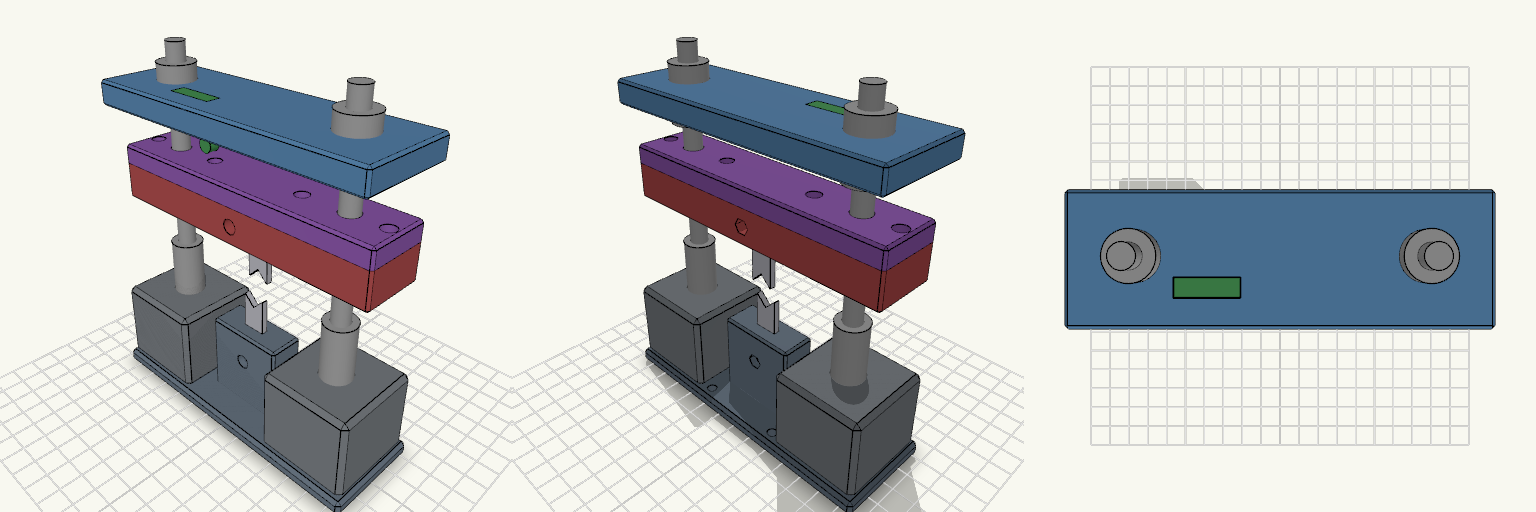
Twin-Screw Guillotine Wire Cutter
A guillotine wire cutter in the spirit of a workshop shear: two V blades pass each other with no face gap, driven by twin 8 mm lead screws on NEMA 17 motors. Design notes Base and bottom blade holder print as one upright piece. Split carriage captures the flanged nuts between two halves. Hex nut traps are 7.0 mm; blade holes sit 4 mm from the held end. Assembled view shows black motors, screws, nuts, blades and limit switch for visualisation only.
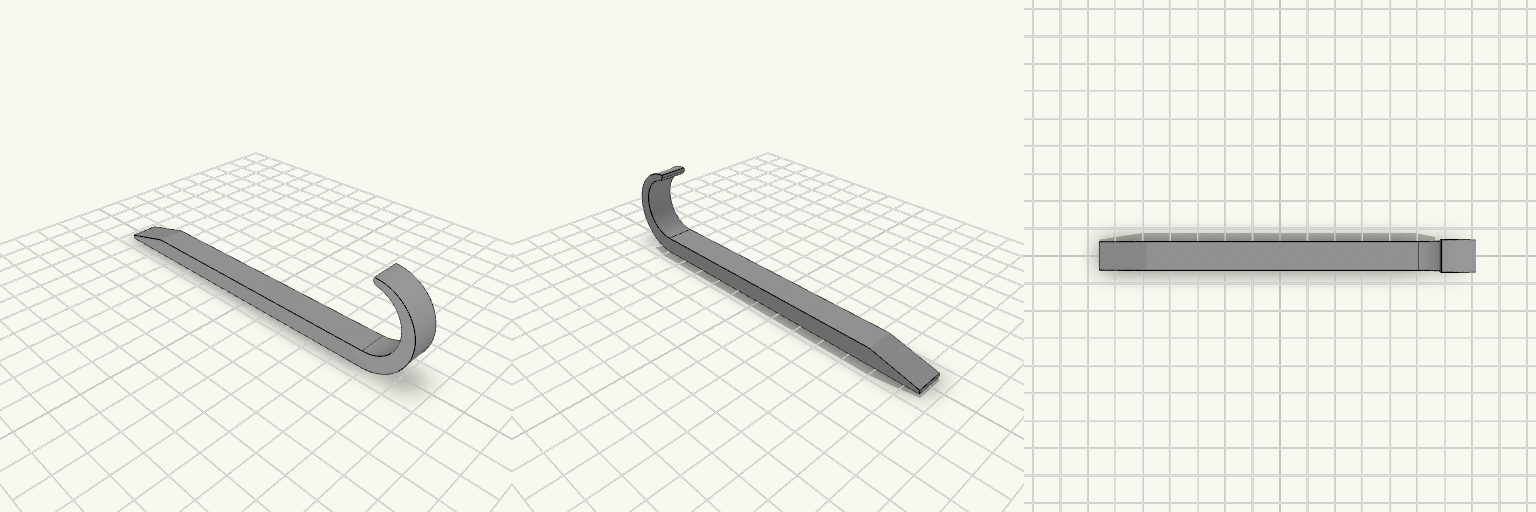
Mini Pry Bar for Stuck Edges and Gaps
A mini pry bar for the gap that is too tight for a fingernail and too shallow for a real crowbar — nothing gets under the edge, so the lid stays shut, the panel stays seated, the trim stays put. It is a flat 4.5 in bar, 2/5 in wide, with a chisel-bevel straight end to start the lift and a 175° claw hook at the other end to catch and hold what you have opened. What it does at each end Chisel-bevel straight end: taps into a seam and starts the gap. 175° hook: wraps the edge you have lifted so it does not drop back. Slanted claw tip: cut at a 35° slant like a crowbar claw, so it bites instead of skating off. Full-width hook: the hook stays 2/5 in (10.16 mm) wide from the handle to the tip, so it catches the full edge instead of narrowing away. Sizes that decide fit Bar length: 4.5 in (114.3 mm), with the hook adding to the overall footprint Overall width at the handle: 2/5 in (10.16 mm) Bar thickness: 6 mm at the handle, thinning to about 2 mm at the hook tip Hook curl: 175° around a 14 mm centerline radius — check this against the edge you want it to wrap Printed footprint: about 130.5 × 10.2 × 31.9 mm, lying flat Printing One piece, straight off the plate — the bar and the curve share solid material at the joint, so there is no slip fit, no glue, no assembly. Lay it flat as it comes and print; the flat bar and the curl sit on the plate without supports. Check the curl radius and the 2/5 in width before you start; those two decide whether the hook wraps your edge or rattles around it. Look over the joint between the bar and the hook in the preview first, since that is where the two shapes meet.