Glue-On Snap Latch for Fly Screen Frames
Created today
Description
A fly screen frame that lifts out of its catch every time the door moves needs a latch that holds it and lets go on demand. This one glues to the wall, the frame presses into the slot and snaps past the hook, and a thumb tab on the outside of the arm pulls the hook clear. One hand does both jobs — no second hand holding the frame, no screwdriver.
Fit
- Slot: 10.4 mm wide, sized for a 10 mm frame with 0.4 mm clearance.
- Base plate: 50 × 24 mm, 2 mm thick, with two shallow relief pockets underneath to hold the glue.
- Snap arm: 30 mm long, 1.8 mm thick.
Printing
- One piece. No screws, no loose parts, nothing to assemble.
- Print standing as modelled, so the layers run across the arm's bend rather than along it.
- PETG suits the flex the snap arm needs.
Measure the standoff between wall and frame before gluing: the base plate is 2 mm thick, so it sits in the gap rather than spanning it. Snap strength and tab size are the two things to adjust if the catch is too stiff or too easy for the frame you have.
Photos
Technical views
More like this
Explore more in Home & Fixtures →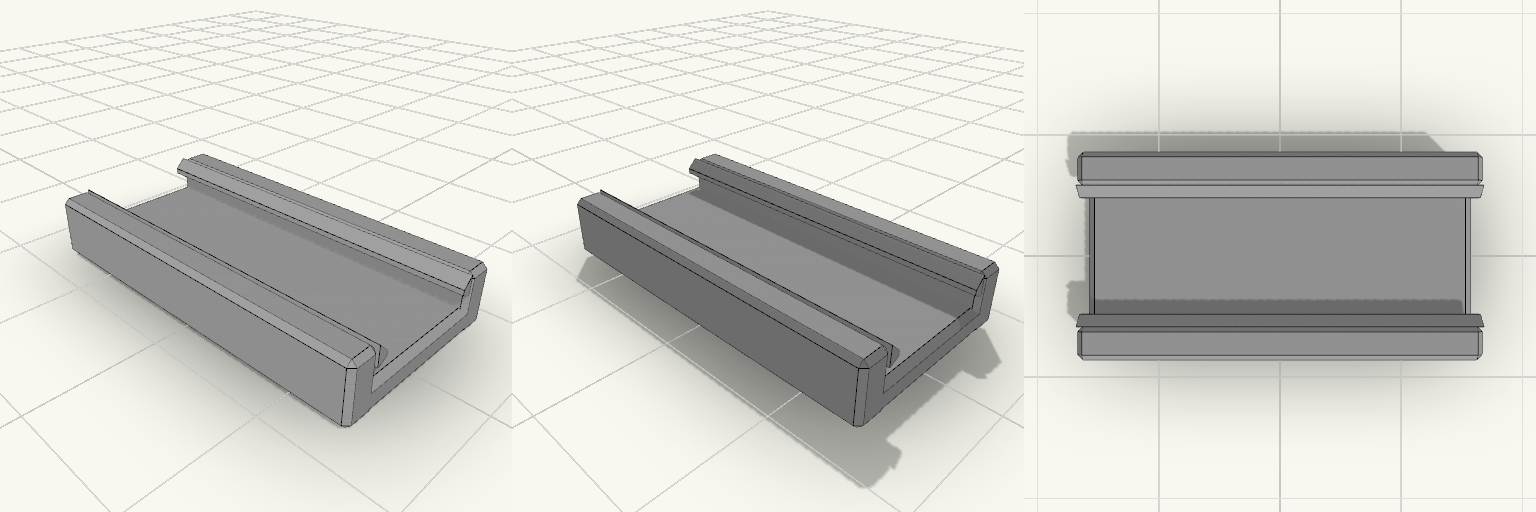
Fly Screen Frame Snap Lock for Wall Gap
A fly-screen frame snap lock holds the screen frame in a narrow gap between wall and frame without screws. The frame presses past two angled lips into a 10.4 mm channel sized for a 10 mm frame, and the back has a shallow inset so a glue strip sits flush against the wall. Fit: 10.4 mm channel for a 10 mm frame, with 0.4 mm clearance; the frame snaps in from above past the lips. Wall gap: 5 mm tall overall, sized for a 0.5 cm gap. Glue pocket: 0.8 mm deep, 24 × 11.4 mm recess on the back, so the glue strip does not hold the clip off the wall. Footprint: 30 × 15.4 mm against the wall.
Bug Zapper Battery Cover 27.65 x 60 mm
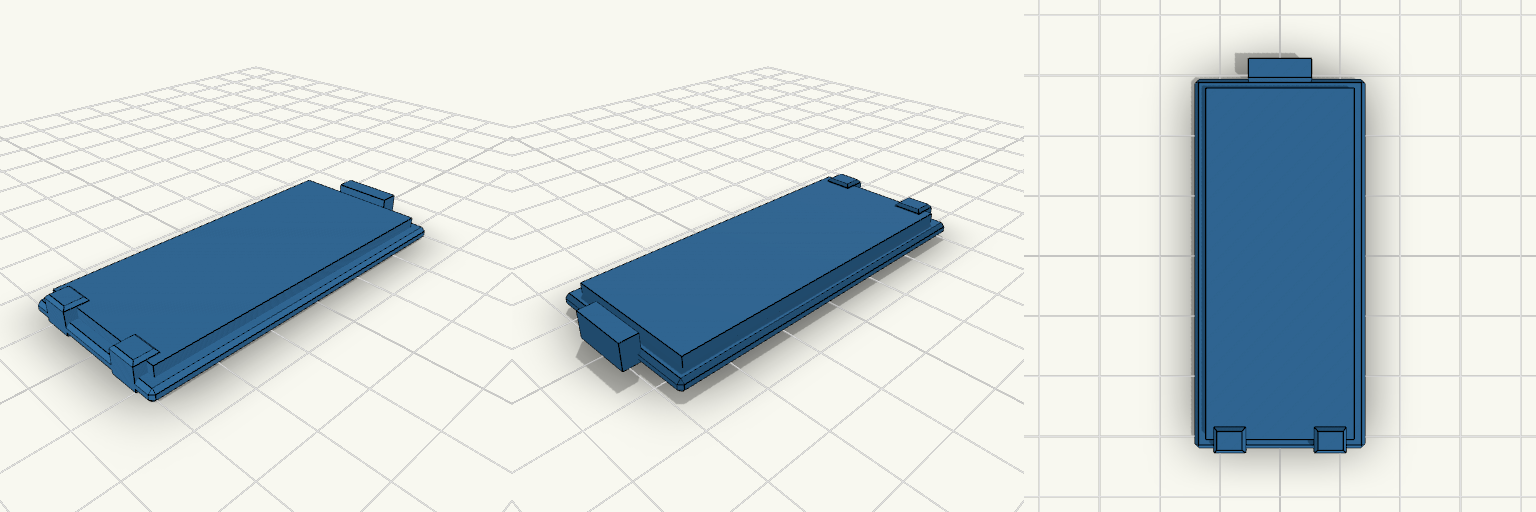
Sliding battery compartment cover plate for a bug zapper, 27.65 x 60 mm. A locating lip sits in the compartment opening, a latch tab sits at one end, and two low retention tabs at the opposite end keep the cover from falling out. Plate: 27.65 x 60 x 2 mm, chamfered edges Lip: 23.65 x 56 mm, 3.8 mm total height Retention tabs: two, 5 mm wide, flush with lip height, at X = ±8 mm Latch tab: 10 mm wide at the +Y end Grip grooves on the outer face Dimensions are estimates; verify against the original opening
100x59 Oval Body Hole Cover with Snap Clips
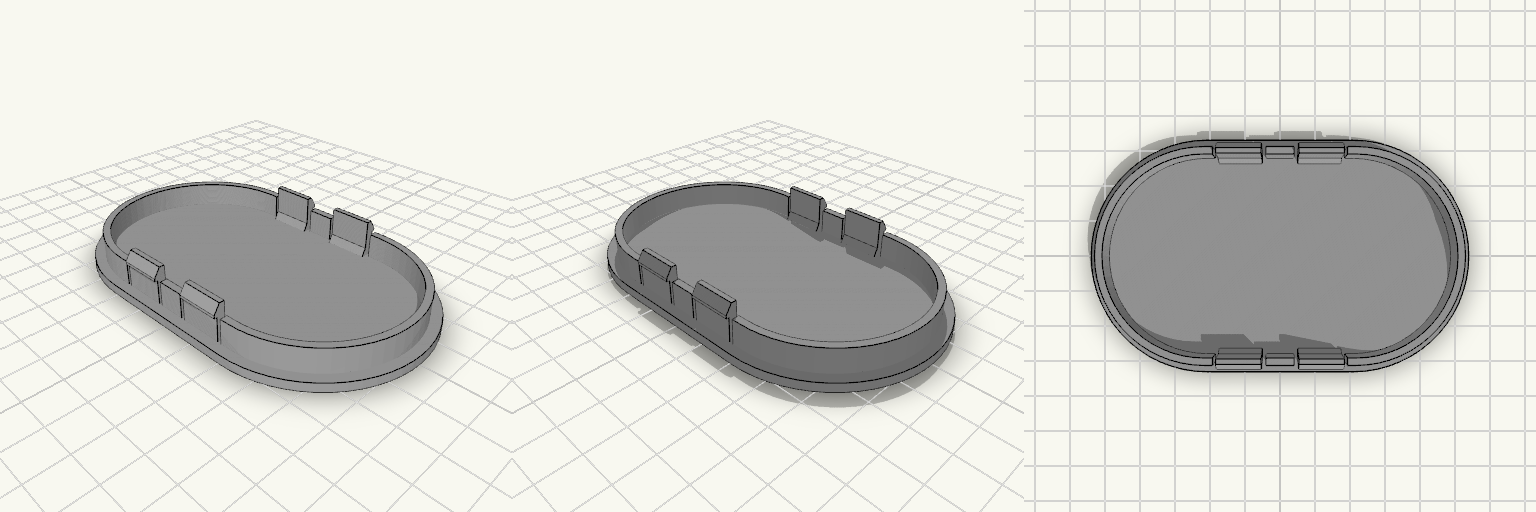
Einsteckbare Abdeckung für eine ovale Öffnung von 100 × 59 mm in etwa 1 mm dickem Blech. Die Frontplatte ist vollständig geschlossen und liegt mit einem 3 mm breiten Auflageflansch rundum auf dem Blech auf; außen misst die Abdeckung 106 × 65 mm bei 2,5 mm Plattendicke. Auf der Rückseite zentriert ein Rahmen mit 2 mm Wandstärke und einer Innenöffnung von 96 × 55 mm als ovales Langloch mit Endradius 27,5 mm. Der Rahmen reicht 7 mm über den Flansch hinaus. Die vier flexiblen Clips – je zwei an den langen Kanten – haben 0,8 mm hohe Haken und angeschrägte Einführflächen; die Rastkante sitzt 7 mm über der Flanschfläche. Mit den verlängerten Federschlitzen baut die Abdeckung insgesamt 13 mm hoch. Bei 1 mm Blech bleibt zwischen Blech und Rastkante in Einsteckrichtung Luft; der Clip rastet erst nach 7 mm Einstecktiefe ein. Werkzeuglose Montage und Demontage Einteiliger Körper, keine Schrauben und kein Kleber Flansch nach unten drucken, in PETG oder ASA Clipsitz beim ersten Druck prüfen, da die Federwirkung des Materials schwankt
Tranca Industrial de Sobrepor com Ferrolho
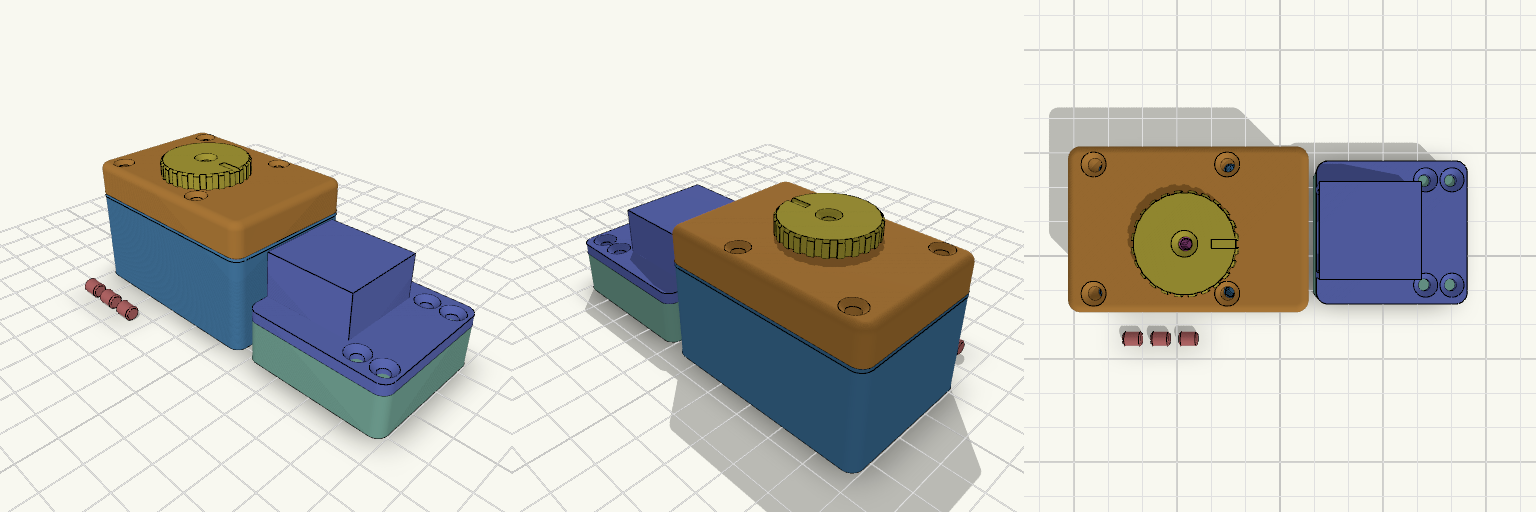
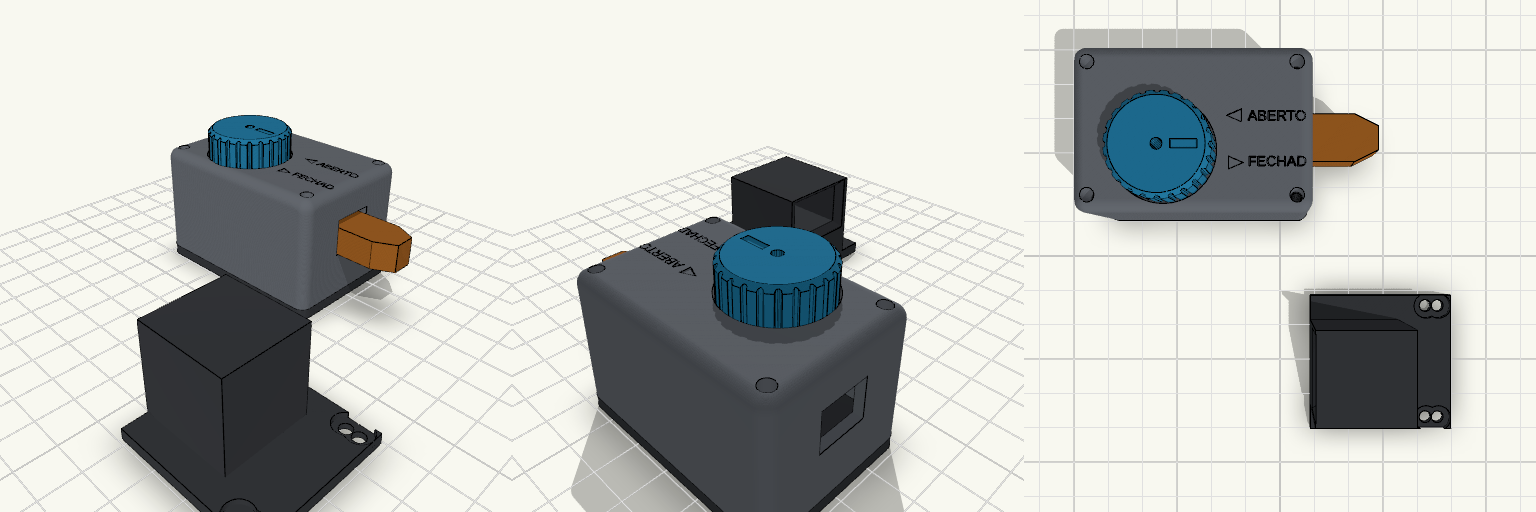
Tranca de sobrepor no estilo cofre de bancada: ferrolho deslizante, manípulo de meia-volta e receptor com bolso de entrada chanfrado. Todas as peças são impressas separadas e se encaixam na montagem, com folgas já embutidas para FDM. Base, tampa, ferrolho, eixo com braço, disco do manípulo, receptor e calço. Pino do braço Ø4 × 5 em PETG, com 3 sobressalentes deitados. Furo do pino no braço Ø4.0, para encaixe com uma gota de cola. Altura total: 36.0 na tampa e 40.4 no topo do disco.
Tranca de Sobrepor com Tampa Removível
Tranca de sobrepor compacta (56,5 × 39 × 35,6 mm) em que toda a parte superior do corpo é uma tampa única. Ao retirar os 4 parafusos M3, a tampa sai inteira e deixa o interior à mostra. O conjunto inclui base com piso de 3 mm, ferrolho, manípulo elevado com serrilha, pino de aço Ø4 mm e receptor separado. Ideias para remix Altura da divisão: a tampa começa no piso (3 mm). Subir esse corte deixa paredes na base e uma tampa mais rasa. Manípulo: disco Ø24 mm com 8 mm acima da tampa. Uma alavanca alongada dá mais braço. Fixação: 4 furos Ø3,4 mm (34 × 29 mm) com rebaixo, para parafusos 3,5 × 25 mm. Combina com: receptor de 40 × 38 mm, que pode ser aparafusado na porta ou no batente.
Finger Trunking with Snap-On Lid
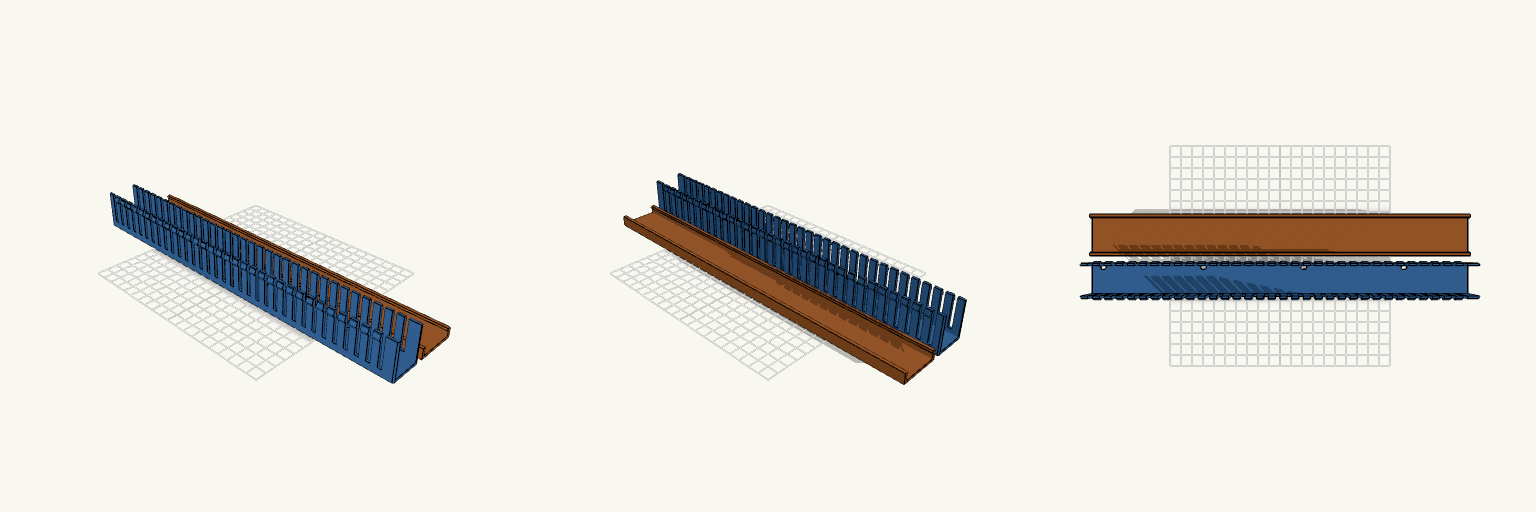
Finger trunking that blocks access to your mounting holes is a problem. This one has floor slots cut where the screws and the access hole need to be, plus a snap-on lid. The walls are free-standing fingers with barbs at the tips. The lid's inward lip clips under the barbs. Size: 340 × 30 × 35 mm, with 2 mm walls and a 2 mm floor. Fingers: 4 mm gaps on a 10 mm pitch. M3 slots: Four slots, 3.4 mm wide and 5.4 mm long. They sit at 10, 100.75, 191.5 and 282.25 mm from the left end, 90.75 mm apart. Access hole: 7 mm diameter, 201.5 mm from the left end. Slot line: All slots sit 10.786 mm toward +Y from the centreline. Printing: The trunking is longer than most print beds. Print it diagonally or split it. The lid lip is a small overhang when printed flat.