Goat Ballerina Christmas Ornament with Hanging Loop
Created today
Description
A baby goat ballerina ornament that hangs from a ribbon loop and stands on a small stage disc. The old version tipped on its tiny shoe soles and looked flat. This one stands on a 44 mm base and has a fuller sculpt.
- Face: lidded eyes with lashes, a highlight in each pupil, rounded cheeks, a nose and a smile line.
- Horns: ridged spiral curls on each side.
- Ears: pointed, stretching out sideways, with raised inner ears.
- Dress: two layers of folds, a beaded hem roll, a sash and a back bow.
- Flowers: on the skirt, the sash and between the horns.
- Pose: hands joined under the chin, legs crossed, ankle-strap shoes.
Print notes
- Height: about 100 mm, with the loop at the top.
- Base disc: 44 mm across and 2 mm thick, so the figure doesn't rely on the shoe soles.
- Loop: 3.5 mm thick, 7 mm opening for ribbon.
- Printing upright works for FDM; the horns and ears are the parts most likely to need supports.
- Resin printing suits the fine detail best.
Images
More like this
Explore more in Decor & Display →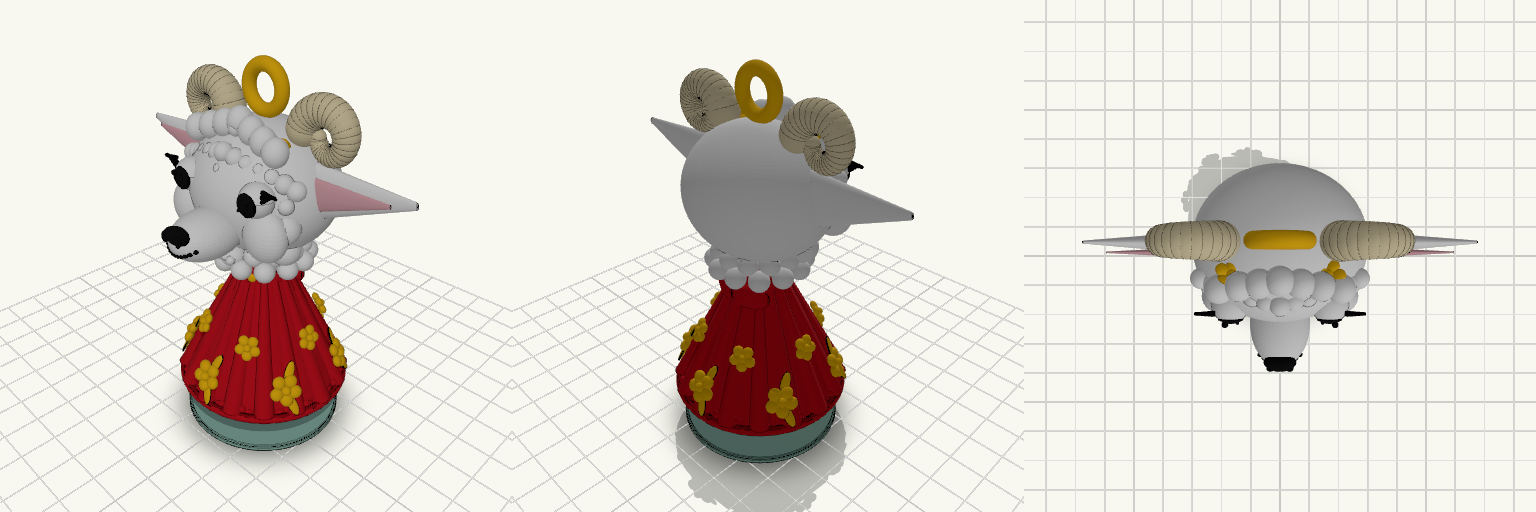
Goat Ballerina Christmas Ornament with Hanging Loop
A baby goat ballerina ornament that hangs from a ribbon loop and stands on a small stage disc. The old version tipped on its tiny shoe soles and looked flat. This one stands on a 44 mm base and has a fuller sculpt. Face: lidded eyes with lashes, a highlight in each pupil, rounded cheeks, a nose and a smile line. Horns: ridged spiral curls on each side. Ears: pointed, stretching out sideways, with raised inner ears. Dress: two layers of folds, a beaded hem roll, a sash and a back bow. Flowers: on the skirt, the sash and between the horns. Pose: hands joined under the chin, legs crossed, ankle-strap shoes. Print notes Height: about 100 mm, with the loop at the top. Base disc: 44 mm across and 2 mm thick, so the figure doesn't rely on the shoe soles. Loop: 3.5 mm thick, 7 mm opening for ribbon. Printing upright works for FDM; the horns and ears are the parts most likely to need supports. Resin printing suits the fine detail best.
Red Fire Goat Ornament, 120 mm
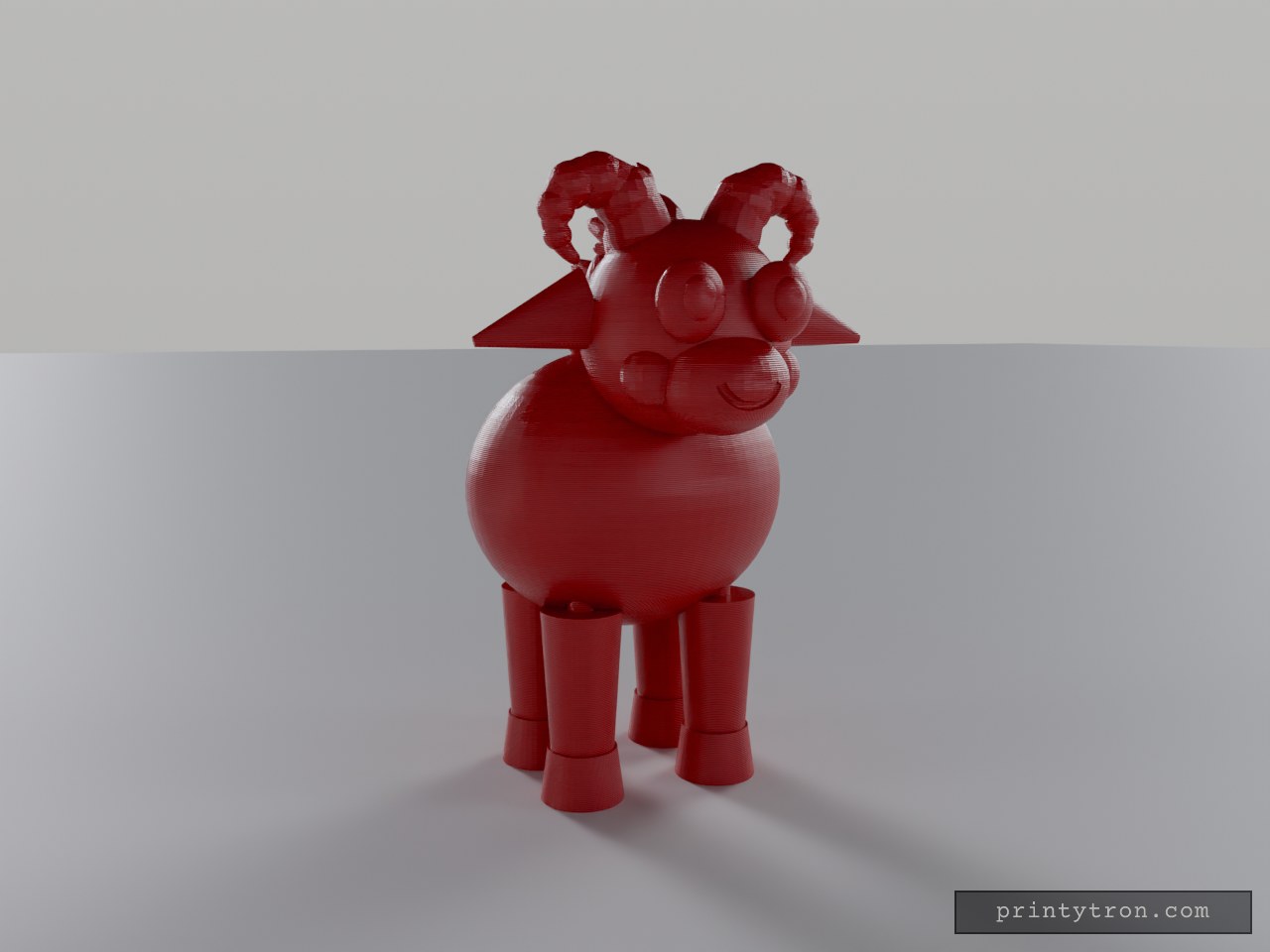
Multi-part Christmas tree ornament of a cartoon red goat with curled golden horns, amber eyes, a smiling muzzle, a flame-shaped mane and a curled tail. The body carries an integrated hanging loop on top. Head, horns, ears, eyes, pupils, legs, hooves, mane, mane flame tips and tail are separate pieces that join with round pegs and sockets. Height: about 120 mm assembled Joints: round pegs in sockets, 0.2 mm clearance per side Pieces: body, head, horns, ears, eyes, pupils, four legs, four hooves, mane, mane flame tips, tail Colours: red body, gold horns, amber eyes, orange and yellow mane, orange tail Printer: FDM, suited to a Bambu Lab P1S in PLA or PETG Export: a part selector at the top of the file switches between the assembly and each single piece for STL export Supports: horns, tail and mane may need light supports or a tilted orientation
Santa
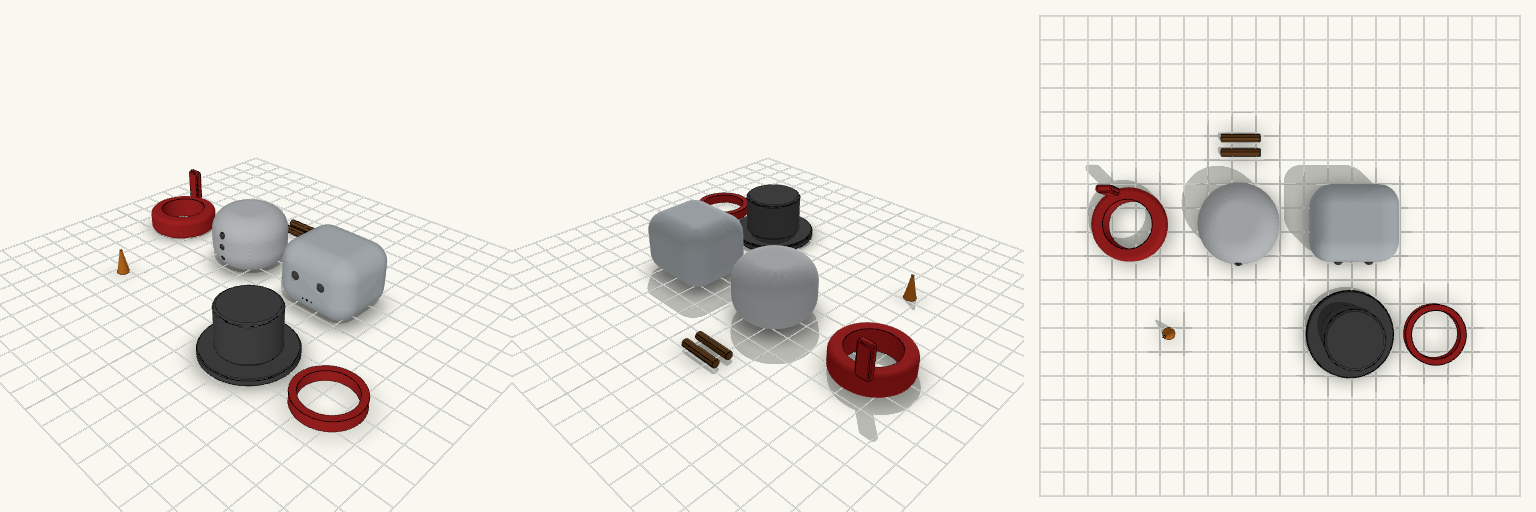
A Funko-style snowman built as separate pieces: body, square head, top hat and two stick arms. The head has a 17.49 × 17.49 mm square pocket, 9.92 mm deep, in its flat underside. Fit notes Pocket: 17.49 × 17.49 × 9.92 mm in the head underside. Measure your mating part before printing. Head top: flat. The threaded post has been removed. Hat: still carries its threaded socket, so it does not screw onto this head as built. Not fitted: the body has no matching peg for the pocket.
Steampunk Articulated Dragon with Saddle
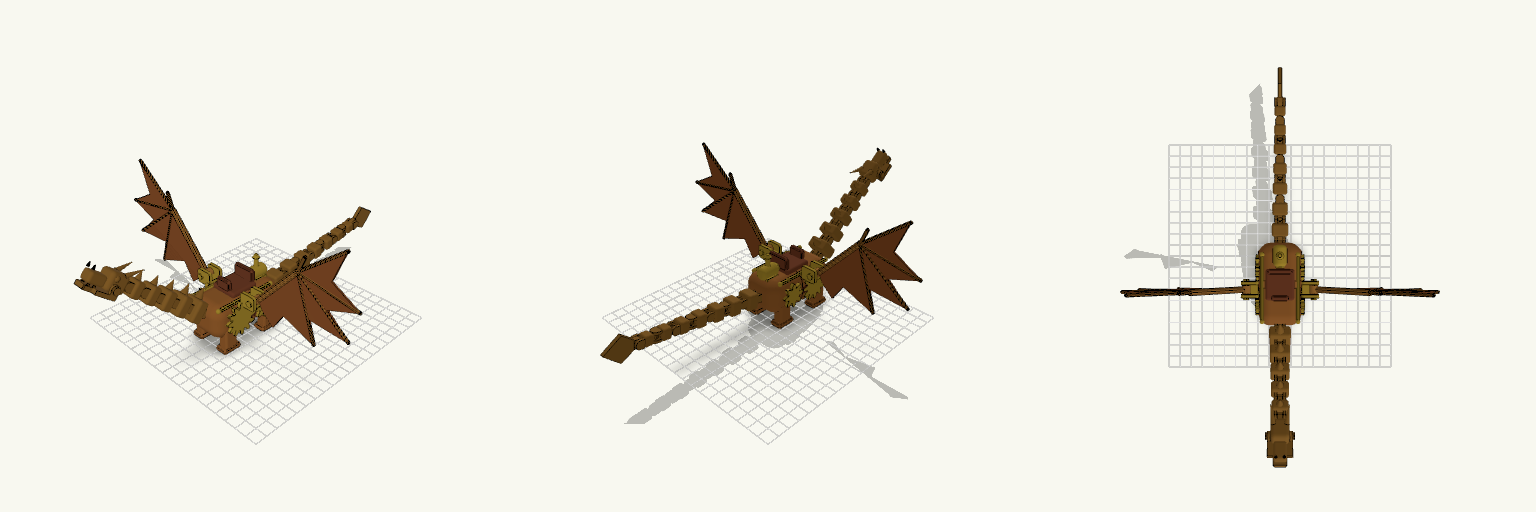
A print-in-place articulated steampunk dragon with a saddle on its back, a hinged neck, a segmented tail and an opening jaw. It is a standalone figure, so the critical dimension is the hinge clearance. What it has Five-segment neck on pin hinges, tilted up from the chest Seven-segment tail with alternating hinge directions, so it swings both up-down and side-to-side, ending in a blade tip Head with a pinned lower jaw that swings open Saddle with pommel, cantle and girth band Brass-style gears on both flanks, side steam pipes and a boiler with a stack Check before printing Hinges use a 0.4 mm gap per side and 3.8 mm holes on 3 mm pins. Printer tolerance has to hold that, or the joints fuse. Print as-is with no rotation. Supports are needed under the jaw, neck and tail hinges. Break each joint free after printing. Does not fit or do The legs are fixed and the figure has no wings. It is not a scale model of any commercial figure.
Noelring — Christmas Lettering Ring for a 97.4 mm Sphere
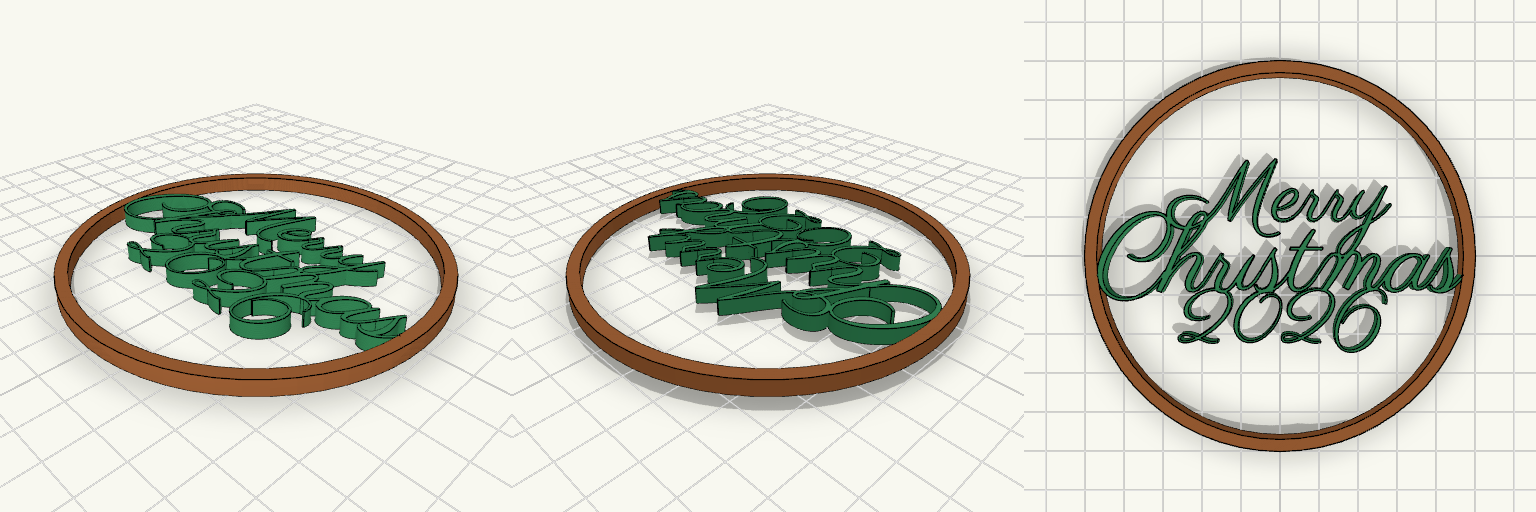
Noelring is a seating ring designed to sit inside a hollow sphere, with “Merry Christmas 2026” lettering held in its opening. The ring’s outer edge is cut to the sphere’s inner curve, so the seat meets a 97.4 mm internal-diameter shell across the full 3 mm ring width instead of resting on a single line. The top and bottom faces are flat, the centre is open with no background plate, and the three text lines run the full 4 mm height of the ring, flush with both faces. The lettering is set in Parisienne, a connected cursive script with a dotless “i” in “Christmas”; “Christmas” runs into the ring wall at both ends and is the only line fused to it, while “Merry” and “2026” are not tied to the ring and depend on touching “Christmas” to stay in place. Dimensions Ring: 97.4 mm outer diameter × 4 mm tall Ring width: 3 mm; inner diameter about 91.4 mm Seat: outer edge curved to a sphere with a 97.4 mm internal diameter (48.7 mm radius) Lettering block: about 91.3 × 48.2 mm, full 4 mm height Features Curved outer edge follows the sphere’s inner surface across the full ring width Flat top and bottom faces, with the seat carried on the outside edge Open centre: the lettering has no background plate behind it Three stacked lines, “Merry”, “Christmas” and “2026”, set in Parisienne, a connected cursive script “Christmas” runs into the ring wall at both ends and is anchored there “Merry” and “2026” are not joined to the ring; they rely on contact with “Christmas” The “i” in “Christmas” is dotless, so the line has no separate dot All three lines are set flush with the ring’s top and bottom faces Fit Made for a hollow shell with a 97.4 mm inner diameter; scale the ring and sphere together for any other size The 4 mm height is a design choice: a taller ring grips more wall but reaches further into the sphere The ring locates itself against the sphere’s curve rather than locking in place Print notes “Christmas” is fused to the ring at its ends; “Merry” and “2026” are held only where they touch “Christmas” — check those contact points before printing If a word does not touch “Christmas”, it will print as a loose piece No struts connect “Merry” or “2026” to the ring wall No supports should be needed for the flat ring and full-height lettering
Germania Relief — Wypukła Mapa Niemiec
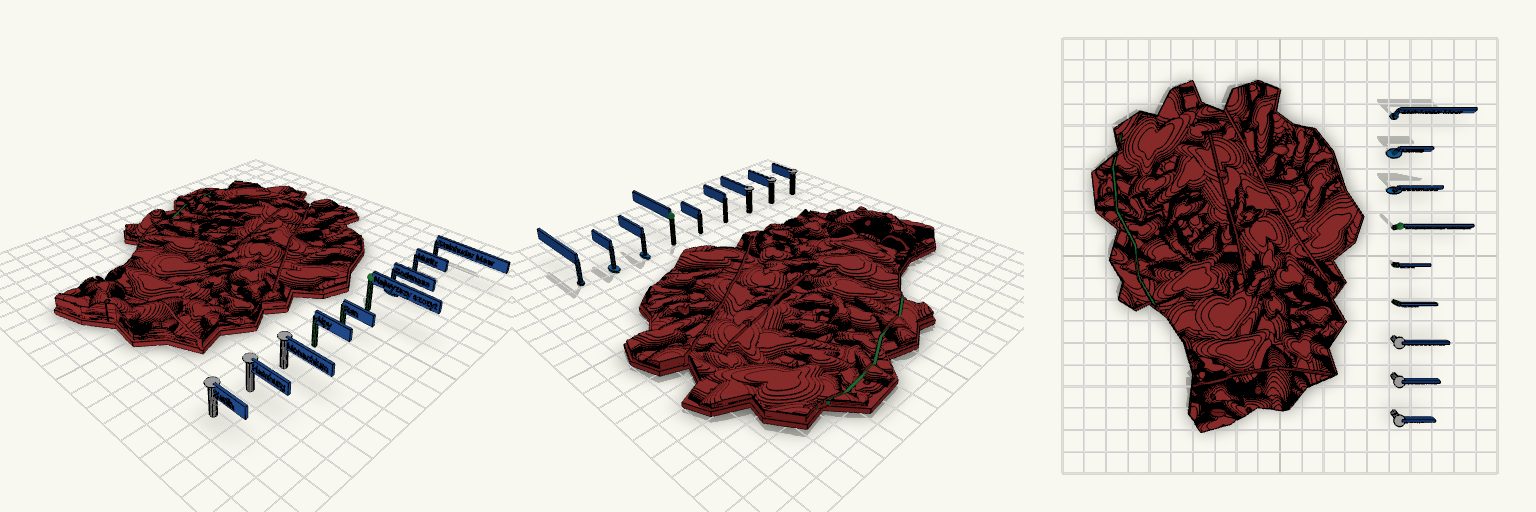
Germania Relief to wypukła mapa Niemiec z rzeźbą terenu: cała powierzchnia jest lekko falista, także na nizinach, a góry wybijają się ponad nią. Wzniesienia mają gładkie, wielowarstwowe zbocza i nieregularne, powyginane obrysy zamiast regularnych owali. Cztery wyżłobione rzeki przecinają teren, a Ren jest wyróżniony zielonym wypełnieniem koryta, przyciętym do zarysu mapy, oraz tabliczką „Ren”. Znaczniki — trzy miasta, szczyt, Alpy, Ren i jeziora — są osobnymi elementami: leżą płasko obok mapy, bez dodatkowej podstawy, i pasują do gniazd w mapie. Całość czyta się jak dekoracyjna mapa reliefowa, a nie płaski plan. Najważniejsze cechy Ukształtowanie terenu w gładkich, wielowarstwowych zboczach, z Alpami wybijającymi się ponad resztę mapy i zieloną tabliczką „Alpy” Cztery rzeki, w tym Ren z zielonym wypełnieniem koryta przyciętym do zarysu mapy i podpisem; wypełnienie leży w korycie na mapie Trzy największe miasta — Berlin, Hamburg i Monachium — oznaczone wyjmowanymi słupkami z pionową tabliczką z wypukłym napisem Najwyższy szczyt Alp oznaczony wyjmowanym znacznikiem z kulką, kołkiem i tabliczką „Najwyzszy szczyt” Jeziora: Muritz, Bodensee i Steinhuder Meer — niebieskie wkładki w wycięciach, podpisane małymi tabliczkami Wyjmowane znaczniki leżą luzem obok mapy, bez podstawy; po przełożeniu wciska się je w gniazda mapy W zestawie Mapa Niemiec ok. 124 × 160 mm z gniazdami na znaczniki Wyjmowane znaczniki miast, szczytu, Alp, Renu i jezior, leżące płasko obok mapy Znaczniki nie mają osobnej podstawy Druk i montaż Model składa się z mapy i osobnych znaczników. Znaczniki są wciskane w gniazda mapy; pasowanie jest ciasne, więc luzy warto sprawdzić na wydruku. Najdrobniejsze elementy, jak kołek szczytu, są delikatne.