Hexagonal Honeycomb Floating Shelf Set
Created today
Description
A three-cell honeycomb of hexagonal wall shelves, each cell deep enough for small plants or a few books. The cells share walls and mount as one cluster, so a blank wall becomes a single graphic statement. Two keyhole slots per hex are hidden in the back panel, so no brackets are visible once hung.
What it's for
- Displaying small potted plants, books, or ornaments on a wall.
- Turning a plain wall into a honeycomb feature without visible hardware.
- Hanging flush: screw heads sit in recesses on the wall side of the 6 mm back panel.
Dimensions
- Each hex: 200 mm across the points, about 173 mm across the flats.
- Depth: 100 mm per shelf.
- Back panel: 6 mm thick.
- Side wall: 5 mm.
- Keyholes: two per hex, 80 mm apart, cut through the back panel with a recess on the wall side.
- Layout: three hexes joined along shared walls in a triangular cluster.
Print notes
- The cluster is oriented back-down on the build plate, so it needs no supports.
- It prints as one large fused piece. Check that it fits your bed, or split it into single hexes.
- Use screws with heads that fit the keyhole recess, and anchors suited to your wall type.
Remix ideas
- Add more cells to extend the honeycomb sideways or upward.
- Change the depth for shallow trinket shelves or deeper book cubbies.
- Print each hex separately in different colours and assemble them on the wall.
- Add a lip or a drainage hole for planters.
Images
More like this
Explore more in Decor & Display →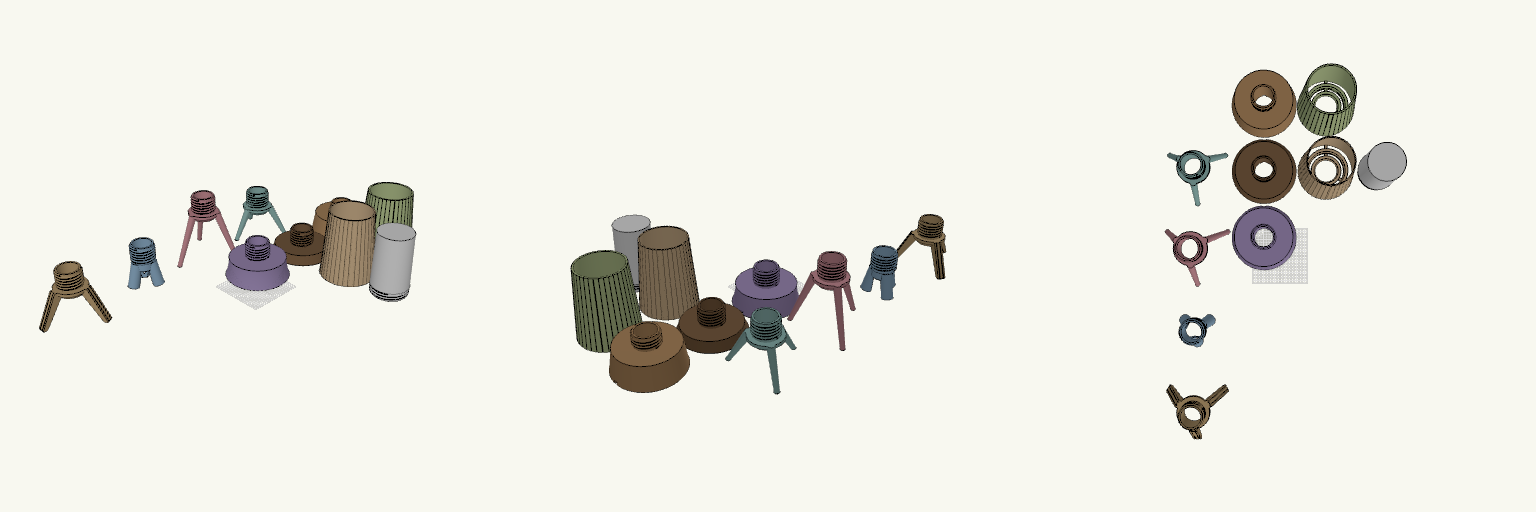
Lamp Bases, Shades and Diffuser Set
A set of mid-century lamp parts that all share one coarse 6 mm-pitch thread, so any shade fits any base. The set has two fluted shades (round and square ribs), a white adjustable diffuser and several bases: tall, short, grooved, two tripods, a flat-leg grooved tripod and a dowel-leg hub. Remix hooks Flat-leg tripod: legs are 16 mm wide slabs (before scaling) with two grooves, 3.2 mm wide, down each outer face. Change the groove count, offset (±4 mm) or width. Leg height and spread: hub height 70 mm and foot radius 70 mm set the splay. Raise both for a taller version. Thread spigot: 52 mm across, 38 mm long. Keep it to stay compatible with the shades. Pairs with: either fluted shade and the diffuser. The 42 mm bore runs straight through for the bulb and cord.
Visor — Smart Goggles Chassis Set
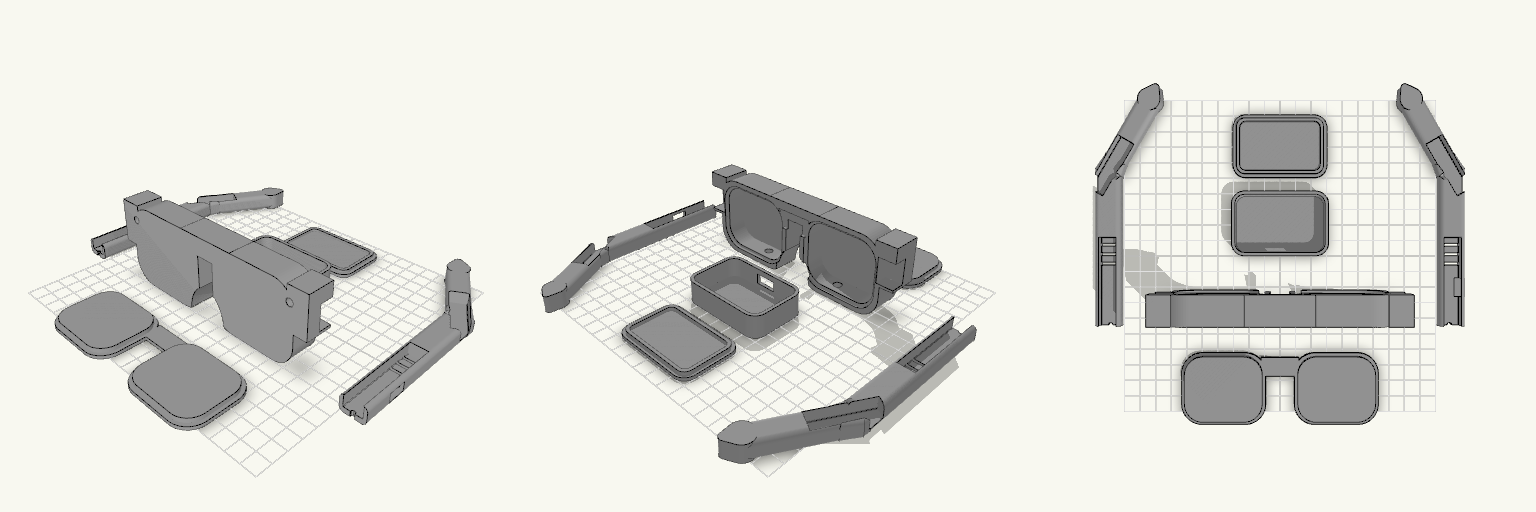
Visor is a printable smart-goggle chassis kit: a front frame, two hollow temple arms, an electronics box and matching caps, laid out flat for printing. Features Frame with two lens-housing cavities, camera ports and downward sensor holes Hollow arms with speaker slots, USB-C opening and power switch cut-out Electronics box with lipped lid Frame cap: a one-piece back cover with two lips that plug into the eye cavities (0.3 mm clearance per side) Print notes Every piece prints flat without supports. Arms join the frame with 3 mm pins or filament offcuts.
Christmas Tree Lantern for LED Tealight
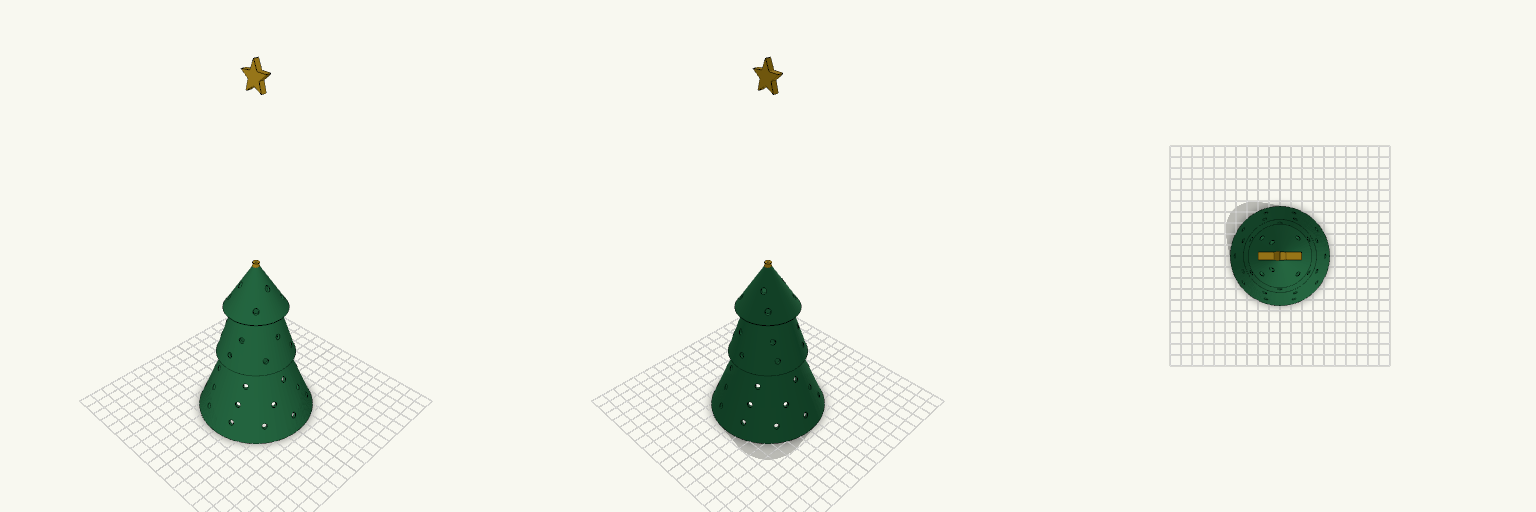
A Christmas tree lantern that sits over a battery LED tealight, so the light stays hidden inside instead of glaring from a bare tealight on the table. The walls are perforated with rings of small round holes that throw dots of light, and the bottom is open so the LED can be placed or swapped without taking anything apart. Key numbers Height: about 135 mm including star Base diameter: 90 mm, open underneath (inner opening about 87 mm) Wall: 1.6 mm, three stacked tiers Perforations: 4.2 mm holes, staggered rings Star: separate colour, peg-mounted into the top tier Printing Print upright, open end down, no supports needed for the cone walls Green for the tree, gold or yellow for the star Use a 0.4 mm nozzle; a lighter or translucent filament glows more
Black and Gold Wedge Desk Nameplate
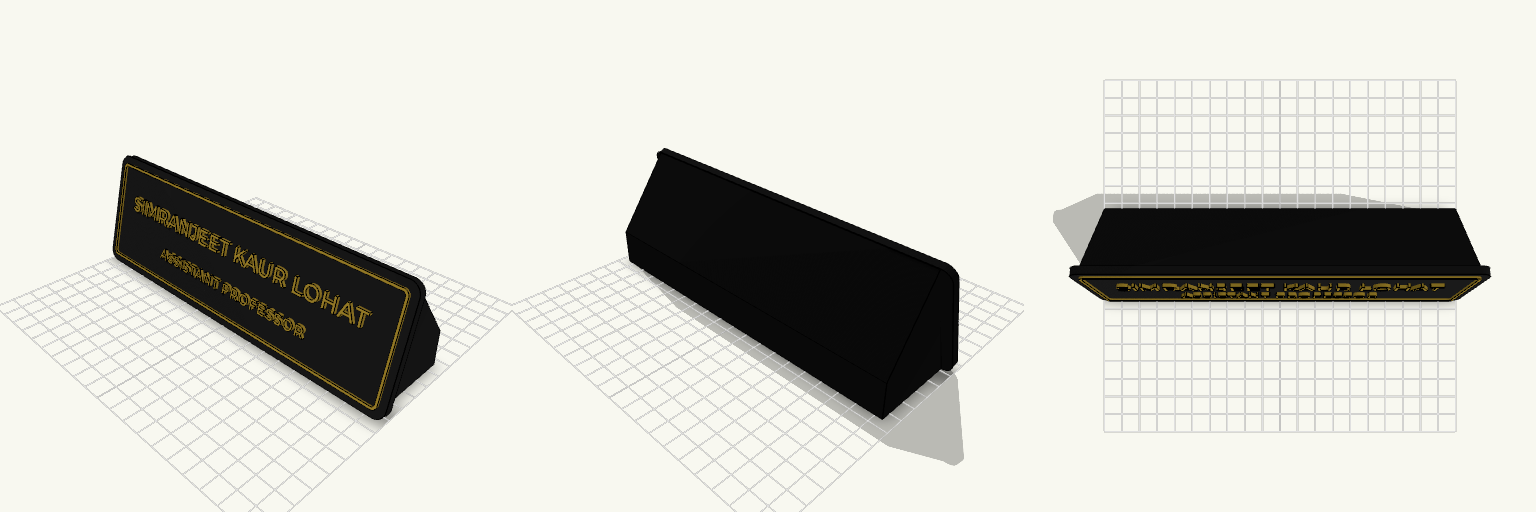
A wide desk nameplate with a black rounded base, thin gold border and raised gold lettering. The name sits on the top line in large capitals, with ASSISTANT PROFESSOR centred below it in smaller capitals. The plate is tilted back on an integrated wedge stand, so it needs no separate parts. The back and underside are flat, and the build needs no supports. Text: SIMRANJEET KAUR LOHAT (top), ASSISTANT PROFESSOR (bottom) Colours: black base and wedge, gold border and letters Letters raised 2 mm, border raised 1.2 mm Plate size 200 × 64 mm, tilted back 15° from vertical Suited to multicolour printing with a 0.4 mm nozzle
Miniature Pop-Up Toaster, 70x46x45 mm
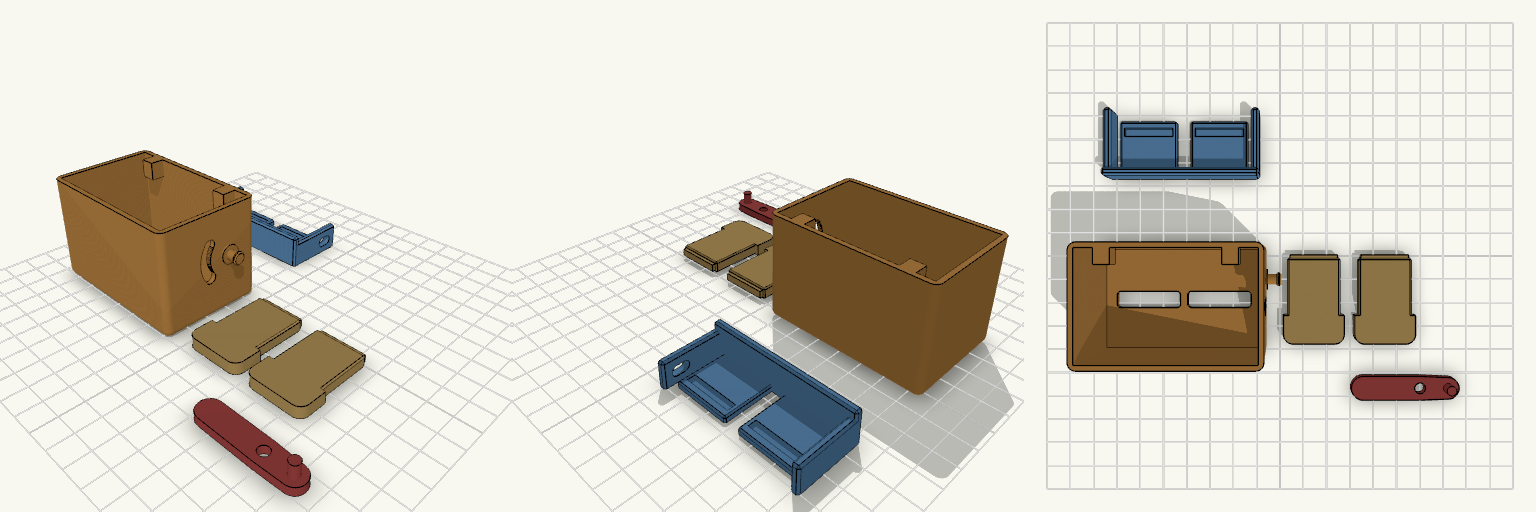
A small mechanical toaster printed as separate parts: body, toast carriage, two toast slices and a side lever. Pressing the lever handle down raises the carriage and pops both slices up out of the slots. No springs are used. Lowering the lever pulls the toast back down. How it works The lever pivots on a pin moulded into the right side wall. A peg on the lever passes through an arc slot in the wall into a horizontal slot in the carriage side plate. The peg's travel lifts the carriage about 14 mm. The ends of the arc slot are the up and down stops. Two floor blocks inside the body act as backup low stops. Each toast slice has a tenon that locates in a pocket on its carriage tray. Specs Body: 70 x 46 x 45 mm, open bottom. Print it upside down with the top plate on the bed. Overall assembled size: about 76 W x 52 D x 60 H mm with the toast raised. Carriage: 1 mm side clearance to the walls. Slice tenon clearance 0.3 mm per side. Slots: 27 x 7 mm for slices 25.5 x 5 mm. Print settings: PLA, 0.2 mm layers, 3 walls, 10-12% infill. No supports are needed. Estimated filament: roughly 35-45 g. This is below the 50-60 g target, so walls can be thickened if more weight is wanted. Assembly Slide the carriage into the body through the open bottom. Slice tenons face up. Press the lever hub onto the pivot pin, feeding the peg through the arc slot into the carriage slot. Add a dab of glue to the pin head if the snap fit is loose. Drop the slices into the slots.
Advent Calendar With 24 Drawers
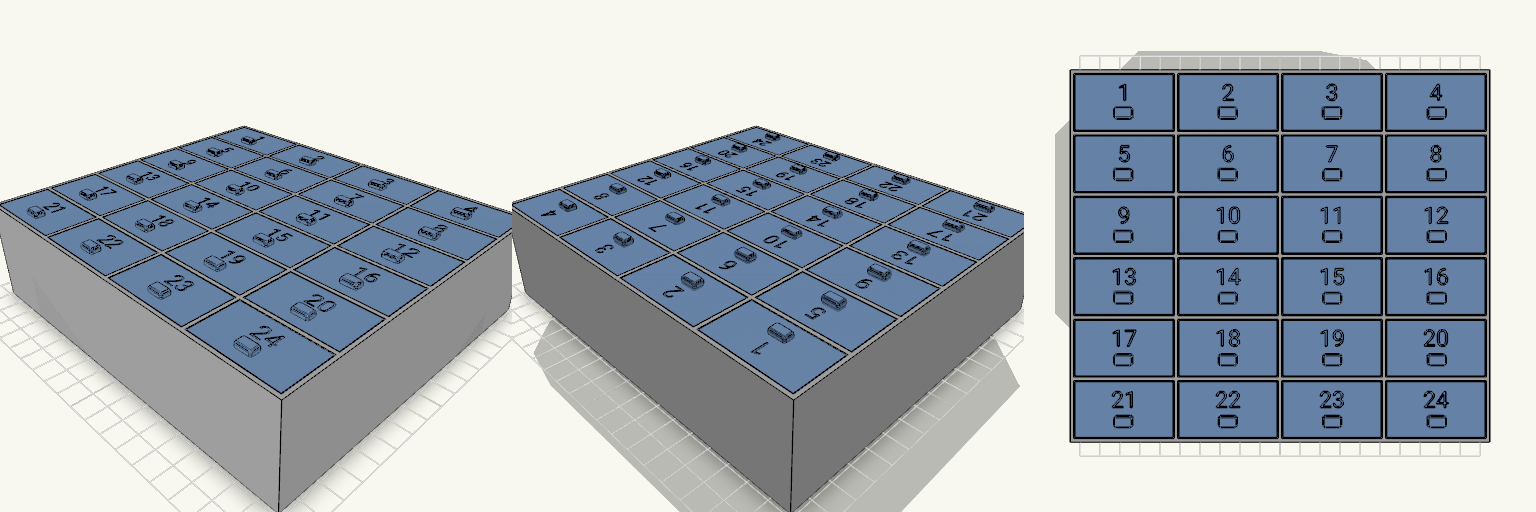
Advent calendar drawers that stick, fuse, or have nothing to grab. Each of the 24 drawers has a rounded finger grip on the front, a numbered face, and 0.5 mm clearance all round, so it slides out freely after printing in place. Key numbers Footprint: 177.5 × 157.5 mm (fits a 180 × 180 mm bed) Height: about 49.9 mm including grips Layout: 4 columns × 6 rows, printed lying on its back, front facing up Drawer interior: 38.5 × 22 × 42.5 mm Walls: 1.5 mm; grips 8 × 5 mm, 2.5 mm proud Print: white PLA, 0.4 mm nozzle, no supports inside the drawers; the drawer back walls hover 0.4 mm above the frame back, so expect a thin first-layer bridge