Info Orbs 1.28in Five-Display Case
Created today
Description
Two-part case for an Info Orbs build: five 1.28in round TFT displays across the top, a hollow base for a 200 mm controller board, and three push buttons in the front wall. The Front Half and Back Half join with four M3 screws running front to back, with heat-set inserts in the back half. Both halves print flat on their cut faces.
What it fits
- Five 1.28in round TFT displays on 40 mm centres, tilted back 30°, with 42 mm outer housings, 39.5 mm PCB pockets and 33 mm windows. The scalloped top edge follows the rims of the displays instead of running as a plain box.
- A 200 mm board, including a large Arduino section. Interior space is 196 × 24 × 35 mm, so there is about 3 mm of slack all round the board.
- Three 6 mm tact-switch caps in 7 mm front-wall holes at −40, 0 and +40 mm.
- Four M3 screws at x = −10, 25, 60 and 92 mm: 3.4 mm clearance holes in the front half, 4.2 mm heat-insert holes 9 mm deep in the back half.
Check before printing
- The screw positions assume the Arduino's 15–70 mm span is measured from the left (−X) end of the board, which puts it at x = −85 to −30 mm and keeps the nearest screw about 20 mm clear. If that span is measured from the right end, mirror the screw holes before printing.
- The screw bosses sit at floor level and run front to back, so they pass under the board — confirm the board clears them.
- The outside measures 200 × 30 × 40 mm with 3 mm walls and floor. That is not 200 × 30 × 25 mm as first specified, so check your electronics against the larger figure.
Known limitations
- There is no internal switch mount. The tact switches must be glued or wired in place.
- The button holes suit 6 mm tact-switch caps, not 12 mm panel-mount buttons.
Images
More like this
Explore more in Desk & Tech →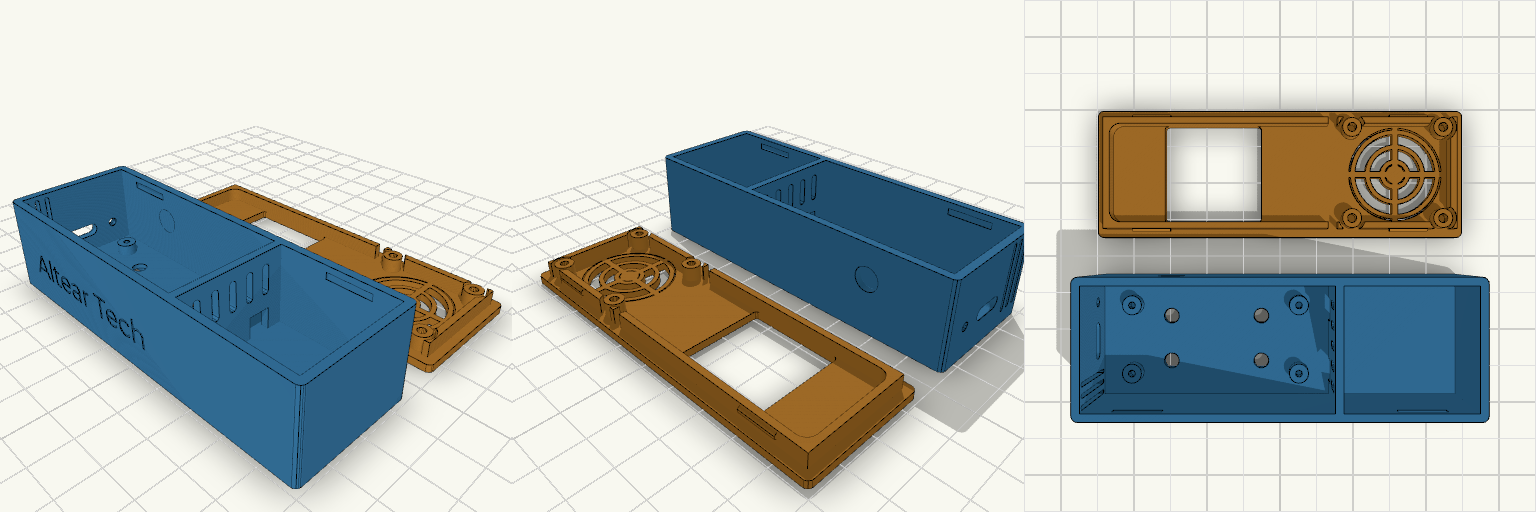
Case ESP32 + LoRa com Display e Cooler
Case compacto para ESP32 e módulo LoRa SX1278, com tampa de encaixe por pressão, janela para display TFT 1.44" e cooler na tampa. Ganchos para remix Altura interna (IH = 21 mm): altura total de 24 mm. Aumente se o LoRa ficar justo. Furação do cooler: quadrado de 24 mm com pinos de 5 mm e furo de 2,4 mm. Ajuste para outro tamanho de cooler. Janela do display: 26 × 26 mm na tampa. Combina com um suporte interno para o módulo. LoRa: sem canaletas internas. Dá para adicionar suportes na medida da sua placa. Ranhuras inferiores: duas ranhuras de 4 mm para cabos entre as placas.
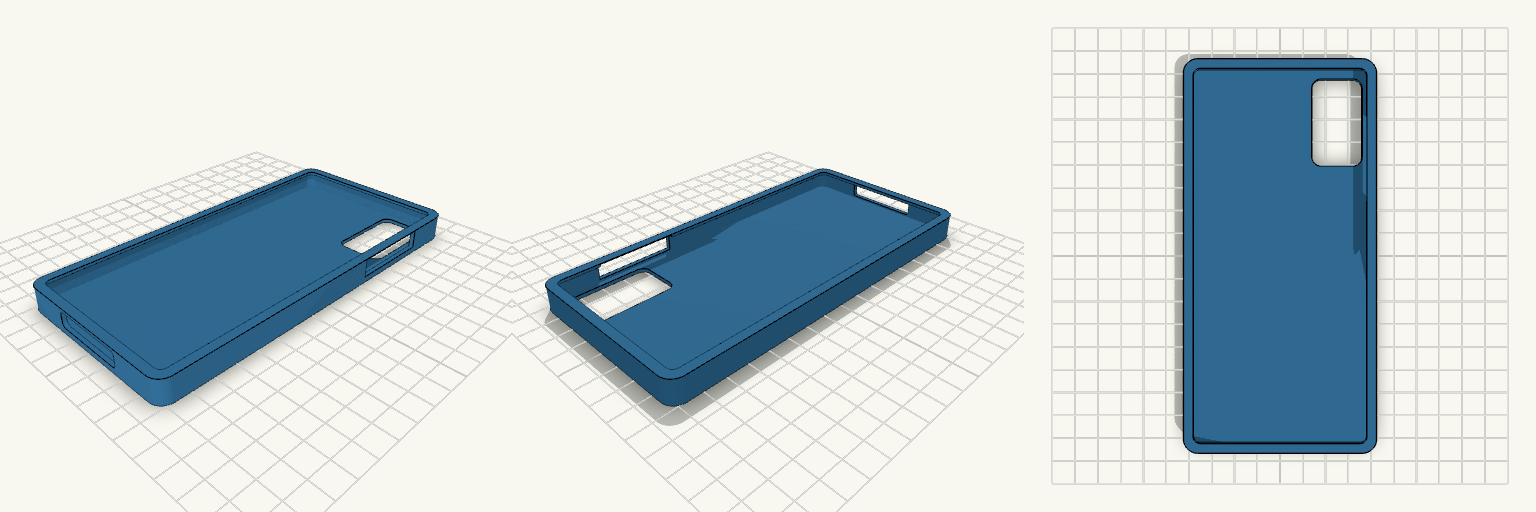
Samsung S24 FE Snap-In Bumper Case
A one-piece snap-in bumper case for the Samsung S24 FE, sized from the 162.0 × 77.3 × 8.0 mm phone spec with 0.2 mm clearance. The open front leaves the screen clear, and the walls are 1.8 mm with a 1.5 mm back and a 1.2 mm lip that catches the screen edge. Camera cutout on the back Button slot along one side Bottom slot for USB-C and the speaker Prints back-down with no supports One piece, no assembly The case is rigid, so the phone presses in from one corner. PLA works, but a flexible filament such as TPU is easier on the phone and less likely to crack the lip. The camera and button positions are estimates, so check them against your phone before printing the whole case.
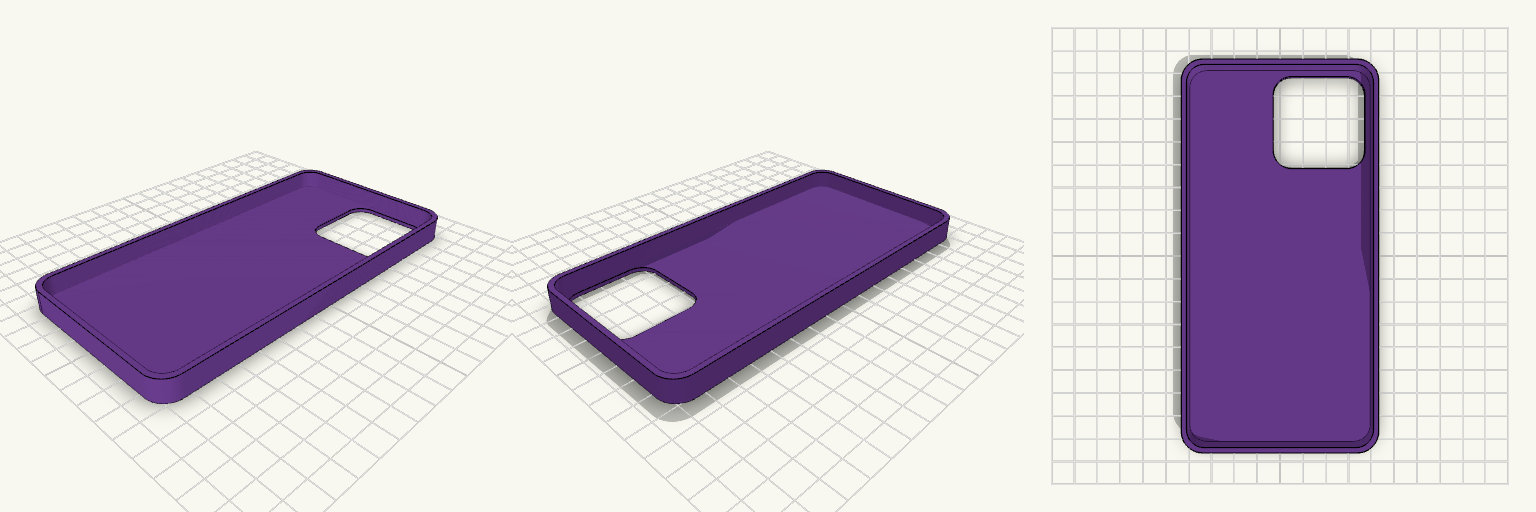
iPhone 13 Pro Max Case with Awareness Ribbon Inlay
What it's for A purple case for the iPhone 13 Pro Max with a peach cancer awareness ribbon inlaid flush into the back. The ribbon sits in a matching recess as a separate 1.2 mm-thick inlay, so you can print it in a second color or change filament at that layer. The screen side is open with a small lip to hold the phone, and the back has a rounded 40 mm camera cutout. It has not been test-fitted on a physical phone. Dimensions Case footprint on the print plate: 83.1 × 165.8 × 10 mm. Phone cavity: 78.7 × 161.4 mm, with 2.2 mm walls and a 1.6 mm back. Peach ribbon inlay: 32 × 49.3 mm, 1.2 mm thick. Camera cutout: 40 mm rounded opening at the top corner of the back. Print the case back-down. Remix ideas Change the ribbon color for another awareness cause while keeping the flush recess. Resize or reshape the ribbon inlay, or add a short message alongside it. Add button cutouts or adjust the front lip for a different fit preference.
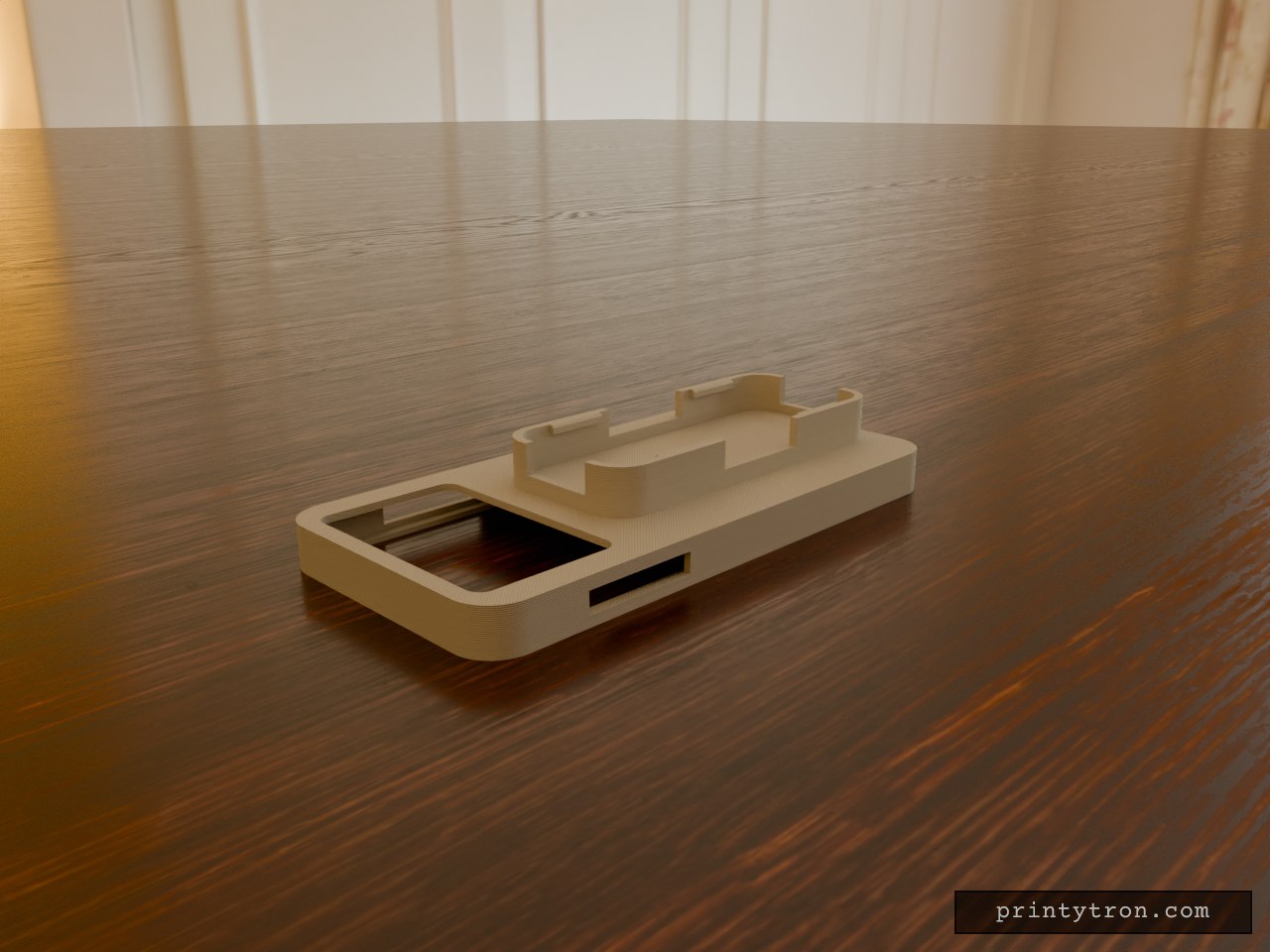
Nothing Phone (1) Case with Flipper Zero Cradle
A snap-on case for the Nothing Phone (1) with an integrated cradle on the back for a Flipper Zero. The phone enters from the screen side and is held by a 1.5 mm lip, while side-button slots and a bottom opening keep the buttons, USB-C port and speaker clear. The cradle sits on the lower two-thirds of the back, clear of the camera, and holds the Flipper Zero with snap ridges and finger notches. Corners on both the case and the cradle are rounded generously for a softer outline. Specs Phone fit: Nothing Phone (1); open front with a 1.5 mm retaining lip; side-button slots; USB-C and speaker opening. Back window: opening over the camera and glyph area. Flipper cradle: lower two-thirds of the back; 13 mm pocket height; port slots at both ends; finger notches on the long sides; snap ridges to hold the Flipper Zero. Flipper clearance: the Flipper Zero is 25 mm thick, so about half of it sits above the cradle rim. Corners: case outline 11 mm radius, cradle 10 mm radius; pockets and screen opening rounded to match; the cradle rim's top edges are still square. Overall size: the case is about 80 mm wide and 164 mm tall; the cradle is about 46 mm wide and 106 mm tall. Wireless charging: the cradle covers the phone’s wireless-charging area. Printing: print screen-side down with the cradle opening facing up. TPU is recommended for the 1.5 mm lip; PLA makes the lip stiff. Print status: this version has not been test-printed.
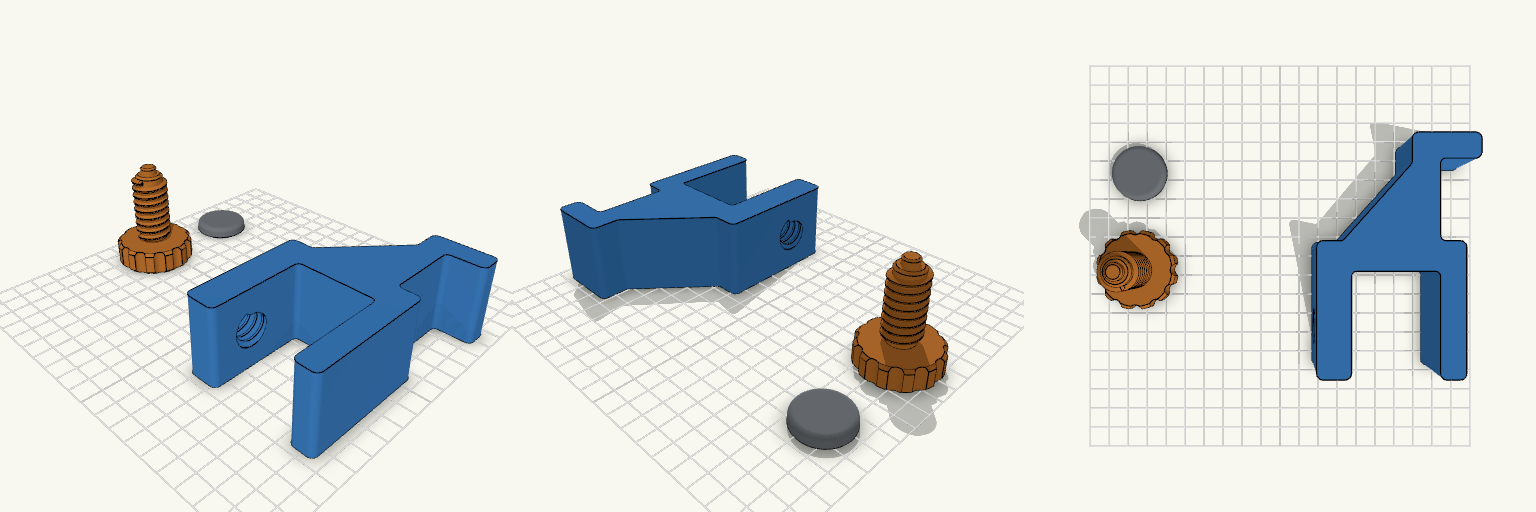
Perch — Clamp-On Headphone Holder
Perch is a three-piece desk-edge headphone holder: a main body with hook and clamp jaws, a separate threaded adjustment screw with a large scalloped knob, and a loose pressure pad. Nothing is joined or printed in place, so the parts are laid out separately and assembled by hand after printing. Features Clamp range of 15–35 mm, suited to a 20 mm desk Internal thread in the lower jaw with 0.4 mm radial clearance for the 18 mm, 4 mm-pitch screw 40 mm knob with scalloped grip Pad snaps onto an 8 mm peg at the screw tip and spins freely Reinforced hook with gusset and rounded lip Print notes Body on its side, screw knob-down, pad flat PLA, 0.4 mm nozzle, 0.20 mm layers, 4 walls No supports expected Assembly Thread the screw up through the lower jaw from below, then press the pad onto the peg. Set the source's mode value to 1, 2 or 3 to export each part individually.
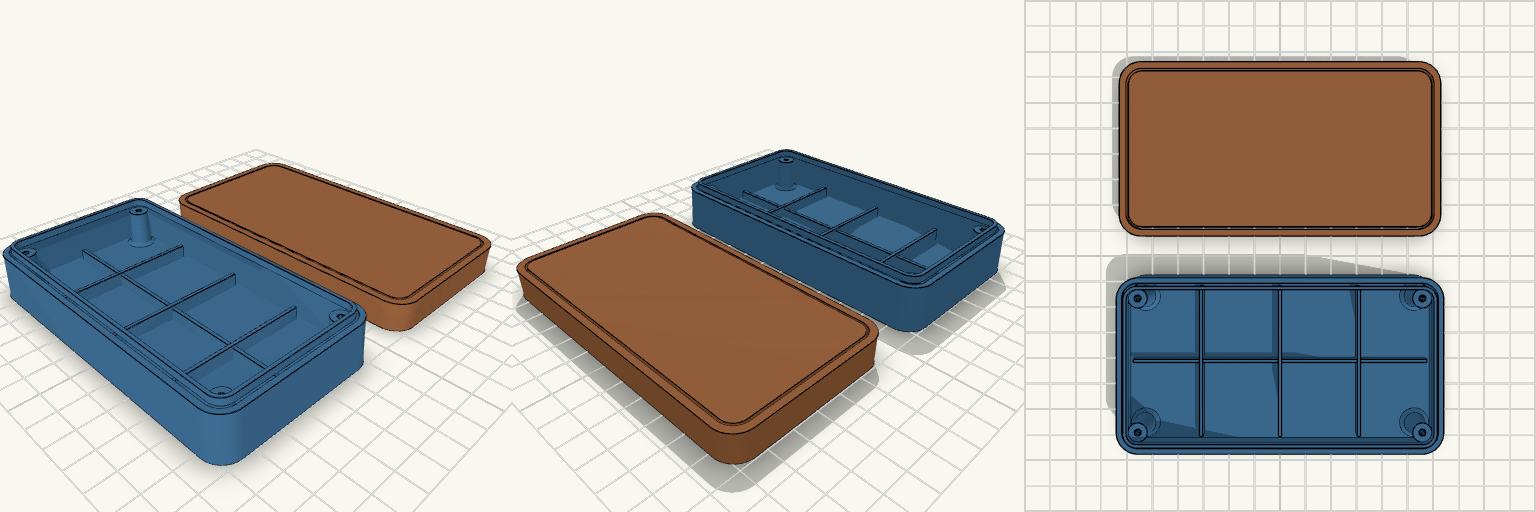
Bakelite-Era Two-Piece Electronics Enclosure
A compact two-piece case with a vintage Bakelite silhouette: rounded corners, softly drafted walls, and a clean split line between the lower housing and the upper cover. At 120 × 65 × 28 mm, it gives a small board or module a protected home, with a hollow internal cavity, four corner screw bosses, reinforcement ribs, and a tongue-and-groove closing lip. The enclosure prints as two separate pieces, with the cover laid beside the housing so both print without supports. Design notes Lower Housing: the deeper shell, with corner bosses, internal ribs, and a raised closing tongue. Upper Cover: the lid, with a matching groove and clearance holes for the screws. Walls and corners: 2 mm walls, 8 mm outer corner radius, and a 1.5° draft on the outer shell and lip. Screw bosses: four corner bosses with 2.6 mm pilot holes in the housing and 3.2 mm clearance holes in the cover. Printing: separate upper and lower parts, oriented to avoid supports.