Modular Ribbed Shoe Shelf Insert
Created 19 days ago
Description
What it's for
A freestanding shelf insert for a 260 × 300 mm wardrobe compartment, sized for children's shoes. It stands on the shelf below with no drilling and no fasteners. The deck is a light ribbed grid in four staggered panels. Each panel fits a small printer bed.
Dimensions
- Assembled deck: 258 × 290 mm, 10 mm deep, top surface 130 mm above the floor.
- Deck panels ×4, brick-bond layout so no point has four panels meeting:
- Front left: 150 × 145 mm
- Front right: 108 × 145 mm
- Back left: 108 × 145 mm
- Back right: 150 × 145 mm
- Legs ×4: 28 × 28 mm foot, 20 mm cross-section post, 120 mm tall, plus a 12 mm square locating peg that is 10 mm long.
- Dovetail keys ×4: bow-tie shape, 24 × 11 mm, 9.6 mm thick.
- Estimated material: about 130–140 cm³ in total. That is roughly 85–95 cm³ for the deck, 45 cm³ for the legs and 2 cm³ for the keys.
Assembly
- Drop a bow-tie key into the paired pockets across each seam. There are 0.2 mm clearances per side.
- Press each leg peg into the socket in its corner of the deck.
- Each leg sits in a different panel, and the peg sockets stop the deck sliding or racking.
- Add felt or a thin TPU pad under the feet if desired.
Print notes
- Print every part flat or upright with no supports, using PLA and a 0.4 mm nozzle.
- Keep the legs peg-up.
Remix ideas
- Add a front lip to stop shoes sliding out.
- Swap the cross-section legs for taller ones to suit other compartments.
- Make the ribs denser for heavier loads.
Images
More like this
Explore more in Storage & Organization →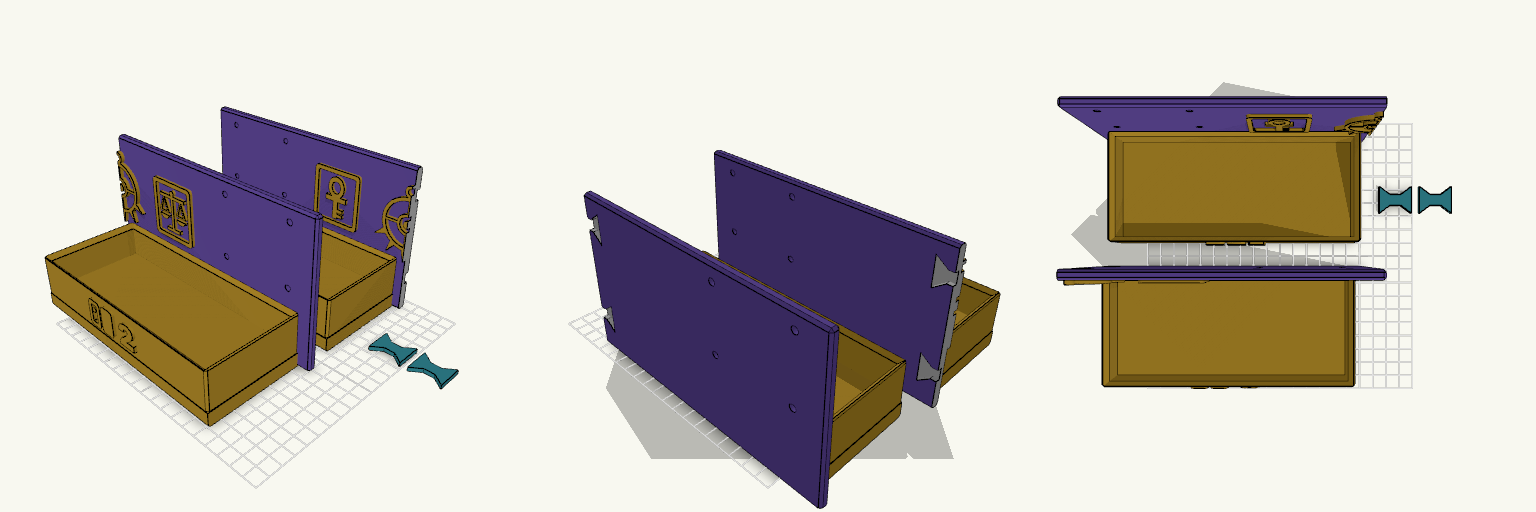
Two-Piece Pro Controller Wall Holder
A 380 mm wall holder for a PS5 and a Switch Pro controller is too wide for most print beds, and a single plate can crack along its length. This version prints as two 190 mm halves that lock together with two butterfly keys. Fit and print Split line: centre of the plate, through the Yu-Gi-Oh! ring emblem Keys: two butterfly-shaped keys, 24 mm wide and 20 mm tall, 2.9 mm thick, printed flat Key pockets: cut 3.3 mm deep into the back face, 0.3 mm clearance all round Assembly: press the keys into the back pockets across the seam, then screw the halves to the wall. The wall holds the keys in Mounting: eight countersunk screw holes in total, four per half Printing: halves lie on their backs or stand on the shelf base. No supports are needed for the hollow blocks Pocket sizes are 166 mm wide and 70 mm deep, from typical controller sizes and not from measurements of a specific controller.
Low-Profile Extractor Set Tray
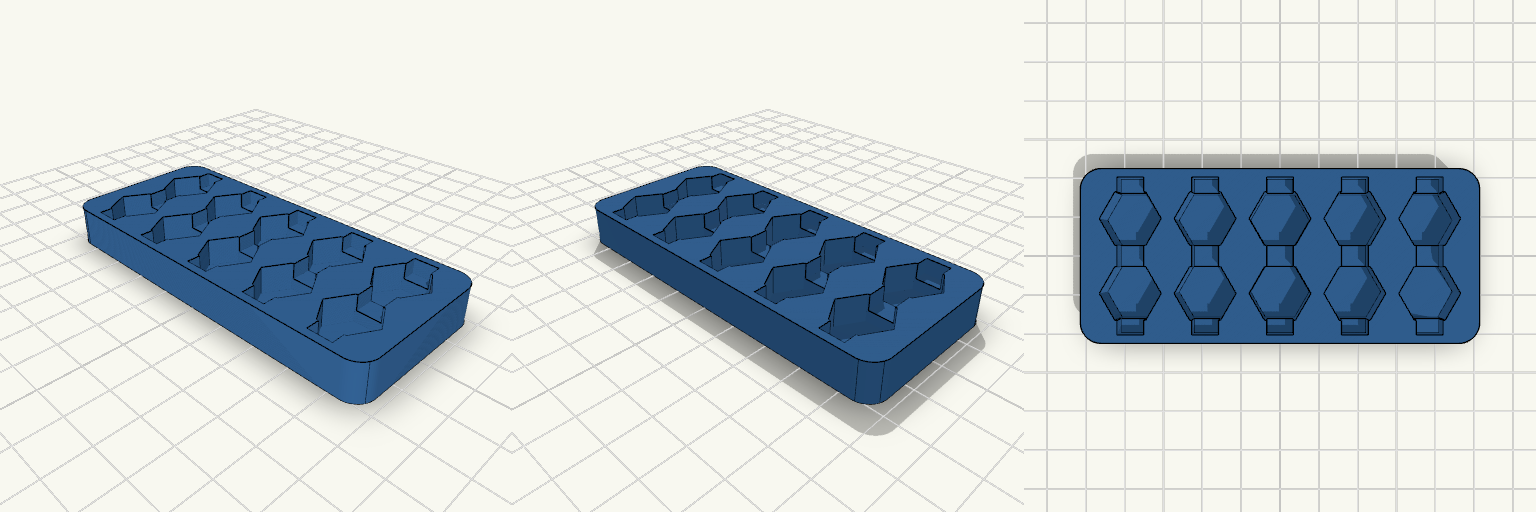
A slim, flat drop-in tray in the spirit of a toolbox foam insert, with ten hex pockets in two rows of five. Each pocket fits a thread extractor with a 12.8 mm hex base, and a finger slot across each one makes lifting them out easy. Overall size: 96 × 42 × 10 mm Pockets: 13.7 mm across flats, 7 mm deep, 3 mm solid floor Extractors stand upright, so the tall ends project above the tray Rounded vertical corners for easy fit into a case
Modulare Lochplatte mit Dorn für Filamentrollen
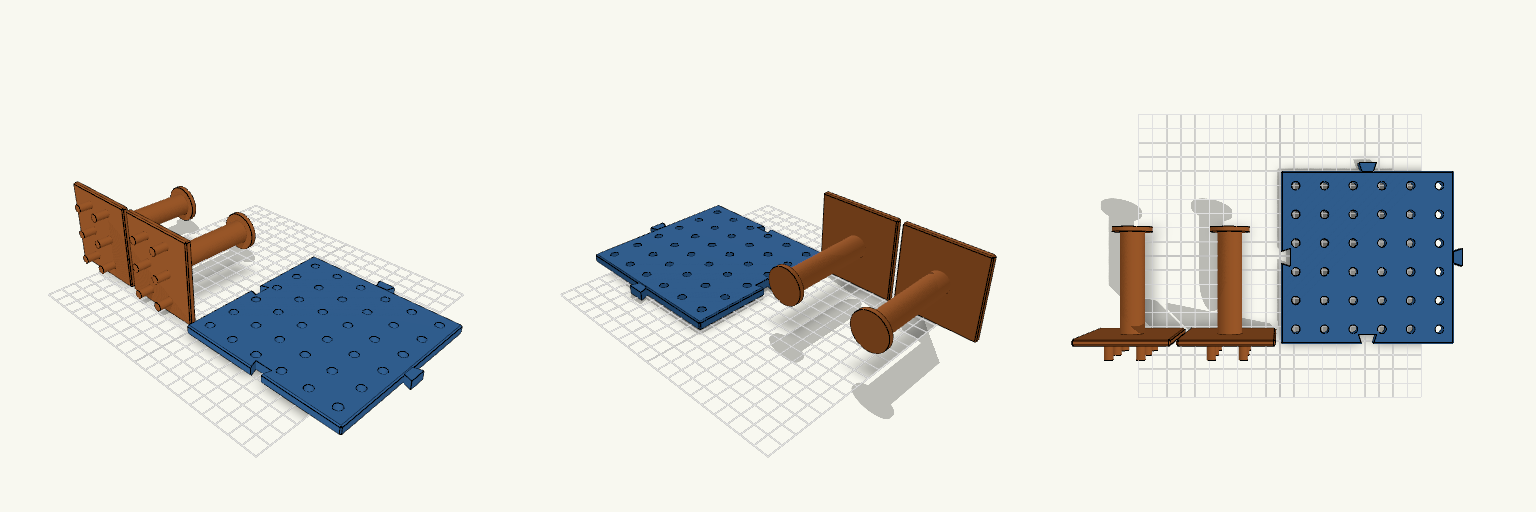
Eine modulare Lochwand aus 120 × 120 mm großen Kacheln, die sich in X- und Y-Richtung beliebig aneinanderstecken lässt: Rechts und hinten sitzen Schwalbenschwanz-Zapfen, links und vorne die passenden Nuten. Jede Kachel ist 6 mm dick und hat 6 × 6 Löcher mit 6 mm Durchmesser im 20-mm-Raster. Mit den Zapfen misst eine Kachel etwa 126 mm und passt damit auf nahezu jedes Druckbett. Dazu gehört ein Steckhalter mit Dorn, der eine Filamentrolle trägt. Auf dem Druckbett steht der Halter seitlich, links neben der Lochplatte; der Dorn zeigt nach hinten, die Stifte nach vorne. Zwischen Halter und Kachel bleiben rund 4 mm Luft, damit beim Drucken nichts verschmilzt. Der Halter hat eine 60 × 60 mm große Rückplatte mit sechs Stiften in 2 × 3 Anordnung im 20-mm-Raster; die Stifte sind 5,7 mm stark und 10 mm lang. Der Dorn sitzt mittig auf der Platte und ragt waagerecht nach hinten: 16 mm Durchmesser, 70 mm Länge, am Ende eine 26-mm-Scheibe, die die Rolle zurückhält. Übliche Rollen mit rund 50 mm Innenloch passen locker darüber. Die Rückplatte verteilt das Gewicht einer vollen Rolle auf mehrere Stifte. Kacheln und Halter werden gesteckt — die Wand wächst mit dem Bedarf, der Halter lässt sich jederzeit umsetzen. Wo ein Remix ansetzen kann Kachelmaß: Die 120 × 120 mm sind bewusst ein Vielfaches des 20-mm-Rasters — 100 mm wäre die nächste kleinere sinnvolle Stufe, 140 mm die nächste größere. Das 20-mm-Raster mit 6-mm-Löchern ist eine Wahl, keine Vorgabe; ein engeres Raster erlaubt feinere Haken. Passung der Verbinder: Das Spiel der Schwalbenschwänze liegt bei 0,25 mm. Das ist der erste Wert, den man an den eigenen Drucker anpasst — strammer für formschlüssigen Sitz, lockerer, wenn sich die Kacheln schwer fügen. Stiftfeld: Die Rückplatte ist 60 × 60 mm groß und nutzt sechs Stifte im 20-mm-Raster. Für leichtere Halter lässt sich das Feld verkleinern; für breitere Lasten kann es weiter wachsen, solange Stiftabstand und Lochraster zusammenpassen. Dorn: 16 mm Durchmesser und 70 mm Länge reichen für schmale Rollen; bei breiten Rollen mit etwa 70 mm oder mehr wird es knapp. Ein längerer Stab deckt breitere Rollen ab, schwerere brauchen eine dickere Rückplatte oder eine Stütze darunter; der Scheibendurchmesser von 26 mm lässt sich an das Innenloch der eigenen Rollen anpassen. Halterform: Derselbe Dorn lässt sich kürzen oder mit einem zweiten Dorn nebeneinander kombinieren, damit zwei Rollen auf einer Kachel Platz finden. Ausrichtung: Der Halter steht derzeit seitlich neben der Kachel, der Dorn zeigt nach hinten. Das ist eine Wahl, keine Vorgabe — die Drehung lässt sich ändern und der Halter weiter von der Kachel abrücken, ohne die Steckverbindung anzutasten. Als System gedacht: Weitere Kacheln vergrößern die Fläche, weitere Halter mit gleicher Rückplatte teilen sich die Wand — und jede Variante bleibt mit allen anderen kombinierbar, solange Raster und Stiftabstand gleich bleiben.
Staggered 5-Key Hook Extender
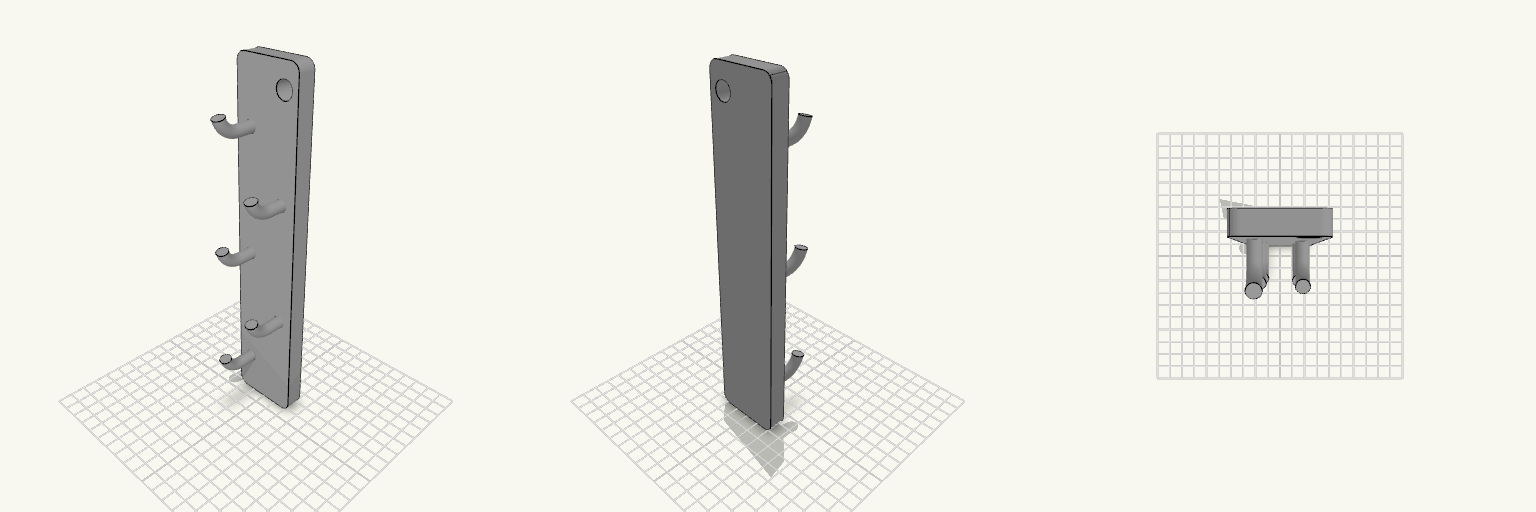
A tall back plate that hangs from a key rack and holds five keys on alternating left and right pegs, so fobs dangle without touching each other. The plate is 46.2 mm wide, 240 mm tall and 12 mm thick, with a 12 mm hang hole at the top right. Each peg is 8 mm in diameter, runs straight for 12 mm, then curves upward through 75° to keep rings seated. Remix hooks Plate thickness (12 mm): the easiest stiffness lever. Pegs are set into the plate face, so going thicker needs no other changes. Peg spacing (42 mm pitch): raise it for longer fobs, lower it to fit more pegs on a shorter plate. Bend angle (75°) and straight run (12 mm): lengthen the run for larger rings, ease the angle for a flatter peg. Hang hole (12 mm): resize to match your rack hook. Pairs with: any horizontal key rack with a post or screw head that fits the hole.
TANKER 3 Water
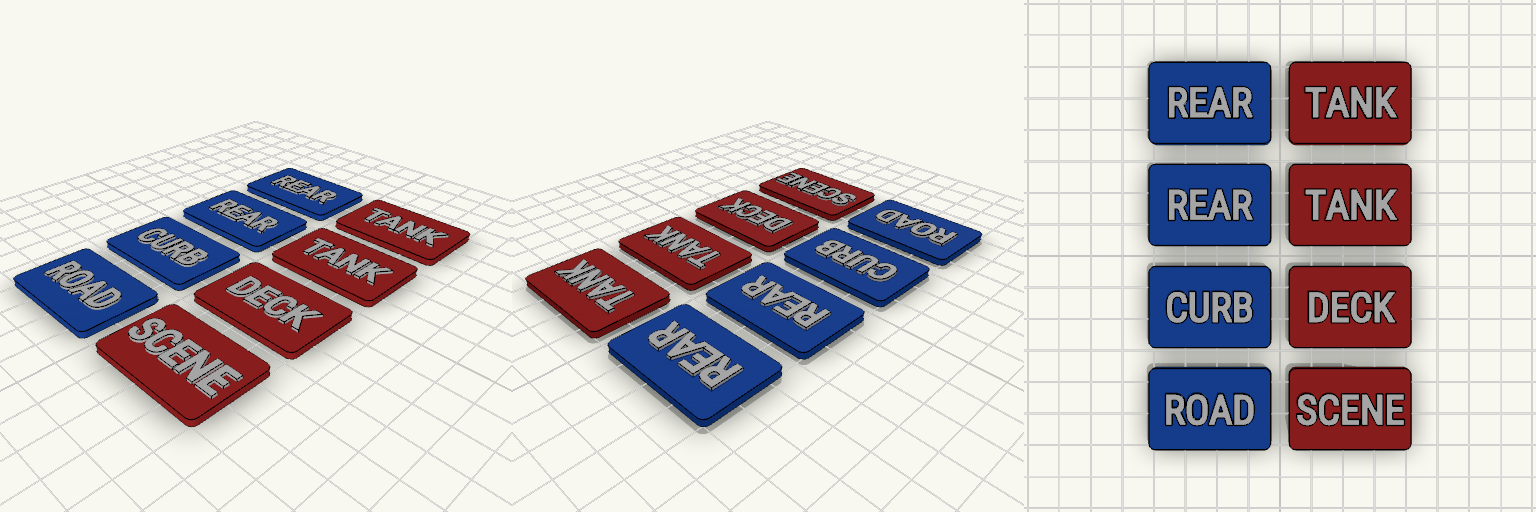
A matched set of eight small label plates with bold raised white lettering, styled like the enamel signage screwed to a garage wall, a shelf edge or the front of a storage bin. Each plate carries a single word — the four blue plates read ROAD, CURB, REAR and REAR, and the four red plates read SCENE, DECK, TANK and TANK — so a wall of bins, hooks, shelves or parking spots can be told apart at a glance. Colour does the sorting: blue for one group, red for the other, both with the same white lettering, so the two families stay distinguishable from across the room while reading as one set. The letters are thickened rather than enlarged, so the strokes carry weight without changing the plate size. The plates are plain rectangles with rounded corners and no fixing hole, leaving the full face free for the text — stick them on with double-sided tape or adhesive, or drill and screw them wherever they are needed. Dimensions Each plate: 1.5 in wide × 1 in tall (38.1 × 25.4 mm), 2 mm thick Rounded corners, no hanging hole Raised lettering: 0.8 mm proud of the face, strokes thickened for a heavier face Lettering centred horizontally and vertically on every plate Plates laid out 32 mm apart in two columns, blue set on the left, red set on the right Set contents Blue: ROAD, CURB, REAR, REAR Red: SCENE, DECK, TANK, TANK Print notes All eight plates sit flat on the bed and print without supports A single filament swap at letter height produces the two-tone face; painting the raised text works just as well The whole set prints in one go and comes off as eight separate tags The same layout takes any short word you want to swap in, as long as the plate size and the two-tone face stay the same.
4x4 Gridfinity Baseplate with Bowtie Clips
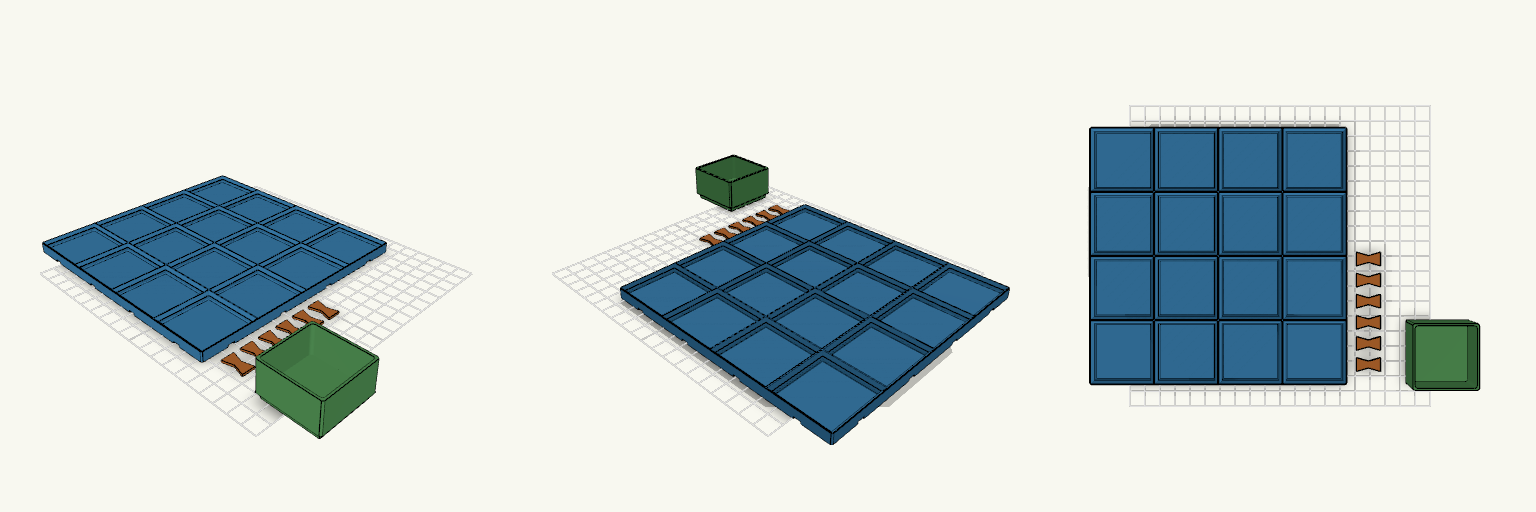
What it's for A 4x4 Gridfinity baseplate that joins to neighbouring plates without interrupting the grid. Each outer edge carries four bowtie-shaped recesses on the underside, one centred on every cell edge. Butt two plates together and press a clip into the matching recesses from below; the clip sits flush so the top surface stays seamless and the 42 mm pitch carries across the join. The set prints as separate parts: the baseplate, the bowtie clips and a 1x1 bin. The bin has a foot profile that matches the baseplate pockets but no stacking lip. Dimensions Baseplate: 168 × 168 × 6.8 mm (4 × 4 cells on the 42 mm grid) 1x1 bin: 41.5 × 41.5 × 25.7 mm Bowtie clips: 16 × 79 × 1.2 mm, sitting in 1.4 mm deep recesses with 0.2 mm clearance Print notes Six clips are included, which is enough for one seam only — print four per cell edge you want to join. Print the clips flat in PETG or a tougher filament rather than PLA; at 1.2 mm thick they are the weak point of the set. Remix ideas Scale the plate to other grid sizes, or mix a 4x4 with smaller plates along the same seams. Add more 1x1 bins, or extend the bin family with deeper sizes. Add a stacking lip to the bin for stacked storage.