Nested Condensation Coaster with Removable Basin Insert
Created today
Description
What it's for
A two-part coaster for a glass or mug on a desk. The cup rests flat on the raised platform of the removable insert — nothing is inserted into a sleeve or ringed by walls — and condensation running down the glass collects in the basin around the platform. The outer shell is a second, watertight barrier that catches anything the insert lets past, and there are no drainage holes or outlets anywhere, so the water stays put until the insert is lifted out and emptied. The two parts print separately and can be cleaned separately.
- Outer Containment Shell — one continuous watertight body, open at the top so the inside is fully accessible with the insert out. Four integrated pillars support the insert.
- Inner Insert — raised cup platform, recessed collection basin, and a groove in the platform floor for a removable silicone grip ring.
- Support pillars — four 8 mm round pillars, 90° apart on a 58 mm radius, rising from the shell floor to hold the insert 3.5 mm clear of the bottom.
- Silicone provisions — a grip-ring groove in the recess floor and four pockets underneath the shell for non-slip feet. The silicone parts themselves are not printed.
Dimensions
- Outer shell: 148 mm diameter, 22 mm tall, 2.4 mm walls, 3 mm base.
- Inner insert: 141.8 mm diameter, 13.5 mm tall, sitting 3.5 mm above the shell floor with 0.7 mm clearance per side.
- Cup platform: 95 mm diameter, top surface at 19 mm height.
- Locating recess: 80 mm diameter, 1 mm deep, in the platform top.
- Grip-ring groove: 1.5 mm deep, between 34 and 37 mm radius, in the recess floor.
- Basin: about 24 mm wide and roughly 10.5 mm deep at the wall, holding approximately 55–65 ml before it overflows into the shell.
- Foot pockets: four at 10 mm, 1 mm deep, on a 58 mm radius circle, directly below the pillars.
Print notes
- Print both parts in PETG with four or more perimeters — the shell's wall seal is what keeps the desk dry.
- The shell's foot pockets stop short of the inside floor, so the base stays closed.
- Watch first-layer elephant foot on the shell's outer base edge; it can make the part rock.
- The shell rim stands 2 mm above the insert, and the space under the insert adds further secondary containment, so overflow is caught.
- The pillars print flat-bottomed with no supports, and the open gap under the insert allows inspection and drying after use.
Remix ideas
- Add a lift tab or finger notch to the insert rim — as it stands the tight gap means a wet insert may need a thumbnail or thin tool to lift, though the open underside helps.
- Add a small locating dimple to the insert underside to stop it sliding its 0.7 mm of play.
- Widen the platform for larger mugs; cups wider than 95 mm overhang the platform and drip into the basin, which works but is less stable.
- Increase the insert height or basin depth if you want more collection capacity.
- Swap the four-pocket foot pattern for a continuous silicone band if the coaster lives on a slippery surface.
Images
More like this
Explore more in Desk & Tech →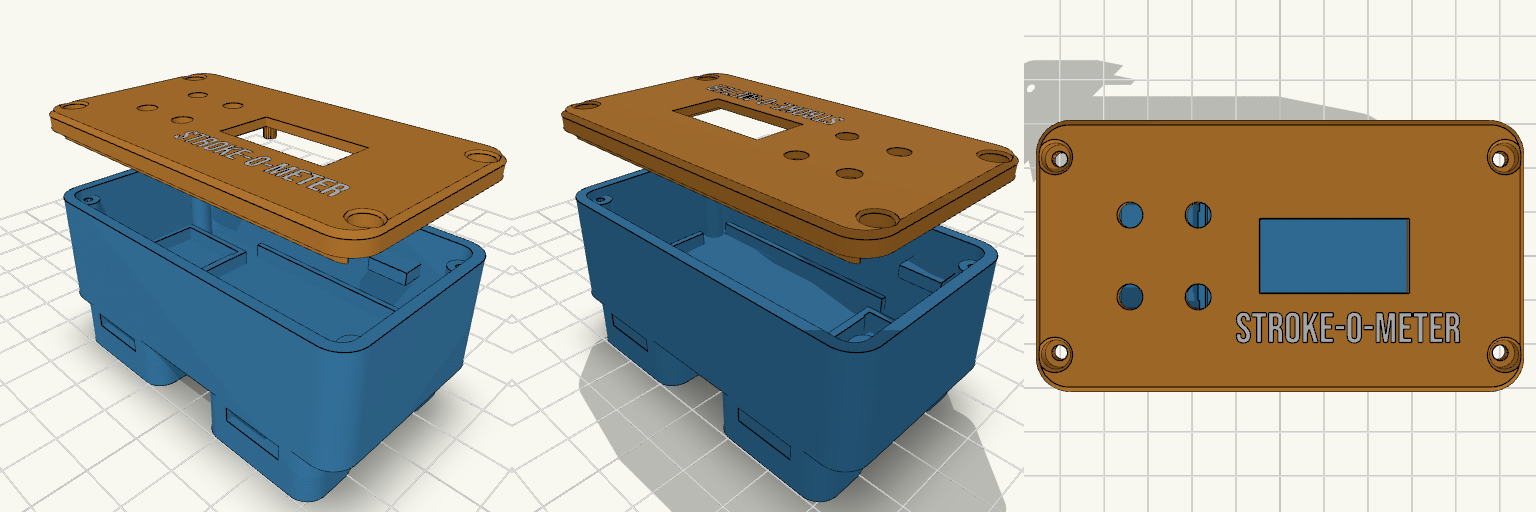
Stacked ESP32 Cue Stroke Analyzer Enclosure
What it's for A compact enclosure that straps onto a pool cue butt and houses an ESP32 30-pin devkit, a 0.96 inch OLED, an IMU, a LiPo battery and a charger board. The lid carries four 6x6 tactile switches, the display window and an inlaid "Stroke-o-Meter" label. Both end walls are closed. The lid comes off for programming, charging and service. Dimensions Body footprint: 72 x 40 mm Overall height: about 49 mm exploded, about 35 mm assembled Battery bay: 45.8 x 32.1 x 9.1 mm, for a 45 x 31.3 x 9.1 mm cell Cue cradle: 32 mm diameter curve on the underside Strap tunnels: 12 x 3 mm, one under each foot Lid fixing: four M2 cap screws in counterbored holes Remix ideas Add a small cable notch in an end wall for in-case charging. Swap the battery bay size for a different cell. Change the cradle diameter to suit another cue. Widen the strap tunnels for a wider strap.
ESP32-S3 Enclosure with Sliding Lid and Dual USB-C v 2
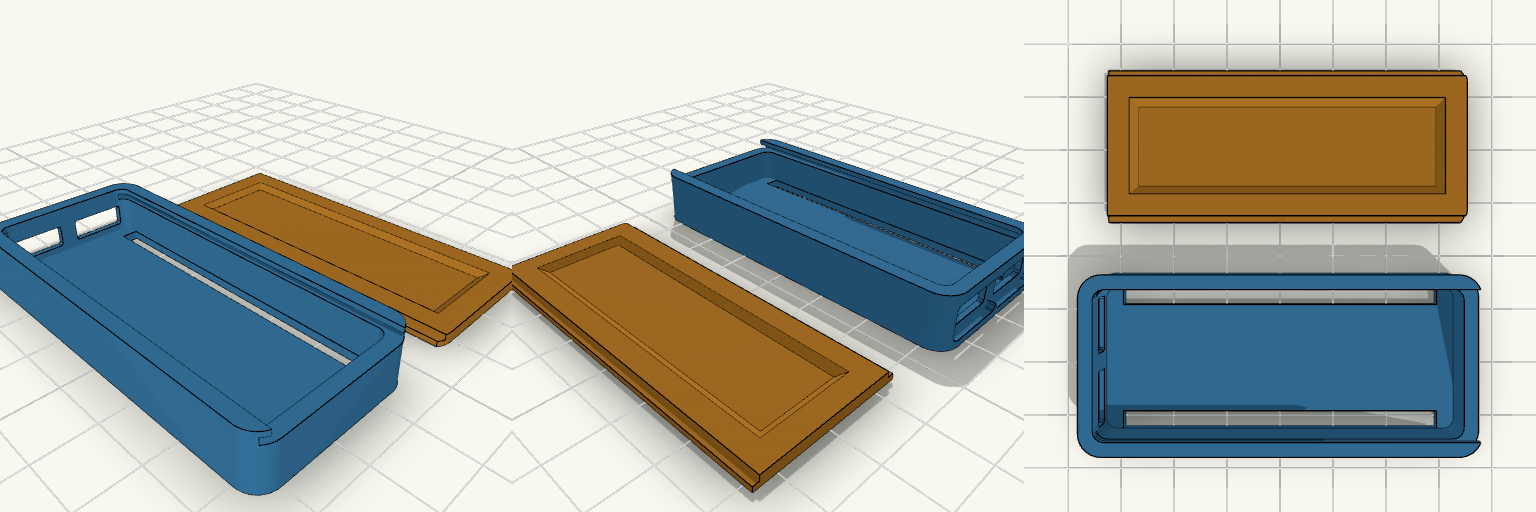
Two-piece enclosure for an ESP32-S3 dev board. The lid slides in from the open end opposite the USB wall, running in grooves cut into the two long walls, and sits flush with the top so no hardware shows. The total height is 10.25 mm, which keeps the profile low but leaves only 6.75 mm inside — enough for the bare board, not for tall headers. Body: 64.3 × 26.2 mm cavity with 0.4 mm clearance per side, 2.5 mm walls, 4 mm vertical corner radius. Lid: 2 mm thick, sliding in grooves on the long walls; recessed centre 1 mm deep with sloped sides and a 4 mm flat border. USB-C: two cutouts on the short wall, each 10.1 × 4.1 mm with rounded corners, a 3 mm strut between them, and a rounded counterbore on the outside of each. Pin rails: two 3.2 × 58 mm slots straight through the floor, 22.9 mm apart (y = ±11.43), lined up with where a DevKitC's header pins sit, so pins can be soldered or connected from below. Blank face: the button and LED area is left plain — no cantilever arms, no LED window. Print the body and lid as separate pieces. The lid sits top-up on the plate with its recess cut from the top, so it needs no supports. Nothing locks the lid in place once it is slid home, so add a small detent or a dab of tape if it needs to stay put. The USB, board and pin positions follow the usual DevKitC layout rather than a measured board, so check them against your own before committing to a long print.
Sleek Ball-Bump ESP32-S3-N16R8 Enclosure v 3
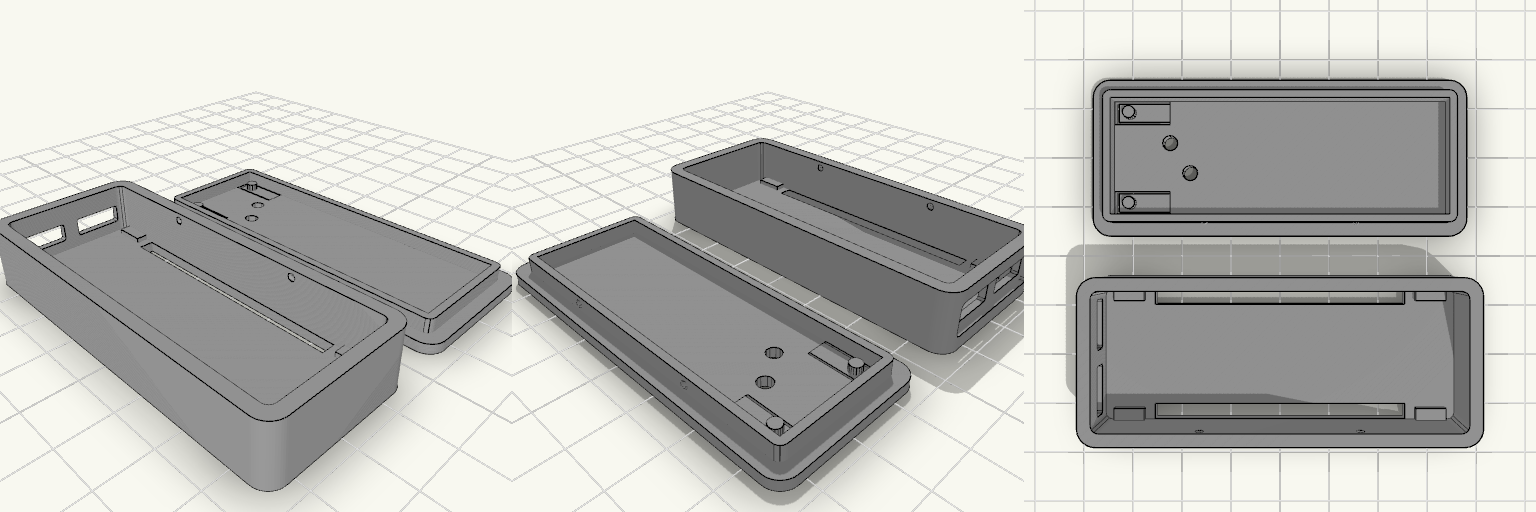
A sleek, modern shell for the ESP32-S3-N16R8 dev board, built around a snap-fit lid instead of screws or hooks. Rounded vertical corners and 2.5 mm walls give it a clean, finished look, while the lid's four ball bumps click into shallow dimples in the long walls: self-centering, no visible hardware, and no layer-line hooks to snap off. A shared counterbore around the USB-C ports lets bulky cable overmolds seat flush against the wall, so the board sits low and the cable still plugs in fully. The lid now carries two cantilever button tongues, and the body is opened underneath for pins from below. Design notes Board fit: internal cavity of 69.8 × 26.2 × 10.25 mm, with about 0.4 mm clearance per side on a 69 × 25.5 mm board. The long rails are now short pads at each end, and overall height is about 12.3 mm. USB-C access: two 9.8 × 3.8 mm cutouts with 0.5 mm rounded corners, separated by a 3 mm strut on the short wall. A single 25.6 × 7 mm counterbore, 1.2 mm deep, wraps both openings so overmolded plugs clear; the strut stays at full depth behind it to keep the board edge captive. Lid and buttons: 2 mm plate with an inner lip; four 0.8 mm ball bumps engage shallow dimples with about 0.5 mm engagement and 0.3 mm interference. Each cantilever button is a tongue cut free of the lid plate by a U-shaped slot, thinned to 0.7 mm, with a 2.4 mm nub under the free end to press the board button. The old plain button holes are gone; the two 3 mm LED holes remain. Button positions are estimated rather than measured, so check them against your board variant before printing. Bottom pin access: two 50 × 3 mm slots run through the floor under the header rows, 22.86 mm apart, so pins can pass through from the bottom. Printing: the shell and lid are separate pieces, sized for PETG. They are laid out side by side on the plate, not stacked, within about 74.8 × 70.4 × 12.3 mm.
iPhone 17 Pro Max Hülle mit Kameraausschnitt
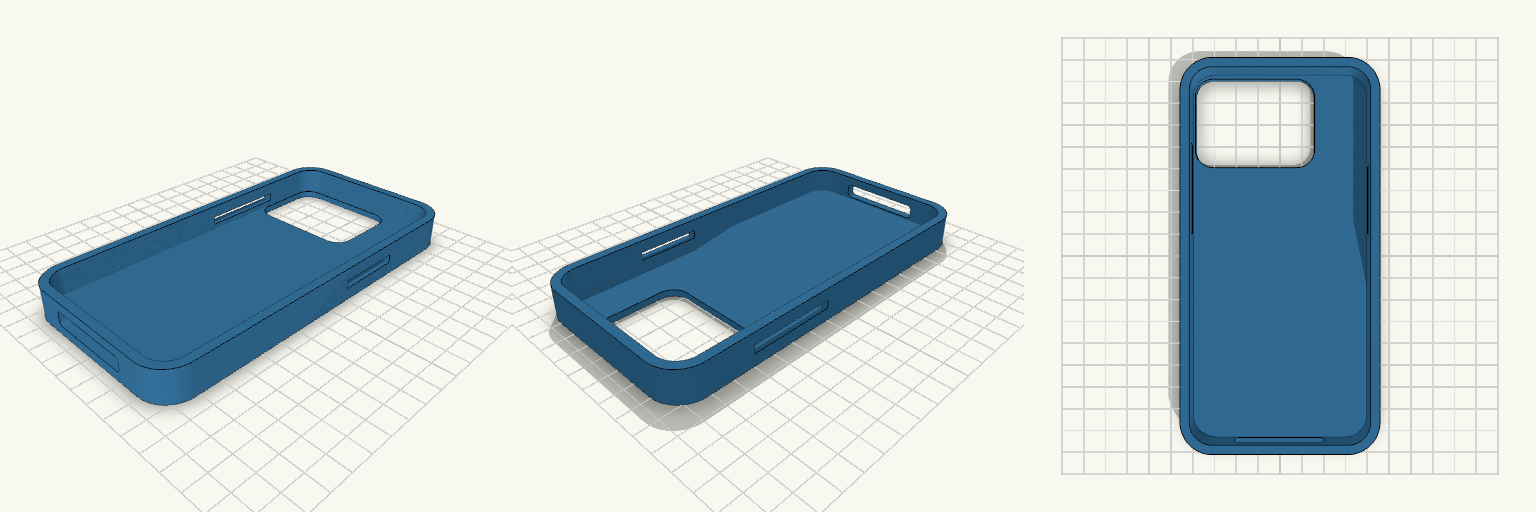
Massive Schutzhülle für das iPhone 17 Pro Max: 4 mm Wände, 3 mm Rückseite und eine 3 mm breite Frontlippe, die höher über das Display steht. Kameraausschnitt, Öffnungen für die Seitentasten und eine Öffnung unten für den Anschluss sind vorgesehen. Die Hülle wird in einem Stück gedruckt. Auf der Druckplatte misst das Teil etwa 86,6 × 172 × 15,1 mm. Auf der Rückseite ist ein eigenes Logo eingraviert: ein Doppelring mit „09“ in der Mitte, umlaufen vom Bogen-Schriftzug „BORUSSIA DORTMUND“. Die Gravur ist etwa 66 mm breit und 1 mm tief. Von hinten gesehen ist sie lesbar und sitzt unter dem Kameraausschnitt. Bei 3 mm Rückseite bleiben 2 mm Material unter der Gravur. Es ist kein offizielles Vereinswappen. Passt für iPhone 17 Pro Max (Gehäuse 163,4 × 78 × 8,75 mm; die Hülle ist mit etwas Spiel darauf ausgelegt) Vor dem Drucken prüfen Die Lage der Kamera- und Tastenausschnitte ist geschätzt und nicht an einem echten Gerät kontrolliert. Miss vor dem Druck die Positionen an deinem Gerät nach und verschiebe die Ausschnitte bei Bedarf. Durch die dickeren Wände sind die Tastenöffnungen tiefer; die Tasten lassen sich dadurch schwerer drücken. Prüfe, ob das für dich noch passt. Für den Bau ist TPU statt PLA sinnvoller, weil es Stöße besser abfedert. Passt nicht Andere iPhone-Modelle, auch nicht die früheren Pro-Max-Größen mit anderem Gehäusemaß.
Case ESP32 + LoRa com Cooler
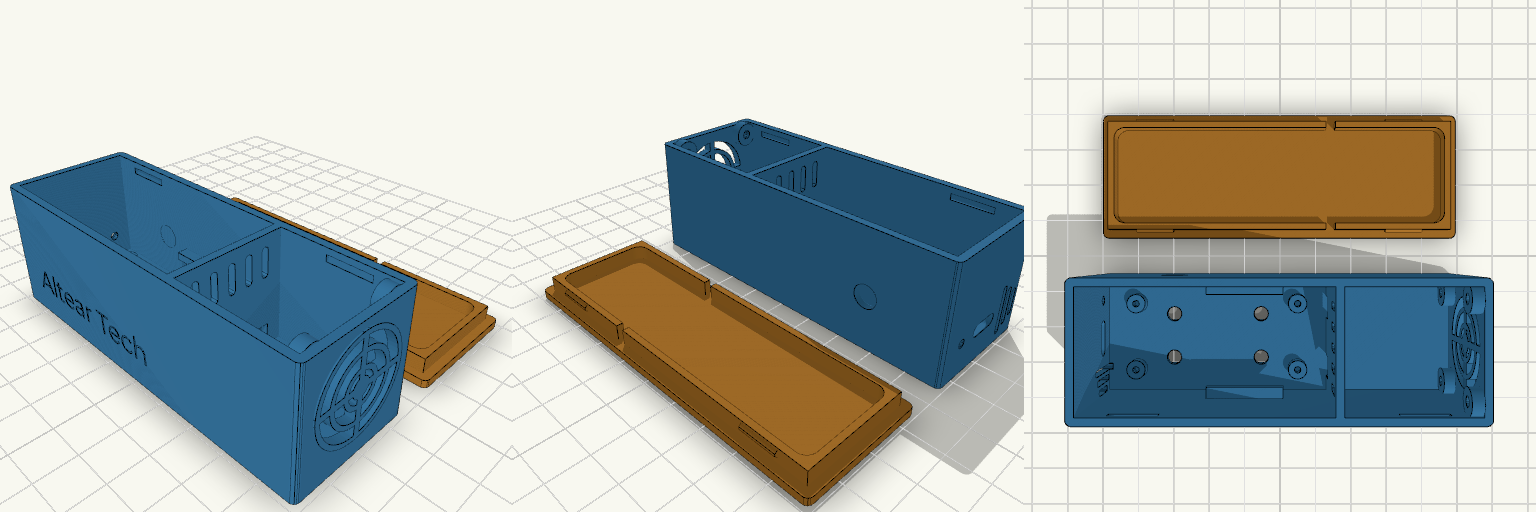
Case compacto para ESP32 e módulo LoRa SX1278, com compartimento para um cooler de 30 mm e tampa de encaixe sem parafusos. A entrada de ar do cooler fica no piso, sob uma capa em grade, e a parede +X é lisa. Ganchos para remix Entrada de ar: abertura de 25 mm no piso, sob a grade. Dá para trocar por outro desenho de grade ou reabrir fendas na parede +X. Cooler: centrado em x = 48, furação de 24 mm (furos de 2,8 mm). Ajuste se o seu for de outra medida. Apoios do ESP32: quatro pinos com furo M2, em x = ±22 e y = ±9. Confira com a sua placa. Prateleira do LoRa: trilhos de 20 mm, 3 mm de largura, 2 mm de altura. Aumente se a placa balançar. Combina com: texto na tampa ("Altear AgroGuard") e na lateral ("Altear Tech"), trocáveis por outros nomes. Dimensões externas: 98 × 34 mm, altura de 24 mm mais a tampa de 6 mm.
Samsung S24 FE Snap-In Bumper Case
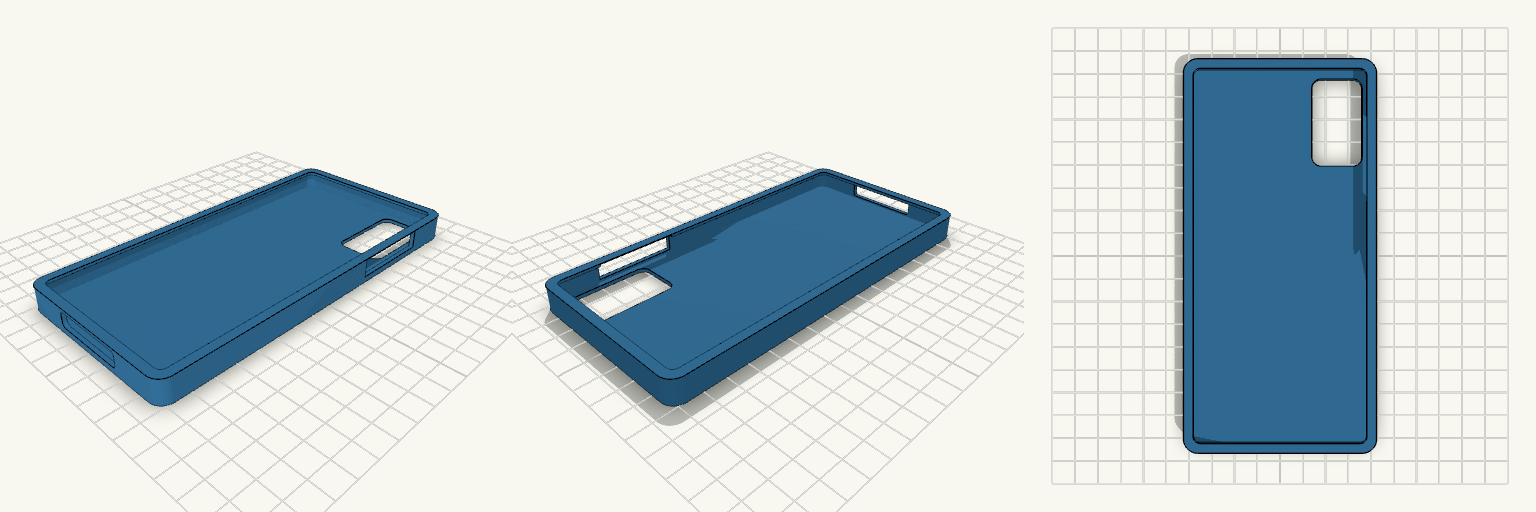
A one-piece snap-in bumper case for the Samsung S24 FE, sized from the 162.0 × 77.3 × 8.0 mm phone spec with 0.2 mm clearance. The open front leaves the screen clear, and the walls are 1.8 mm with a 1.5 mm back and a 1.2 mm lip that catches the screen edge. Camera cutout on the back Button slot along one side Bottom slot for USB-C and the speaker Prints back-down with no supports One piece, no assembly The case is rigid, so the phone presses in from one corner. PLA works, but a flexible filament such as TPU is easier on the phone and less likely to crack the lip. The camera and button positions are estimates, so check them against your phone before printing the whole case.