Professional Egg Transport Case
Created 1 months ago
Description
What it's for
A heavy-duty, miniature equipment case engineered to safely transport precisely two standard chicken eggs. It features a rugged ribbed exterior, mechanically hinged lid, cam-action latches, and a folding front handle — designed entirely around a genuine Pelican-style aesthetic. The egg recesses are integrated cleanly into the base block, spaced with a center finger groove for easy retrieval. The top lid carries a clean, framed blank plate ready for your own branding.
Dimensions
- Overall footprint: 130 mm wide by 90 mm deep
- Closed height: 55 mm
- Internal capacity: Specifically contoured for two 45 mm x 60 mm eggs (large/XL chicken eggs), leaving a generous 3.5 mm top clearance.
Print notes
- Orientation: All pieces are laid flat in their ideal printing orientations. The upper lid is flipped to print face down.
- Tolerances: Hinge mounts and pins are designed with 0.3 mm radial clearance. A well-tuned printer will allow the pins to slide right into place. The latches snap firmly over the base hooks.
- Supports: No supports required. The hinge knuckles and latch mounts feature steep bridging, but standard FDM cooling handles this easily.
- Adhesion: The cylindrical pins incorporate subtle flats on the bottom edge to ensure they don't roll off the bed mid-print.
Assembly
No hardware required. Press the 26mm pins through the rear hinges to mate the base and lid, the 20mm pins through the front latches, and the short 15mm pins through the handle mounts. Everything relies on reliable friction fits and printed mechanics.
Images
More like this
Explore more in Kitchen & Bathroom →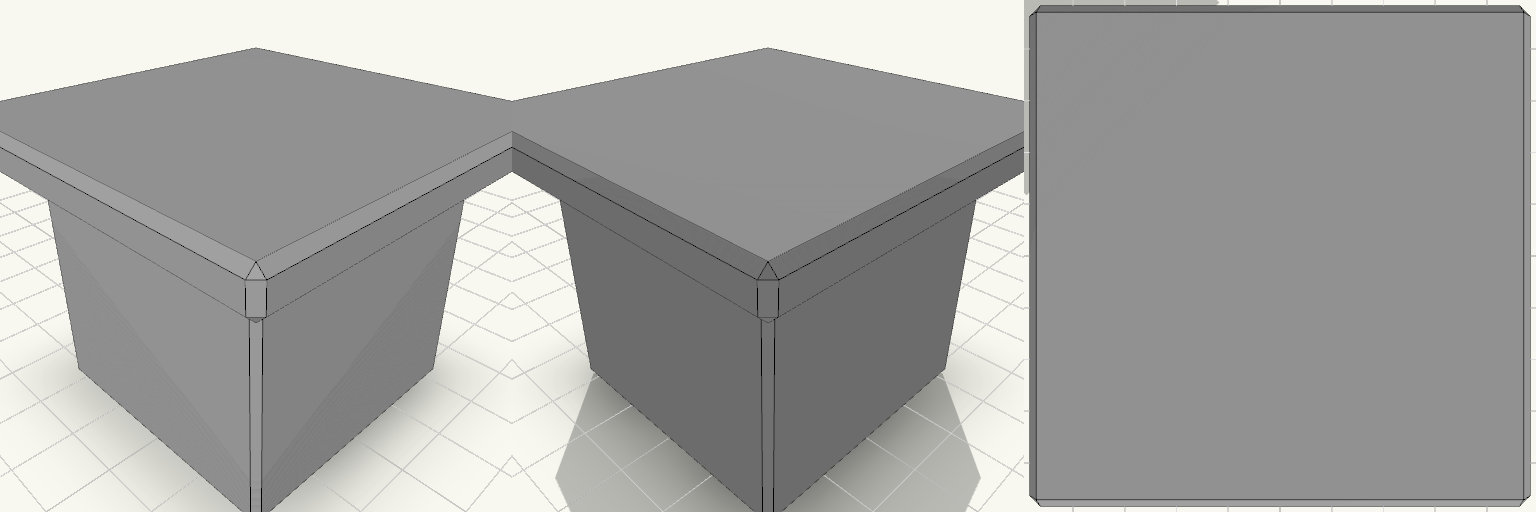
Brutalist T-Post Cap with Square Platform
A blocky sleeve that drops over a T-post and carries a flat square platform on top — a brutalist plinth silhouette in cap form, all hard edges and stacked planes. The pocket inside is T-shaped, cut generously around a typical steel fence T-post: a 38 × 7 mm flange opening and a 7 × 38 mm stem slot, leaving roughly a millimetre of play per side so it drops on without a fight. The sleeve is 40 mm deep with 3 mm walls and a 4 mm roof, and the whole cap stands 46 mm tall over a 60 × 60 × 6 mm platform. Design notes T-shaped pocket for a T-post — flange opening 38 × 7 mm, stem slot 7 × 38 mm. Pocket sized with a little slack per side; the 7 mm slot width is the fit-critical dimension on real posts. 40 mm deep sleeve, 3 mm walls, 4 mm roof. 60 × 60 × 6 mm square platform sits on top as one solid piece with the sleeve. Overall footprint on the print plate: 60 × 60 mm, 46 mm tall. Prints as a single part; no assembly and no fasteners. Good to know The pocket is shaped from a typical steel fence T-post rather than a measured one — check your post's flange width, stem length and metal thickness before committing to a long print. Platform size is independent of the pocket, so it can grow or thicken without touching the post fit. Tightening or loosening the pocket is a small change if the cap ends up sloppy or stubborn on the post. The sleeve's outside was widened to 44 mm to keep the walls at a full 3 mm around the bigger pocket, so the cap stays chunky rather than thin-shouldered.
Modern Egg Cup With Shell Dish
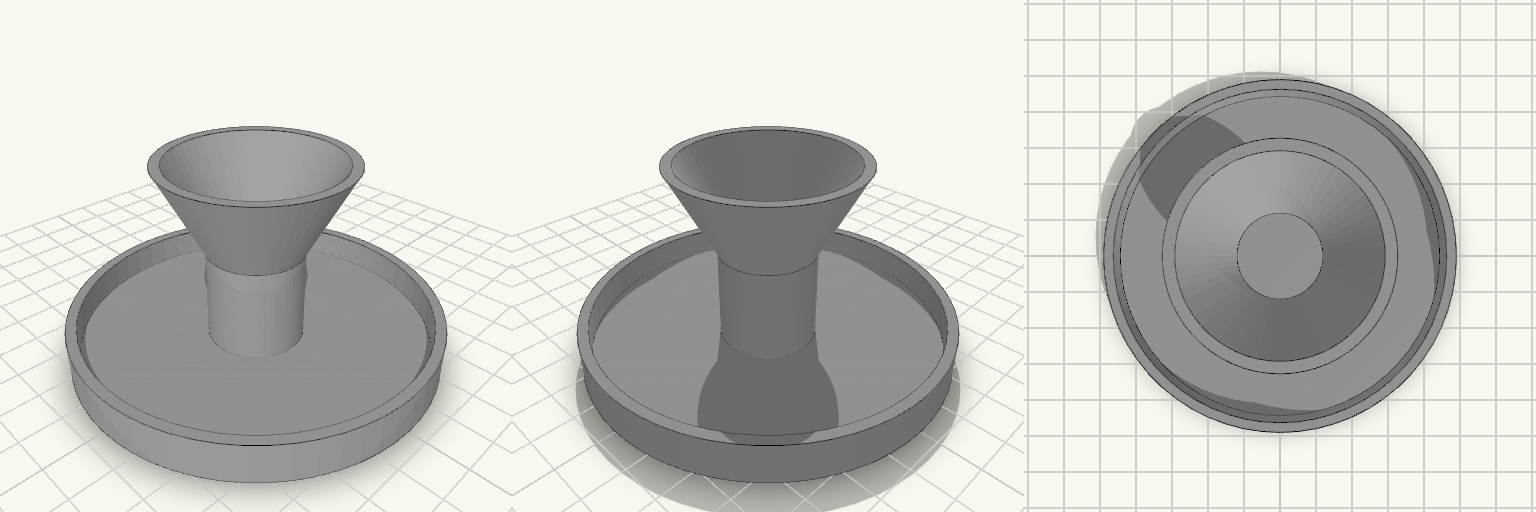
A one-piece egg cup for soft-boiled eggs. The cup has a 42 mm opening that tapers inward, so a standard chicken egg (about 45 mm at its widest) sits snugly at the rim. It stands on a short stem inside a wide 92 mm dish with a 10 mm lip, which catches the shell top when you crack it off. Remix hooks Opening diameter (42 mm): Make it 40 mm for small or bantam eggs, or 44 mm for a looser fit with large eggs. Keep it a few mm under the egg's widest point so the egg sits on the rim instead of dropping in. Cup height and taper: The cup is 48 mm tall overall, narrowing to a 20 mm seat. A shorter cup shows more of the egg. A steeper taper holds it more upright. Dish size (92 mm wide, 10 mm lip): Widen it or raise the lip to catch more shell. Shrink it for a tighter footprint. Stem (about 12 mm radius): Thicken it for more stability, or lengthen it to lift the cup higher above the dish. Pairs with A matching spoon rest, or a second cup in a different colour for a set. A flat lid or cap over the opening to turn the dish into a small storage cup. A set of four on a shared tray. Dimensions have not been test-printed. The dish floor is 3 mm thick, which is a good first value to check before changing anything else.
Sentinel Cylinder Candy Dispenser
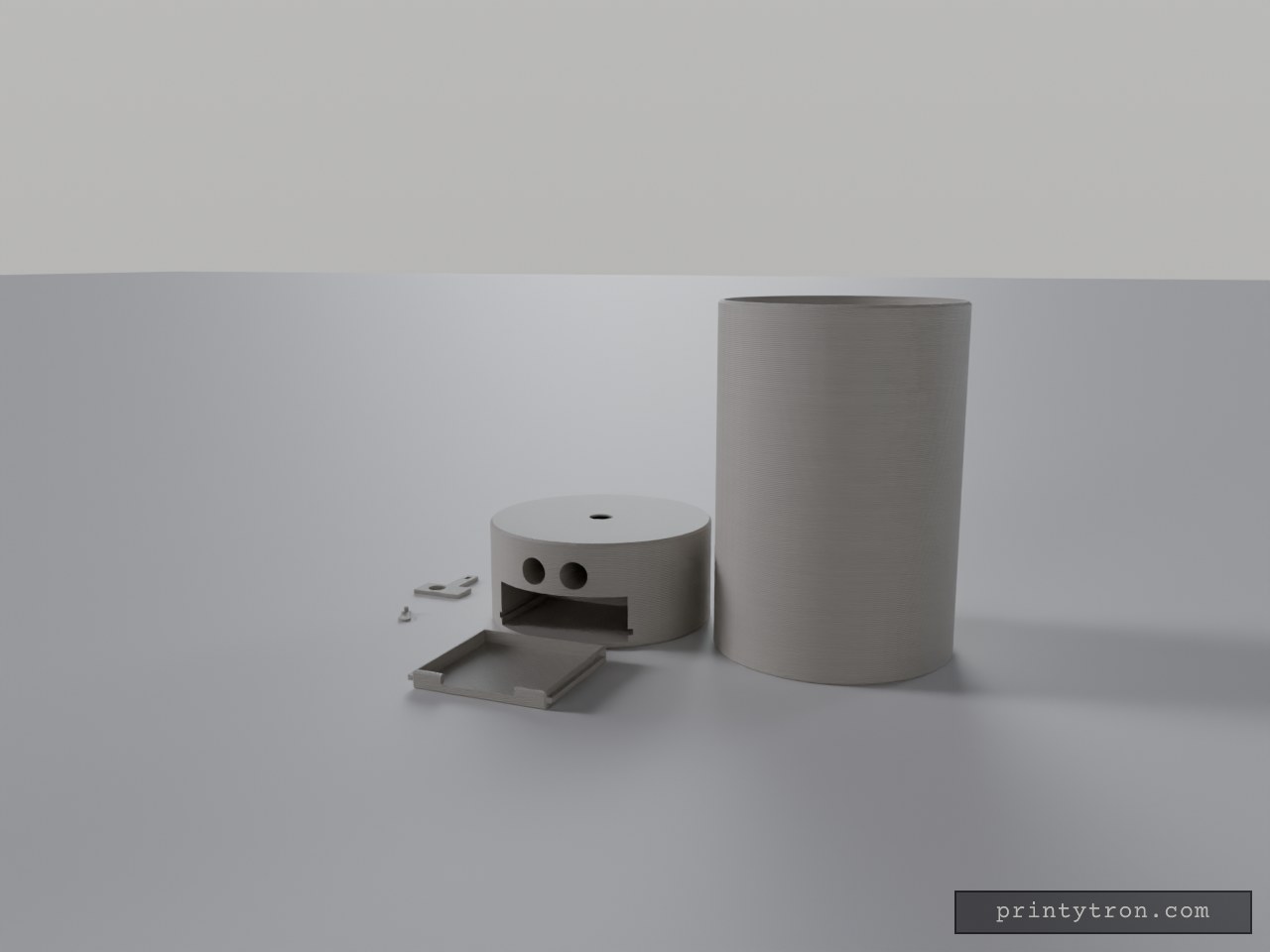
A candy dispenser with a watchful streak: the body stands as one straight 105 mm cylinder from foot to rim, and two eye holes on the front give it the look of a sentinel standing guard over the opening below. Those eyes are through-holes opening into a pocket for an ultrasonic sensor, so a wave of the hand can trip the servo below the gate slot and slide the gate open, dropping candy into the hand opening below. That opening is a genuine hole cut clean through the front wall, about 63 mm wide and 21 mm tall, sized for an average hand rather than a large one. A retractable catch tray rides on side rails on its floor, just under the outlet, with a low notch at the front so you can scoop the candy out with your fingers. A cone at the floor of the candy cylinder funnels the sweets down to the outlet, and the whole thing stands 200 mm tall — a tall column that holds a serious load of candy while keeping a modest footprint on the counter. All five pieces are laid out separately on the plate, each oriented for printing without supports. The candy cylinder is silk white, the base pink, the catch tray light blue, and the gate slider and servo horn white. The printed parts Base Housing — a round 105 mm pink body, 48 mm tall. The hand opening sits at the front bottom, open through the wall. The two sensor eye holes sit just above it, also cut clean through, so the sensor has a clear line of sight out the front. The servo bay is sized for an SG90: the servo slides in from the back wall, shaft up, with its mounting ears resting in a slot cut into the housing. A round recess above the body lets the shaft boss sit so the horn runs flush under the gate. The wider body leaves room to open the sensor pocket to full size. Candy Cylinder — a 105 mm open cylinder, 152 mm tall, in silk white, with roughly 3 mm walls, flush with the base so the body reads as one uninterrupted column. A wide, shallow cone at its floor feeds the outlet; everything above it is candy storage. Gate Slider — a flat 26.3 × 33.8 × 2.3 mm white plate that slides sideways in a slot across the outlet, just under the candy cylinder floor. A solid bar covers the outlet when closed; a 12 mm hole lines up when open. Its tail has a slot for the servo horn pin, and about 60° of servo sweep moves the gate roughly 13.6 mm — enough to fully open or close the outlet. Servo Horn — a 10.1 × 13.3 × 3.2 mm white horn with a pin that rides in the gate’s tail slot. The servo below the gate slot turns it to shift the gate. Catch Tray — a 64.5 × 57 × 7.5 mm light-blue tray that slides into the hand opening on two side ribs set in matching grooves, and sits directly under the outlet. Its back and side walls are about 1.5 mm thick, the front wall carries a low scoop notch, and the front edge stands about 1.5 mm proud of the housing as a pull tab. The rails are 3 mm wide with about 0.5 mm clearance in the grooves. There is no end stop, so the tray pulls out completely; a small snap bump would add a stopping point. It prints flat and needs no supports. Before you print The servo pocket matches an SG90: about 12.6 mm wide and 23 mm tall, with a mounting-ear slot. The sensor pocket and eye holes are undersized for an HC-SR04. Open those up while keeping the outside dimensions, or plan on a smaller sensor. The wall between the servo bay and the hand opening is thin, about 0.6 mm at final scale. Print the base with extra perimeters. The 152 mm cylinder is a tall, thin-walled tube — print it upright as laid out, and print it slowly. Check that it fits your printer’s height; if not, split it into two stacking rings. The gate slot has only about 1.4 mm of material above it before the cylinder floor, and the wall between the hand opening and the sensor pocket is thin. Print the base with extra top layers and extra perimeters for strength. Keep the gate plate flat on the bed so it slides cleanly through its slot, and keep the tray flat so its side rails and walls stay square. The base and candy cylinder have no locating lip, so glue or tape them together. Test-fit a real SG90, ultrasonic sensor and tray before final assembly. Wire the sensor and servo to the same controller. When the sensor sees a hand, the controller turns the servo to open the gate, waits, then turns it back to close. Remix hooks — cap the 105 mm cylinder with a lid, open the outlet up for faster dispensing, open the sensor pocket to HC-SR04 size now that the round base has the room, widen the hand opening, deepen the catch tray, add a small snap bump to give the tray a stopping point, or add a shallow funnel lip around the outlet for easier loading.
Flocon — Plateau Apéritif Bonhomme de Neige
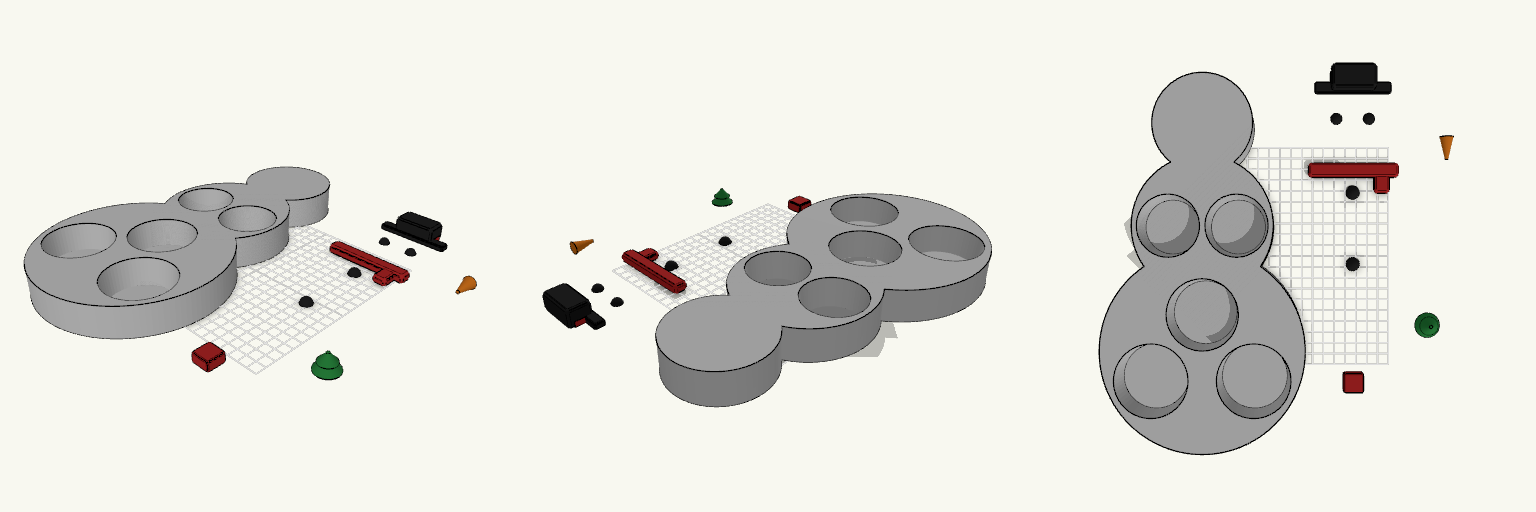
Flocon est un plateau apéritif de Noël en forme de bonhomme de neige à trois boules, posé à plat pour rester stable sur la table. Cinq compartiments creux à fond plat sont intégrés dans les deux boules basses pour les chips, cacahuètes, bonbons et biscuits. Les décors — chapeau, écharpe, boutons, yeux, nez en carotte, sapins et cadeau — sont sculptés en véritable relief, mais fournis en pièces séparées posées à plat à côté du bonhomme : les compartiments restent dégagés et chaque couleur peut être exportée séparément. Dimensions Bonhomme de neige : environ 180 × 334 mm, pour 30 mm d’épaisseur ; prévoir de la place à côté pour les décors. Compartiments : cinq à fond plat — deux d’environ 66 mm et un d’environ 64 mm dans la grosse boule du bas ; deux d’environ 56 mm dans la boule du ventre. Parois : environ 4 à 5 mm au bord des compartiments. Décors séparés : écharpe et cadeau, chapeau-boutons-yeux, nez carotte et sapins, tous posés à plat. Pièces et couleurs Blanc : le bonhomme de neige. Rouge : l’écharpe, le cadeau et le bandeau du chapeau. Noir : le chapeau, les boutons et les yeux. Orange : le nez en carotte. Vert : les sapins. Impression Décors imprimés à plat à côté du bonhomme, chacun avec sa base sur le plateau : pas de supports à prévoir. Le nez est couché sur le côté ; surveiller son adhésion au plateau au premier essai. Fonds de compartiments plats et parois évasées, faciles à nettoyer. Pièces séparées par couleur, à exporter couleur par couleur pour conserver le rendu multicolore.
Funnel 6 to 2.5 Inch
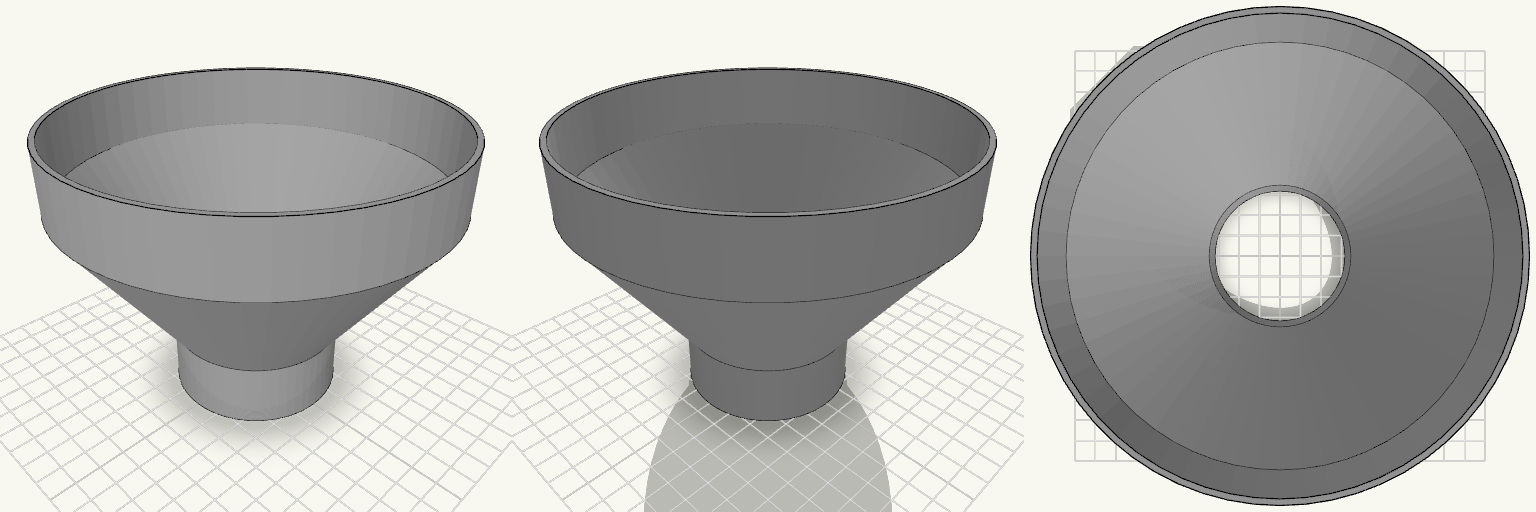
A one-piece funnel with a 6 in (152.4 mm) inner diameter at the wide end, tapering to a 2.5 in (63.5 mm) inner diameter spout. Each end has a 1 in (25.4 mm) straight wall. Remix hooks Taper length: 60 mm cone section. Lengthen for a gentler slope, shorten for a squat funnel. Wall thickness: 2 mm. Raise to 3 mm for rigidity with heavy contents. Spout diameter: 63.5 mm inner. Change it to match a specific container neck. Pairs with: a mesh strainer disc sitting in the 1 in top collar, or a rubber gasket on the spout. Variants: add a rim lip or hanging tab.
Stackable 4-Pop Ice Lolly Mold
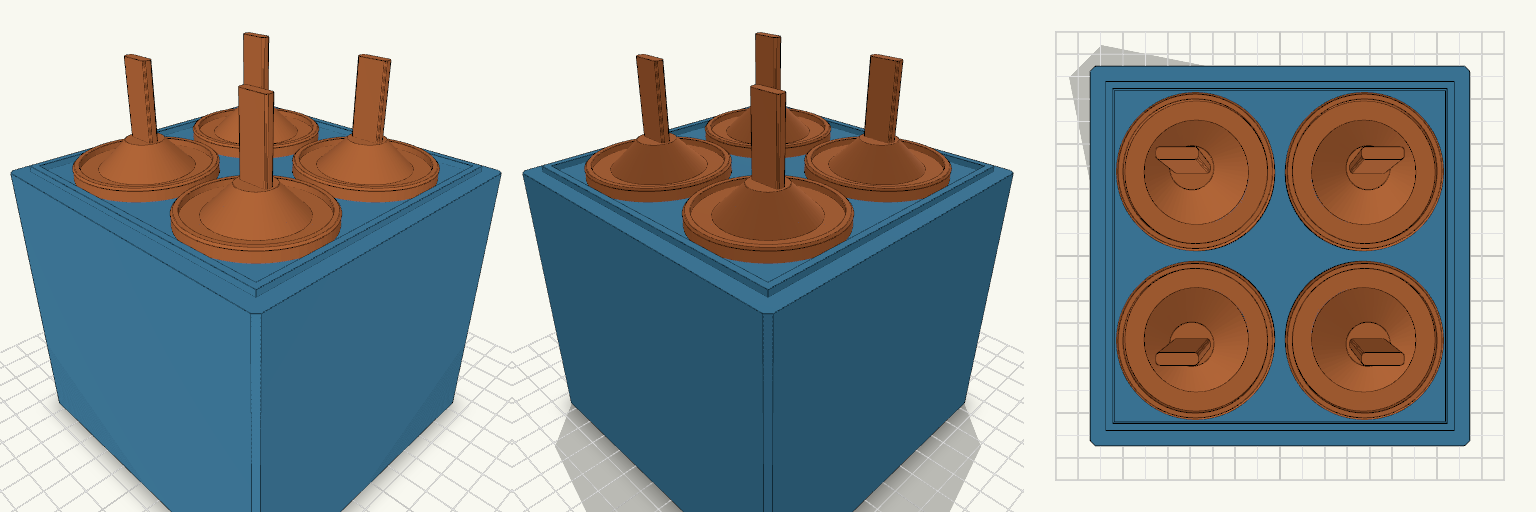
A 2x2 ice lolly mold that makes four pops at once, with a separate stick for each cavity. Each stick flares into a 45 mm round catch disc, so melting juice lands on the disc instead of running down a child's arm and onto the floor. What it's for Making four ice lollies per fill, with a drip guard built into every stick. Summer use with kids, where sticky hands and floors are the main problem. Stacking several molds in a freezer. A lip on top fits a groove underneath. Dimensions Mold body: 110 x 110 mm footprint, 96 mm tall, plus a 2 mm stacking lip on top. Cavities: 90 mm deep, 30 mm across at the mouth, tapering to a rounded tip with an 8 mm radius. Cavity spacing: 48 mm centre to centre in a 2x2 grid. Sticks: 10 mm wide and 3 mm thick, with a 45 mm disc and a raised rim (about 4 mm tall). Disc: dished, with a 41 mm inner recess to hold drips. Print notes Print the mold body upright, with the cavity openings facing up. Print each stick disc-down so the disc lies flat on the bed. Use food-safe filament and a smooth finish if the mold will touch food. Wash it thoroughly before use. Remix ideas Change the tip radius for a blunter or sharper pop. Make the disc larger for extra-messy flavours. Add a name or initial on each disc to tell kids' pops apart. Change the cavity count to a 1x4 or 3x3 layout.