100mm Square Gutter S-Bend Section
Created today
Description
A short section of square (half-octagon) 114 mm gutter with an S-bend, for when the gutter has to sit 30 mm closer to the wall it's fixed to. A straight run would leave the gap, and this section closes it.
Key numbers
- Overall length: 100 mm
- Width: 114 mm, depth: 57 mm
- Wall thickness: 2.4 mm
- Offset toward the wall (+X side): 30 mm
- Open channel, hollow from end to end
Printing
- Print with the open side up; no supports needed for the channel.
- The bend runs the full 100 mm, so there is no straight run at either end.
Photos
Technical views
More like this
Explore more in Home & Fixtures →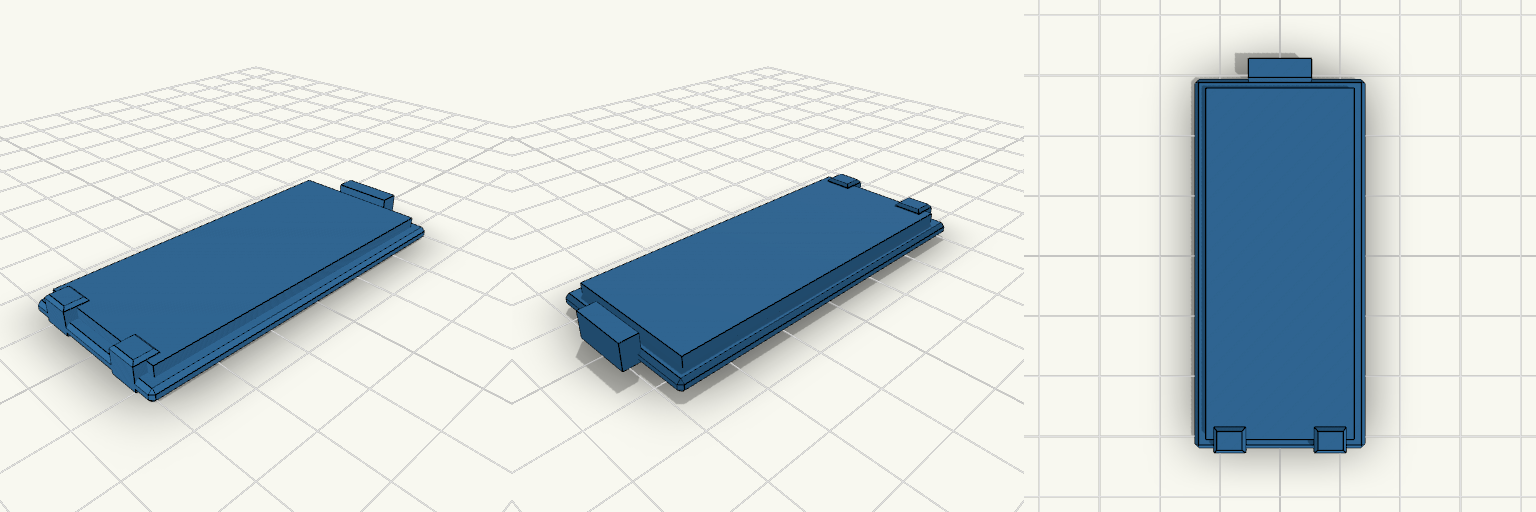
Bug Zapper Battery Cover 27.65 x 60 mm
Sliding battery compartment cover plate for a bug zapper, 27.65 x 60 mm. A locating lip sits in the compartment opening, a latch tab sits at one end, and two low retention tabs at the opposite end keep the cover from falling out. Plate: 27.65 x 60 x 2 mm, chamfered edges Lip: 23.65 x 56 mm, 3.8 mm total height Retention tabs: two, 5 mm wide, flush with lip height, at X = ±8 mm Latch tab: 10 mm wide at the +Y end Grip grooves on the outer face Dimensions are estimates; verify against the original opening
Four-Piece Baseboard Register Hood and Duct Kit
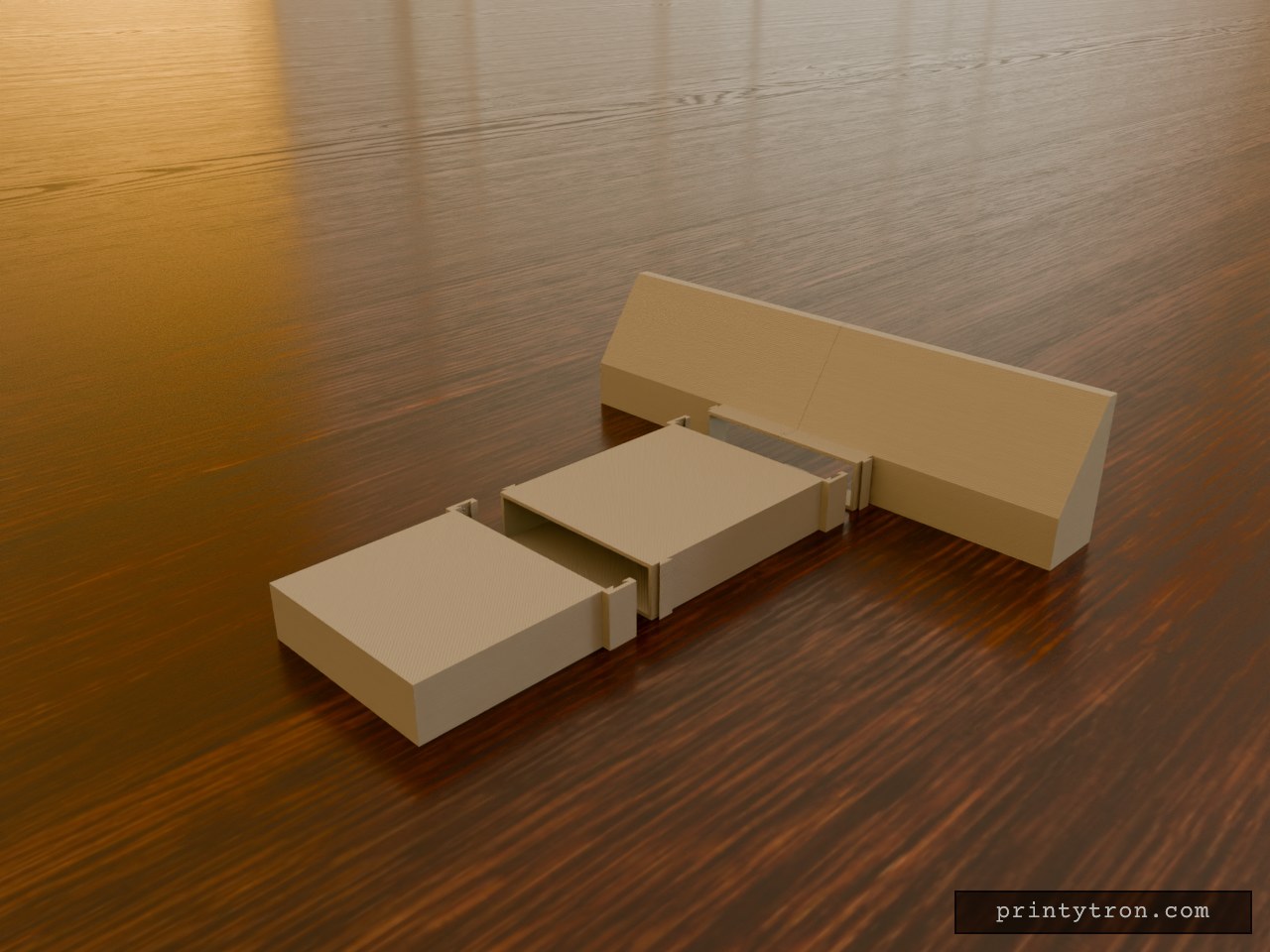
This is a four-part replacement hood and duct kit for a baseboard HVAC register: two hood halves, a straight extension tunnel, and a 90-degree side-turn end cap. When the hood halves are joined, the hood measures 450 mm wide along the wall, 80 mm deep, and 115 mm tall. The rear and bottom are open to take air from the baseboard void; the sloped front funnels that air into a centered horizontal nozzle at the lower front edge. The nozzle is 150 mm wide, 40 mm tall, and projects 20 mm forward. All four parts print separately and slide together with dovetail joints. The extension and cap sit on the plate beside the hood halves, not pre-assembled. The sliding joints use 0.3 mm clearance per side, and the chunk and cap sockets have small friction bumps. For an air-tight run, add foam gasket tape or silicone along the socket edges; test-print one joint before reducing clearance below 0.3 mm. Hood Specifications Printed hood halves: HoodLeft and HoodRight, joined by a central vertical sliding dovetail with 0.3 mm clearance. They slide together vertically along the seam. Shell: nominal 3 mm walls, with a 24 mm wide band across the center of the sloped roof and front wall thickened to 8 mm so the dovetail cuts through solid material. Joined hood footprint: 450 × 80 × 115 mm. Rear wall side and bottom floor are open. Outlet nozzle: 150 × 40 mm, projecting 20 mm forward. Nozzle side tracks: male dovetail on each outer side, 6 mm wide at the root and 12 mm at the tip, 3 mm deep, with 45° flanks. The wider printed hood half measures about 228 mm across, so check print-bed width. Extension Chunk Extension_Chunk is a straight hollow tunnel, 150 × 40 mm outside and 200 mm long, with 3 mm walls. Inlet socket: the first 20 mm has no top or bottom plate so it drops down over the nozzle; its side walls carry dovetail slots held 0.3 mm off the nozzle tracks. Small friction bumps sit at the top and bottom, two per side, to resist lifting off; they add friction rather than a positive click or seal. Outlet tracks: the same male dovetail as the hood nozzle, set 10 mm back from the end so the next chunk's socket fits over them. The socket end measures about 162.6 mm outside to house those slots. The tunnel has a bottom floor; it keeps the channel stiff and the sliding joints aligned over uneven flooring. Thinning that floor to 2 mm saves plastic; removing it will leak along the bottom. Chain as many chunks as the run needs; each one slides on vertically and can be swapped or added without tools. The chunk prints as a separate part alongside the hood halves, not pre-assembled. Side Turn Cap SideTurnCap is a 90-degree flat elbow end cap, nominal 150 mm wide, 40 mm tall, and 160 mm long, with 3 mm walls. Inlet: the same 20 mm dovetail socket as the chunk, open top and bottom, sliding vertically onto the chunk's outlet tracks with 0.3 mm clearance. Small friction bumps sit at the top and bottom, two per side, to resist lifting off; they add friction rather than a positive click or seal. Front end: closed off completely. Vent: one entire side wall is open as the exhaust; the top and bottom plates stay intact. Vanes: three internal quarter-circle turning vanes, 2 mm thick, with radii of 36, 72, and 108 mm, running the full interior height to turn airflow 90° out the side opening. The inlet gaps are an even 36 mm, including the gap to the far wall. Flip: the top and bottom are identical and symmetrical, so turning the cap upside down directs air out the other side. The socket end measures about 162.6 mm across; the cap prints as a separate part beyond the chunk on the plate.
Swivel Quran Stand
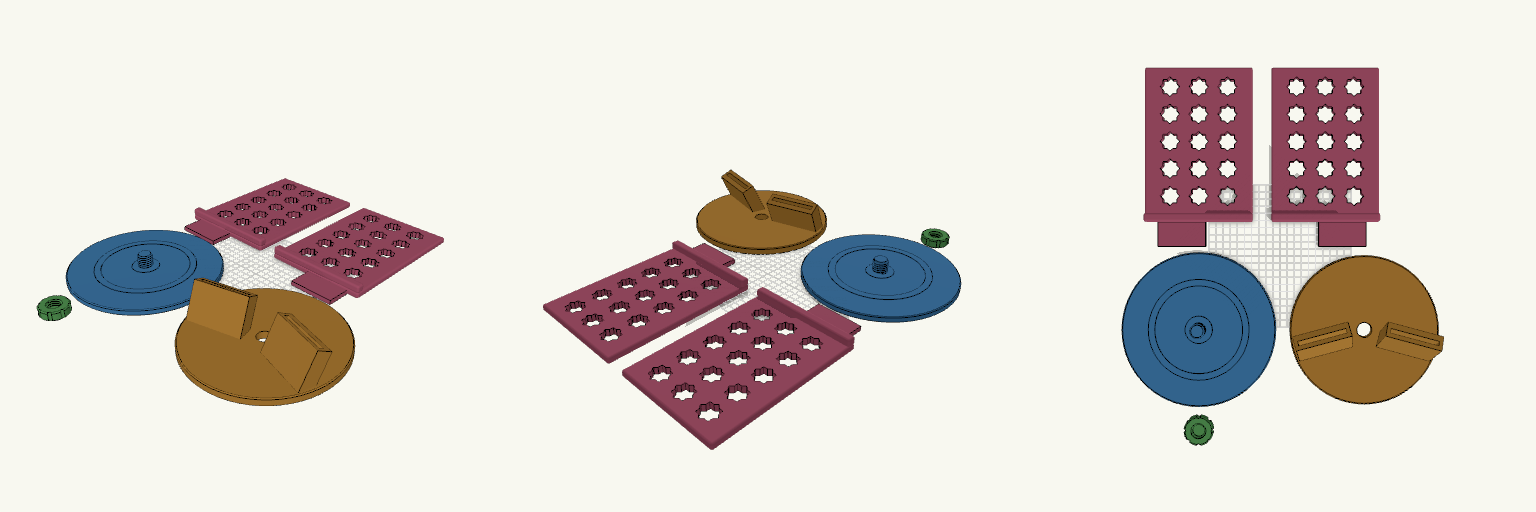
A rehal-style book stand with a turntable base and two backward-leaning panels, pierced with eight-pointed khatam stars. The stars cut filament use while leaving a solid perimeter frame. A narrow gap between the panels takes the book's spine, and a rounded lip along the bottom edge holds the pages. Base: 214 mm disc with a coarse threaded pivot post and low bearing rings. Swivel carriage: spins 360° on the post. Two angled slot blocks are printed into it, with no supports needed. Retaining cap: screws onto the post to lock the carriage on, no metal or glue. Panels: two mirrored panels, 150 × 215 mm, with a flat tongue that slides into each carriage slot. Designed around a 170 × 240 mm book of about 1.5 kg, on a 220 mm bed with a 0.4 mm nozzle. Panels print flat on their backs. Flip the cap so its top is on the bed.
Finger Trunking with Snap-On Lid
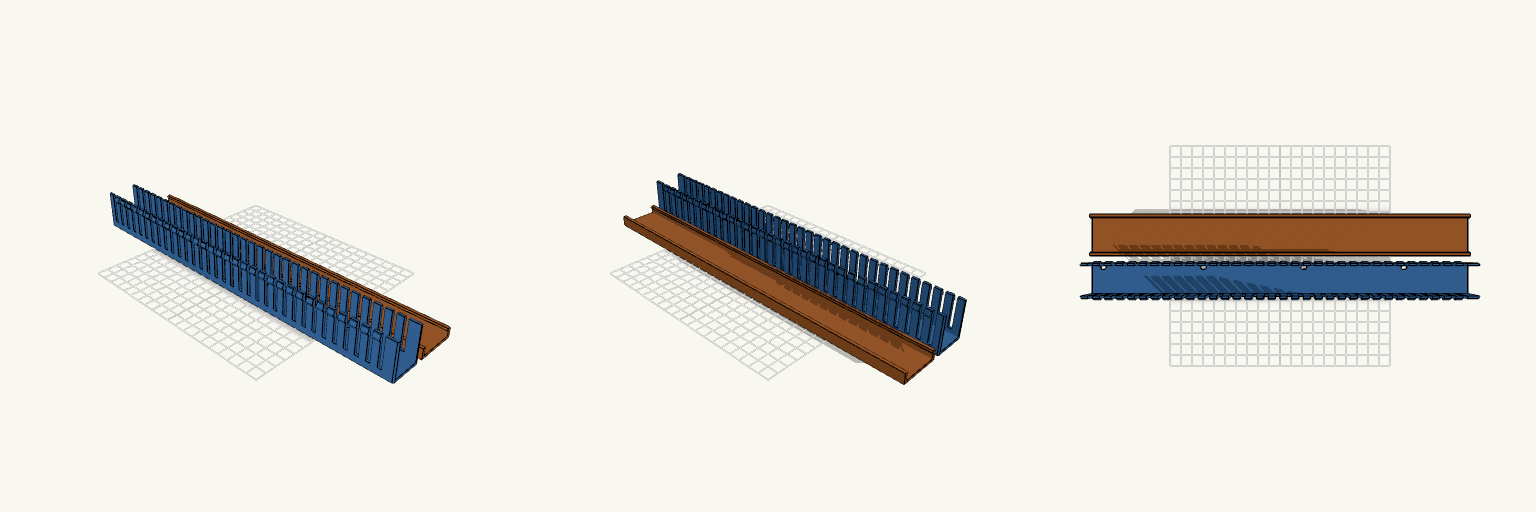
Finger trunking that blocks access to your mounting holes is a problem. This one has floor slots cut where the screws and the access hole need to be, plus a snap-on lid. The walls are free-standing fingers with barbs at the tips. The lid's inward lip clips under the barbs. Size: 340 × 30 × 35 mm, with 2 mm walls and a 2 mm floor. Fingers: 4 mm gaps on a 10 mm pitch. M3 slots: Four slots, 3.4 mm wide and 5.4 mm long. They sit at 10, 100.75, 191.5 and 282.25 mm from the left end, 90.75 mm apart. Access hole: 7 mm diameter, 201.5 mm from the left end. Slot line: All slots sit 10.786 mm toward +Y from the centreline. Printing: The trunking is longer than most print beds. Print it diagonally or split it. The lid lip is a small overhang when printed flat.
Anglewright — 90° L Profile
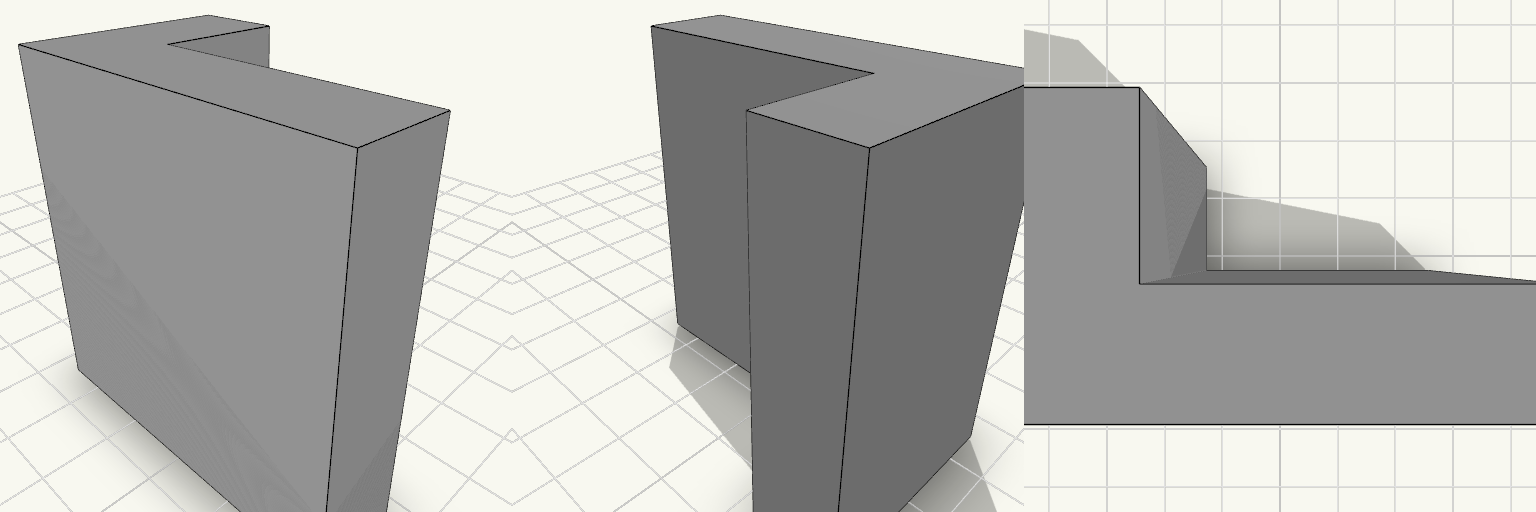
Anglewright is a clean 90° L profile with unequal legs: 2 in along one axis and 1.2 in along the other, standing 2 in tall. Both legs are 0.5 in thick, giving a simple right-angle section for corner bracing, spacing, or building up a frame. The form is a single continuous L, so the shape itself carries the function. Dimensions Overall height: 2 in (50.8 mm) Leg lengths: 2 in × 1.2 in (50.8 mm × 30.5 mm) Leg thickness: 0.5 in Corner angle: 90° Print notes At 2 in tall the profile sits comfortably within a typical print bed, so it can be printed standing up on its end with no special base. Lying on its side also works and keeps the flat L section stable on the plate. No supports are needed either way; the 0.5 in legs give plenty of contact area. Features Single-piece right-angle profile with no assembly Unequal legs for mixing offsets in two directions Small enough to print several at once for a set of matched braces
Cactus Pot With Drainage Hole
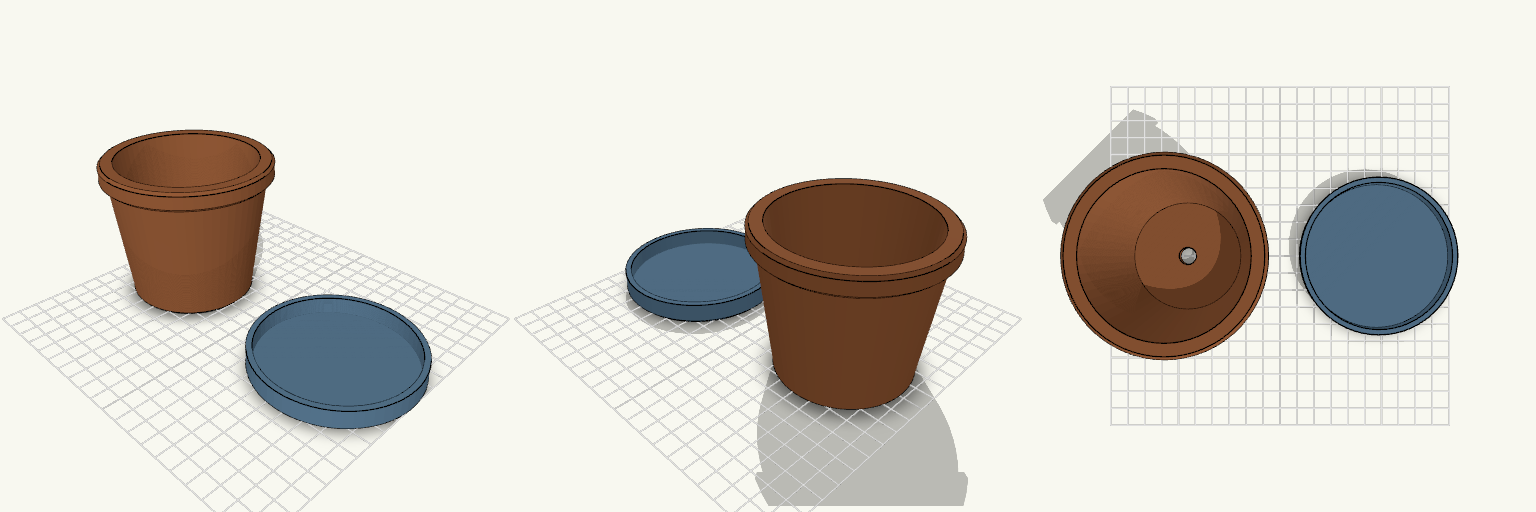
A cactus pot with a drainage hole, so water leaves the soil instead of rotting the roots. A separate saucer catches the runoff so it doesn't end up on the windowsill. Key numbers Pot: 70 mm base, 90 mm opening, 75 mm tall, 96 mm rim lip Drainage hole: 10 mm diameter, centred in the 6 mm floor Saucer: 90 mm diameter, 12 mm tall, 2.5 mm floor. The pot's 70 mm base sits inside it. Print: no supports needed, both pieces print upright. 0.2 mm layers, PETG or PLA.