T-Post Cap With 2.5-Inch Round Platform
Created today
Description
A slip-on cap for a steel T-post: 4 in tall, with a T-shaped socket that drops over the post and a 3 in round platform, 1/4 in thick, on top.
Fits
- Steel T-posts, matched to the T-socket below.
- The socket is a T: a 36 mm crossbar, 7 mm wide at the stem entry, with a 7 × 30 mm stem running down, and a 4 mm wall following that T all the way around.
- Takes the place of a plain post cap and adds a flat, 3 in round surface on top of the post.
Check before printing
The socket is the whole fit, and its numbers are a starting size, not a standard — T-posts differ in flange width and web thickness between manufacturers and post weights. Measure the post you intend to use across the crossbar, across the stem, and across the full depth, then set the socket to those sizes plus a little clearance for paint and burrs before you commit filament. Nothing else on the part affects fitment.
Does not fit
- Round posts, wooden 4x4 posts, or any post without a T cross-section.
- T-posts whose crossbar or stem is wider than the socket above — T-post profiles are not interchangeable, so do not assume a fit from the post name or the post weight alone.
The cap prints as a single piece, 76 × 76 × 102 mm overall.
Images
More like this
Explore more in Home & Fixtures →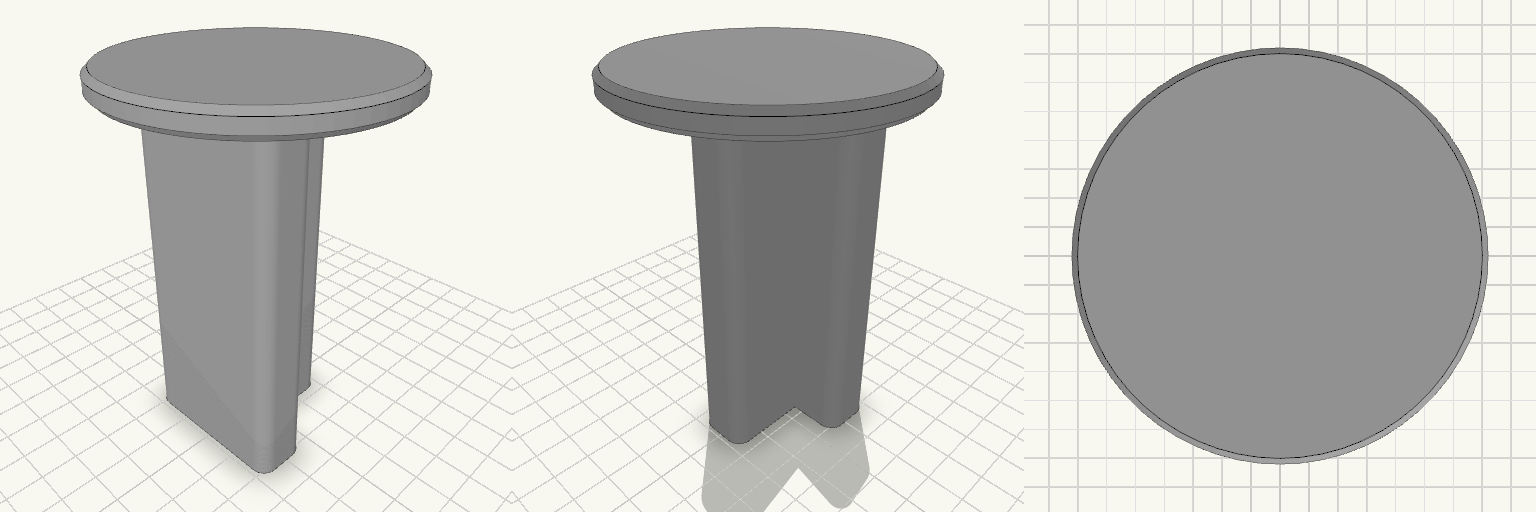
T-Post Cap With 3-Inch Round Platform
A slip-on cap for a steel T-post: 4 in tall, with a T-shaped socket that drops over the post and a 3 in round platform, 1/4 in thick, on top. Fits Steel T-posts, matched to the T-socket below. The socket is a T: a 36 mm crossbar, 7 mm wide at the stem entry, with a 7 × 30 mm stem running down, and a 4 mm wall following that T all the way around. Takes the place of a plain post cap and adds a flat, 3 in round surface on top of the post. Check before printing The socket is the whole fit, and its numbers are a starting size, not a standard — T-posts differ in flange width and web thickness between manufacturers and post weights. Measure the post you intend to use across the crossbar, across the stem, and across the full depth, then set the socket to those sizes plus a little clearance for paint and burrs before you commit filament. Nothing else on the part affects fitment. Does not fit Round posts, wooden 4x4 posts, or any post without a T cross-section. T-posts whose crossbar or stem is wider than the socket above — T-post profiles are not interchangeable, so do not assume a fit from the post name or the post weight alone. The cap prints as a single piece, 76 × 76 × 102 mm overall.
Veranda End Bay with Leaf Outline Infill
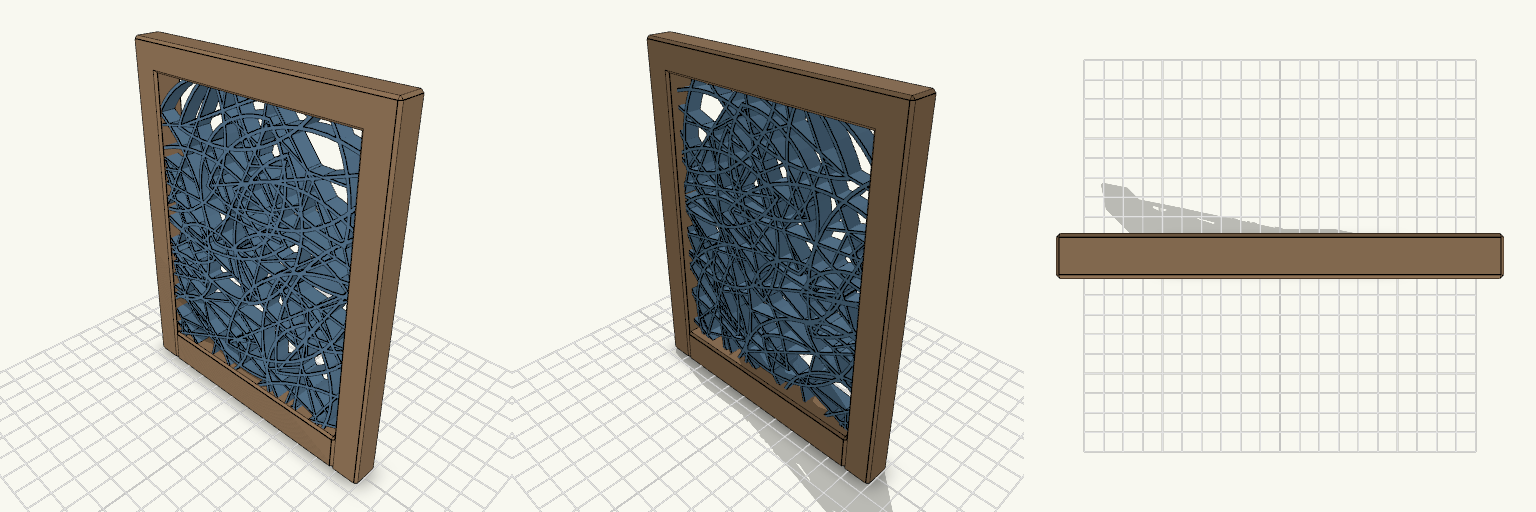
A rectangular end frame for a veranda run, built from two uprights, a top beam and a lower rail, with a decorative leaf panel set into the opening. The infill is a collage of large overlapping leaves drawn as open outlines. Each leaf has a centre rib and four angled side veins, so the panel reads as fine, see-through line work rather than a solid fill. Leaves sit at random angles and positions and are clipped flush at the frame, where edge leaves run into the posts, top beam and bottom rail. A leaf sits one third of the way in from the left post, just under halfway up the panel. Frame and infill print as one piece. What it's for Closes the end of a veranda run with a decorative open screen instead of a solid infill. The overlapping leaf outlines fill the panel with line work while leaving gaps open, so sightlines and airflow stay partly clear. The scattered leaf layout gives an organic, uneven look rather than a repeating geometric pattern. The layout is fixed, so the pattern is the same from print to print. Dimensions Overall frame: 120 × 150 mm, 12 mm deep. Infill opening: about 96 × 123 mm, 6.5 mm deep; the leaf collage fills it edge to edge. Leaves: roughly 50–105 mm long and 26–46 mm wide, with a 1.2 mm outline, a 1 mm centre rib and four side veins at 0.8 mm. Frame and infill print as one piece; no assembly required. Print notes Lay the frame flat on the plate and print it as a single piece. The leaf outlines, ribs and veins are thin line work; slow the outer walls if the printer tends to string across the gaps. Because the leaves are placed at random, a leaf near the edge may be held only by its neighbours rather than by the frame. Check the perimeter first when cleaning up the print. Remix ideas Change the frame proportions to suit a different veranda or porch opening. Reuse the leaf collage alone as a decorative screen or window insert. Simplify the leaf outlines for a bolder, less detailed screen. Swap the leaf shape for a different botanical outline while keeping the scattered layout.
83mm Desk Grommet with Sealed Hollow Body
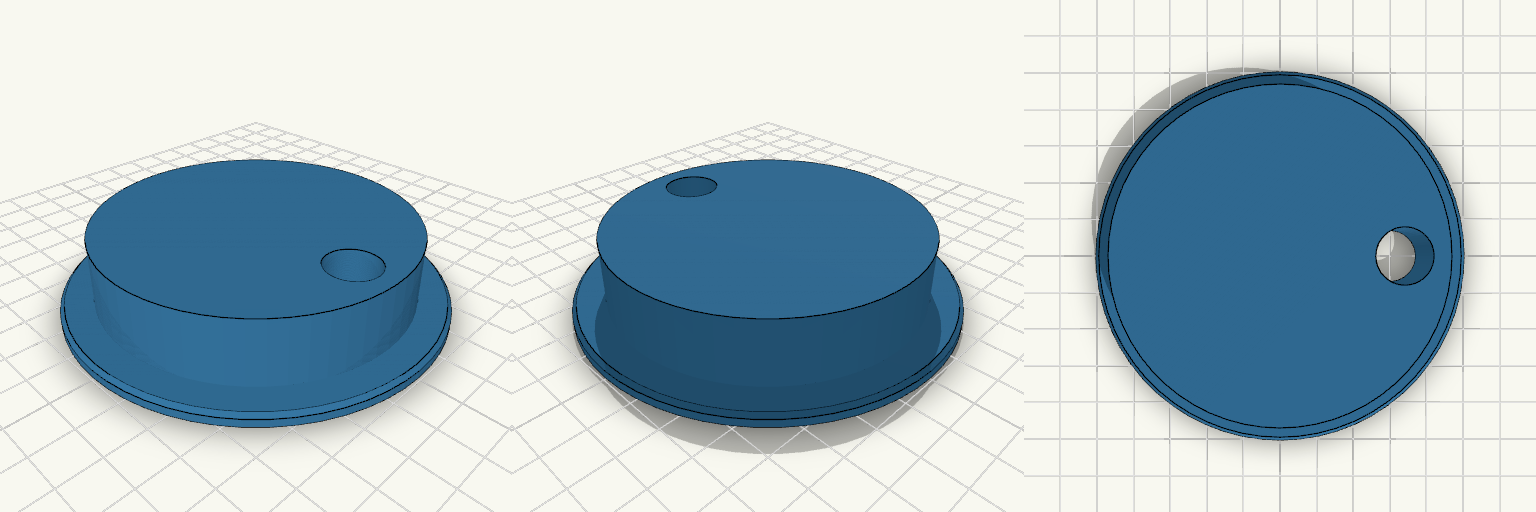
A one-piece desk grommet for an 83 mm hole, with an off-center cable passage. The barrel drops through the desk and the 99 mm flange rests on the surface; 3 mm caps close the part at both ends and the interior is a sealed hollow, so it uses little filament for its size. A 14 mm cable hole sits 30 mm from the center, about 4 mm in from the rim, and passes through the flange and both caps. It takes most round power cables but will not pass a plug. Desk hole: 83 mm Barrel: 82.6 mm outside diameter, 20 mm tall Flange: 99 mm diameter Cable hole: 14 mm diameter, 30 mm from center, near the edge Wall and cap thickness: 3 mm; cable-hole wall: 2 mm Interior: sealed hollow cavity Fit: desk tops up to about 17 mm thick Print: one piece; no external supports; the enclosed cavity will bridge internally near the top of the void Overall footprint on the plate: 99 × 99 × 20 mm
20 mm Round Hollow Pipe, 136 mm Long
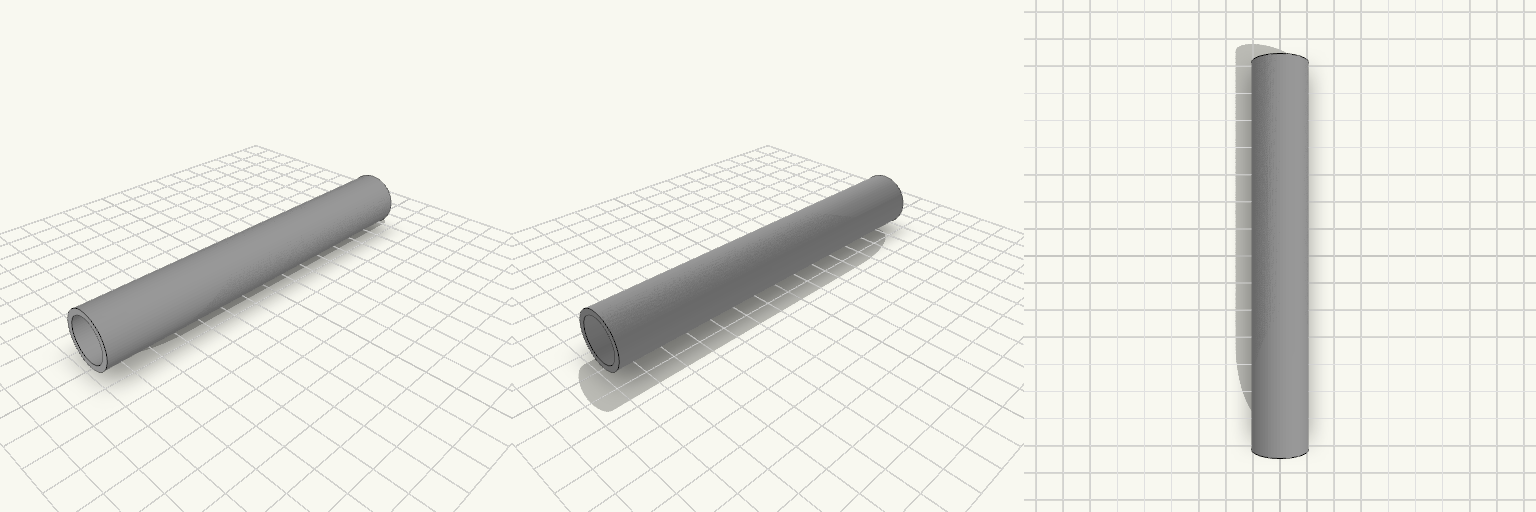
A round hollow pipe with a 20 mm outer diameter, a 16 mm bore and an even 2 mm wall, 136 mm long and open at both ends. It serves as a sleeve, spacer or bushing stock, or as a straight run in small frames, racks, handles and standoffs. At 136 mm it prints as one piece on a common print bed, with the length running along the plate. Specs Outside diameter: 20 mm Bore: 16 mm, centered Wall thickness: 2 mm, even all round Overall length: 136 mm Both ends open, full length through Rests on the build plate with the length along the plate Printing notes 136 mm length fits standard beds without splitting into segments. Vertical orientation needs no support inside the bore; horizontal orientation holds truer round but needs support in the bore. The bore is centered, so the wall is even all round where concentricity matters.
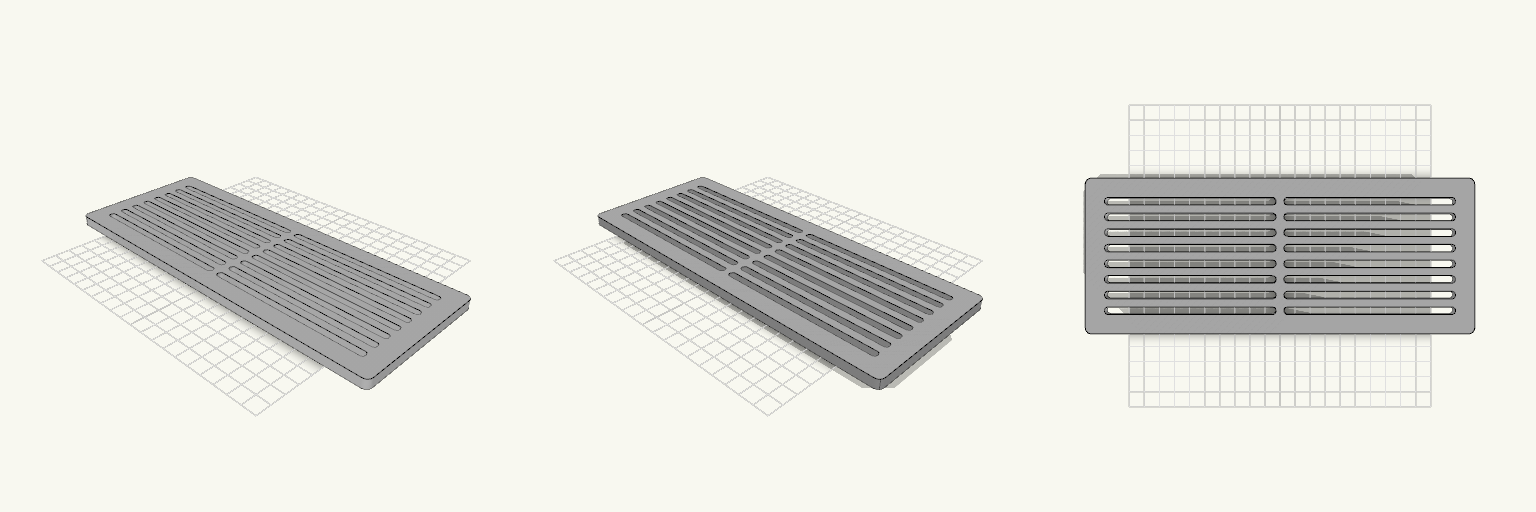
White 4 x 10 Inch Flat Vent Grill
Flat slotted vent grill, 10" x 4" with a thickness of 1/4". Two banks of eight through-slots are separated by a center rib for stiffness, inside a solid border. Size: 254 x 101.6 x 6.35 mm Slots: 8 per side, 5 mm wide, 112 mm long, rounded ends Border: about 10 mm solid on the long edges, 15 mm on the ends Print flat, no supports; PETG or ASA suits warm airflow Edges: 4 mm rounded vertical corners
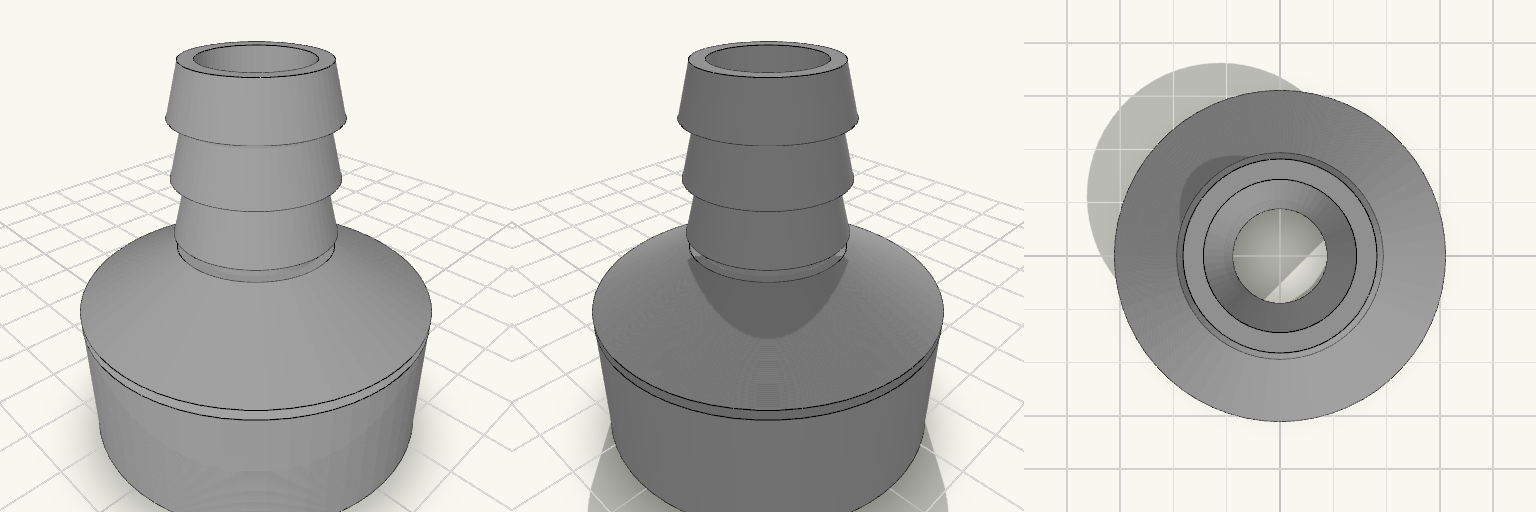
Garden-Plumbing Workhorse: BSP to 3/4 Hose Barb
A straight-line adapter that bridges a 1-1/4" BSP female threaded socket to a 3/4" hose barb, with a tapered shoulder carrying the eye from the wide threaded end down to the narrow ridged nozzle. It reads like a piece of honest utility hardware: a ring of 11 TPI thread at one end, three crisp ridges at the other, and a 15 mm bore running clean through a compact 55 mm body — short enough to tuck into tight pump and tap arrangements without a loop of hose fighting for room. The barb's ridges ramp up gently from the tip and widen toward the body, then drop off in a sharp step — the hose slides on without a fight, and the step keeps it from backing off again. Design notes: 1-1/4" BSP female socket, 11 TPI, 41.91 mm major diameter, 18 mm deep Tapered transition from the socket down to the barb 19 mm barb with three retention ridges, 7 mm tall and spaced 8 mm apart, narrow at the tip and widening to a step at the body side, for 3/4" hose 15 mm bore through the full length; 55 mm overall Prints as a single piece, sitting upright at roughly 50 × 50 mm on the plate Fit and sealing: The thread is modelled at nominal size with no added clearance, so a first test fit against the male fitting is worth doing — if it binds, opening it out by 0.2–0.4 mm is the easy fix. For a watertight joint, wrap the thread with PTFE tape or seat a flat washer against the socket floor. The shortened barb leaves less hose length to grip; a hose clip just behind the final ridge makes up for it. Pairs naturally with garden hose, pump outlets and tank fittings.