30° Ceiling Vent Air Deflector
Created 17 days ago
Description
A clip-on deflector for a 10 x 10 cm ceiling vent. A blade tilted 30° redirects cold air sideways across the room instead of straight down onto a desk. Four spring tabs grip the vent edges and flex over a 5 mm thick lip.
What it's for
- Redirects airflow from a square ceiling vent away from a desk or seat.
- Mounts without screws or adhesive: the four tabs snap over the vent lip.
- The blade spans the opening at a fixed 30° angle.
Dimensions
- Frame: 108 x 108 mm outer, 96 x 96 mm opening, 3 mm thick.
- Spring tabs: four, one per side, 16 mm wide, with a 5.4 mm gap under the hook for a 5 mm lip.
- Tabs reach about 10.4 mm above the frame base.
- Blade: 96 mm wide, 2.4 mm thick, tilted 30°. Overall height is about 22.6 mm.
- Assumes a 100 x 100 mm vent opening with the frame sitting around it.
Print notes
- PETG is the better choice, since the tabs flex and PLA is more likely to snap.
- Print the frame flat, with its base on the bed.
- Check the lip thickness on your vent. Adjust the tab gap if it is not 5 mm.
Remix ideas
- Change the blade angle for a steeper or shallower sweep.
- Make the tabs wider or thicker for a firmer grip.
- Resize the frame for a different vent size.
- Add a second blade to split the airflow in two directions.
Images
More like this
Explore more in Home & Fixtures →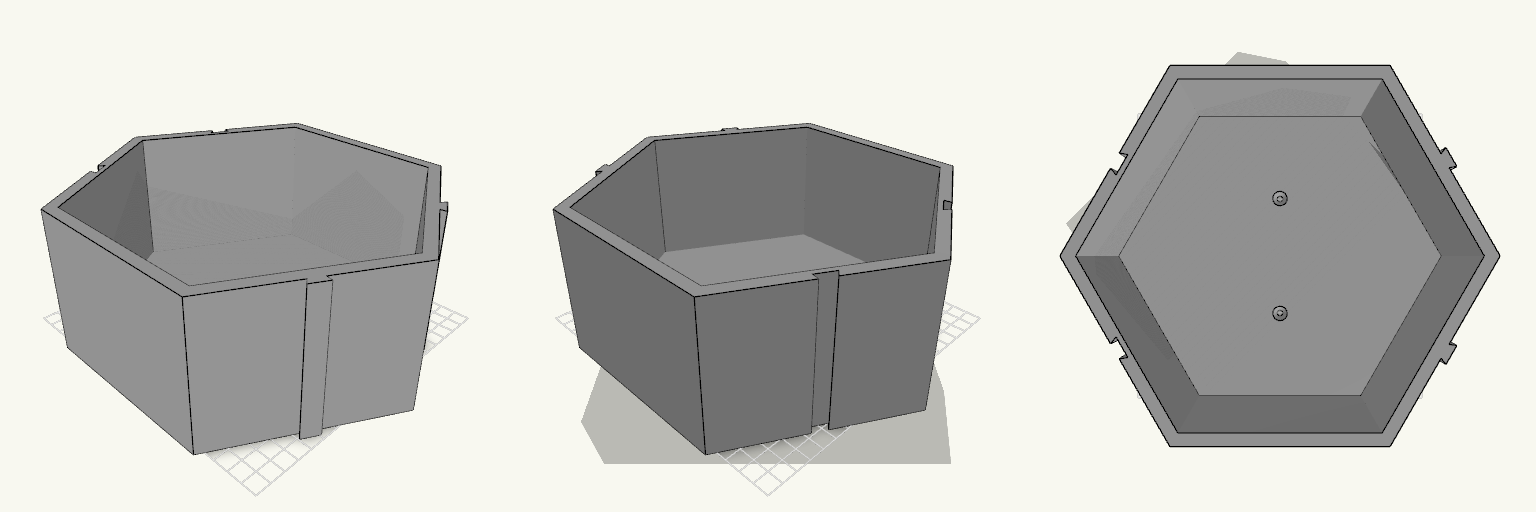
Flat-Printing Interlocking Hexagonal Wall Shelf
A hexagonal wall shelf that locks to matching units through dovetail keys and slots, so several can form a honeycomb. The back plate has two countersunk screw holes for wall mounting, and the front is open and flush. 170 mm flat-to-flat height, 95 mm deep 8 mm walls, 5 mm back plate Dovetail keys and slots with 0.5 mm clearance per side Printed lying on the back plate, fits a Creality K2 bed PETG recommended, with supports for the dovetails Test one pair of faces first to confirm the fit.
Abdeckkappe mit 50 mm Innendurchmesser
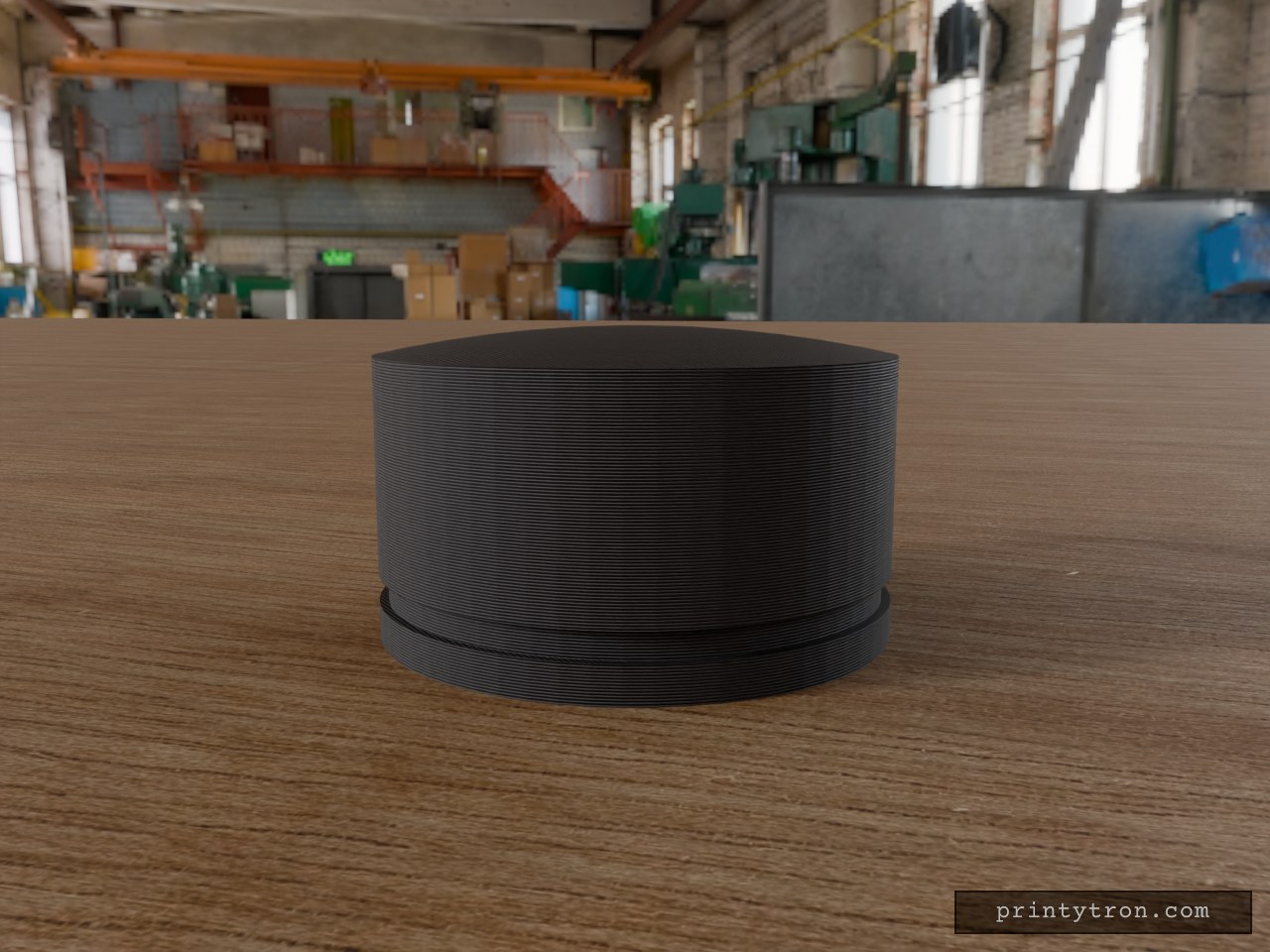
Eine geschlossene Abdeckkappe für Rohre und Öffnungen mit 50 mm Außendurchmesser. Die Kappe sitzt mit 50 mm Innendurchmesser satt auf dem Rohr, die Wandstärke von 3 mm und der leicht nach außen gewölbte Deckel geben ihr Form und Stabilität. Außen umlaufend, knapp über der Unterkante, liegt eine Nut zum Einrasten oder für einen O-Ring. Die Kappe wird in einem Stück gedruckt; Stützen sind nicht nötig, solange sie mit der Öffnung nach unten auf dem Druckbett steht. Innen-Ø: 50 mm Wandstärke: 3 mm, Außen-Ø: 56 mm Gesamthöhe: 33 mm, Deckel leicht nach außen gewölbt Umlaufende Nut außen: 1 mm tief, 3 mm hoch, ca. 4 mm über der Unterkante Wer die Nut innen oder direkt an der Kante braucht, muss die Maße vor dem Druck anpassen — die Kappe selbst passt sonst nur auf Rohre, deren Außendurchmesser zum Innendurchmesser von 50 mm passt.
Eccentric Duct Adapter 125mm
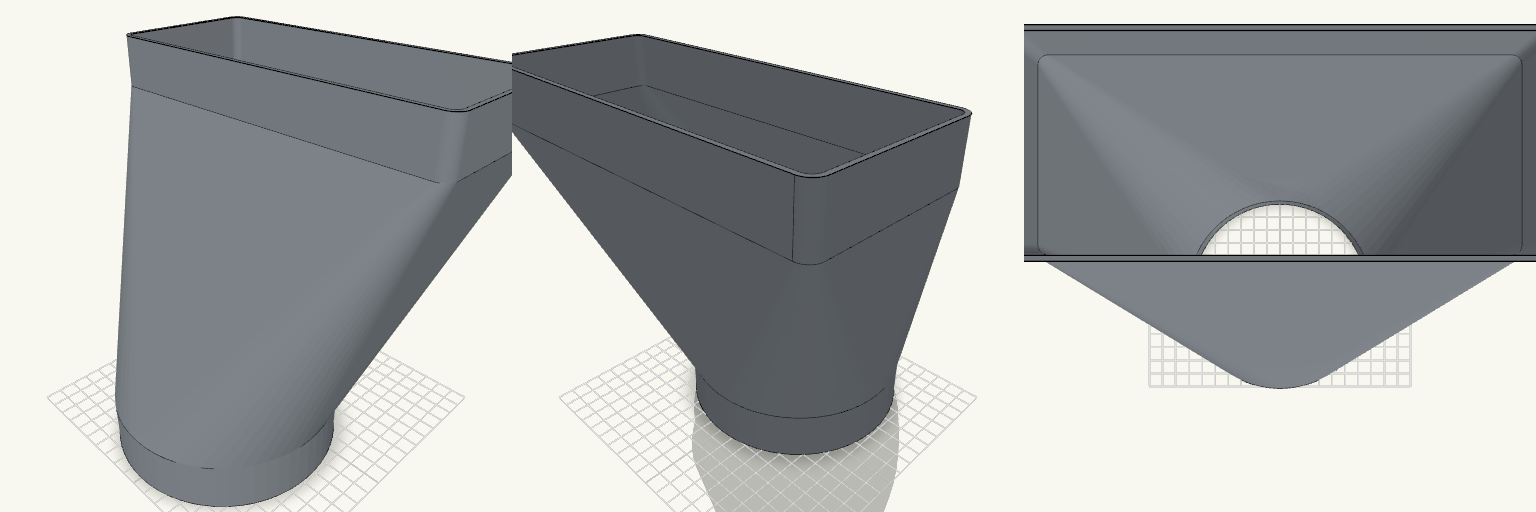
What it's for Bathroom duct adapter that joins a round duct to a flat rectangular duct in one continuous piece. Both ends are female sockets, so the ducts slide into the adapter rather than over it, and the internal passage stays fully open from end to end with no obstruction to airflow. The round socket is bored to Ø132 mm for a free, loose fit over Ø125 mm duct — roughly 3.5 mm of clearance per side, which can be taken up with tape or a gasket if a tighter seal is wanted. Dimensions Round socket: Ø132 mm inner, Ø136.8 mm outer, 30 mm long, 1.5 mm entry chamfer Flat socket: 222 × 92 mm inner, 5 mm corner radius, 30 mm long Transition: 160 mm, smooth round-to-rectangle loft, horizontally symmetric Vertical offset of the flat socket: 72.5 mm Wall thickness: 2.4 mm throughout Overall length: 220 mm Print notes Print as one piece; no assembly and no supports are needed for the open bore. The bounding volume on the plate is about 227 × 189 × 220 mm, so check the build volume before slicing. A 2.4 mm wall prints cleanly in PETG or ABS if the part sees warm bathroom air; PLA works for a dry run-in fit. Remix ideas Change the bore diameter to tune the fit for a different round duct. Adjust the 72.5 mm vertical offset for another mounting position. Lengthen either socket for a deeper grip on the duct.
Tampão com travas para abertura semicircular
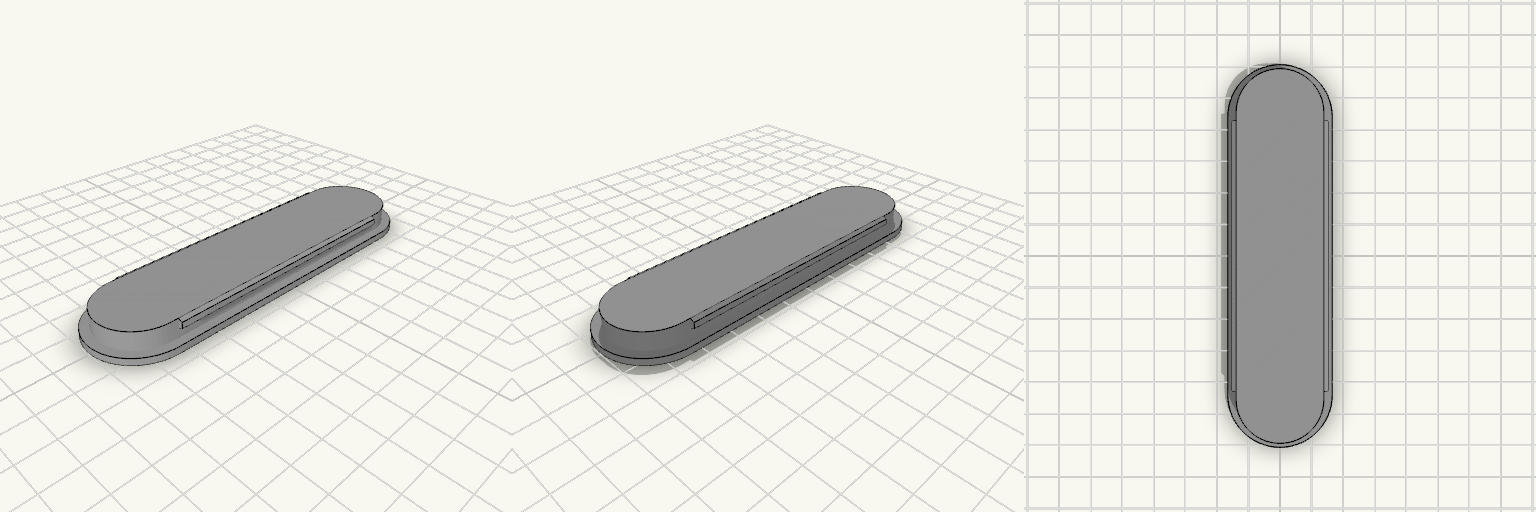
Um tampão para abertura retangular de pontas em semicírculo — aquele vão que fica aberto porque nada encaixa direito nele. A peça assenta por pressão: duas travas embutidas nos lados compridos prendem na abertura, a aba assenta na borda e o interior é oco por baixo, então o tampão cobre o buraco sem virar um bloco maciço. As laterais são maciças, sem fendas: é a parede fina que cede no eixo X na hora de encaixar. Medidas que decidem o encaixe Abertura coberta: 27 × 114 mm, com as duas pontas em semicírculo de raio 13,3 mm; o corpo tem 26,6 × 113,6 mm, já descontada a folga. Aba de 2,1 mm em volta: assenta na borda e impede a peça de afundar no vão. Espessura total: 8 mm, contando a aba — o perfil fica baixo, rente à superfície. Duas travas embutidas, uma em cada lado comprido, com 84 mm de largura cada; não há travas nas pontas, que brigariam com a curva. As travas ocupam a faixa de 5 mm a 8 mm na altura, com ressalto de 3 mm. Parede lateral de 1,8 mm, inteira e sem fendas nem aberturas: a flexibilidade vem só da espessura da parede. Interior oco e aberto por baixo; o topo é fechado por uma tampa de 0,5 mm. Peça completa: 32,6 × 119,6 × 8 mm. Para imprimir Sai em uma peça só, sem montagem, sem parafuso e sem cola. Imprima com o lado da aba para baixo, apoiado na mesa, para as travas saírem limpas. O topo é uma tampa fina de 0,5 mm: reduza a velocidade nas últimas camadas para ele não ondular. O interior é oco e aberto por baixo — dá para escolher o preenchimento e conferir a parede por dentro depois de imprimir. Use um material que ceda um pouco — PETG funciona bem; PLA muito rígido pode rachar a trava no primeiro encaixe. O encaixe depende da parede de 1,8 mm: se ainda ficar rígido demais, afine mais a lateral antes de mexer nas travas, mas abaixo de 1,5 mm a parede começa a ficar frágil.
Doorstop Wedge Rib Clip
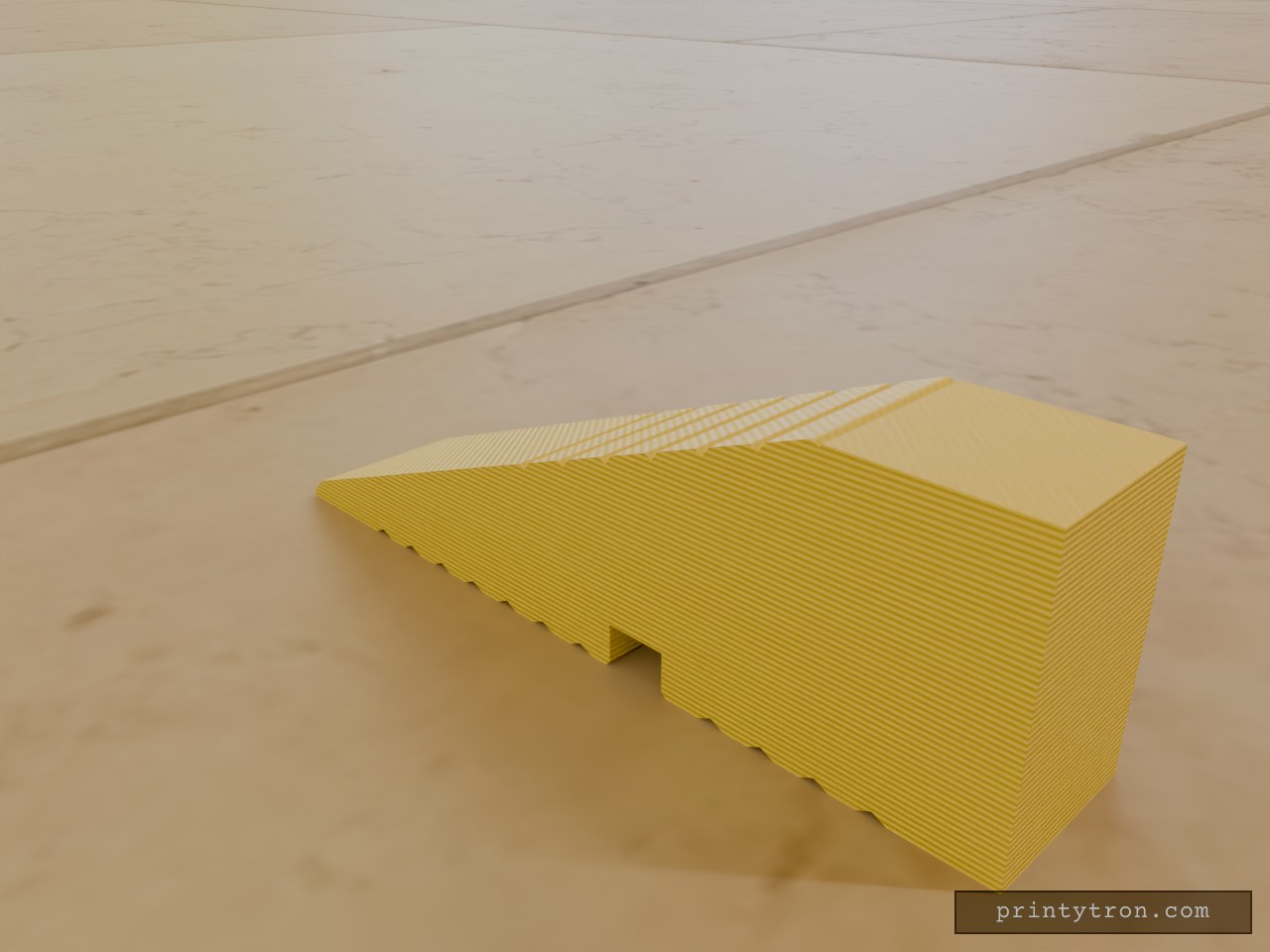
A doorstop wedge with the low, hard-working profile of a chalk wedge, cut to a 10 mm width to grip the raised PVC rib on a balcony door sill. The underside carries a straight snap-fit groove that presses over the rib, the thin tip lets the door glide across, and the block behind it stops the door dead so it cannot swing open while you are out on the balcony. The top rises from a 1 mm tip to a flat 16 mm shelf — the ramp reaches that height about 39.5 mm back from the tip and then runs flat to the fat end. Both the top and bottom faces carry shallow V-ribs across the width: grip where a hand or a door meets the wedge, and a lightly textured finish underneath. Design notes 50 × 10 mm footprint with a 16 mm flat top; the ramp climbs from a 1 mm tip to the shelf, and the shelf’s front edge is left sharp Bottom groove 3.6 mm wide (3.4 mm rib plus 0.2 mm clearance) and 2.5 mm deep, flat-bottomed with a 0.3 mm entry chamfer, centred 20 mm back from the fat end V-ribs run 3 mm apart at 0.4 mm deep; bottom ribs start about 8 mm from the tip and stop clear of the groove so its edges stay clean, while top ribs begin where the wedge is thick enough to cut into 0.5 mm chamfers along the top edges, and a 1 mm 45° bevel at the tip to help the door ride over Printing Print flat on the bottom face with the groove facing down, in PETG at 0.2 mm layers, 4 walls and 40% infill.
plaque support avant araignee
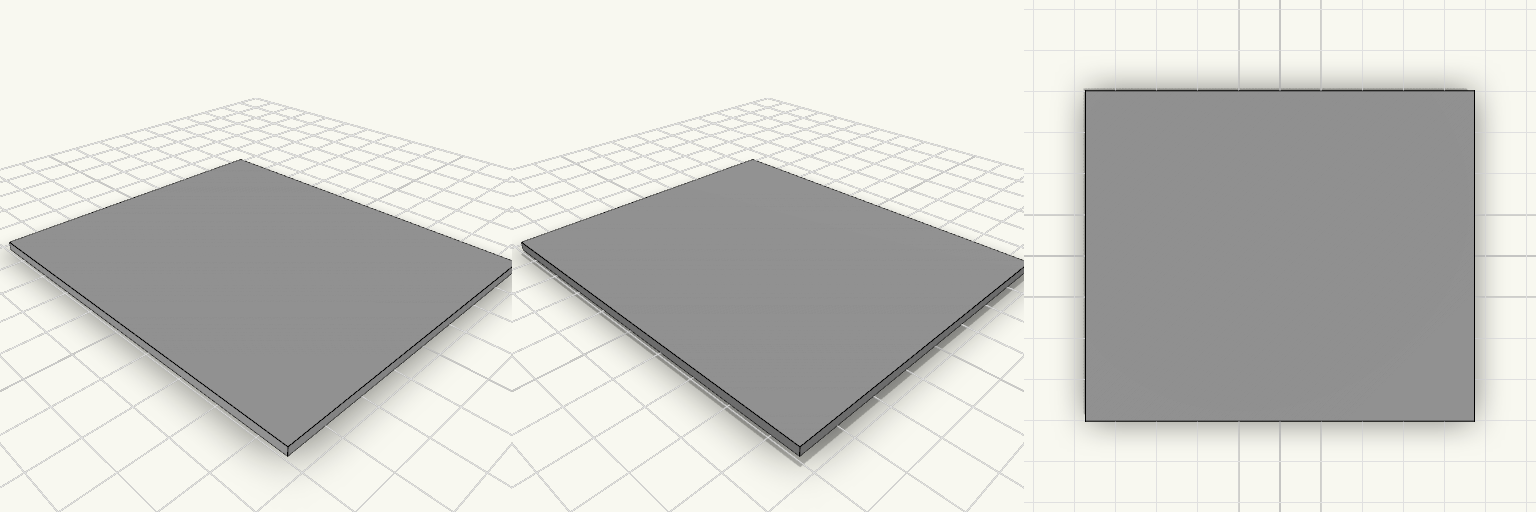
Une plaque plane de 93 × 79 mm sur 2 mm d'épaisseur : le morceau de base qui remplace la découpe qui n'existe pas dans le bon format. Elle s'imprime à plat, sans support, et sort avec des arêtes vives — à chanfreiner ou percer plus tard si besoin. Ce qui décide de l'usage Dimensions au sol : 93 × 79 mm Épaisseur : 2 mm — assez rigide pour ne pas gondoler, assez fine pour se glisser sous un élément Contour : arêtes vives, aucun chanfrein, aucun trou de fixation Orientation : posée à plat sur le plateau, aucun surplomb Impression Sans supports, face plane sur le plateau 2 mm se remplissent bien en 4 à 5 périmètres ; une dizaine de couches suffit PETG ou PLA selon la rigidité voulue ; le PETG encaisse mieux la flexion