3D-printable decor & display pieces
Lithophane shades, planters, trophies, wall art and display models. Browse what makers built, or describe the exact piece you want and Printy makes it.
Need one that fits your exact measurements? Start building →
Newest
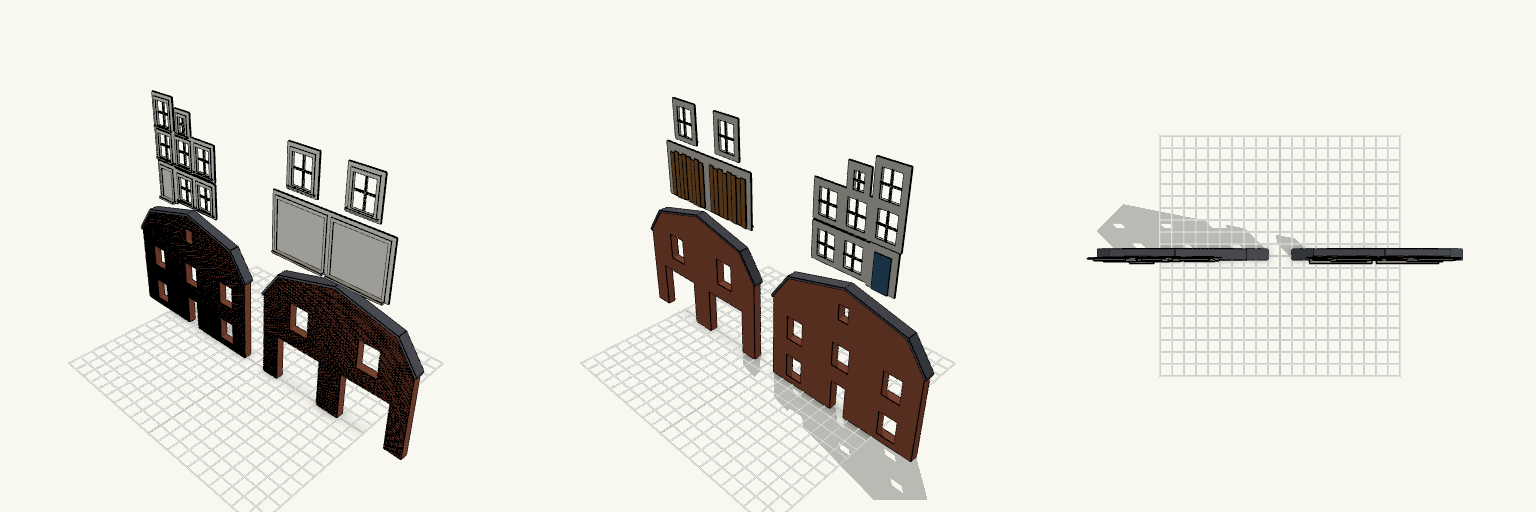
OO Gauge Gable, Dutch barn roof, Wide Low Slat Doors
Two half-relief gable-end frontages for 1:76.2 (OO gauge) buildings, each 120 mm wide and 6 mm deep, with a 68 mm eaves height and a two-pitch roofline rising to a 100 mm apex. Fitment Scale: OO, 1:76.2. Not intended for HO or N scenery without rescaling. Front face: Flemish bond mortar joints, 0.2 mm wide and 0.25 mm deep, over the full height. Frontage one: door and five windows plus a loft frame. Frontage two: two 38 × 38 mm wooden slat doors and two high windows. Frames and doors are printed as a separate sheet above each apex. Check before printing Joint detail needs a 0.4 mm nozzle or finer. The wall openings are through-holes, so the frame sets must be glued in from the front. Does not fit No back wall, floors or side walls are included.
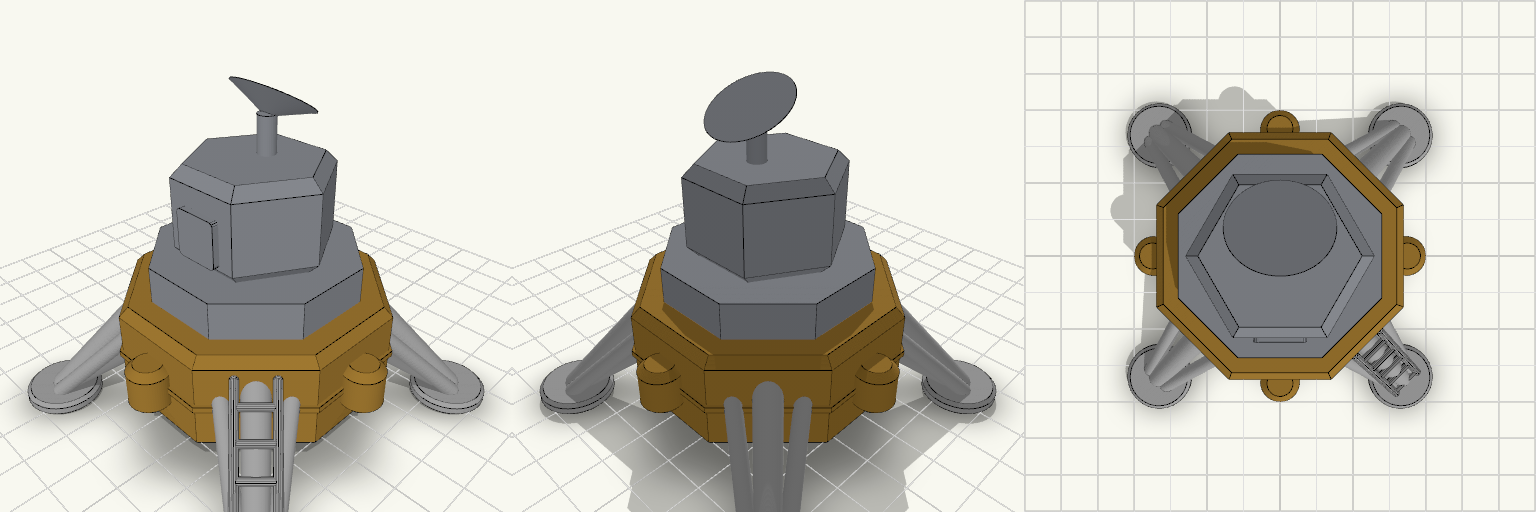
Apollo-Style Lunar Lander Model, 82 mm Footprint
This is a stylized Apollo-style lunar lander display model. It has an octagonal descent stage with four shallow fuel-tank bulges and a panel band around the middle, a faceted hexagonal ascent cabin with a raised front hatch, an engine bell underneath, and four splayed A-frame legs with chamfered footpads. One leg — the front-right — carries a ladder with two rails and rungs, and a tilted dish on an 8 mm mast sits toward the rear of the cabin roof. At roughly 82 mm across the footpads, it is sized as a compact desk or shelf piece. The cabin front is clean apart from the hatch, so the model reads as a lander rather than anything else. The legs are the widest part of the print; the body sits well inside that spread. Specs Footprint: approx. 82 mm across the footpads Descent stage: octagonal, approx. 68 mm across × 22 mm tall, with four shallow fuel-tank bulges and a mid panel band Ascent stage: faceted hexagonal cabin, approx. 42.5 mm across × 43.5 mm tall, with a raised front hatch and a tilted dish on an 8 mm mast Engine bell: approx. 18 mm across × 9 mm tall, mounted low under the central body about 1 mm above the plate, so it reads best from a low viewing angle Legs: four A-frame legs, each with a thick main strut anchored into the descent stage, a lower angled strut and two side struts; chamfered footpads approx. 17 mm Ladder: two rails and rungs on the front-right leg Use: display model for a desk, shelf, or space-themed collection Printing notes The splayed legs and footpads set the build plate footprint; check the 82 mm spread against your plate before scaling up The dish mast, ladder rungs and hatch are the finest features — a smaller layer height keeps them crisp
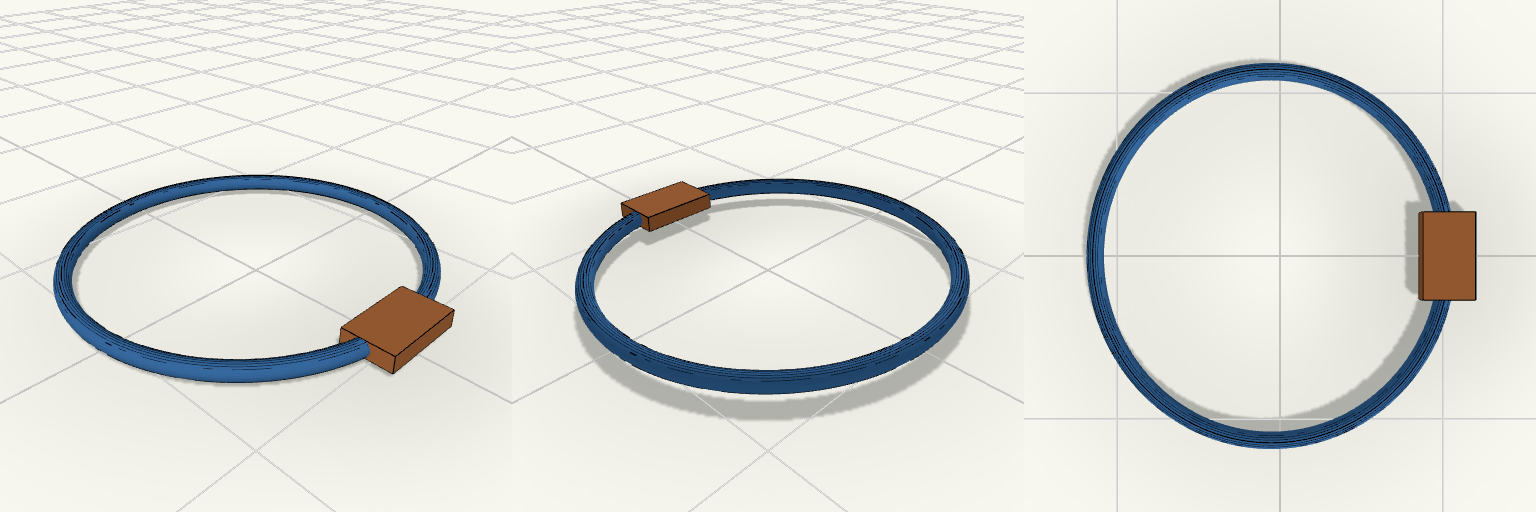
Toroide con caja abierta de 5,2 mm
Un toroide ovalado hueco con una caja abierta integrada en el lateral +X. El anillo mide 21,7 mm en X y 23 mm en Y, y el tubo tiene 2,8 mm por fuera con un canal interior de 1,2 mm, suficiente para pasar un cable de 1 mm sin forzarlo. La caja mide 5,2 mm de largo por 3,1 mm de ancho y 2,8 mm de alto, igual que el tubo, con paredes de 0,8 mm y el fondo interior a 0,8 mm, justo donde el canal desemboca en la cavidad. El tubo no atraviesa la caja: se corta en sus dos lados en Y y el canal se abre hacia el interior, de modo que la caja hace de cámara entre una entrada y una salida. La pieza se apoya en Z = 0 con la abertura de la caja mirando hacia la cama de impresión, así que probablemente necesite soportes o un primer nivel bien ajustado. Todo se imprime como una sola pieza. Puntos para remezclar Toroide: la elipse de 21,7 × 23 mm es la restricción de tamaño; el tubo exterior de 2,8 mm es una elección, y es lo que permite el canal de 1,2 mm con pared de 0,8 mm. Si quieres un canal más ancho o más justo, mueve el diámetro exterior antes que la elipse. Caja: parte de 5,2 × 3,1 × 2,8 mm, con paredes de 0,8 mm y fondo interior a 0,8 mm. Largo y ancho son libres; el alto está atado al del tubo. Engrosa el fondo si buscas resistencia. Entrada y salida: el canal se corta en Y a ambos lados de la caja. Cambia la posición de esos cortes o el recorrido para que la cámara quede más centrada o más discreta. Orientación: la pieza va girada con la abertura hacia la cama. Volver a girarla mejora el primer nivel pero deja la cavidad mirando arriba, con lo que la cámara necesita soportes por otro lado; elige según tu material. Variantes: mueve la caja alrededor del anillo, duplícala en el lado opuesto o añade una tapa. Conserva la proporción 5,2 × 3,1 mm si quieres que la cámara mantenga su escala. Combinaciones: funciona como colgante geométrico, llavero o pieza de exhibición, y la cámara con paso de cable invita a convertirla en contenedor pequeño o en guía para un cordón.
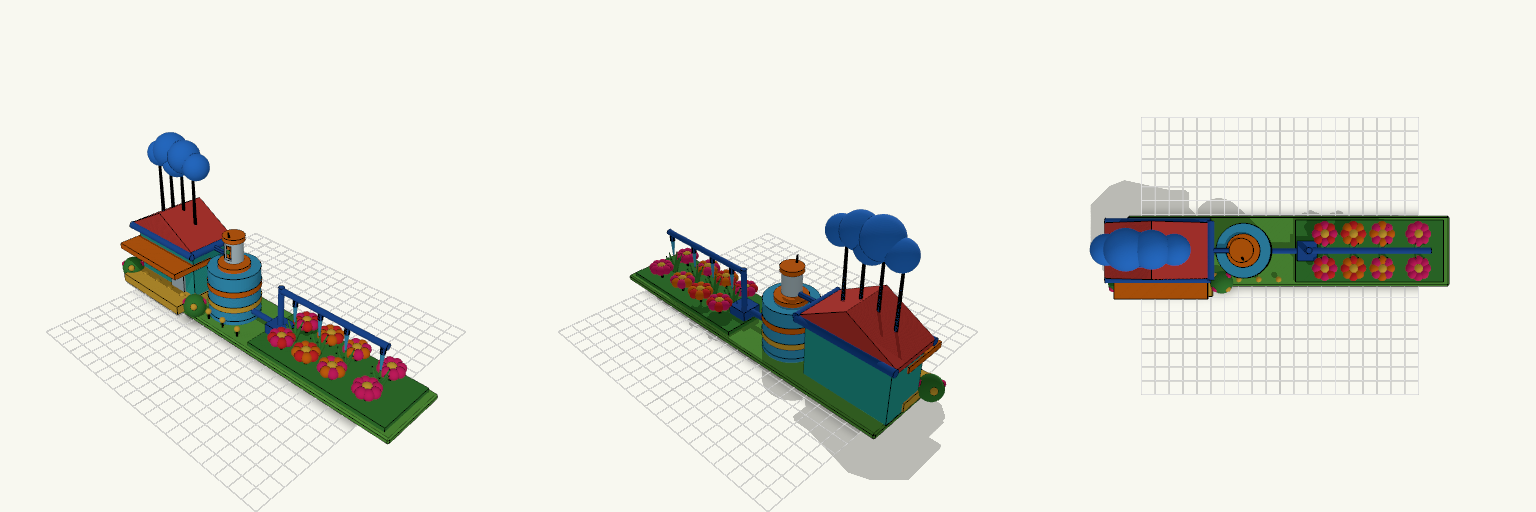
Prototipo Equipo 5
Maqueta de captación de agua de lluvia en estilo de dibujo con marcadores: nube azul, casa turquesa con franjas amarilla y naranja, canaleta, filtro pequeño, tanque, tubería y riego sobre un cultivo florido. Recorrido del agua Nube azul con gotas que caen sobre el techo rojo Canaleta azul en los dos bordes largos del techo Filtro compacto con ventana frontal: hojas verdes y basura naranja atrapada Tanque azul cielo con anillos de color y tapa naranja Tubería azul hacia el riego y cuatro boquillas sobre las plantas con flores
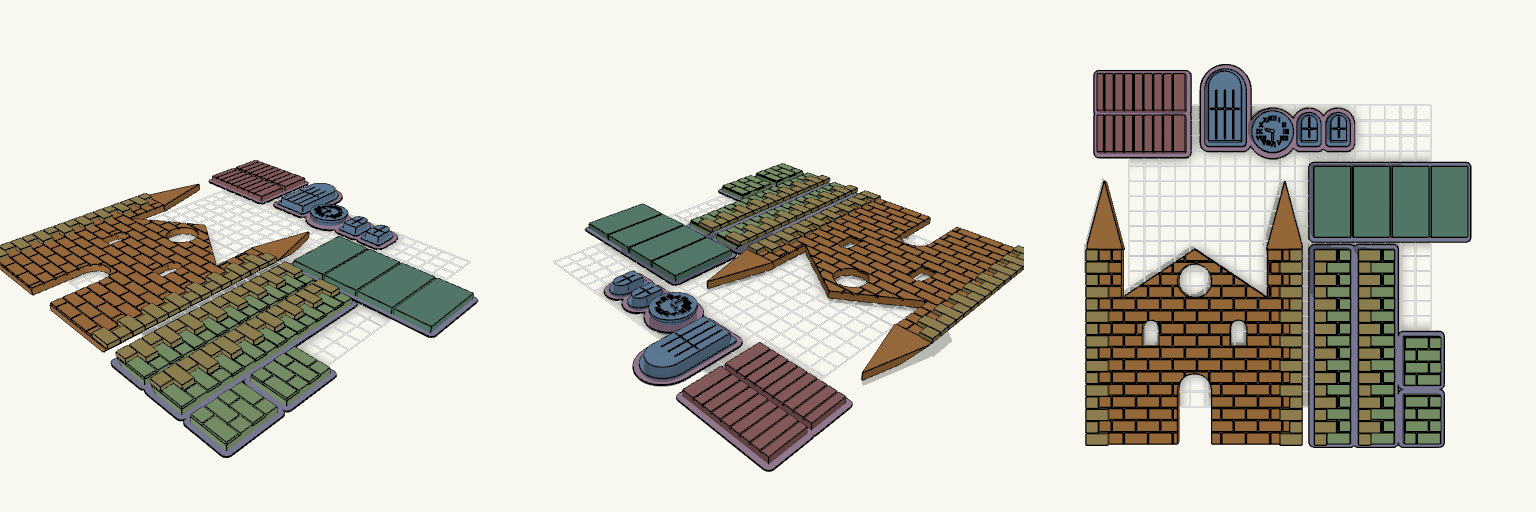
Medieval Church Front Flat-Pack, Bambu A1 Plate
Flat-pack kit for a medieval stone church frontage at 1.6× scale, laid out for a Bambu A1 plate (256 × 256 mm). The one number to check before printing is the plate fit: the layout is about 252 mm across, so leave the skirt and brim off. What is in the kit Front piece: nave, gable and both tower fronts in one 3 mm plate, with the door, clock and lancet openings cut through and quoin blocks built into both outer edges. Tower sides: two panels with quoins moulded along the mitred front edge. Small inner pieces and spire sides: two nave-height inner pieces and four plain spire panels. Roof strips, door insert and clock insert: printed on a separate thin web. Webs A 0.4 mm web surrounds the building side panels, and a second, separate web surrounds the roof strips, door and clock. Cut the parts free with a knife. Not included The two small side windows and their inserts are removed. There are no inserts for the tower lancets or the clock opening other than the clock itself.
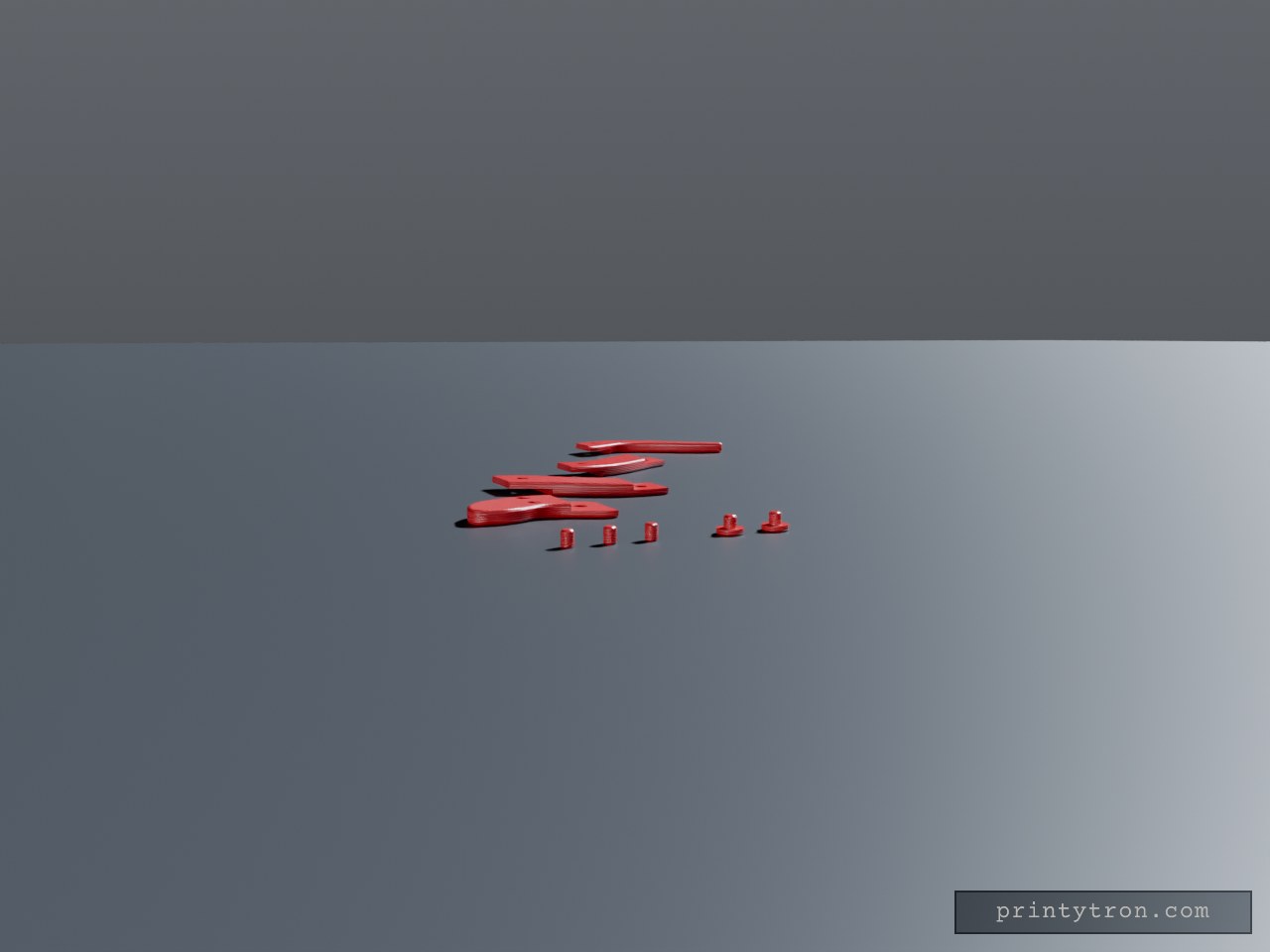
Flat Snake Assembly Kit
What it's for A flat, solid snake that prints as separate pieces and snaps together by hand: head, two body segments, tail, two eyes and three connector pins. Edges are rounded, there is no surface detail, and nothing needs supports. Dimensions Thickness: 4 mm Pin holes: 3.5 mm diameter Pins: 3 mm diameter, 4 mm long Joints: half-thickness lap joints, so the pin passes vertically through both overlapping ends Eyes: 6.5 mm domed discs with a 3 mm peg that fits holes in the head Remix ideas Lengthen the snake with more body segments. Change the wave amplitude for a tighter or straighter snake. Add a keyring hole in the tail.
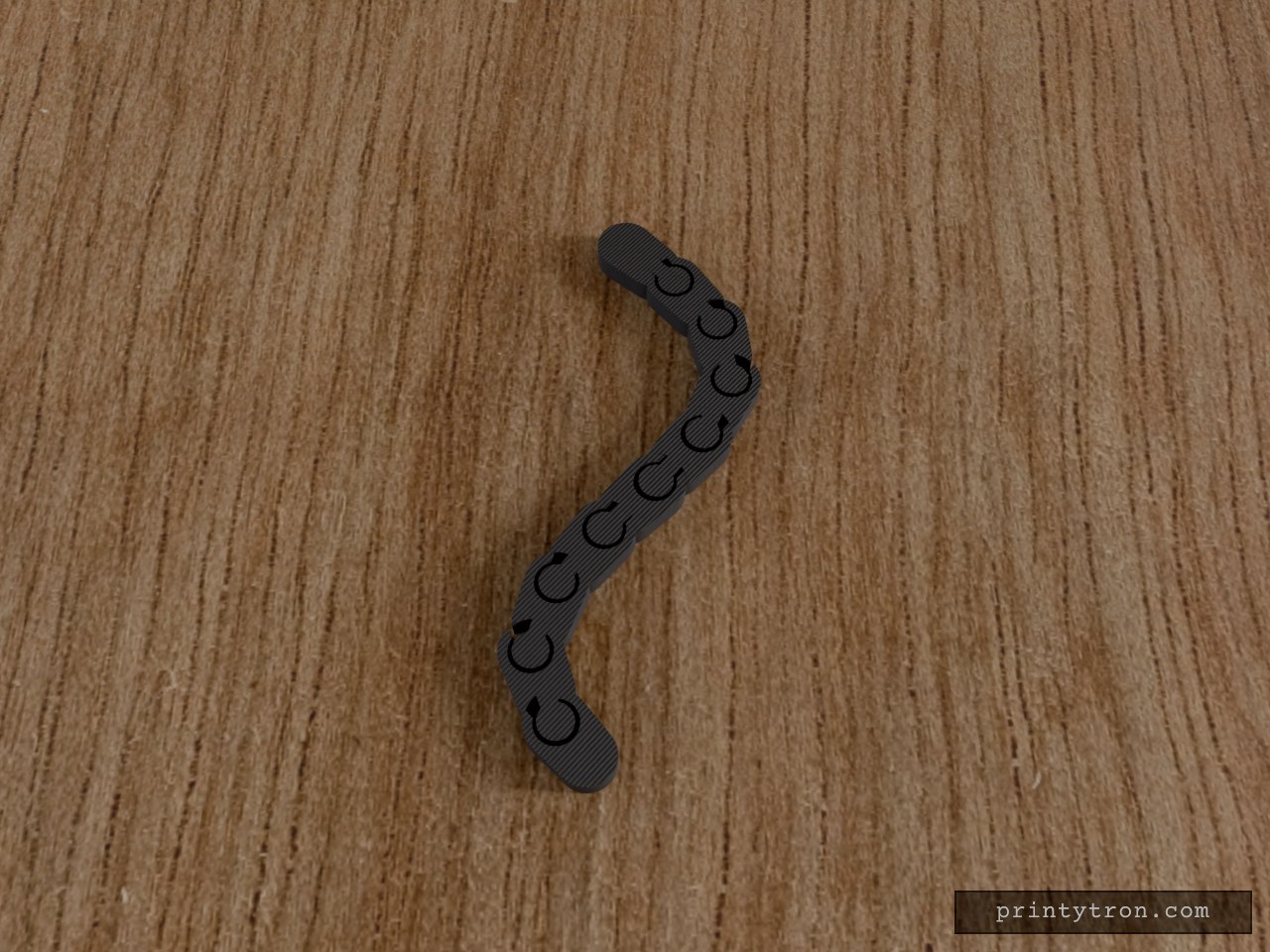
Articulated Flat S-Shaped Snake
A flat snake made of separate links joined by knob-and-socket joints, laid out in an S shape. Each link is 3 mm thick with smooth rounded outlines and no extra detail. Links print already connected, with clearance in each joint Flat on the bed, no supports needed Links pivot in the plane, so the snake can be bent into other curves Plain solid links, no surface detail Use a small layer height and check that the joints move freely after printing.
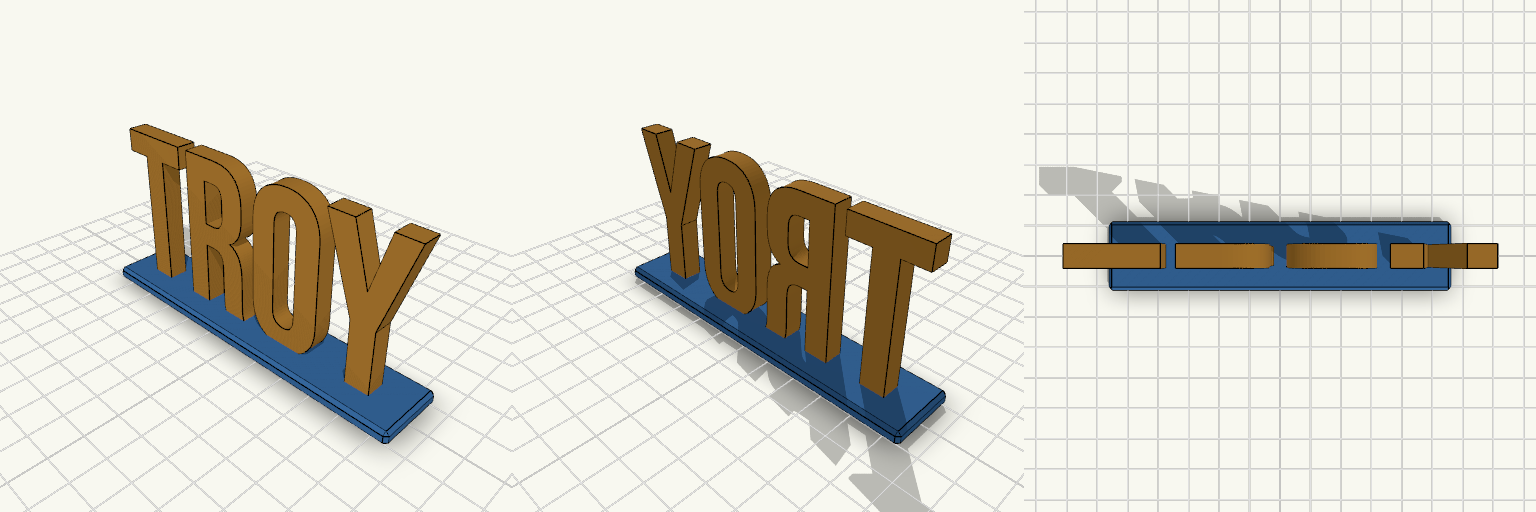
Marquee Block TROY Name Stand
Tall condensed capitals in a movie-poster, marquee style, standing 50 mm high on a slim chamfered plinth. Letters are fused to the base so the whole thing prints as one sturdy piece. Letter height: 50 mm, Bebas Neue lettering Base: 60 x 22 x 4 mm with chamfered edges Prints flat on the base, no supports needed Pairs well with a desk, shelf or door-side display
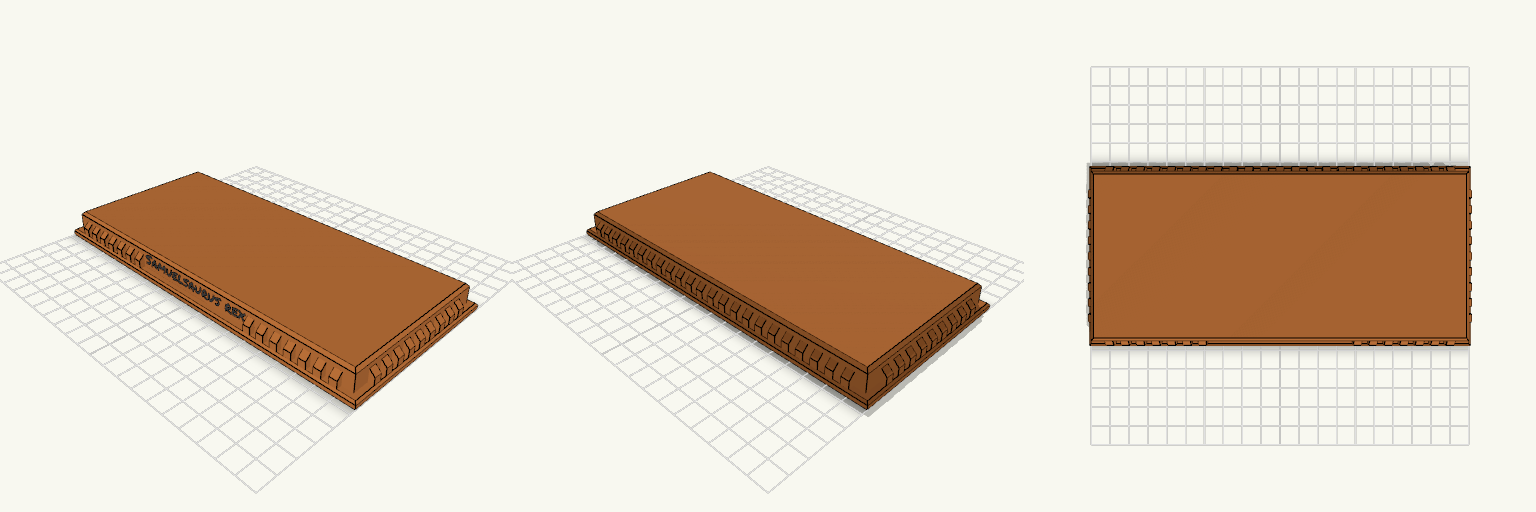
Saurbase — Flat-Top Dinosaur Display Plinth
Saurbase is a display plinth built to give a model dinosaur — or any figure that deserves a proper stage — a base with real presence. The top is deliberately left flat and uninterrupted, so placement stays entirely up to you: set the figure where it balances best, or glue it down once you're happy with the stance. Around the sides, a cornice-inspired profile does the decorative work: a stepped base, a band of dentil blocks and a flush cap give the silhouette the look of a museum pedestal rather than a plain slab — and because the cap sits flush with the recessed core, the whole profile steps inward as it climbs, with nothing hanging over empty space. The front long side carries the name “Samuelsaurus rex”, engraved into a plain stretch of wall and filled with a dark grey inlay so the lettering reads in a second colour without taking any space from the top. Dimensions Footprint: 200 × 94 mm Height: 14 mm Base: 3 mm step with a small top chamfer Dentil band: 4 mm square blocks on 8 mm spacing, running around all four sides, with 45° cuts across the block tops; cleared along a 72 mm stretch on the front long side for the nameplate Cap: flush with the recessed core, with a 1.5 mm chamfer on its top edge Top face: flat, no recesses; flat glue area about 189 × 83 mm Nameplate: text 6 mm high in Permanent Marker style, engraved 0.6 mm deep on the front long side with a matching inlay filling the cut Name text inlay: about 73 × 0.6 × 6.4 mm, sitting flush with the front wall Features Cornice-style edge detail that reads as classical trim without any fussy undercuts Dentil blocks on all four sides slope from their outer faces up into the band above, ending smoothly instead of with a flat shelf Every block sits inside the lower bevel, its outer face stopping where the bevel starts, about 1 mm in from the plinth edge Inward-stepping profile throughout, so no part of the trim overhangs open space Broad 200 mm length leaves room for a tail and head to overhang the body Flat top accepts glue or double-sided tape for a semi-permanent mount “Samuelsaurus rex” nameplate on the front wall, outside the figure area The plinth and the name text are separate coloured pieces in one model, ready for a multi-colour print Nameplate The lettering sits on the front long side, centred on a 72 mm stretch where the dentils are left off. It is cut 0.6 mm deep and filled by a matching inlay that sits flush with the wall, so the text shows as a dark grey band against the plinth body. Because it lives on the vertical side wall, it takes nothing from the glue area on top. Print notes The geometry needs no supports: the cap sits back over the dentil band rather than out past it, every step moves inward as it rises, and the 45° dentil tops remove the flat ledges. The corners between the long and short sides are tight at this scale, so check them in your slicer preview. The dentils are sized to print cleanly — going smaller will lose definition. The nameplate is a vertical wall cut, so it needs no supports either; at 0.6 mm deep the text spans only a few layers, so assign a black or dark grey filament on those colour-change layers. Permanent Marker lettering is loose and uneven, so check the text length against the 72 mm cleared stretch; if thin strokes print rough, a slightly larger letter size or deeper engraving will help. A slightly denser infill keeps some weight in the base so the plinth doesn't tip when a figure is set on it.
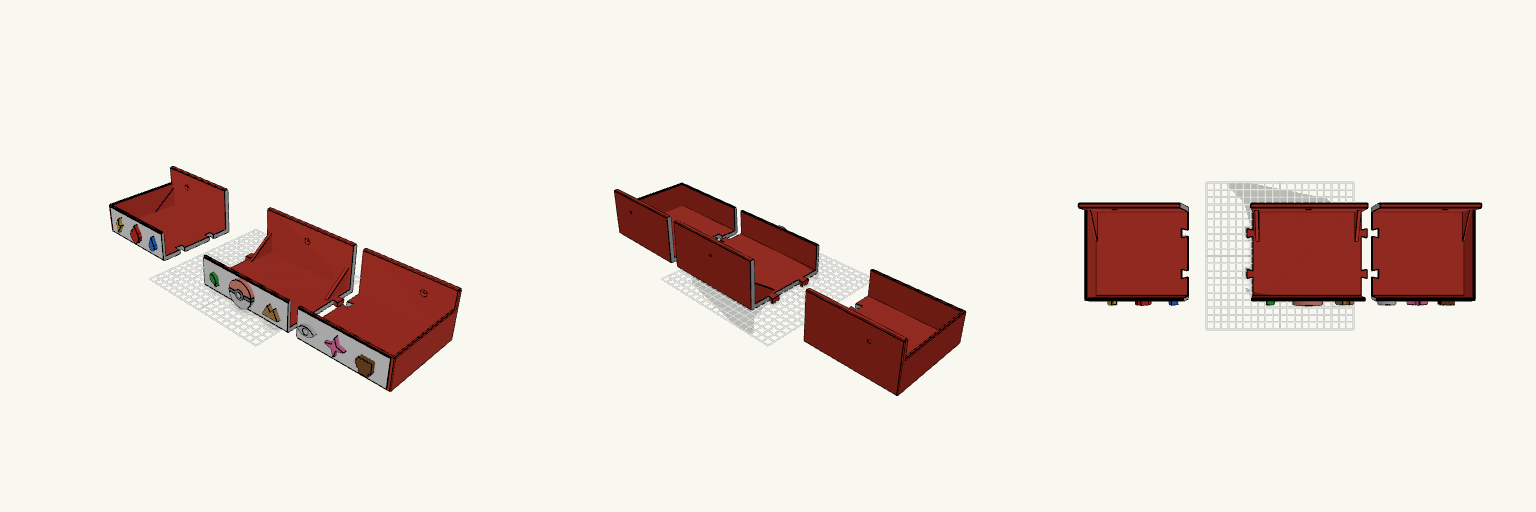
pokemon shelf in three peices
A 400 mm wall shelf that splits into three printable sections, joined with dovetail tongues and glued together. Each piece fits a typical build plate. The shelf has closed ends, a front lip with a white panel, a raised Poké Ball and raised type symbols (electric, fire, water, grass, ground, psychic, fairy, fighting). It hangs on three countersunk screw holes. Remix hooks Cut positions: the splits sit at x = ±73 mm, giving pieces about 127 / 146 / 127 mm wide. Move them to balance piece widths, but keep them clear of the symbols and gussets. Joint size: each dovetail is 8 mm long and tapers from 8 mm to 12 mm wide, with 0.3 mm of clearance. Increase the clearance for a loose printer and decrease it for a tight one. Joint count: two tongues per seam, at y = -35 and y = -90. Add a third for more glue area. Print spacing: the pieces are laid out with a 15 mm gap. Set it to 0 to see the assembled shelf. Pairs with: CA glue or two-part epoxy for the seams, and No. 8 / M4 screws for hanging.
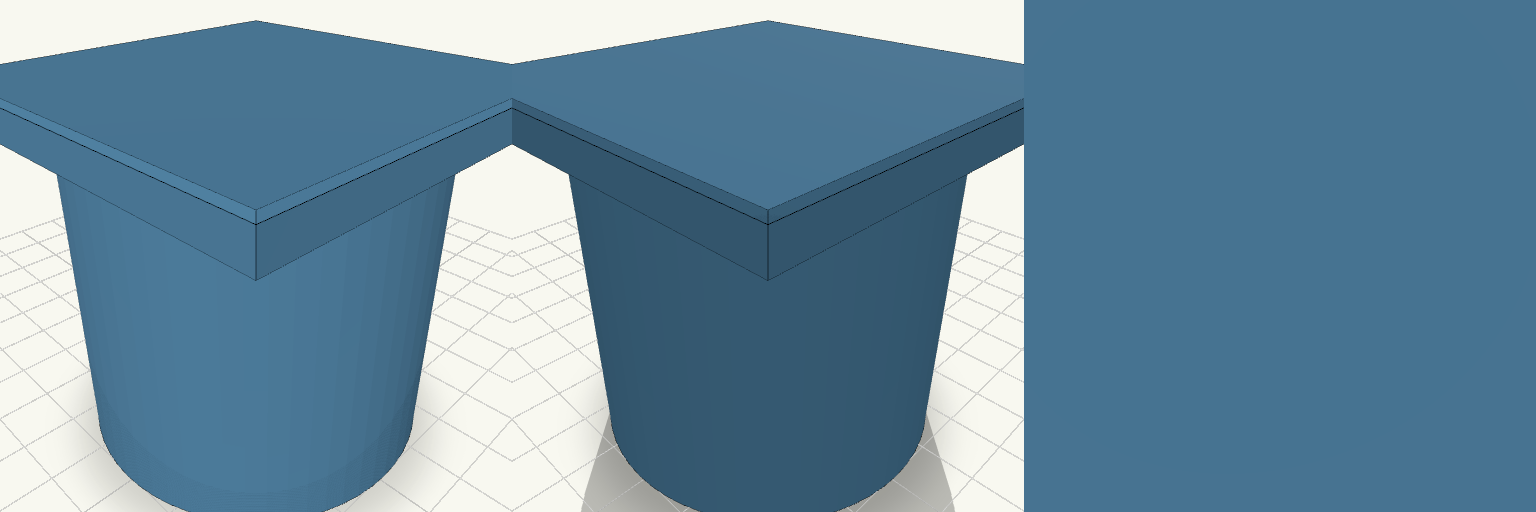
Base tpost
PostCrown is a push-on cap that gives a metal T-post a flat, wider, squared-off top and covers its sharp edges. A round body carries a round socket hollowed out from below, and a solid square platform caps it off — a clean, sturdy profile that slips over the post and presents a full 1/4-inch slab of material on top. The body is a 62 mm cylinder with a 56 mm bore, leaving walls about 3 mm thick; the bore runs up to the platform and stops there, so the top stays solid rather than becoming a ring with a hole through it. Because the bore is round, it clears the flat faces and raised humps of a T-post with room to spare, making this a slip-on fit rather than a press-fit. Dimensions Overall height: 2.5 in (63.5 mm) Overall footprint: about 68 × 68 mm Top platform: square, 68.35 mm per side, 1/4 in (6.35 mm) thick, solid Body: 62 mm diameter cylinder Socket: round, 56 mm bore, open at the bottom and closed under the platform Wall thickness: about 3 mm around the bore Features Round socket hollowed from underneath, so the cap drops onto the post and seats without force Solid, full-thickness 1/4-inch platform on top — not a ring with a hole through it Square platform sized 1/4 in (6.35 mm) larger than the body all round, giving a consistent overhang on every side Body walls around 3 mm, thick enough to hold up in use and to print cleanly Prints as one piece with no supports when oriented platform-down Print notes Print platform-down: the socket opens upward that way and needs no support The bore was set from typical T-post dimensions rather than a measurement of a specific post, so check your post's widest point if a snug or loose fit matters Compatibility Intended for common metal T-posts; the round bore is oversized to clear the post's humps and ridge, but posts with heavier flanges or thicker ridges may still need the socket adjusted
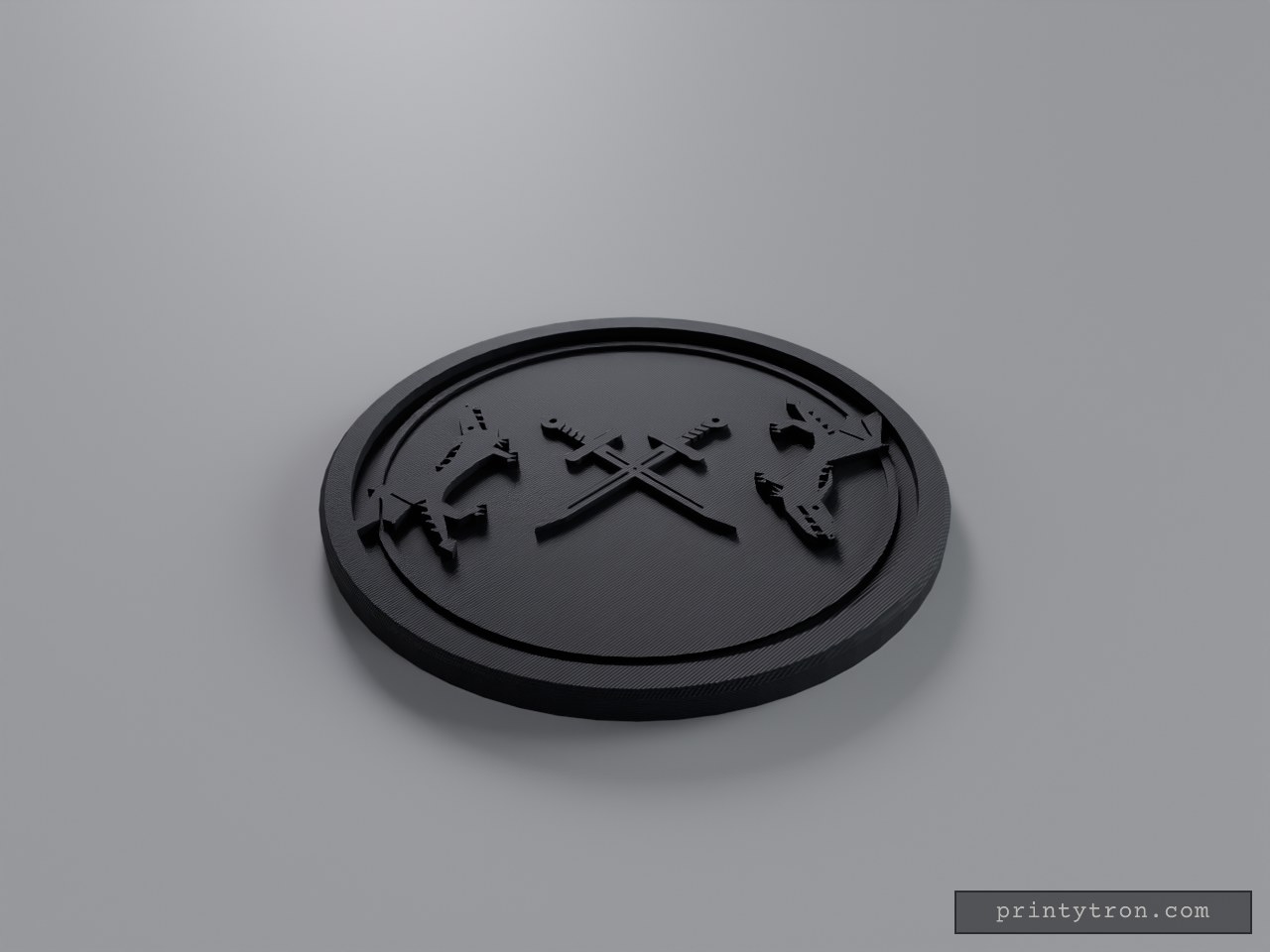
Dragonguard Crossed Sword Coaster
A coaster out of a dragon-hoard fantasy: two winged wyverns circle a pair of crossed longswords, all raised from a recessed floor inside a thin rim. The dragons carry spined backs, scaled flanks, ribbed bat wings, clawed legs and horned, toothed heads. The swords have fullers, curled quillons, wrapped grips and gem-socket pommels. Single-colour print, flat base, no supports needed 100 mm diameter, 5 mm tall, with a raised rim to hold a glass steady Relief is 1.1–1.7 mm above the floor, so the detail stays readable at 0.4 mm nozzle width Pairs well with a dark filament and a felt or cork pad underneath
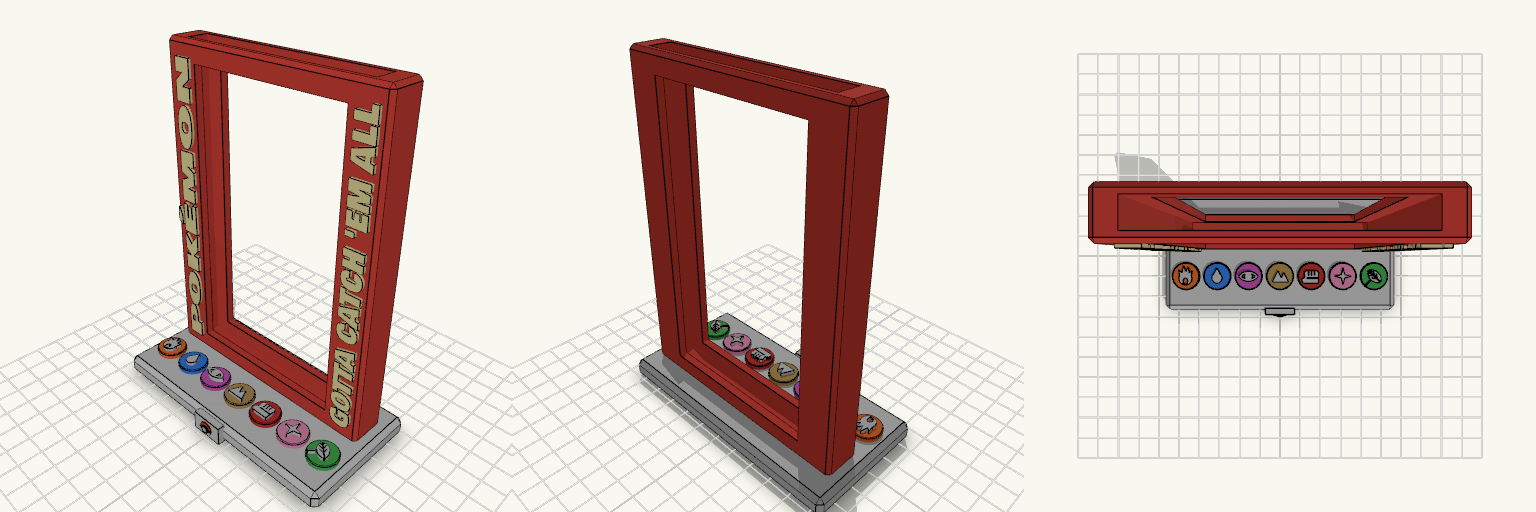
Pokéball Trainer Graded Card Stand 2 cgc
Freestanding display stand for a CGC graded card slab, with a Pokéball button on the base front and seven element badges. The slab drops into an open-top pocket in the frame, and the frame sides carry vertical POKÉMON and GOTTA CATCH 'EM ALL lettering. Base: 110 mm wide, 8 mm tall, with a raised plinth carrying the Pokéball button Pocket: 84 mm wide, 9.5 mm deep, open at the top Badges: fire, water, psychic, ground, fighting, fairy, grass on 13 mm discs, icons raised 1.5 mm Frame: 100 mm wide, 145.5 mm overall height Pokéball plinth overlaps the button back so the two print as one piece
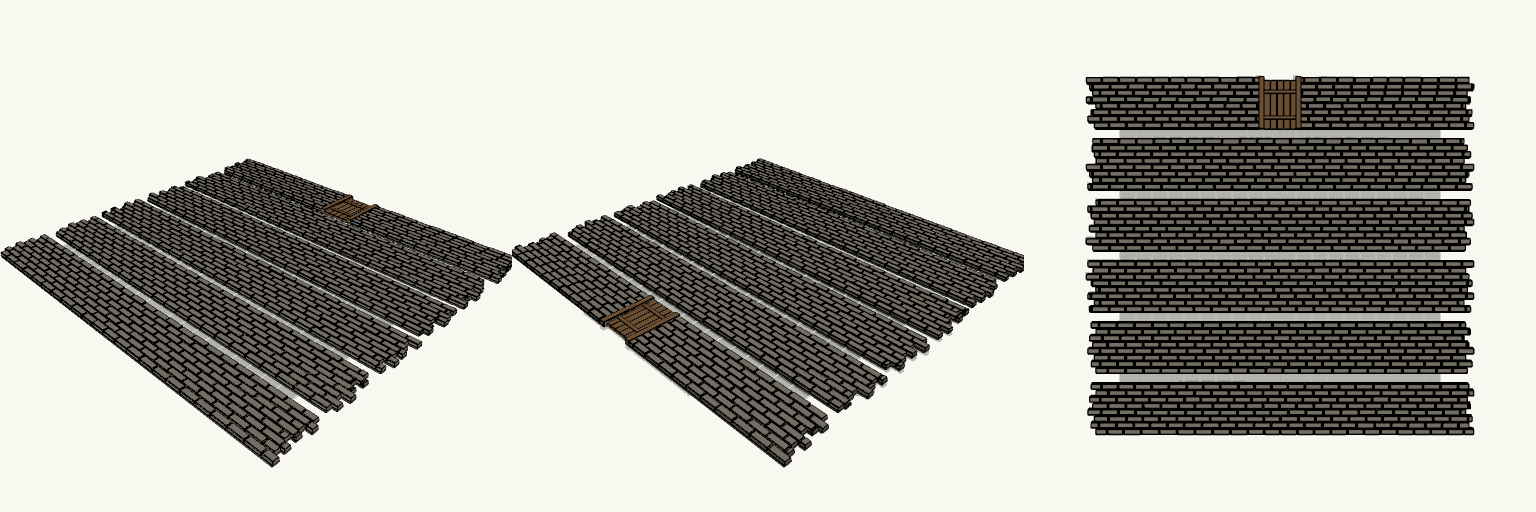
Cobble Run — Joinable OO Stone Walls flat stones
Brickline is a set of six thin, bendable garden wall panels in OO scale, laid out flat on a single Bambu A1 plate. Each panel is 240 mm long and 32 mm high (8 ft at 1:76), with chamfered brick blocks in a running bond on a 0.8 mm backing. Features Six walls, each with its own random brick pattern Stepped end profiles, different at each of the five joins, so walls mesh without a straight seam Bricks stand about 1.5–2 mm proud of the backing Wall six carries a single 20 mm plank gate with a framing post on each side Print notes Print flat, backing down PETG or TPU suits gentle curves Walls are spaced 38 mm apart on the plate
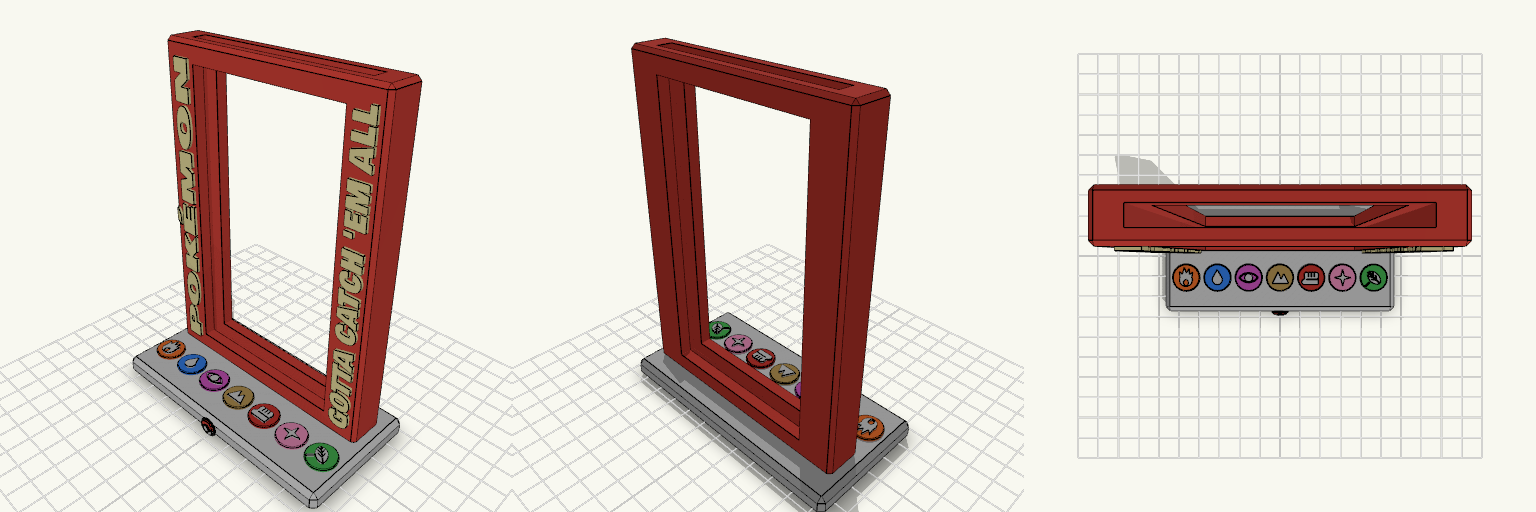
Pokéball Trainer Graded Card Stand 2
A Pokéball-themed display stand for a graded card slab, with a red frame, a white base and a row of seven raised elemental badges: fire, water, psychic, ground, fighting, fairy and grass. The slab drops in from the top and lifts out for easy swapping. A tall front window shows the card. "POKÉMON" and "GOTTA CATCH 'EM ALL" run up the two sides, and a small Pokéball button sits on the front of the base. Design notes Frame 100 mm wide on a 110 mm wide base Slot 135.5 mm tall, open at the top Window 70 mm wide, with equal margins at top and bottom Badges are 13 mm discs with fine raised icons
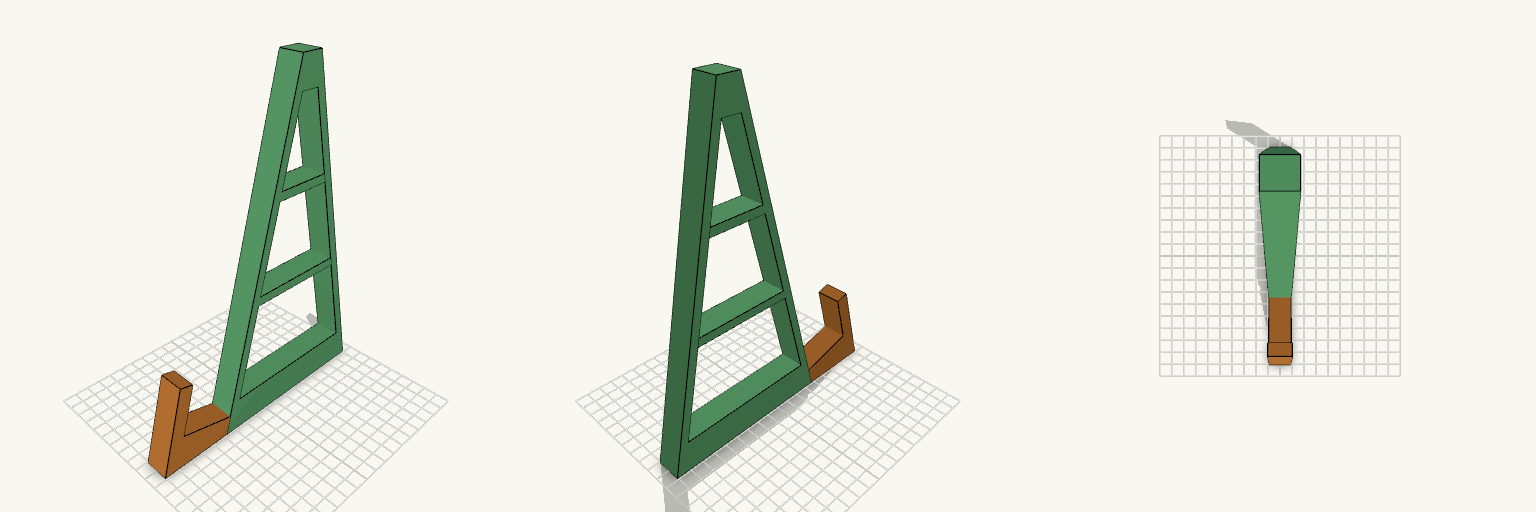
v2
What it's for A single side support for displaying a 260 × 400 × 40 mm slab with its large face tilted back 15°. Print two and mount them 180 mm apart to hold the slab. Dimensions Width: 18 mm Depth: about 176 mm (Y -26 to 150) Height: about 246 mm Tilt: 15° Remix ideas Add a crossbar to join two copies. Deepen the hook for heavier slabs. Add a foot for extra stability.
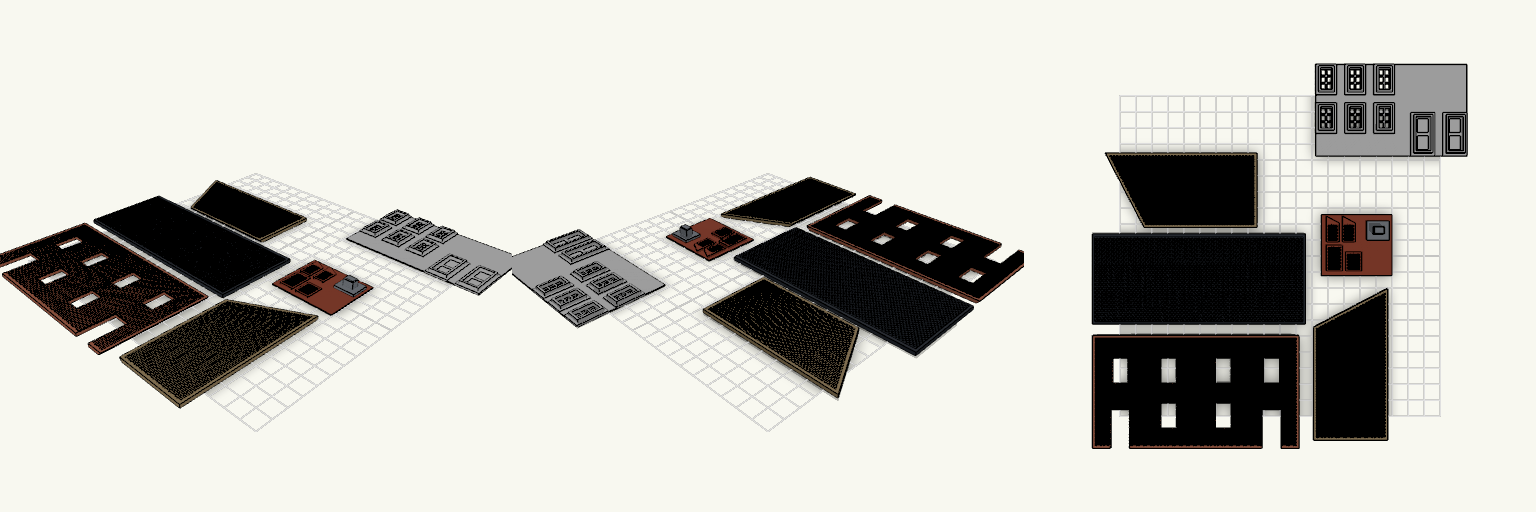
OO Gauge half relief house Kit With Fittings
Half-relief OO gauge (4mm to the foot) house kit in flat-pack form: brick-faced front wall, two sloped gable ends, a tiled roof panel and a flat-pack chimney, with one-piece window and door units. What it fits Window units for the 10 × 16 mm openings (six supplied). Door units for the 12 × 24 mm openings (two supplied). Each unit is a frame with its sash or door leaf fused inside, with a 1.5 mm flange and a liner that sits in the opening with 0.3 mm clearance. Check before printing Measure the wall openings: 10 × 16 mm for windows and 12 × 24 mm for doors. The sashes and leaves are 0.8 mm thick and fragile, so print the units flange-down. Does not fit Openings of any other size. The kit is scaled to 4mm to the foot only.
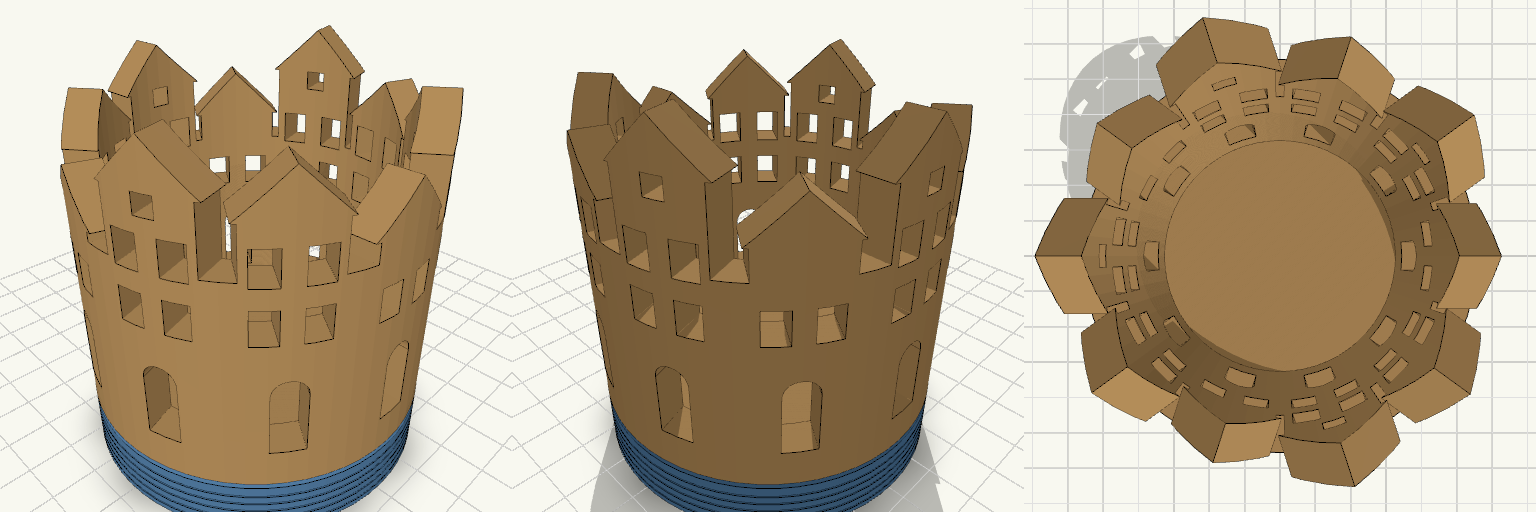
Häuser-Windlicht mit gerilltem Sockel
Rundes Windlicht aus zehn aneinandergereihten Häusern unterschiedlicher Höhe, mit Giebeldächern, Türen und Fenstern, durch die das Licht scheint. Es steht auf einem runden Sockel mit feinen horizontalen Rillen. Alle Teile haben denselben Außendurchmesser, der Übergang vom Sockel zum Windlicht ist bündig. Außendurchmesser: 74 mm, überall gleich Innendurchmesser: 60 mm Sockel: 14 mm hoch, massiv, mit eingravierten Rillen von 0,5 mm Breite Glatter Streifen über dem Sockel: 8 mm hoch, Platz für ein 5 mm breites Schleifenband Zehn Häuser mit Türen, Fenstern und Giebelfenstern Für Teelicht oder LED-Kerze
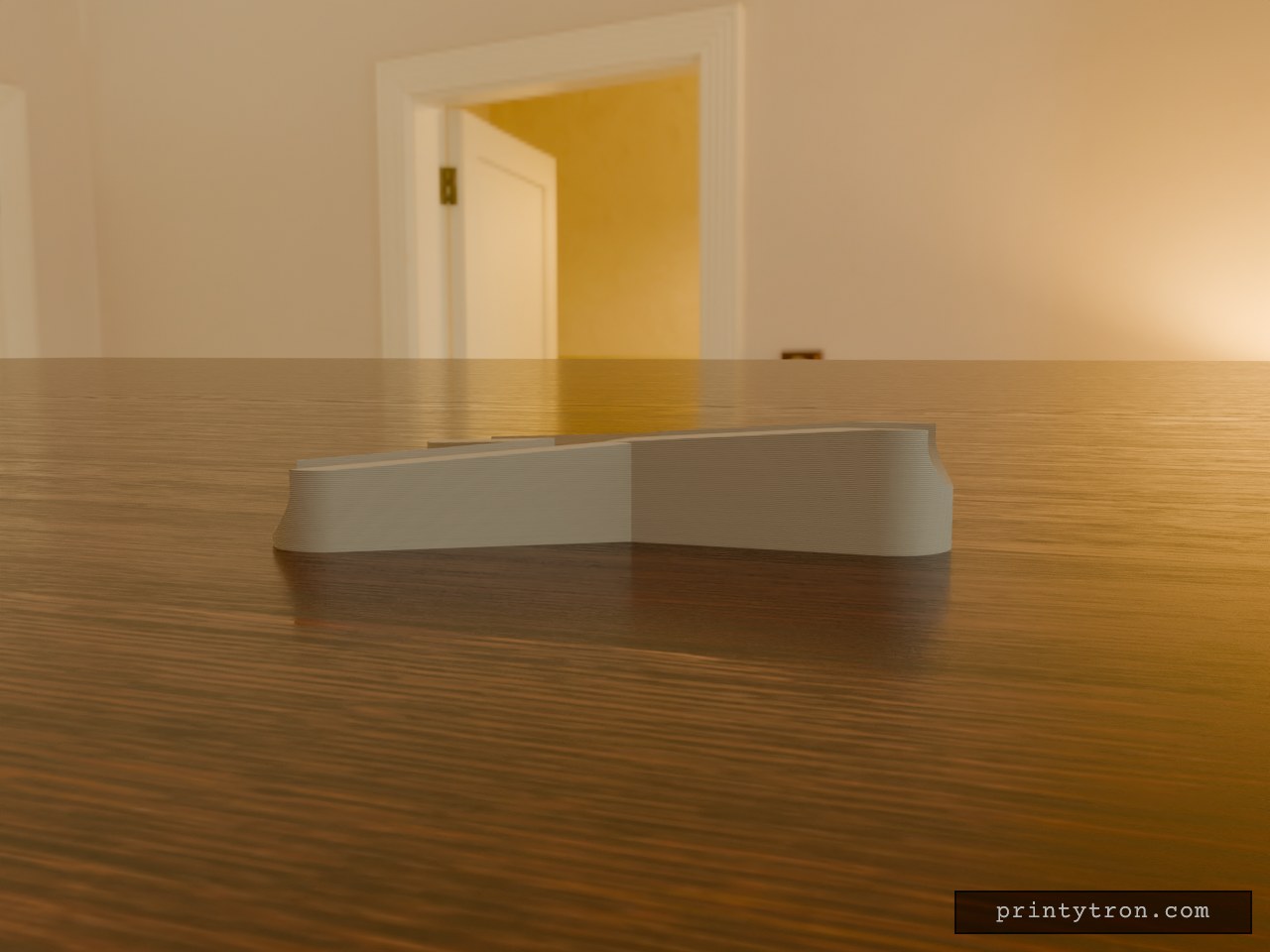
Open Passthrough Y-Splitter Marble Track
A Y-splitter track piece for 16 mm marbles: one inlet channel splits into two outlets, all three ends open so pieces can run end to end. The channels are open-top U grooves (9 mm radius) with 3 mm walls and a 3 mm floor, and the underside is one flat face at z=0, so it prints with no supports. Remix hooks Channel radius R (9 mm): change for other marble sizes; keep it about 1 mm over the marble radius. Wall W (3 mm): thicker walls stiffen the piece; the floor follows z0 = 3 + R. Slope (slope 0.07, about 4°): raise for faster marbles, lower for gentler runs. Branch points A and B (±30, 50): widen or narrow the Y. Tabs: the 14 × 9 × 3 mm flat tabs at the outlets could become dovetails or pockets in the channel wall. Pairs well with straight and curved track sections sharing the same radius and wall.
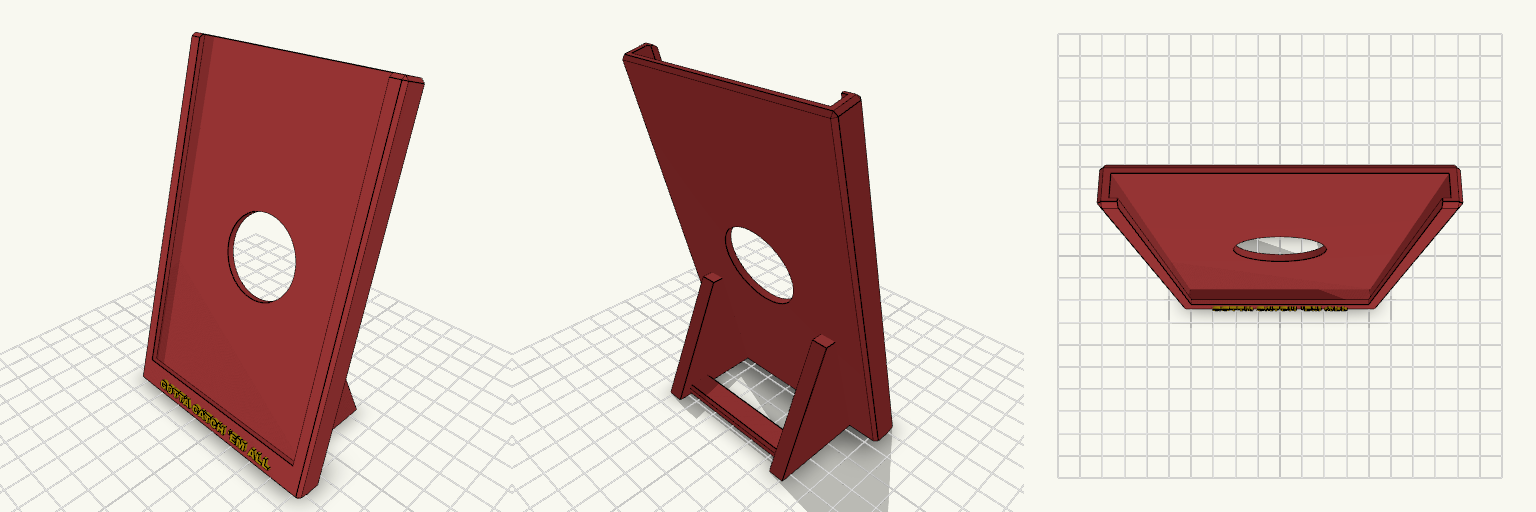
PSA Graded Card Holder with Stand 3
Pokemon-themed holder for a PSA graded card slab, with a built-in rear stand. The slab drops in and lifts out from the top, with no change to the slab. Pocket: 85.6 x 8.4 mm, about 0.3 mm clearance per side Front window with an 11 mm chin carrying the text and Pokeball 32 mm thumb push-out hole in the back, centred at Z 69.18 mm 15 degree recline on two rear gussets Small snap bumps on the side walls hold the slab
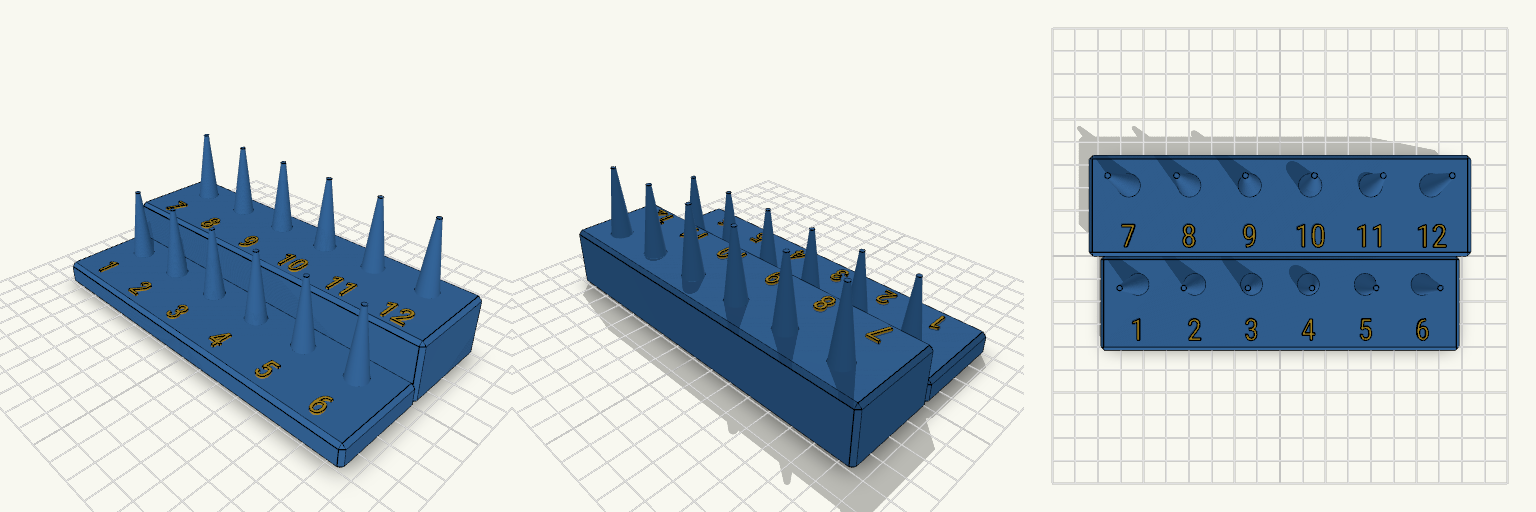
Auction House Tiered Bead Stand
A two-step display riser in the spirit of a jewelry-counter showcase, built for live-stream bead auctions. Twelve tapered cone rods hold beads upright, and the slim tip to wide base fits a range of hole sizes. Raised numbers 1–12 sit in front of each rod, designed to print in a contrasting color so they read clearly on camera. Front tier: beads 1–6, low step Back tier: beads 7–12, raised so every bead stays visible Rods: 9 mm base tapering to 2 mm tip, 30 mm tall Numbers: separate color body, 1 mm raised; swap filament or use a color change at the layer Footprint: about 152 × 80 mm
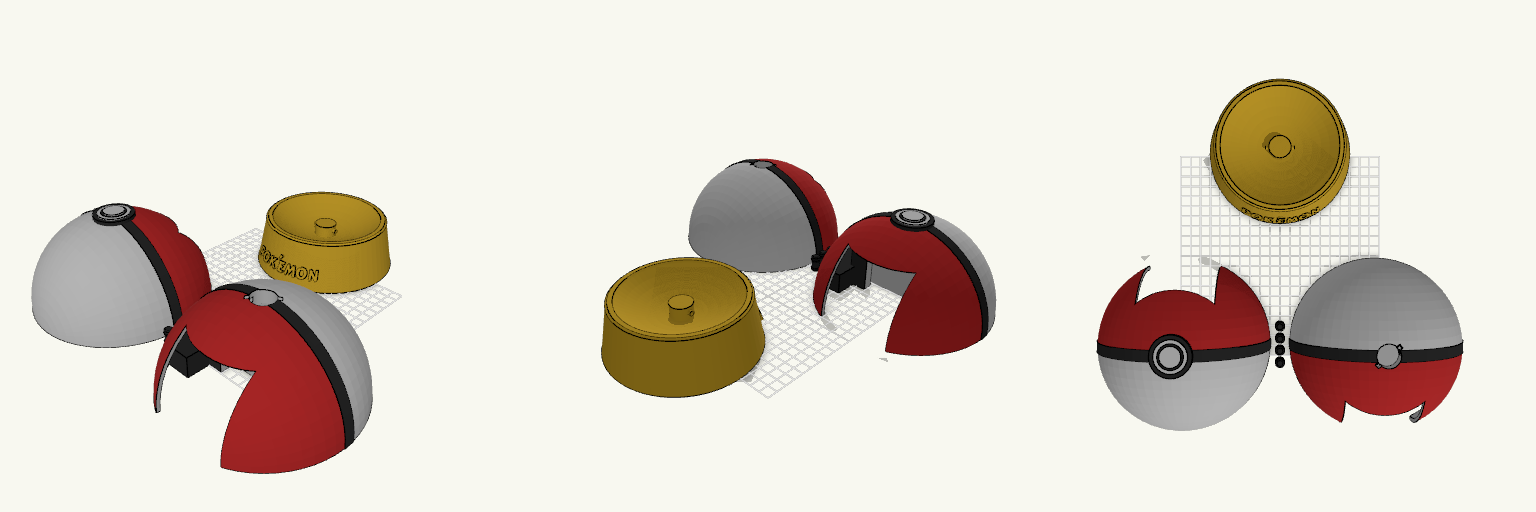
Apex Ball — Twist-Lock Card Case With Stand
Apex Ball is a Pokéball-style display case for a graded card slab, with a matching cradle stand that locks to the ball. Features Hollow two-half shell with a 80.45 × 135.8 × 6.52 mm slab pocket Tiny retaining ribs on the pocket side walls to grip the slab Viewing window on the red half; the white half is solid Snap-fit link pins join the halves Layered Pokéball button Twist-lock socket in the dome opposite the button Stand with a raised POKÉMON lettering and a locking post Print notes Use at least 3 perimeters for the shell. Check the post-and-peg fit and the pin snap first.
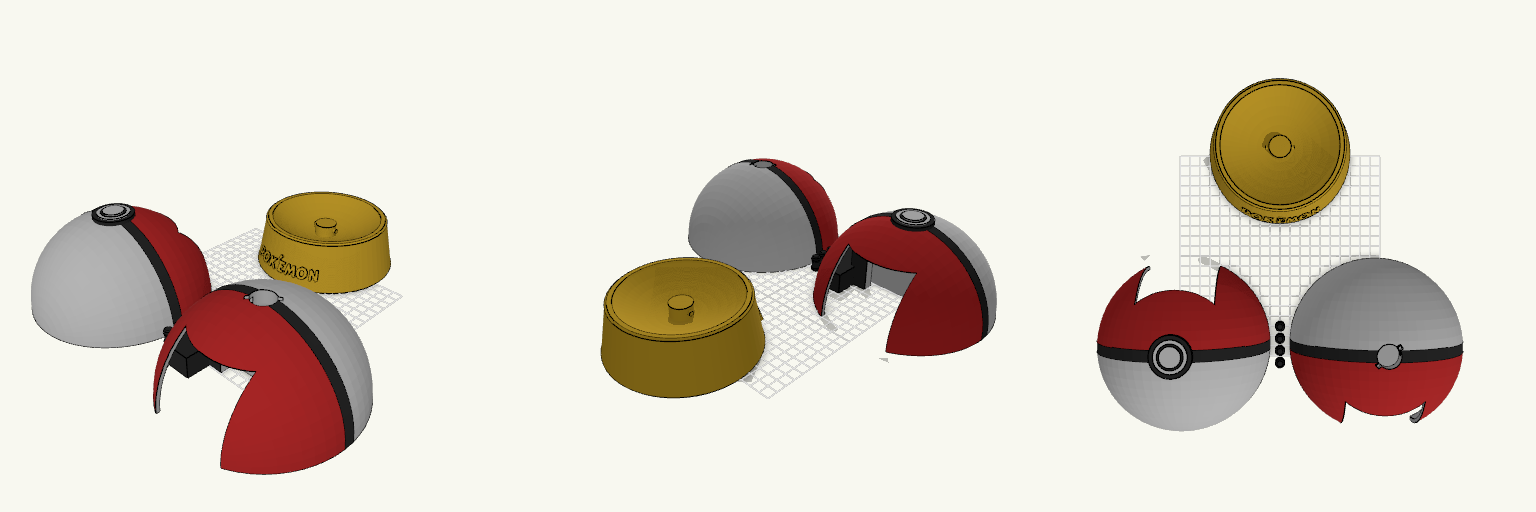
Apex Ball — Twist-Lock Card Case With Stand
Apex Ball is a Pokéball-style display case for a graded card slab, with a matching cradle stand that locks to the ball. Features Hollow two-half shell with a 80.45 × 135.8 × 6.52 mm slab pocket Tiny retaining ribs on the pocket side walls to grip the slab Viewing window on the red half; the white half is solid Snap-fit link pins join the halves Layered Pokéball button Twist-lock socket in the dome opposite the button Stand with a raised POKÉMON lettering and a locking post Print notes Use at least 3 perimeters for the shell. Check the post-and-peg fit and the pin snap first.
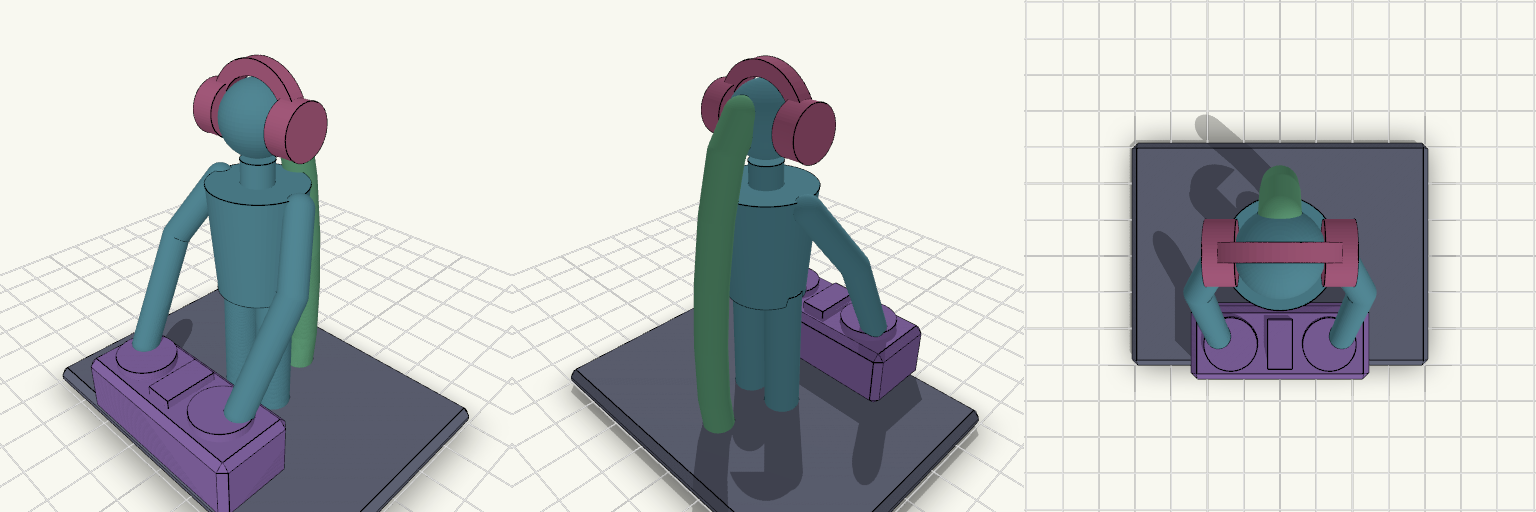
Deckhand — Standing DJ Figure Statue
Deckhand is a free-standing DJ figurine: an original character with oversized headphones, arms reaching to a twin-platter deck, and a long braid that runs down to the base as a rear support. Everything is fused into one solid piece on a chamfered plinth, so it prints without assembly. Features Single welded body, no loose parts Wide 80 x 60 mm base for stability Braid doubles as a rear brace Twin-platter deck fused to the base and the hands Print notes Print upright; supports help under the arms and headphones Roughly 80 mm tall
Need a part that doesn't exist yet?
Start building →