3D-printable storage & organizers
Boxes, wallets, dispensers, holders and carriers sized for real contents. Browse what makers built, or describe the exact organizer you need and Printy makes it.
Need one that fits your exact measurements? Start building →
Newest
Vizio XRT140 Remote Holder Brick
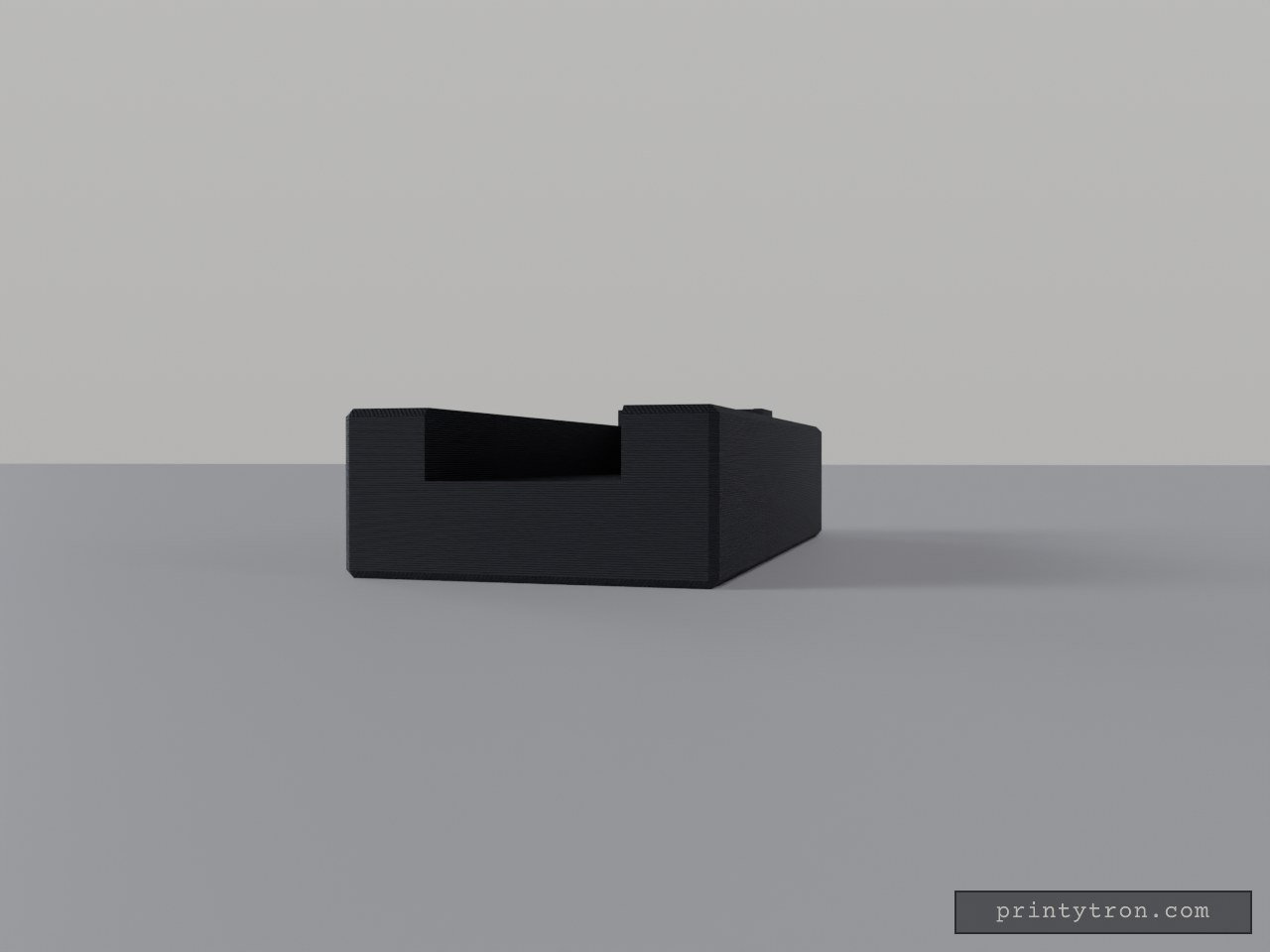
A solid brick-shaped holder sized for the Vizio XRT140 TV remote, made to keep the remote from disappearing into a couch. The remote lies in a channel running the length of the top and drops into a closed pocket at the bottom end. The opposite end of the channel is open, so the sensor end of the remote stays unobstructed and the remote can slide out that end as well as lift out. The body is 90 mm wide and 185 mm long, with a 40 mm brick body; the pocket is raised as a hood above the top face so it keeps its full depth while the channel is set to the depth you asked for. Overall size: 90 × 185 mm footprint, 40 mm brick body, 46 mm tall at the highest point of the hood Remote channel: 47 mm wide, 171 mm long, 17 mm deep, so the floor sits 23 mm up and a 19 mm remote sits about 2 mm below the top surface Bottom pocket: 47 × 20 mm opening, 17 mm deep, closed at the bottom end by a 3 mm strap and raised above the brick as a hood that tops out 6 mm above the top face Pocket clearance: 1 mm over a 19 mm thick remote, so the fit is snug — open the opening up to 21 mm if it binds in your print Sensor end: the channel runs out through the end of the brick, leaving the front of the remote clear; the remote can slide out that end as well as lift out Fit: sized for a remote about 170 mm long, 45.15 mm wide and 19 mm thick Button clearance: the pocket stops about 2 mm short of the first button row at 19 mm from the bottom end Use: couch-side or tabletop holder that keeps the remote in one place and easy to spot Measure your own XRT140 before printing, and scale the pocket opening and channel if it differs from the figures above.
Pojemnik z nasuwanym wieczkiem
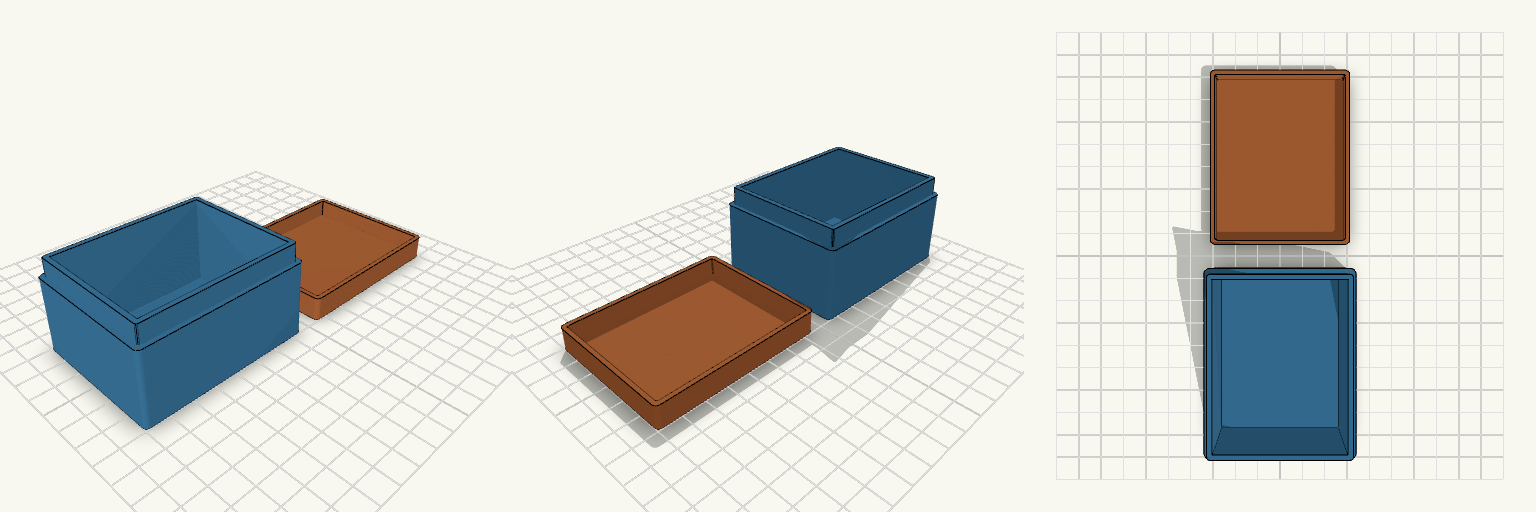
Do czego służy Pusty w środku pojemnik na zapasową baterię CR2032, także w małym opakowaniu blisterowym. Wnętrze nie ma kratki, więc baterię lub całe opakowanie wkłada się do środka i zamyka wieczkiem nasuwanym z zewnątrz, jak pokrywka pudełka. Pojemnik i wieczko to dwa osobne elementy; wieczko nie ma zawiasu ani magnesu, a po nałożeniu jest równe z korpusem na bokach. Wymiary Pojemnik: podstawa 60 × 75 mm, wysokość 40 mm; ścianki i dno po 2 mm. Wnęka: 56 × 71 mm, u góry zwężona do 52 × 67 mm na wysokości 8 mm. Wieczko: 60 × 75 × 10 mm; otwór 56,4 × 71,4 mm, luz 0,2 mm z każdej strony. Po założeniu wieczka całość ma 42 mm wysokości. Opakowanie baterii o grubości niecałe 5 mm mieści się z zapasem. Druk Dwa elementy do wydruku: pojemnik i wieczko — drukują się osobno. Wieczko nasuwa się z zewnątrz; przy zbyt luźnym pasowaniu zmniejsz luz lub zwiększ wypełnienie ścianek. Bez kratki i bez napisów na wieczku. Pomysły na modyfikacje Zmiana wymiarów wnęki pod inne opakowania baterii lub stos. Wersja z kratką na kilka baterii obok siebie. Nacięcie lub uchwyt przy krawędzi wieczka, ułatwiający zdejmowanie. Miejsce na napis lub oznaczenie na wieczku.
Revo7 Armbrust Tischständer
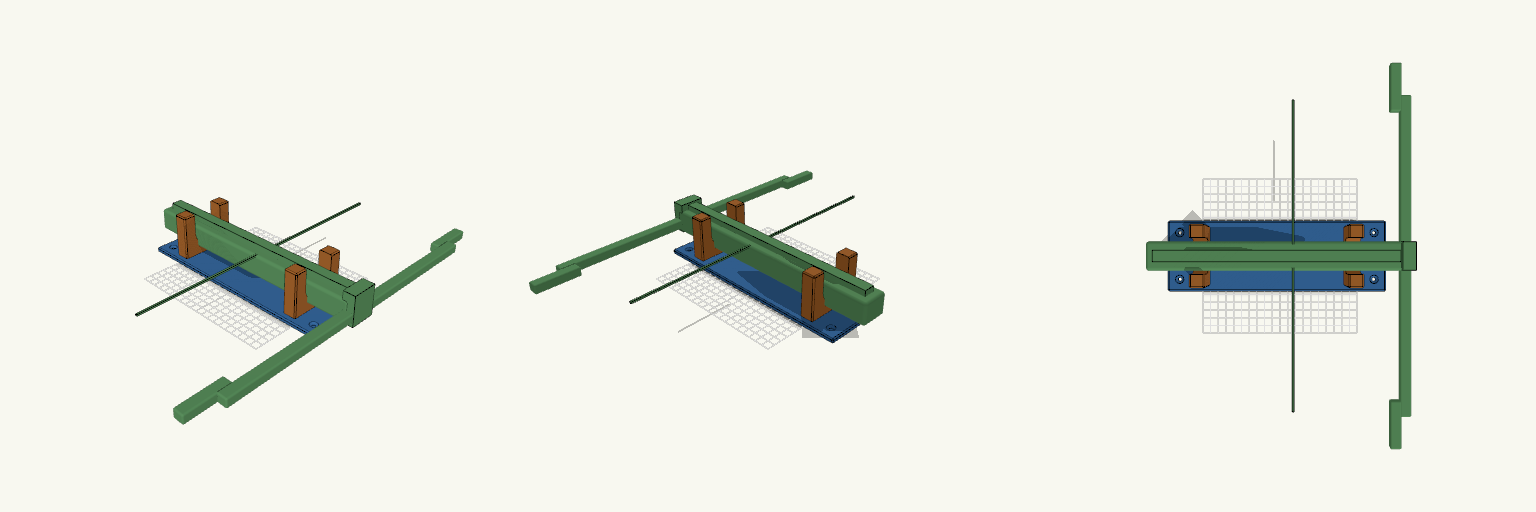
Ein Tischständer im Stil eines Waffenregals: Die Armbrust liegt waagrecht in zwei U-förmigen Auflagen, die auf einer flachen Grundplatte stehen. Die Platte lässt sich mit vier Senkschrauben auf der Tischplatte befestigen. Grundplatte 280 × 90 × 6 mm mit vier Senkbohrungen Zwei Auflagen im Abstand von 190 mm, Aussparung 44 mm breit Grüner Revo7-Platzhalter zeigt die Lage der Armbrust (Maße geschätzt) Auflagen und Abstand lassen sich an die echten Maße anpassen
Logitech G PRO X 60 ISO Keycap Organizer
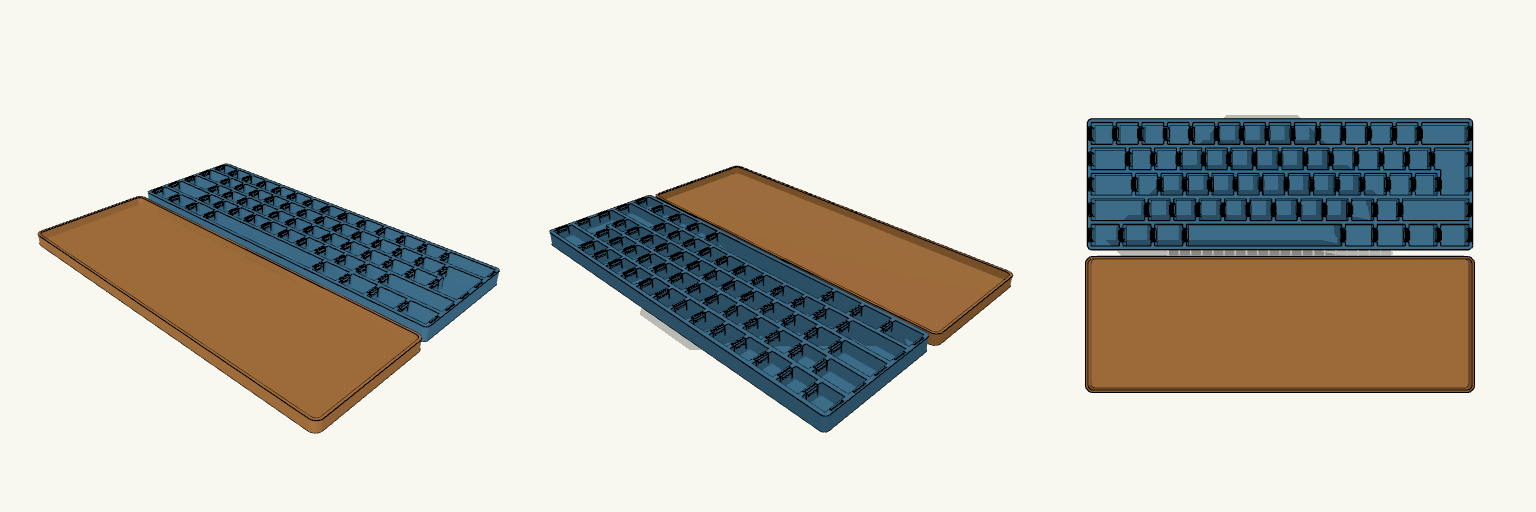
A fully 3D-printable keycap storage organizer for the Logitech G PRO X 60 mechanical keyboard in ISO layout. It keeps the keycap set in keyboard order rather than loose in a bag or tray, with a snap-fit pocket for each keycap and a separate slip-over dust lid. The organizer body and lid print as two pieces; the lid is laid out upside-down beside the body so it prints flat. Fitment Host: Logitech G PRO X 60, ISO version only. The pocket layout follows the 60% ISO rows; it does not fit the ANSI G PRO X 60 layout. Key sizes: 1u, 1.25u, 1.5u, 1.75u, 2u, 2.25u, 2.75u and a 6.25u spacebar pocket. The left Shift pocket is 2.25u. ISO Enter: one L-shaped pocket, 1.5u across the top and 1.25u across the lower step, joined into a single cavity. Retention: each pocket has two thin flexing fingers on the left and right walls, 10 mm wide with a 0.8 mm ramped bump. The fingers are separated by an air gap inside the 3.2 mm wall. Keycaps click past the bumps and pull out by hand. Spares: there is no spare-key row. The organizer holds the keyboard's keycaps in layout order only. Check before printing Pocket pitch is 22.2 mm. A 1u pocket is 19 mm wide, leaving about 0.5 mm per side around an 18 mm keycap base; wider bases will not seat. Pocket depth is 11 mm. Confirm this against your keycaps before printing; the fit has not been checked against physical keycaps. The organizer body measures about 336.2 × 114.2 × 13 mm and the lid 341.2 × 119.2 × 10 mm, with 4 mm rounded corners. Both are over 336 mm long, so a typical 220 mm bed will not fit them; the supplied model is not split into sections.
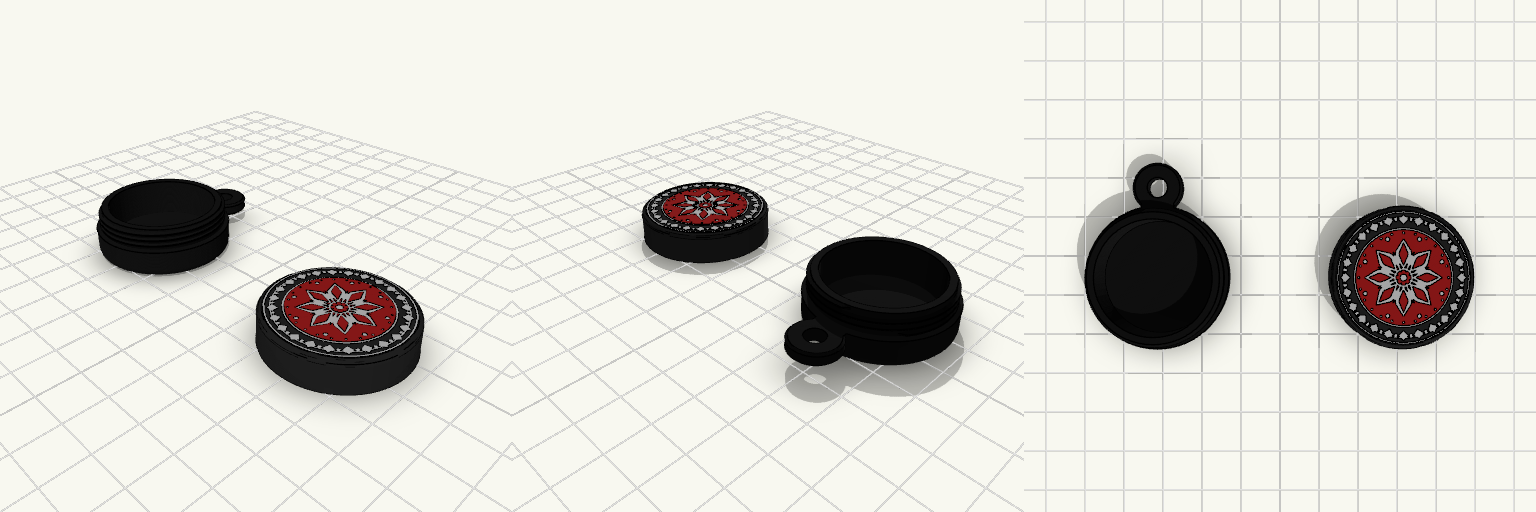
35 mm Turbah Container, Raised Medallion Lid
A 35 mm round screw-top container for a small Turbah, with a black body and lid, a red medallion and white ornament on the lid, and a keychain loop on the base. Fitment Outer diameter: 35 mm, both parts. Thread: 33 mm major diameter, 1.5 mm pitch, with 0.3 mm clearance on the lid. Closed height: 15 mm. Keychain loop: on the base, 5 mm through-hole. Check before printing The cavity is 28 mm across. It will not take a 35 mm Turbah, only a piece of about 25 mm or less. Decoration The red medallion and white ornament stand 0.1 mm above the black lid surface. There is no text. Print with at least 3 perimeters, because the walls around the thread are thin.
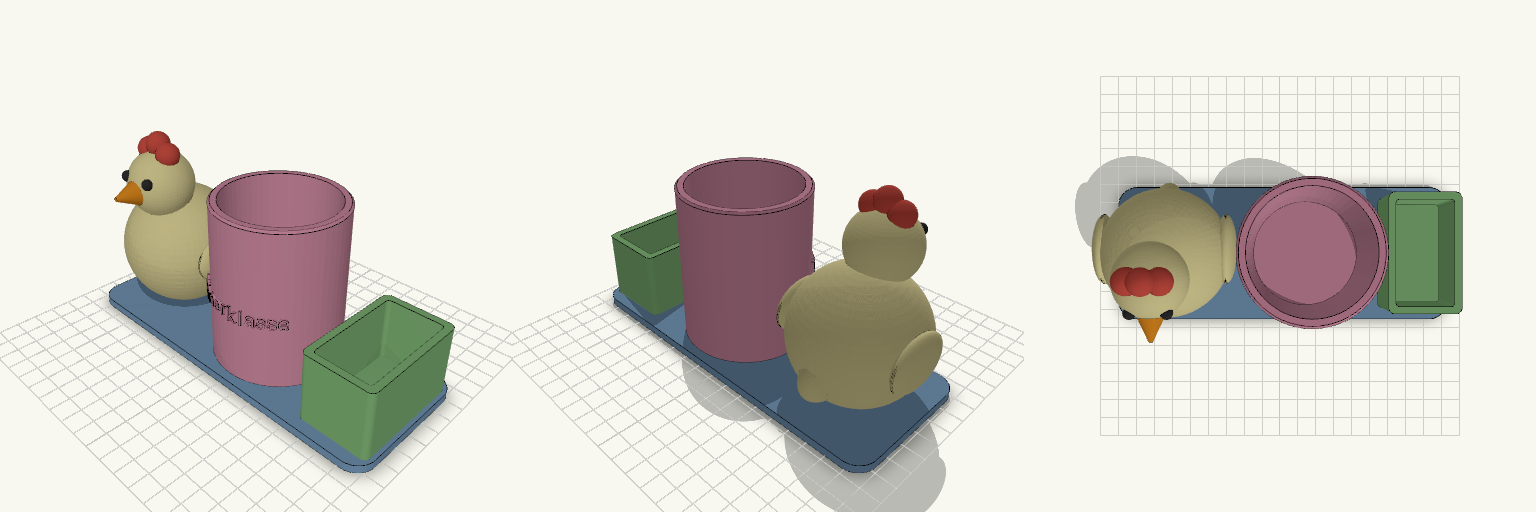
Hühnerklasse: Schreibtisch-Organizer mit Hühnchen
Ein kleiner Hühnerhof für den Schreibtisch einer Grundschullehrerin: Links sitzt ein rundliches Hühnchen mit dreiteiligem Kamm, Kegelschnabel, Augen, Flügeln und Schwänzchen. In der Mitte steht der Stiftehalter als runder Zylinder mit 64 mm Außendurchmesser; die erhabene Aufschrift „Hühnerklasse“ läuft Buchstabe für Buchstabe um seine Vorderseite, sodass sie auf der Rundung liegt und nicht davor schwebt. Rechts daneben bleibt ein niedrigeres, eckiges Fach für Büroklammern und Radiergummis. Alles steht auf einer schmalen, abgerundeten Bodenplatte von 180 × 72 mm und bildet zusammen ein einziges, zusammenhängendes Stück. Das Hühnchen ist vollplastisch gehalten – Kugelkörper, Kopf, Flügel und Schwanz statt flacher Reliefs. Der Organizer ist als ein Teil ausgelegt, das ohne Stützen auskommen soll; an der Unterseite der kugeligen Körperformen sind leichte Überhänge möglich. Die erhabene Beschriftung auf der runden Vorderseite des Stiftehalters bleibt auch nach dem Druck gut lesbar. Maße, die beim Aufstellen zählen Bodenplatte: 180 × 72 mm, abgerundete Ecken, 4 mm stark Stiftehalter: runder Zylinder, 64 mm Außendurchmesser, 80 mm hoch, oben offen, 4 mm Boden, Innenraum ca. 76 mm tief Ablagefach: eckig, 35 mm hoch, geschlossener Boden Hühnchen: rund 86 mm hoch, mit Kamm und Schnabel als klar abgesetzte Formen Passt zu Stiften, Büroklammern und Radiergummis.
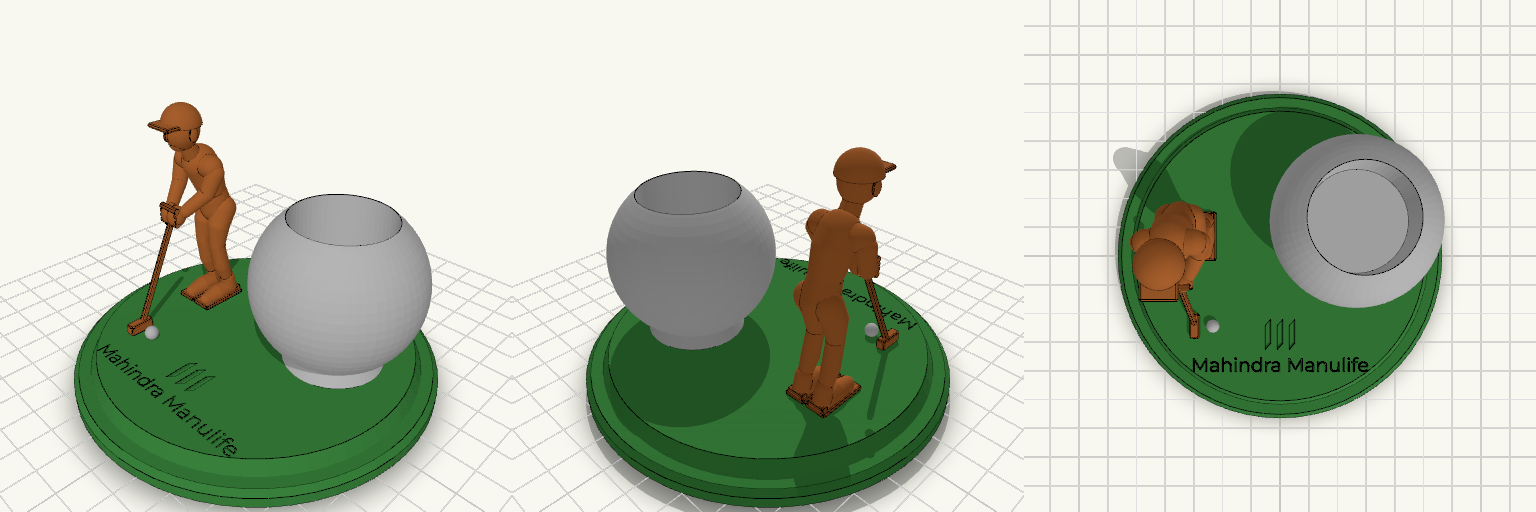
Golf Ball Pen Cup with Golfer Figurine
A desk pen stand built around a small golf scene: a 110 mm round base carries a slim golfer figure toward the back and a smooth golf-ball pen cup at the front-right, with the pen dropping into a 30 mm hole in the top of the ball. The club head sits at ground level on the base. A separate small golf ball, 4.2 mm across, sits on the base about 9 mm in front of the club head. "Mahindra Manulife" is cut into the front edge of the base, 4.5 mm tall and 1 mm deep, reading from the front, with the golfer set back so the club head clears the lettering. Above the text sit three upright parallel marks, each end cut at a slant — top tip pointing up on the right, bottom tip pointing down on the left — 10 mm long, 1.8 mm wide at the middle, 4 mm apart and cut 2 mm deep. The pen cup is a plain smooth sphere about 50 mm across; its golf-ball read comes from the cup shape and context rather than surface texture. The golfer has a slimmer, less muscular build: thinned thighs, calves, upper arms and forearms, a narrower torso and shoulders, and smoother blended limbs. It has a calf bulge, thighs that widen into the hips, a continuous torso from pelvis to chest, shoulders that blend into the upper arms, a slight jaw, a separate neck, ears, a nose, and a cap, with both hands on the grip. The legs and shoes sit inward under the pelvis rather than out at the sides of the waist; the feet are about 7 mm from the centreline and the hips about 6 mm apart. The hands are rounded palms with four fingers wrapped across the grip and a thumb, with no wrist cuffs. Each shoe has a thin flat sole, an upper that tapers from a heel block to a rounded toe, and a short ankle collar. The base, golf-ball cup and golfer are the three named areas of the design. Starting dimensions Base: 110 mm round, 10 mm tall Golf-ball cup: 50 mm across, 45 mm tall, with a 30 mm pen hole Golfer: about 21 mm wide, 42 mm deep and 68 mm tall, set back to clear the front lettering, with the legs under the pelvis and the feet about 7 mm from the centreline Small front golf ball: 4.2 mm across, about 9 mm ahead of the club head Front text: 4.5 mm tall, 1 mm deep Three marks above the text: 10 mm long, 1.8 mm wide at the middle, 4 mm apart, 2 mm deep Remix hooks Base outline is the freest choice. The 110 mm round plate can be trimmed, squared off or stretched into an oval without touching the figure or the cup — just leave a clear arc at the front for the lettering and the marks, and enough surface behind the golfer for the stance. The front text is the easiest thing to make your own: the wording, the 4.5 mm height and the 1 mm depth are all movable, and the three marks above it can be swapped for any shape — a monogram, a club crest, a simple icon. A deeper cut reads more boldly, a shallower one stays crisp on a resin print, and taller letters need a wider clear arc along the front edge. Golfer setback is a real parameter, not a fixed value: moving the figure forward or back trades text clearance against the balance of the composition, and the club head has to stay clear of the lettering. Leg stance is set with feet about 7 mm from the centreline and hips about 6 mm apart; moving them outward changes the silhouette and can make the thighs touch near the top. Golf ball size is the next knob: the 50 mm ball and its 30 mm bore scale together, and the 30 mm bore is already wide for a 50 mm ball — widen it further only if the ball grows with it. Ball surface is an open canvas: the smooth sphere is the neutral starting point, so add your own dimples, a seam ring, a fine pattern, or a painted finish. Keep whatever you add clear of the pen opening. Small front ball is a separate detail: the 4.2 mm sphere and its 9 mm gap can be scaled, moved closer to the club, or swapped for a tee, marker or small flag without touching the cup. Pen hole depth is not tied to any particular pen — set the bore to your own pen length before printing, deep enough to stop it toppling and shallow enough to grab. Golfer details are the obvious swap: change the club for a putter, a flag or a raised arm, re-dress the figure, or thicken the fingers if your printer turns them into a ridged lump — they finish around 1.7 mm across as drawn, and the shoes are about 16 mm long. Pairs with other desk organisers and small pieces: a ball marker dish or a tee tray works alongside it on the same desk. These numbers are a starting point rather than a fixed spec: only the pen bore and the ball wall behind it carry a real constraint; everything else is a dimension you can move.
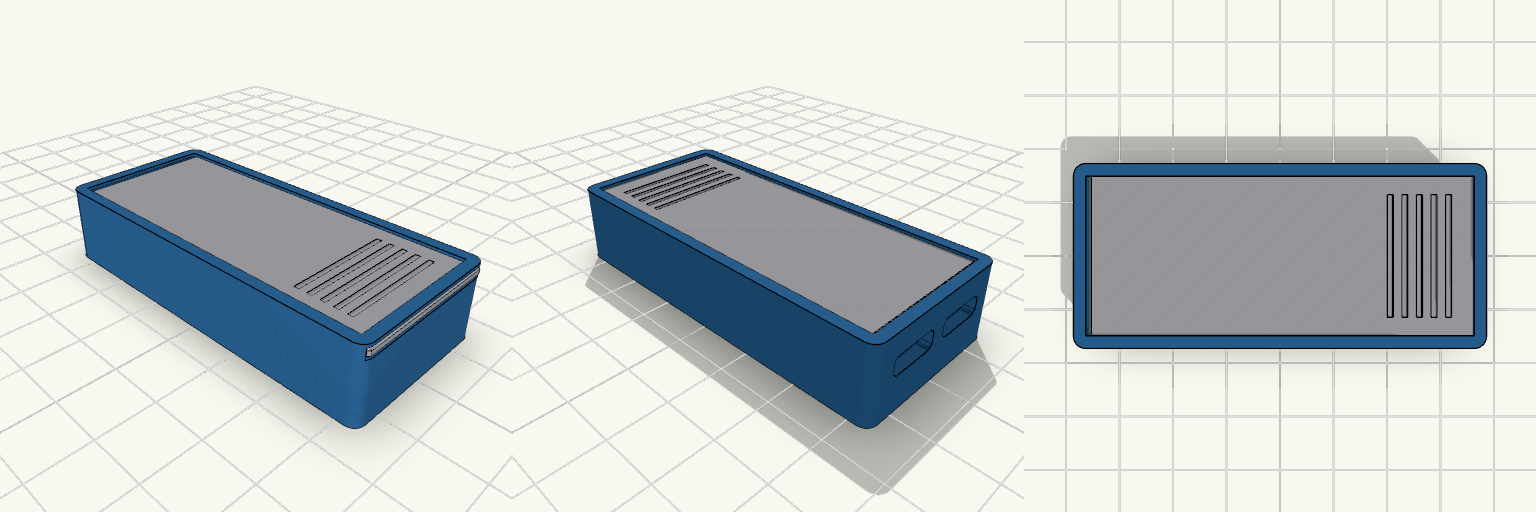
ESP32-S3 Sliding-Lid Enclosure with Dual USB-C Cutouts
What it's for A modern, low-profile enclosure for an ESP32-S3 N16R8 board measuring 62.7 × 25.4 mm. The base holds the board on four standoffs, and the sliding lid closes the case from the end opposite the USB-C openings. Two rounded USB-C cutouts in the end wall give access to the board's connectors. Dimensions Base: 67.5 × 30.2 × 14 mm. Sliding lid: 65.2 × 28.2 × 1.6 mm, with five shallow grip ribs. Interior: 63.5 × 26.2 × 12 mm, giving about 0.4 mm of play per side around the 62.7 × 25.4 mm board. Walls: 2 mm. USB-C cutouts: 9.4 × 3.6 mm with rounded corners; 3 mm gap between the two cutouts, so their centers sit about 11.9 mm apart. Print notes Prints as two separate parts: the base and the sliding lid. Assemble by sliding the lid into the base. The USB-C cutout height assumes the connectors sit on top of the board; check the connector position against the actual board before printing. The two USB-C openings are separate cutouts, not a single merged slot. Remix ideas Adjust cutout spacing or height for a different board or connector layout. Add ventilation slots, an antenna opening, or a label recess. Change the lid grip ribs or wall thickness for a different fit and finish.
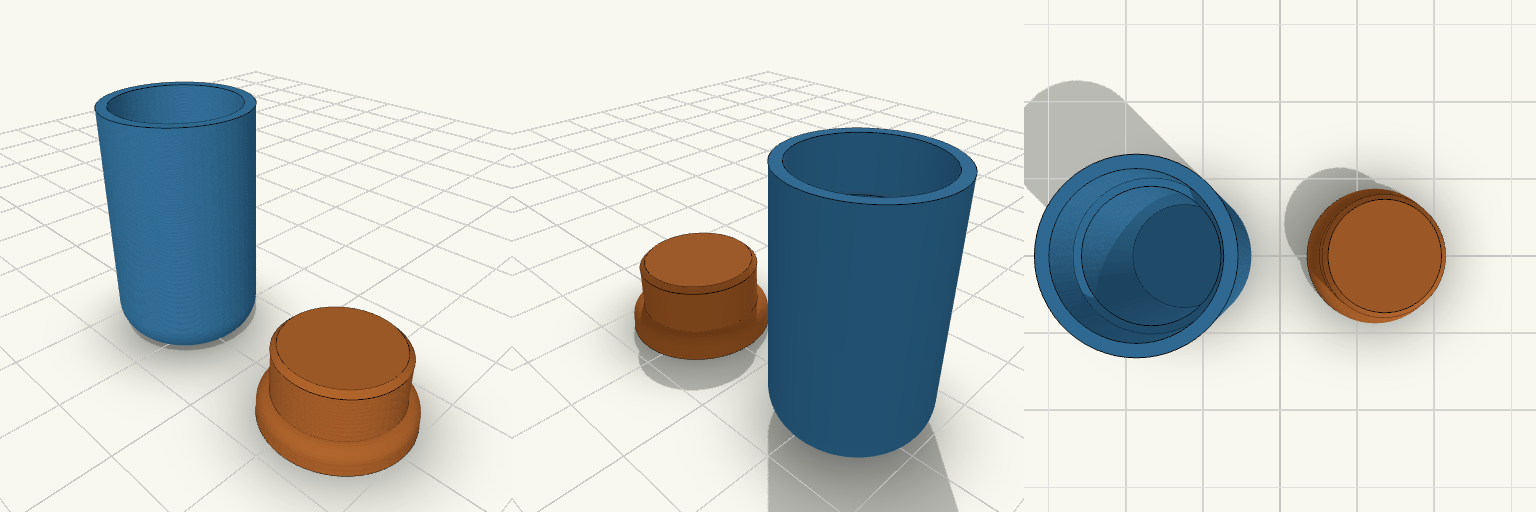
17 mm Pocket Capsule for a Nurofen Tablet
A small two-piece capsule for carrying a single Nurofen Flex 400 mg tablet in a pocket. The cavity is sized so the tablet stands upright inside with about 2 mm to spare, and a push-fit lid closes over the body. The lid sits beside the body on the print plate. Specifications Capacity: One Nurofen Flex 400 mg tablet, standing on end. Internal cavity: 13 mm wide × 20 mm deep. Overall height: About 28 mm including the floor and lid seat. Body size: 17 mm across × 28 mm tall. Lid size: 17 mm across × 8.8 mm tall. Pieces: Prints as two pieces — capsule body and push-fit lid. Lid fit: The lid plug is about 0.2 mm smaller than the seat on each side; check the fit after printing and expect it to vary with your printer. Tablet check: Sized around an assumed tablet of about 18 × 10 × 7 mm; measure your own tablet before relying on the fit.
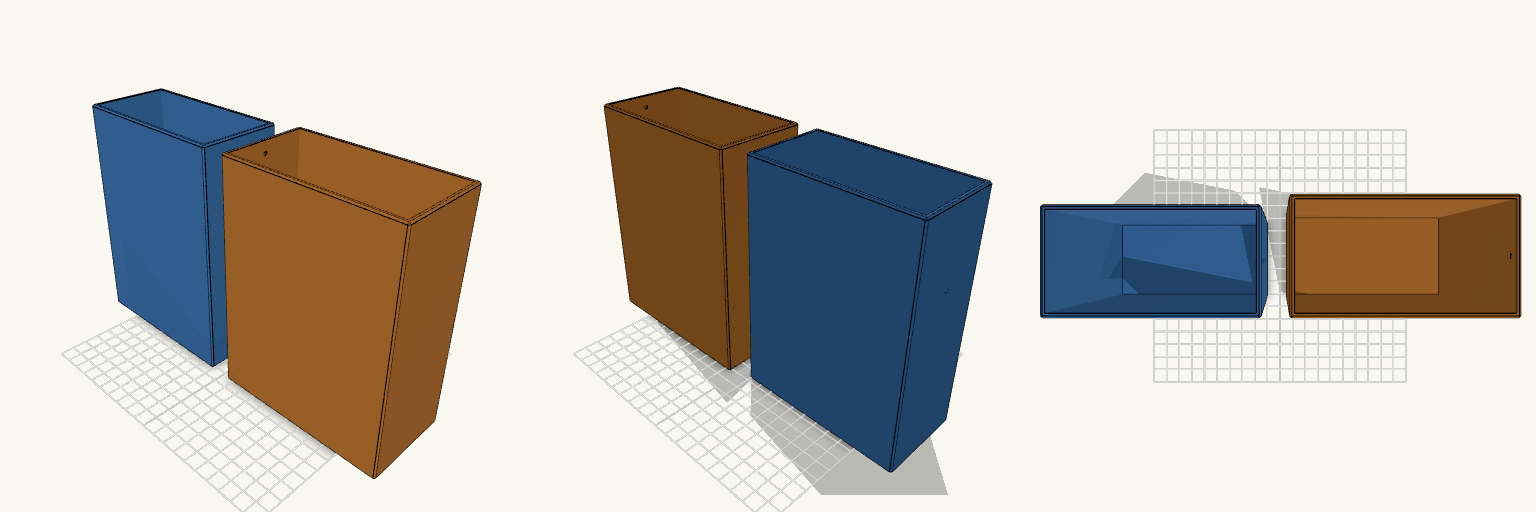
Telescoping Tube Container with Detent
What it's for Two rectangular tubes, each closed at one end, that slide together lengthwise into a closed container. Small detent bumps keep it shut. Dimensions Interior when closed: 112 x 262 x 55 mm Overlap: 60 mm Each tube: about 163 mm long, fits a 250 mm plate lying flat Clearance: 0.4 mm per side Print notes Print each tube as its own job. They are spaced apart in the preview so they do not touch. The detent is a pair of small round bumps on the inner tube that click into matching dimples in the outer tube's walls. Remix ideas Add a finger notch on the rim. Deepen the dimples for a firmer hold. Add dividers inside.
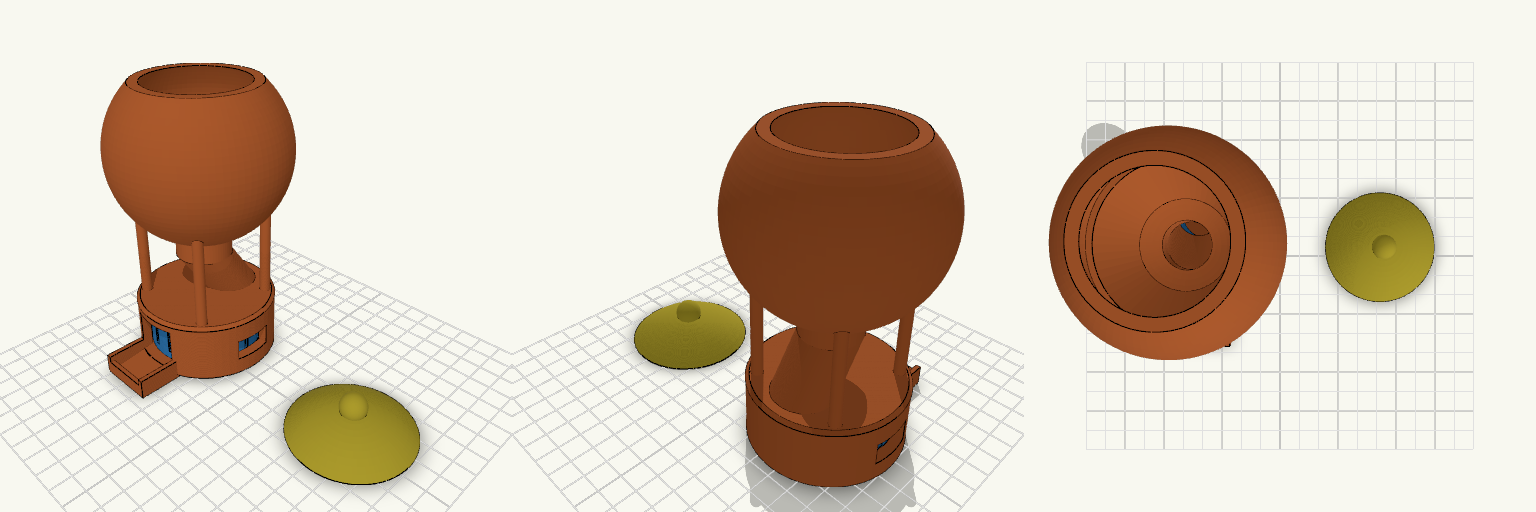
Kaugummiautomat im Heißluftballon-Stil für 18-mm-Kaugummis
Der Kaugummiautomat gibt einzelne Kaugummis vorne aus dem Zylinderfuß aus. Die Kugel sitzt mittig über dem Fuß und lässt sich über einen abnehmbaren Deckel befüllen. Vier gerade, senkrechte Streben tragen die Kugel vom Fußrand bis in die Kugelwand. Ein Rohr führt von der Kugelmitte über einen schrägen Trichter zur Drehmechanik im Zylinder: Eine Drehscheibe mit einem Loch für je ein Kaugummi wird von außen durch die Seitenfenster gedreht, sodass pro halber Umdrehung ein Kaugummi zur vorderen Öffnung rollt. Vor der 22-mm-Öffnung liegt eine mitgedruckte Ablagerampe, die das Kaugummi auffängt und nach vorn führt. Gesamtgröße (Druckplatte): 82 × 91 × 129 mm Kaugummi-Durchmesser: ca. 18 mm Deckel: 55,8 × 55,8 × 19 mm, abnehmbar Drehscheibe: 55 × 55 × 20 mm, im Fuß mit ca. 0,3 mm Luft eingebaut Streben: vier Stück, gerade und senkrecht vom Fußrand bis in die Kugelwand Rohr: oben mittig unter der Kugel, unten zum versetzten Loch der Drehscheibe abgewinkelt; ein Trichter in der Kugel leitet die Kaugummis dorthin Ausgabe: 22 mm breite Öffnung vorn, davor eine 26 mm breite Ablagerampe mit 2 mm Seitenwänden, 20 mm Länge, 6 mm hoher Frontkante und Abfall von 4 mm auf 1,5 mm Druck: als ein Stück; im Bereich der Drehscheibe Stützmaterial einplanen oder die Scheibe nach dem Druck kurz lösen
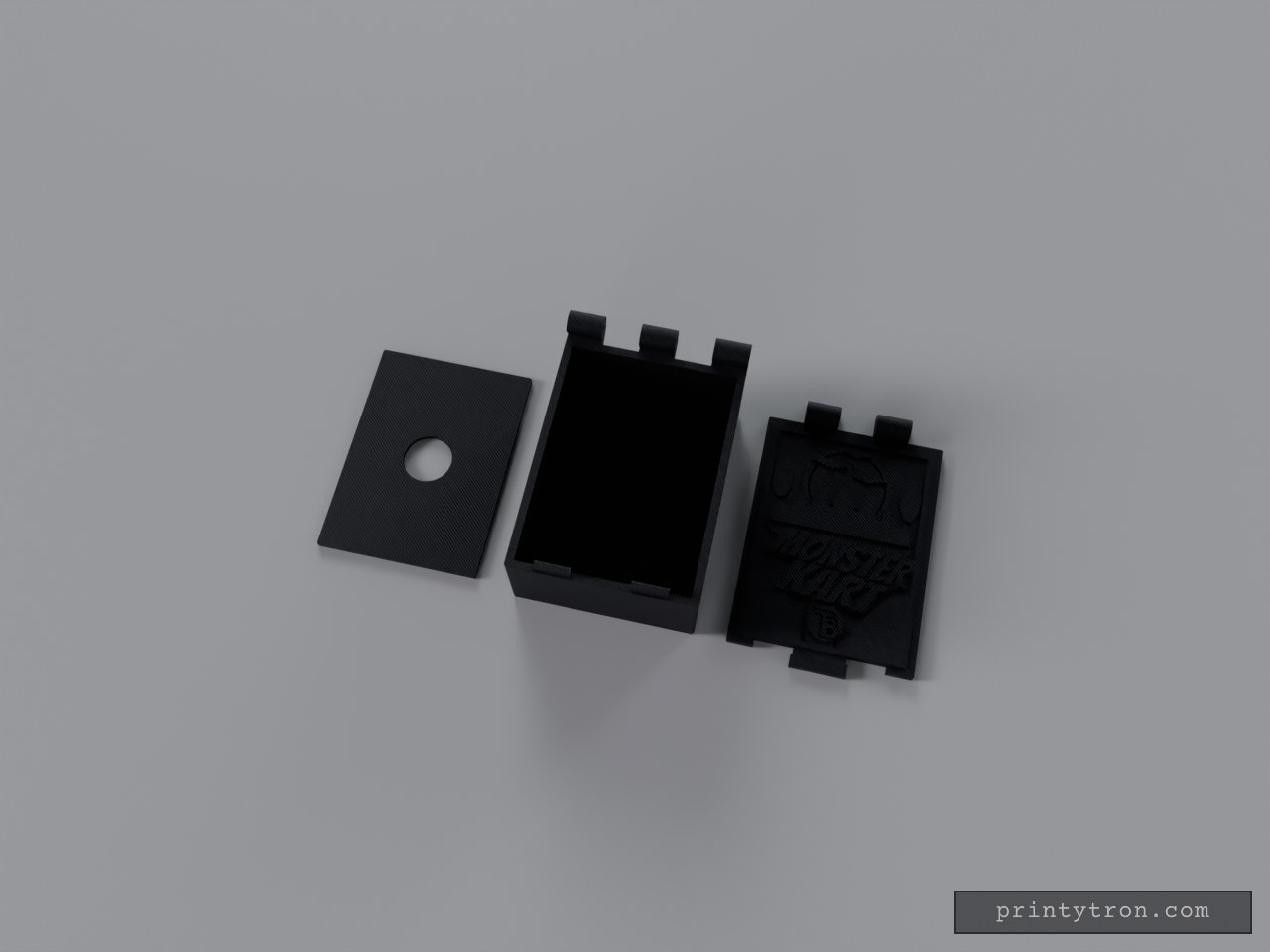
Monster Kart box
A hinged-lid card game box for a deck of 63 × 88 mm cards, sized for about 50 cards. The lid pivots on a mechanical barrel hinge along the back: three knuckles on the box and two on the lid, interleaved and held by a removable 1.75 mm filament pin. A front snap latch keeps the lid closed, and the hinge axis sits behind the back wall so the lid corner clears the rear wall and knuckle supports through 120°. Beneath the card stack, a removable divider plate with a 20 mm finger hole covers a hidden 12.7 mm compartment for paper inserts or original drawings. The box and divider plate are plain black to limit AMS waste; only the lid top carries the four-colour relief artwork. Specifications Box: 72.4 × 106.8 × 45.7 mm overall; card space approximately 66 × 91 × 20 mm for about 50 cards. Hidden compartment: 12.7 mm high under the card stack, with four corner posts supporting the divider plate. Divider plate: flat and removable, 2 mm thick, with a 20 mm finger hole. Hinge: five interlocking 9 mm knuckles with 0.4 mm axial gaps; moving-part clearance approximately 0.3–0.4 mm; 2.1 mm bores on one straight coaxial axis. The axis sits 4.9 mm behind the back wall. A 1.75 mm filament pin feeds in from one end through a flared lead-in and is held by friction; the opposite end is closed 1.2 mm short of the face, so the pin is pulled back out from the entry side. Latch: two flexing front posts with sloped hooks snap into lid notches; a thumb tab at the front centre releases it. Lid artwork: red rectangular border; dark black/purple background; large white moon near the upper centre; black haunted-castle silhouette with varied pointed towers; black bat silhouettes that read mainly as two long curved wings with very small bodies, sharp tips and scalloped trailing edges; purple hills and mist; a curved purple path; angled MONSTER in white and KART in red with black outlines; a 16 mm interlocking TB monogram centred near the bottom — a white glyph inside a red disc separated by a 0.5 mm black gap. The T carries an 8 mm top bar and a 1.8 mm full-height stem. The B shares the stem as a flat left spine, with a smaller upper bowl and fuller lower bowl, a pinched waist, and D-shaped counters rather than circular holes. A gap of about 1 mm separates the T bar from the top of the B. Only black, red, purple and white are used. Printing: support-free geometry for a 0.4 mm nozzle; latch posts are 1.4 mm thick; bat membranes come to about 1 mm. In the TB monogram the upper counter is about 1.1 mm tall — check it on a first print. Assembly: three printed pieces — box, divider plate and lid — plus a 1.75 mm filament pin. The lid's colour layers are grouped as one multi-colour object for four-slot AMS printing.
Stickpot
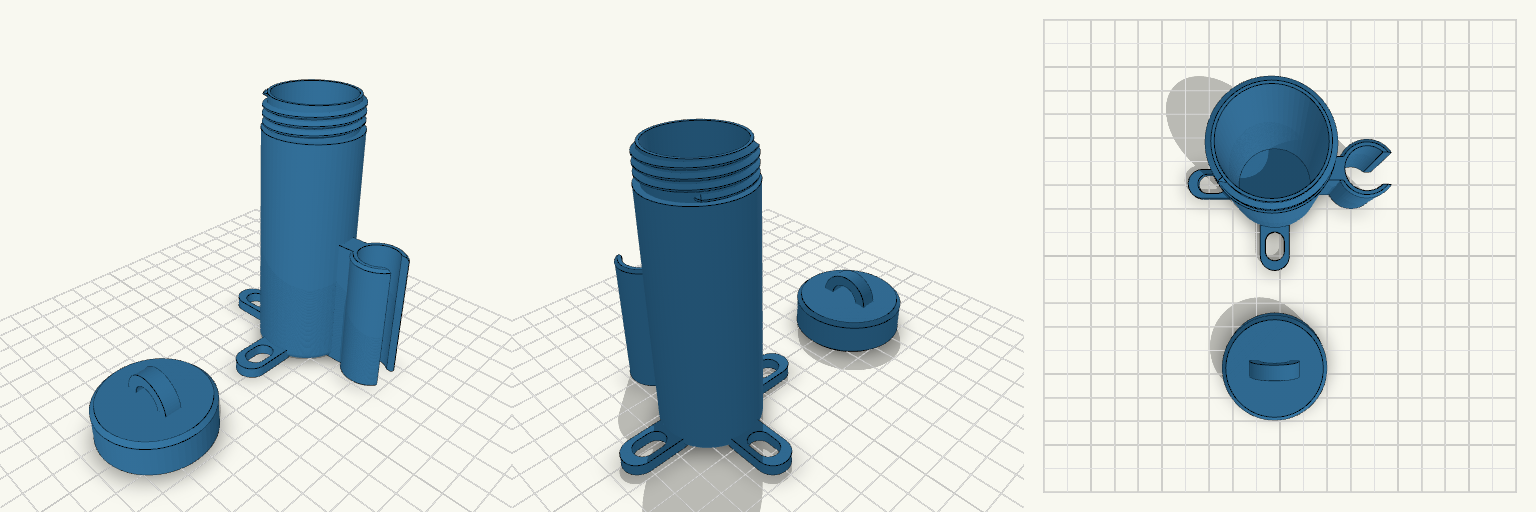
A screw-top tackle jar in the spirit of a carp angler's bankstick kit: tall bore, flat slotted tabs at the base, and a half-circle arch standing on the lid for hanging rigs. Design notes 30 mm bore, 100 mm tall Bankstick clip now runs from the base of the jar upward, 50 mm long, with a snap-in slot Three flat slotted loops at the base, printing flat with no overhang Lid with a 6 mm wide half-circle arch, printed upside-down beside the jar
RigPot — Bankstick Jar with Rig Loops
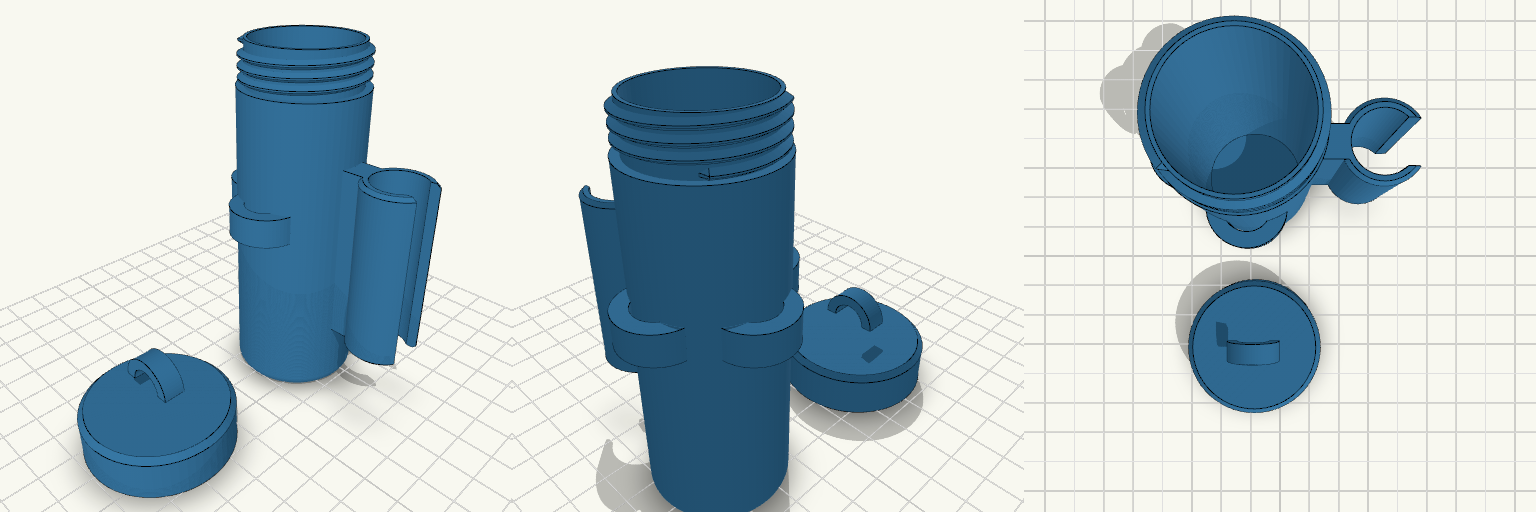
RigPot is a 30 mm bore, 100 mm tall screw-top jar built for carp tackle. It has a 50 mm side clip for a 15 mm bankstick, and three half-round loops for hanging rigs. Features 30 mm inside diameter, 100 mm tall Screw lid printed separately beside the jar Bankstick clip, 50 mm long, 15.4 mm bore with a snap-in slot Three flat half-ring rig loops at 90°, 180° and 270°, both ends fused into the jar wall Print notes The jar, clip and loops print as one body The lid is a separate piece and prints beside the jar
Estojo de gavetas para materiais de APH
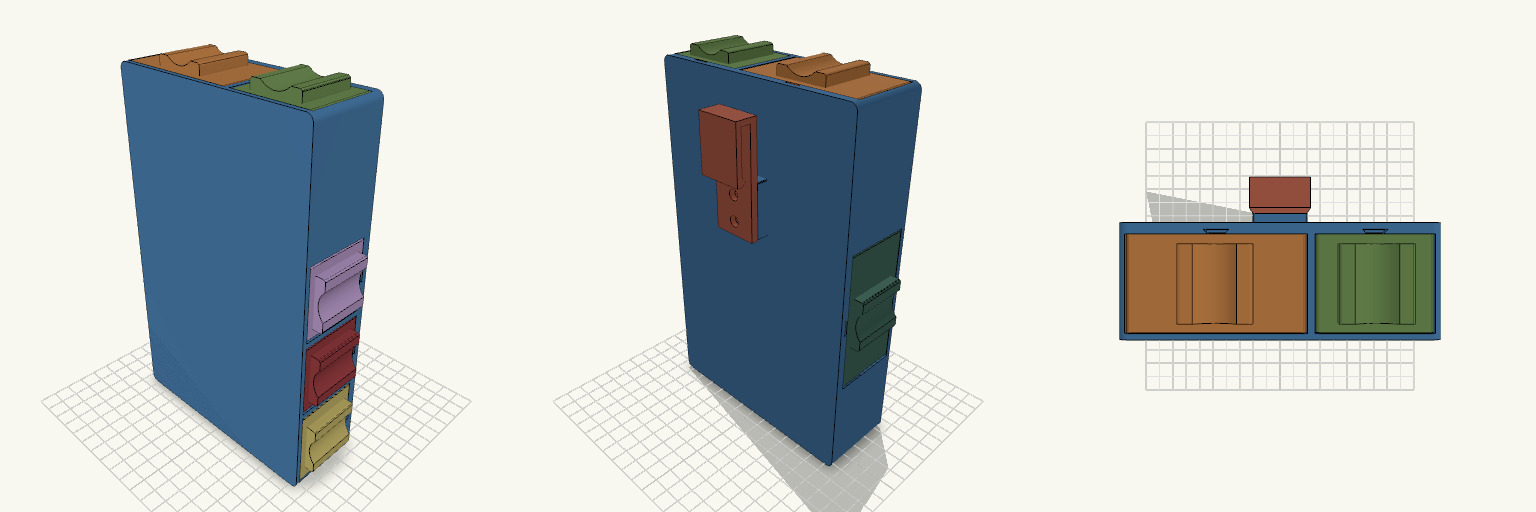
Estojo de seis gavetas independentes (A–F) para materiais de APH, com corpo inteiriço e clipe traseiro para prender no cinto ou na borda do bolso do uniforme. O corpo é uma peça única, com placa traseira, placa frontal e divisórias compartilhadas entre gavetas vizinhas; as seis gavetas e o clipe são peças separadas, para imprimir e montar depois. Cada gaveta corre no seu próprio trilho curto em cauda de andorinha de 45° e sai por completo quando liberada de propósito — o batente de fim de curso abre cerca de 77%, com cerca de 0,5 mm de sobreposição com o trilho, e só deixa passar inclinando a gaveta com a unha. O clipe é aparafusado ao reforço traseiro com dois parafusos M3×10: os furos de 3,4 mm atravessam todo o reforço, cada porca sextavada tem bolso próprio a 2,5 mm da face do corpo e uma fenda lateral para inserção; a fenda não tem trava, e uma gota de cola resolve. Dimensões de partida Corpo: cerca de 130,6 × 54 × 213,6 mm (L × A × E). O clipe separado acrescenta cerca de 13 mm de profundidade, levando o conjunto a cerca de 67 mm. Cavidades internas: A com 67,5 × 60 mm, B com 42,5 × 60 mm, C com 77 × 77 mm, D e E com 35 × 37,5 mm cada, F com 112 mm no sentido do curso (para a atadura de 110 mm) e 40 mm de altura útil. Profundidade útil de 35 mm em todas, mais folga. Em A e B, o curso da gaveta tem 62 mm para o item de 60 mm, com 1 mm de folga por lado. Paredes das gavetas de 2,5 mm, divisórias de 3 mm, folga de deslizamento de 0,4 mm por lado. O conjunto fica maior que a área útil de referência de 110 × 175 mm — é a consequência direta de manter as cavidades exatas com essas paredes e folgas, não um erro de montagem. O que vale ajustar numa remixagem Profundidade das gavetas: 35 mm é o valor de partida; reduza se o material guardado for mais fino, e o conjunto encolhe sobretudo em profundidade. Parede da gaveta e divisória: 2,5 mm e 3 mm são o mínimo que mantém a lingueta com massa suficiente; engrossar melhora a resistência dos trilhos, mas cada milímetro aparece no tamanho externo. Folga do trilho: 0,4 mm por lado funciona em PETG; afrouxe para 0,5 mm se a sua máquina estiver com sobre-extrusão. Batente de fim de curso: cerca de 0,5 mm de sobreposição com o trilho — é o ponto mais provável de precisar de ajuste fino, e o primeiro a testar. Lingueta de retenção: detente com rampa na parede de 2,5 mm, com fendas laterais de 1,2 mm e raio maior na raiz para flexionar sem esforço. Nas gavetas A, B, C e F ela tem cerca de 21,5 mm; nas D e E tem desenho próprio, com cerca de 16 mm, para caber na face de 35 mm. A versão curta é mais rígida, então a força de abertura de D e E é o número a conferir na primeira impressão — se ficar dura, aumente só o comprimento da fenda dessa gaveta, sem tocar no resto. Não é uma pinça de duas alavancas. Puxador: rebaixado, com concavidade para o dedo e saliência máxima de 6 mm, pensado para uso com luva de procedimento. Gaveta F: acompanha o padrão das gavetas da direita e vai até a face direita do corpo, com o puxador saindo 6 mm quando fechada. Tem um bloco interno de cerca de 10 mm no fundo, perto da parede fechada, que reduz a cavidade para 112 mm e impede a atadura de 110 mm de correr; o bloco não mexe no trilho, no batente nem na trava. É o ponto para redimensionar ou remover o batente interno se o conteúdo mudar. Gavetas D e E: dimensionadas como 35 × 37,5 mm úteis sem um item definido — é o par óbvio para redesenhar em torno do que for guardado ali, e o primeiro a imprimir para conferir o encaixe e a trava. Clipe: sai como peça à parte, com 0,2 mm de vão em relação ao reforço traseiro — dá para substituí-lo sem refazer o corpo, e é o lugar natural para variantes de fixação, como uma aba de cinto mais larga ou outra furação. Fileira superior: A e B somam 110 mm de cavidade e, com as paredes e divisórias, definem a largura mínima do corpo; qualquer variante mais compacta passa por rever a cavidade dos itens, não só a caixa. Impressão PETG, sem suportes, em Bambu Lab A1. Gavetas com o fundo para baixo e a face aberta para cima, deixando o trilho apoiado na mesa. Corpo com a placa traseira na mesa e a frente para cima; com cerca de 214 mm de altura, ocupa quase toda a mesa da A1 e só cabe na diagonal ou em linha reta, então imprima-o sozinho e deixe as gavetas para um segundo trabalho. O clipe imprime deitado de lado, para a flexão ocorrer no plano das camadas. Um primeiro teste econômico é imprimir o corpo e uma única gaveta D ou E, para sentir o encaixe e a força da trava antes de gastar o resto do filamento. Os trilhos são curtos, então o guiamento vem principalmente das paredes do alvéolo — mantenha as cavidades lisas para não criar pontos de travamento.
Estojo de APH — gaveta F para atadura
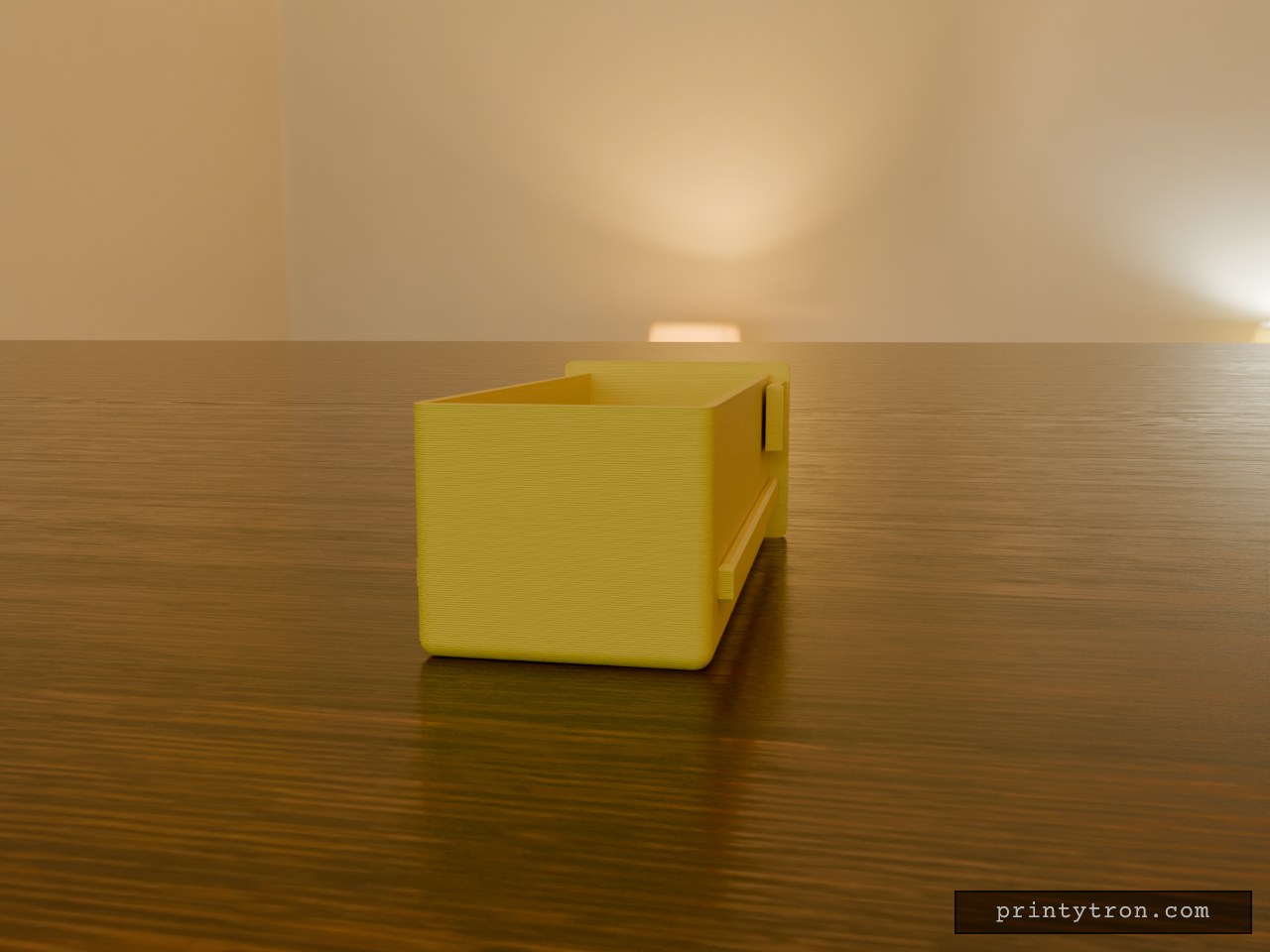
Gaveta F é a peça deslizante que guarda a atadura de 110 × 40 × 35 mm no estojo de APH. Ela encaixa no canal F do corpo do estojo e abre para a direita. O que encaixa Cavidade interna de 112 × 42 × 37 mm, com paredes de 2 mm e fundo de 2,5 mm — comporta a atadura de 110 × 40 × 35 mm sem apertar. Guias laterais de 6 mm de altura, com vão total de 50,2 mm entre elas. Ressalto batente de 3 mm na face de abertura que encosta no batente do corpo. Puxador central com 6 mm de saliência e concavidade para o dedo, dimensionado para uso com luva de procedimento. Duas linguetas flexíveis de 2,5 mm com dente externo que entra no entalhe do corpo; flexionam no plano da camada. Confira antes de imprimir A medida que decide o encaixe é a largura do canal F. O vão de 50,2 mm entre as guias foi calculado para um canal de 51 mm, com 0,4 mm de folga por lado, e as guias ficam entre 9 e 15 mm em altura. Meça o canal e a posição do entalhe no corpo antes de fatiar: se a largura ou a altura das guias forem outras, as folgas não valem. Não serve para Canais de largura diferente de ~51 mm, nem corpos sem entalhe na posição correspondente às linguetas. Ataduras maiores que a cavidade: 112 × 42 × 37 mm é o limite interno. Impressão PETG, em Bambu Lab A1. Imprima com o fundo na mesa e sem suporte — guias e linguetas são verticais ou têm chanfro. A força de trava ainda não foi testada; vale imprimir uma peça de teste antes de fechar o estojo.
Corpo de estojo de gavetas para material de APH
Corpo único de um estojo de gavetas para materiais de APH, com quadro de placa traseira e frontal, paredes divisórias compartilhadas entre gavetas vizinhas e seis canais com trilhos trapezoidais de 45° já integrados. Gavetas, trava e clipe não fazem parte deste arquivo: aqui está só o corpo, com os canais prontos para receber as gavetas. As medidas externas são 118 mm de largura × 196 mm de altura × 45,5 mm de profundidade, contando os reforços traseiros dos furos M3. As paredes têm 2,5 mm e sobem para 3,5 mm nas divisórias entre fileiras e entre D e E, onde passam trilhos dos dois lados. Os cantos externos são arredondados com raio de 2,5 mm. Seis canais: A e B abrem para cima, C para a esquerda, D e E ficam empilhados e abrem para a direita, e F na base abre para a direita. Trilho trapezoidal com chanfros de 45° em cada parede lateral, com 0,4 mm de folga por lado para a língua da gaveta. Entalhe de retenção na posição fechada e batente de fim de curso em todos os canais, liberável de propósito com a unha ou ponta de chave. Dois furos M3 passantes na placa traseira, com porcas sextavadas embutidas e reforço local, fora da área dos trilhos. Cupom de teste com um canal, no mesmo arquivo, para conferir a folga antes de imprimir o corpo inteiro. Para imprimir, deite o corpo com a face frontal na mesa: assim os chanfros de 45° e os furos saem sem suporte. O desenho é voltado a FDM em PETG. A folga de 0,4 mm por lado ainda não foi validada em impressão, por isso o cupom de teste acompanha o modelo.
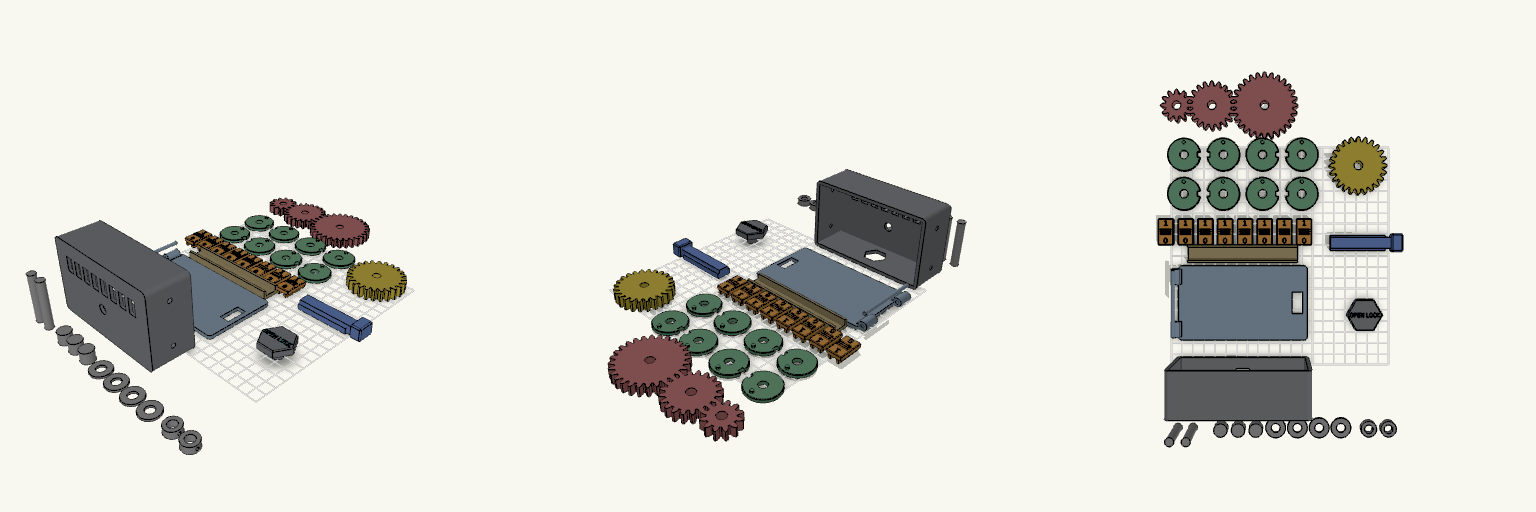
Gear Locker Housing and Parts Kit
A parts layout for a small mechanical binary gear locker: the housing, door and hinge pin, selector rail, eight 0/1 selectors, eight checking discs, a three-gear train, a main turning gear, a sliding bolt, a hexagonal OPEN LOCK button, and loose shafts, spacers, washers and collars. Fit notes Gears are module 2 spur gears: 12, 20 and 28 teeth in the train, 24 teeth for the main gear. Shaft bore is 8 mm. Shafts are 7.6 mm, spacers and washers are bored 8.4 mm, collars 8 mm with a 3 mm set-screw hole. Housing: 120 x 40 x 70 mm, open back, eight 8 x 14 mm selector slots, 9 mm shaft opening, 23 mm hex bottom opening, 4.5 mm side holes. Door hinge bores are 3.6 mm for a 3.2 mm pin. Check before printing Measure your printed shaft against the 8 mm bores. The housing selector slots (8 mm wide) are not matched to the 14 mm selector bodies; the selector grip sits behind the panel. The mechanism is not tuned for a specific commercial lock, and no electronics are included.
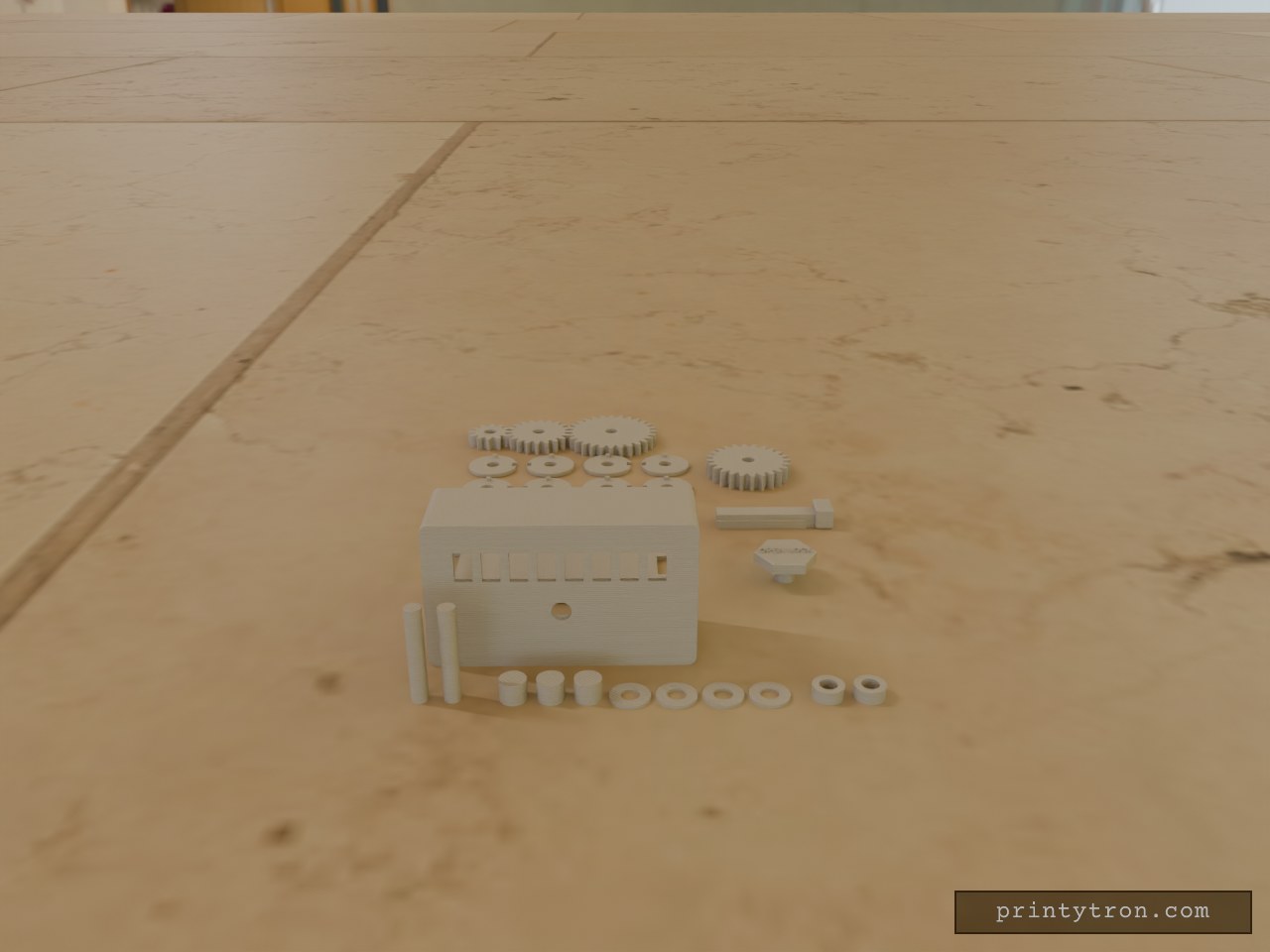
Gear Locker Housing and Parts Kit
A parts layout for a small mechanical binary gear locker: the housing, door and hinge pin, selector rail, eight 0/1 selectors, eight checking discs, a three-gear train, a main turning gear, a sliding bolt, a hexagonal OPEN LOCK button, and loose shafts, spacers, washers and collars. Fit notes Gears are module 2 spur gears: 12, 20 and 28 teeth in the train, 24 teeth for the main gear. Shaft bore is 8 mm. Shafts are 7.6 mm, spacers and washers are bored 8.4 mm, collars 8 mm with a 3 mm set-screw hole. Housing: 120 x 40 x 70 mm, open back, eight 8 x 14 mm selector slots, 9 mm shaft opening, 23 mm hex bottom opening, 4.5 mm side holes. Door hinge bores are 3.6 mm for a 3.2 mm pin. Check before printing Measure your printed shaft against the 8 mm bores. The housing selector slots (8 mm wide) are not matched to the 14 mm selector bodies; the selector grip sits behind the panel. The mechanism is not tuned for a specific commercial lock, and no electronics are included.
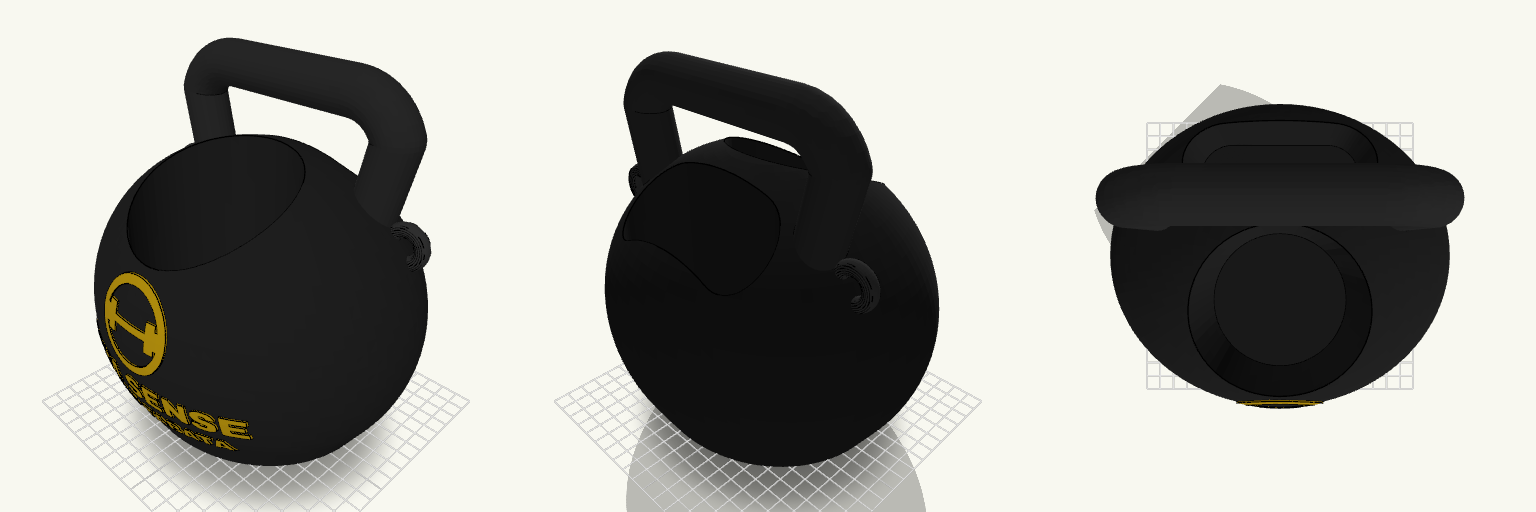
Organizador Kettlebell para Termo de 90 mm V2
Organizador de sobremesa con forma de kettlebell para un termo de 90 mm de diámetro. No es una pesa para entrenar: es una pieza para dejar el termo y la toalla de gimnasio en el mismo sitio. El cuerpo es una esfera ligeramente achatada, de unos 202 mm de ancho por 180 mm de fondo, con base plana y la parte superior en cúpula redondeada, sin corte plano, que llega a unos 176 mm de altura. El termo va delante, en la zona delantera de la cúpula, y la toalla queda detrás. El asa va retrasada unos 25 mm respecto al centro del cuerpo, con un tramo superior plano y esquinas curvas de 28 mm de radio; sus patas arrancan juntas en los hombros de la esfera y se abren hacia fuera al subir, de modo que el hueco queda ancho arriba y estrecho abajo, como un trapecio. La sección del asa es circular, de 26 mm, y el hueco central sigue abierto. La altura total ronda los 221 mm y el asa se integra en la cúpula sin piezas sueltas. El conjunto incluye dos argollas laterales de 26 mm de diámetro exterior y 10 mm de hueco interior, situadas en la unión del asa con el cuerpo y desplazadas con ella, pensadas para un mosquetón fino o un cordón, no para una correa ancha. El logotipo GYM SENSE / CROSS TABATA, con su círculo y su mancuerna, ya no forma parte del cuerpo: es una pieza aparte, en amarillo, que encaja en un hueco de 1,6 mm de profundidad tallado en la cara curva frontal, con 0,3 mm de holgura alrededor del contorno para que no se atasque. El esquema de color de referencia es cuerpo negro con el logotipo amarillo. Qué aloja Termo: hueco circular de 90 mm de diámetro y unos 125 mm de profundidad, con fondo cerrado, situado delante, a unos 30 mm por delante del centro. Pensado para termos de 750 ml a 1 litro que entren en esa medida. Toalla: ranura rectangular de 100 × 40 mm, con los lados cortos semicirculares de 20 mm de radio y los lados largos rectos, y unos 100 mm de profundidad, con fondo cerrado. Va detrás, a unos 50 mm por detrás del centro. Pensada para toalla doblada o enrollada fina que no pase de 40 mm de grosor. Argollas: dos, una a cada lado, en la unión del asa con el cuerpo. Miden 26 mm exteriores y 10 mm de hueco interior. Sirven para un mosquetón fino o un cordón, no para una correa ancha. El logotipo va aparte El texto y el símbolo se imprimen como pieza independiente y se encajan después en el hueco del cuerpo. El conjunto entra 1,4 mm en el alojamiento y sobresale 0,8 mm, siguiendo la curvatura de la esfera. Cada letra y cada trazo del símbolo es una pieza suelta, no una placa única: hay que presentarlas en su sitio y pegarlas con una gota de cianoacrilato o pegamento para plástico. Imprime las letras con la cara plana hacia abajo, apoyadas en la cama, para que el relieve quede limpio. Separa el logotipo del cuerpo en el programa de corte antes de laminar: el cuerpo se imprime solo, con el asa y las argollas ya integradas. La medida que hay que comprobar Antes de imprimir, mide el diámetro exterior real del termo con un calibre, no con la ficha del fabricante. El alojamiento admite 90 mm justos y unos 125 mm de profundidad útil, sin holgura: el termo debe entrar y quedar apoyado, no colgando. Comprueba también que la toalla doblada entra en la ranura de 100 × 40 mm y no supera los 100 mm de profundidad. La cúpula se curva hacia abajo en los bordes, así que las paredes junto a los alojamientos quedan finas; revisa en especial la pared delantera junto al termo, la separación entre los dos huecos y la pared trasera entre la ranura de la toalla y las patas del asa, que ahora va retrasado. Revisa igualmente el solape de las argollas con el asa, que es de solo unos 2 mm, y que el hueco del logotipo quede centrado en la cara frontal. Imprime con el cuerpo apoyado en su base plana: el asa en arco y el hueco central deberían salir sin soportes. No encaja Termos con asa de transporte integrada o plegable que superen los 90 mm de diámetro exterior: no pasan por el hueco del termo. Fundas de neopreno o silicona: suman varios milímetros y convierten un termo de 88 mm en uno que no entra. Botellas de boca ancha o cantimploras de más de 90 mm de diámetro. Toallas enrolladas de más de 40 mm de diámetro o dobladas que superen los 100 mm de largo: la ranura mide 100 × 40 mm. Correas anchas o mosquetones grandes en las argollas: el hueco interior es de 10 mm. Uso como pesa rusa para entrenar: la pieza está pensada para organizar, no para cargar peso.
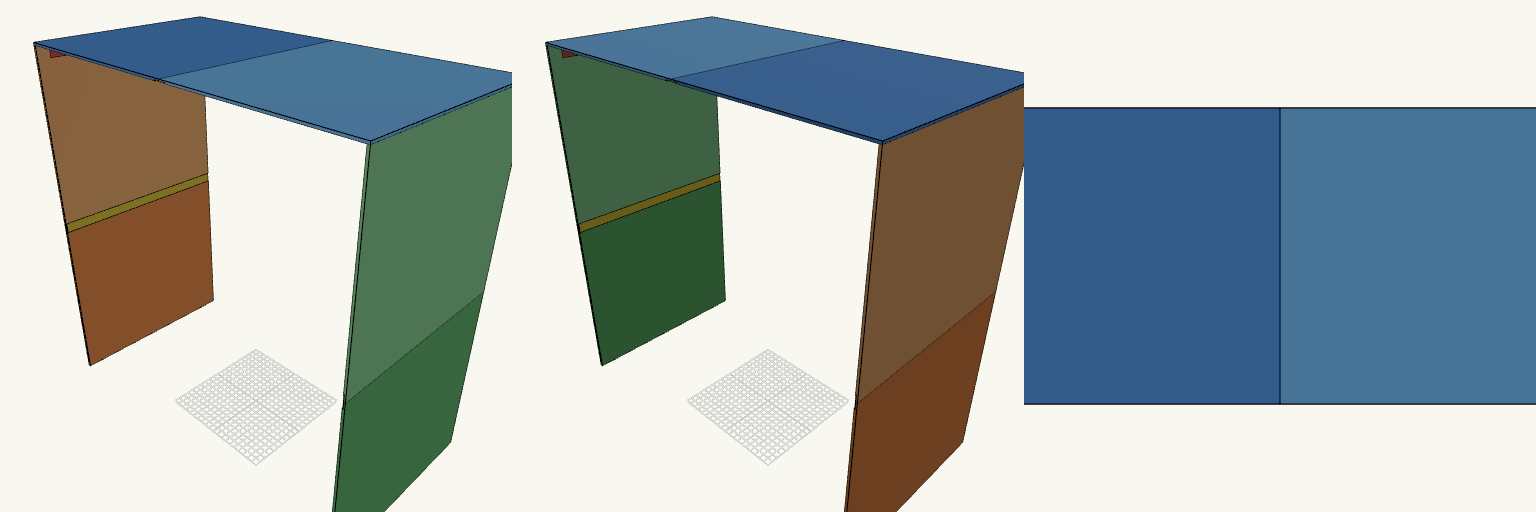
Kommoden-Verkleidung, 6 Segmente
Außenverkleidung aus Deckel und zwei Seitenwänden für eine Box mit 570 mm Breite, 580 mm Höhe und 305 mm Tiefe. Front, Rückseite und Unterseite bleiben offen. Plattenstärke 3 mm, Innenmaß 572 × 307 mm, Gesamtbreite außen 578 mm. Remix-Ansätze Boxmaße: Die Parameter W (Deckelsegmentbreite, 289 mm), H (Wandhöhe, 580 mm) und XI (halbe Innenbreite, 286 mm) steuern alle Flächen. Tiefe D = 307 mm. Teilung: HM = 290 mm legt die Stoßkante der Wandsegmente fest. Verbindungsleisten: Schwalbenschwanz, 1,5 mm tief, 0,15 mm Spiel je Seite. Tiefer oder länger machen für mehr Halt. Winkelverbinder: 6 Stück, je 60 mm lang und 1,35 mm stark, eingelassen und verklebt. Mehr Winkel oder längere Schenkel erhöhen die Eckstabilität. Montage Wandsegmente je Seite mit der Leiste auf halber Höhe verbinden. Deckelsegmente mit der Leiste in der Mitte verbinden. Winkelverbinder in die Eck-Taschen kleben. Verkleidung von oben über die Box setzen. Alle Segmente passen flach in 305 × 320 mm.
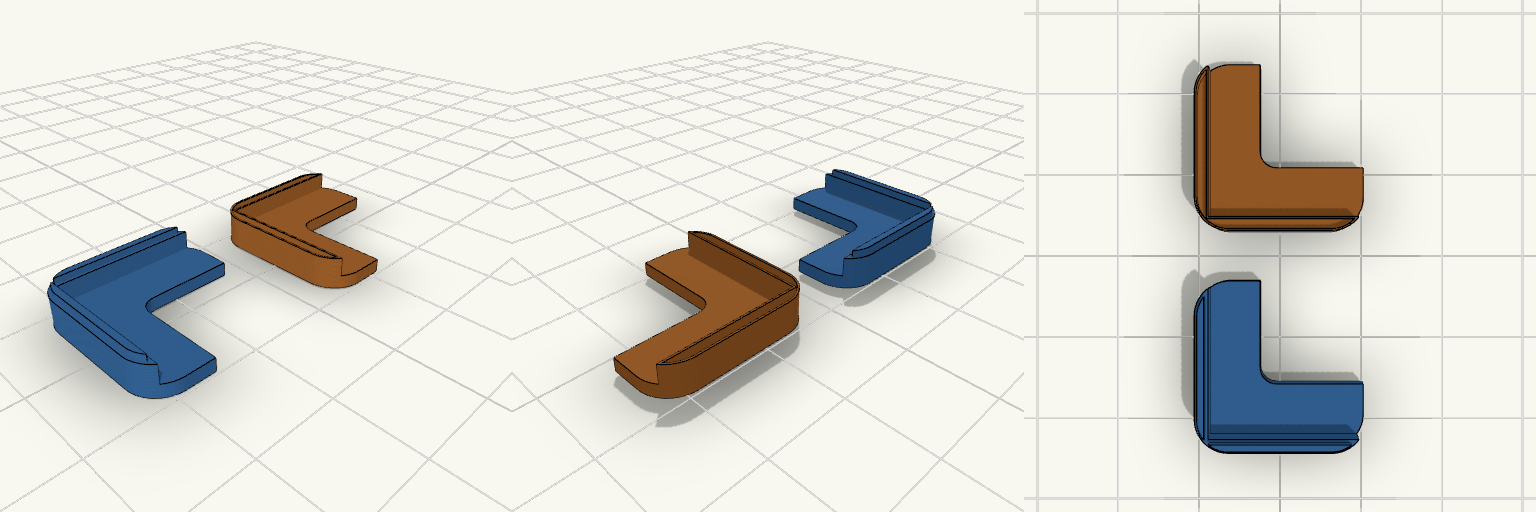
Esquinero en L 20 mm
Para qué sirve Esquinero en L para sujetar la esquina de un taco de hojas de hasta 4 mm de espesor. Las esquinas redondeadas lo hacen más suave al tacto y evitan puntas. Se imprime en dos mitades planas que se encajan y se pegan para formar la pieza completa. Dimensiones Brazos: 20 × 20 mm Ranura: 4,6 mm (4 mm de papel + 0,6 mm de holgura) Paredes: 1,6 mm Banda entre la esquina interior y la exterior: 6 mm Alto total montado: 7,8 mm (mitad inferior 4,7 mm, mitad superior 3,9 mm) Esquinas exteriores redondeadas con radio de 4 mm Encastre: cresta de 0,8 × 0,8 mm en la mitad inferior y ranura con 0,2 mm de holgura por lado en la superior Impresión y montaje Las dos mitades se imprimen planas y sin soportes; en la mitad superior la cara de pegado queda hacia arriba. La cresta recorre toda la pared en L de la mitad inferior y encaja en la ranura de la superior, de modo que las mitades quedan alineadas y rectas. La superficie de pegado es estrecha, porque la ranura de las hojas ocupa casi todo el centro. Conviene un pegamento que rellene bien, como cianoacrilato en gel o epoxi. Ideas de remix Cambiar el largo de los brazos para hojas más grandes. Ajustar la ranura según el espesor del taco. Añadir un agujero para atornillarlo a una superficie.
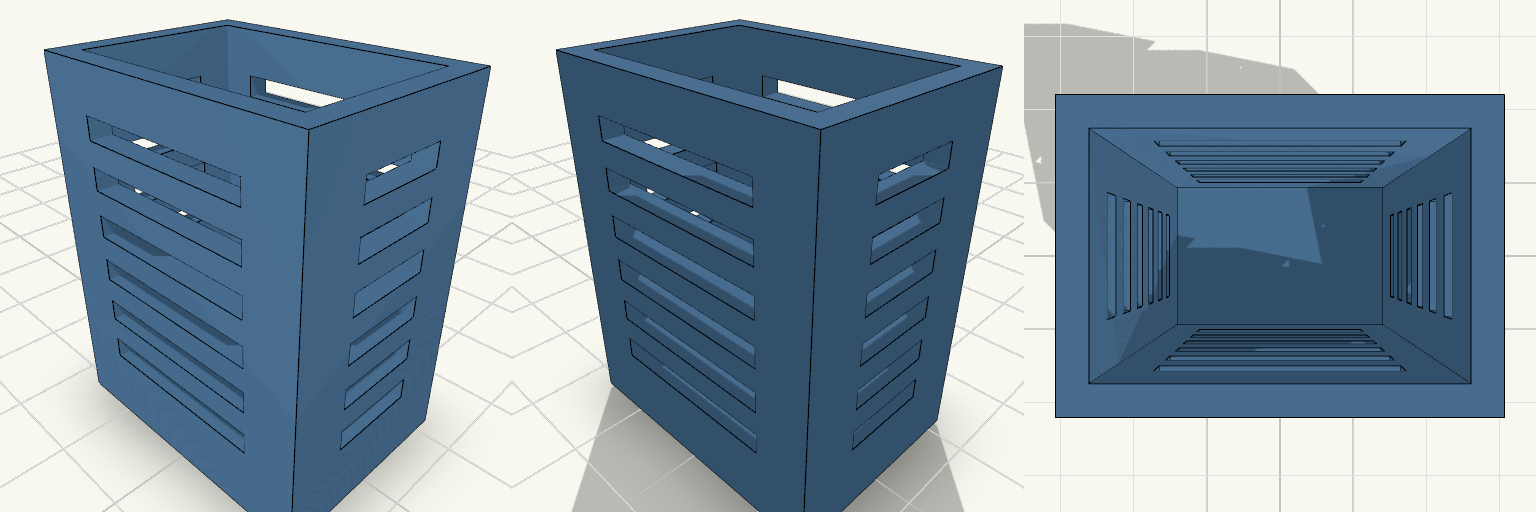
ORBISVENTILATION
Botvent is a plain, tall rectangular holder for a 9V battery, with rows of horizontal vent slots that give it a machine-panel look. No base plate, no add-on parts: just a clean open-top shell. Features Open-top box, 27.2 × 18.2 mm cavity 2.4 mm walls and floor Six horizontal vent slots on each face Square edges, 40 mm tall Print notes Prints upright with no supports needed for the slots at typical settings.
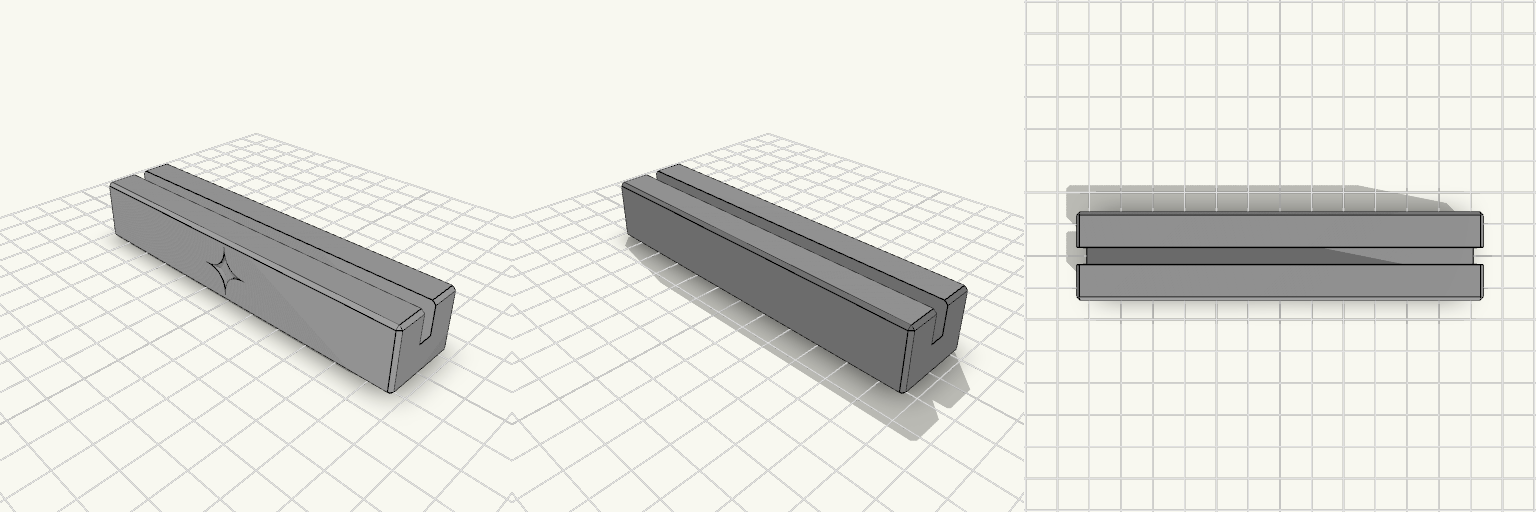
Soporte de tarjetas con estrella grabada
Soporte de tarjetas en forma de bloque rectangular, con una ranura central de extremo a extremo y una estrella de cuatro puntas con lados curvos grabada hacia el interior de la cara frontal. La ranura mide 5 mm de ancho y 10 mm de profundidad, y el bloque mide 115 × 25 × 20 mm con bordes achaflanados. Se imprime como una pieza única, sin soportes, apoyado sobre su base. Puntos para remezclar Ranura: 5 mm de ancho y 10 mm de profundidad. El ancho es la cota que decide qué tarjetas entran; súbelo si necesitas tarjetas plastificadas o más gruesas. Estrella frontal: 16 mm de punta a punta, hundida 1,5 mm y centrada. Puedes cambiar el motivo o su escala sin tocar la ranura. Bloque: 115 × 25 × 20 mm. El largo y el alto dan margen para una base más estable o una versión más compacta. Variantes y parejas: una ranura más ancha pide un bloque algo mayor; como organizador de tarjetas de visita o de identificación, combina bien con un escritorio o una entrada.
Need a part that doesn't exist yet?
Start building →